Relaxation Gift Baskets Built Around a Sensory Theme
Choosing one coordinating scent makes a wellness gift both intentional and actually effective.
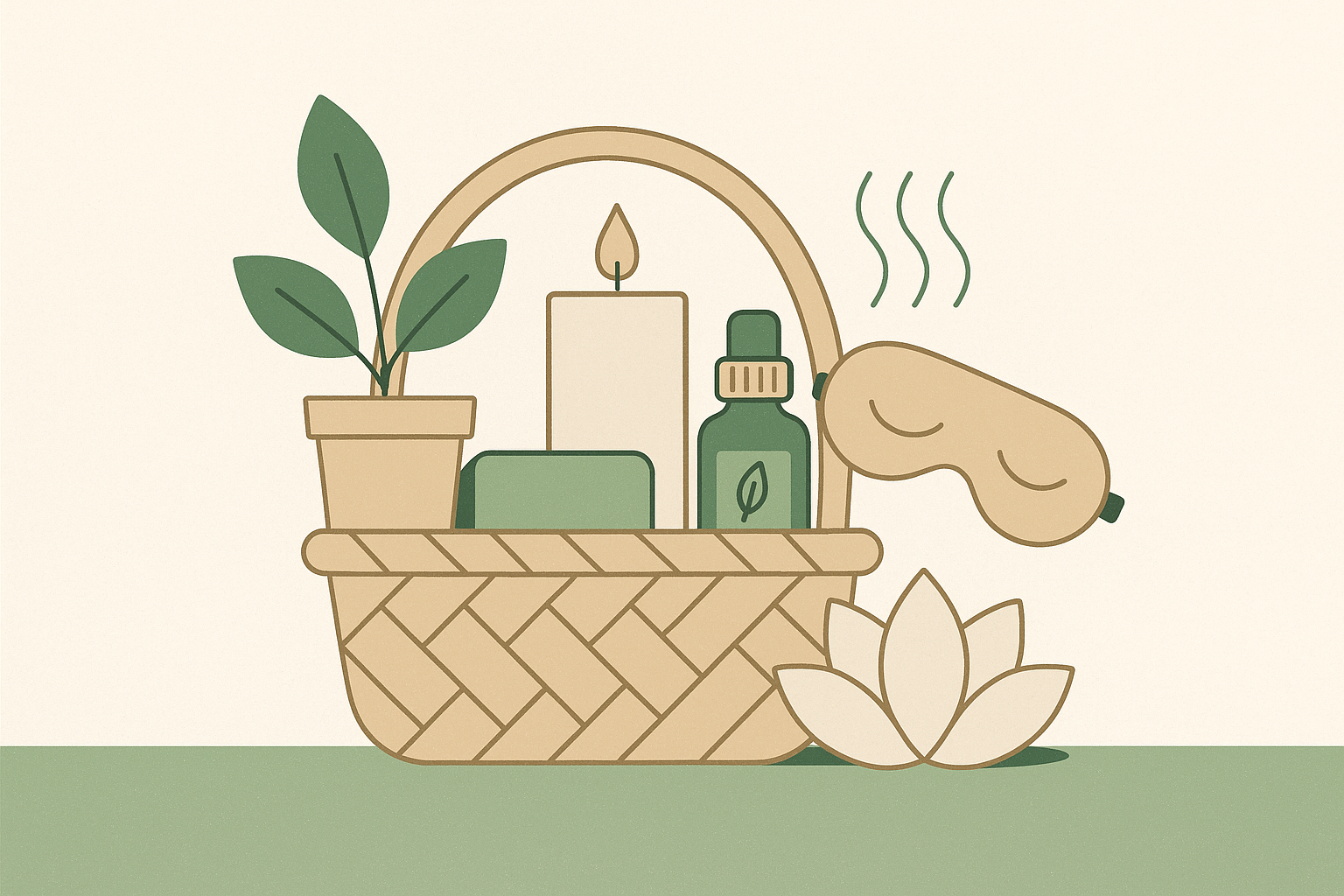
Building a relaxation basket around one scent instead of four unrelated products is the whole idea here. Smell reaches the emotional centers of the brain before anything else in the box gets touched or tasted, which makes fragrance the strongest organizing principle a gift basket can have, and most people buying wellness gifts actually want them to work well, not just photograph well.
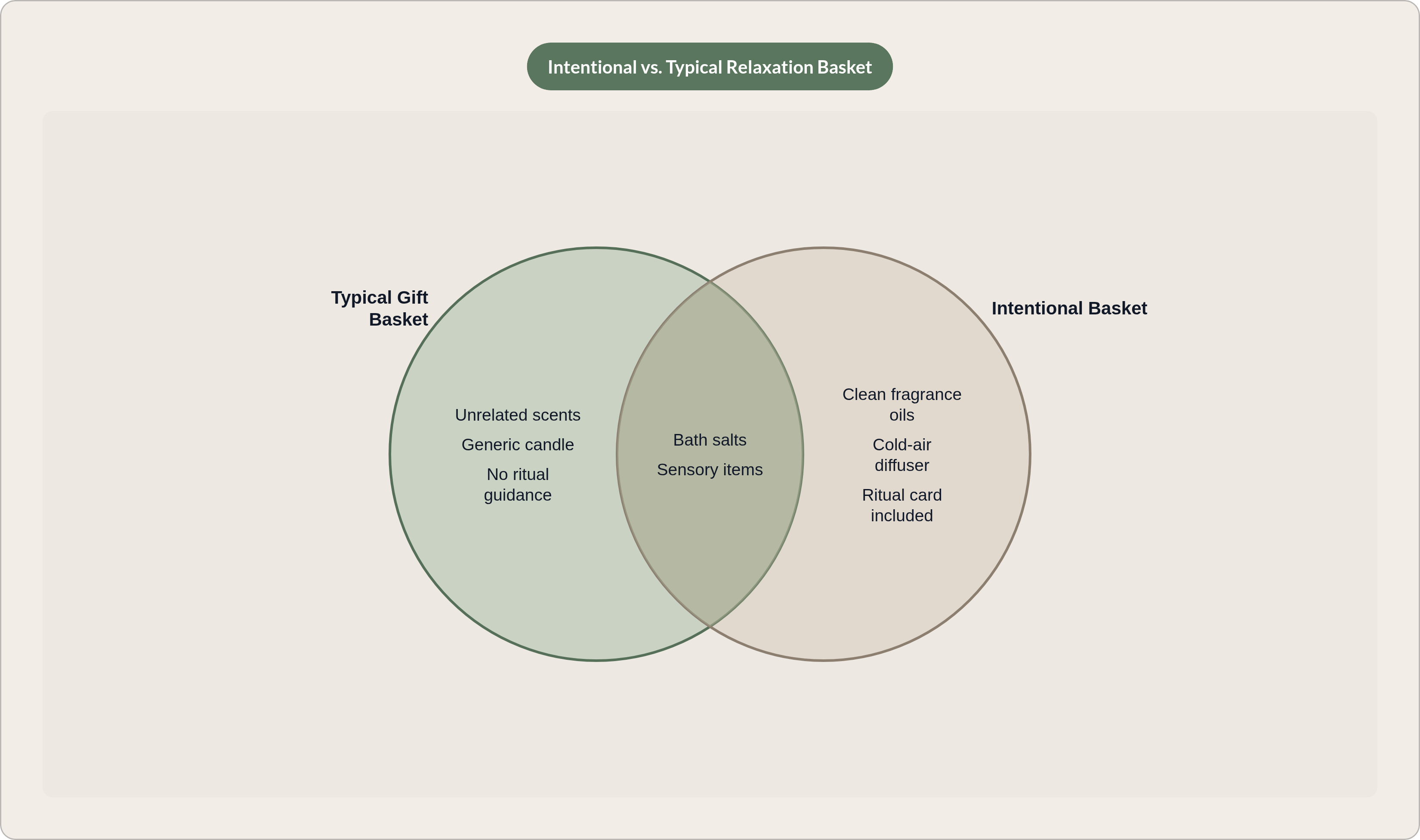
Walk into any gift shop's "relaxation" section and you'll find the same four items in a basket, wrapped in cellophane like a science fair project. A candle. Some bath salts. A face mask. A chocolate bar, usually dark, usually 70% cacao because that number apparently signals sophistication to somebody. Each item is fine on its own; together they don't say much of anything. Nothing connects the vanilla candle to the eucalyptus bath salts to the rosewater face mask to the chocolate. The recipient ends up with four disconnected pleasant things instead of one coherent mood, which is a shame, because the fix is not expensive.
That's the gap worth digging into: what turns an assembled basket into an intentional one. The answer is simpler than the gift industry wants it to be. Pick one organizing principle and make everything else answer to it. Consumer research keeps finding that most gift buyers are actively hunting for presents tied to relaxation or health, so demand isn't the problem. Good intentions just don't automatically produce good design; you can want to give someone rest and still hand them a basket that fights itself at every layer.
How scent works as an atmospheric anchor in a way other senses can't replicate
Here's the biology, and it explains a lot once you sit with it. Per Harvard Medical School research, the olfactory system connects directly to the limbic system, the part of the brain that handles emotion and memory. No relay station, no detour through the thalamus the way most sensory input travels. Smell walks straight into the room where feelings live, no knock, no waiting in the hallway.
Touch gets processed. Taste gets filtered through expectation and context, a bitter coffee tastes different depending on whether you ordered an espresso or found curdled milk in your fridge. Sound needs interpreting. Scent skips the line entirely, and that's the whole reason fragrance can set a mood before the recipient has unwrapped, sipped, or switched on a single other thing in the box.
So what does that mean in practice? The scent works less like one item competing with the tea and the eye mask for attention, and more like the tuning fork everything else gets measured against. Lavender, chamomile, and sandalwood together cue the brain toward rest; the Sleep Foundation has confirmed lavender aromatherapy can improve both sleep quality and duration. Citrus notes like bergamot and sweet orange do close to the opposite, lifting alertness and cutting stress, which is exactly why they're wrong for a sleep basket and right for a morning one. Jasmine has documented effects on lowering heart rate and lifting mood. Rosemary shows up in research tied to memory and reaction time. These aren't interchangeable "nice smells." They're different emotional tools, and mixing them up rarely ends well for the basket's overall effect.
The anchor decision is a mood decision first. Picking the actual diffuser and oil comes second, once you know what mood you're chasing.
Choosing the fragrance anchor: matching the scent to the experience the basket is meant to create
Start backward. Rather than cracking open a fragrance catalog and grabbing whatever smells nice in the bottle, ask what the recipient should feel three hours from now, then work back to the scent family that gets them there.
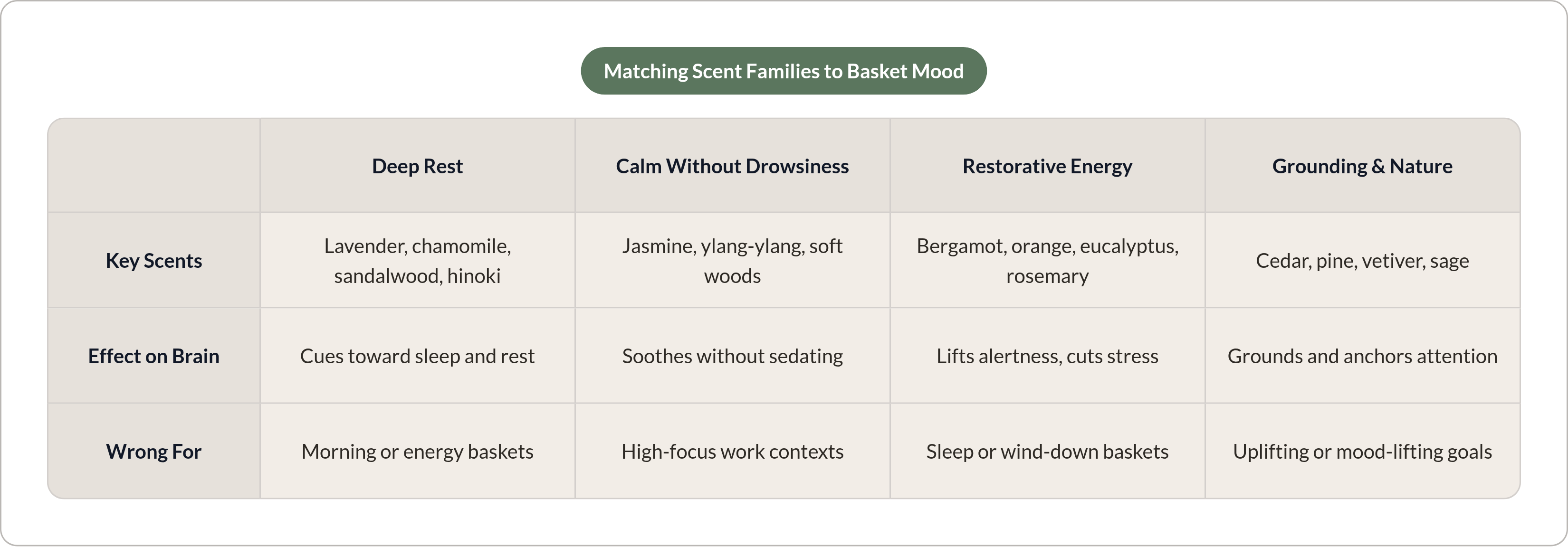
Deep rest calls for lavender, chamomile, hinoki, sandalwood, oakmoss. Calm without drowsiness points toward jasmine, ylang-ylang, soft woods, something that soothes without knocking anyone out midway through the afternoon. Restorative energy wants bergamot, orange, eucalyptus, rosemary. Grounding and nature immersion lean on cedar, pine, vetiver, sage. Four different emotional destinations, four different scent vocabularies, and picking the wrong one is the fastest way to build a basket that feels off without anyone quite knowing why.
Once you've settled on the family, the delivery format matters almost as much as the scent itself. A cold-air diffuser is the strongest anchor format going, for a few concrete reasons. It fills a room with fragrance before the recipient opens anything else, so the atmosphere is already set by the time they get to the tea or the blanket. Cold-air diffusion also preserves the oil exactly as it was formulated: no heat degrading the top notes, no water diluting the concentration the way it can with some reed diffusers. And there's no flame, which matters more than people give it credit for around kids, pets, and hardwood floors that don't love wax drips.
A diffuser is reusable and rechargeable too, so you're handing someone a ritual tool rather than a candle that burns down over three weeks and becomes a fairly nice paperweight. Worth noting: even candles marketed as nontoxic introduce some carcinogens through the act of combustion itself, simply because you're burning something. Cold diffusion sidesteps that variable entirely. The oil paired with the diffuser should match the basket's emotional theme exactly, and the hardware-and-scent pairing together function as the anchor, not one piece of it. Look for curated, vegan, cruelty-free oils with no phthalates or parabens.
Why the fragrance in a relaxation basket needs to be clean and transparent
Here's a question worth asking before you buy anything: if the basket exists to support someone's wellbeing, why fill it with a scent that might be working against that?
Conventional fragrance labeling allows a single word, "fragrance," to legally stand in for dozens of undisclosed chemical compounds. Phthalates, formaldehyde-releasing preservatives, synthetic musks, all hiding behind one word that tells you nothing about what's actually in the bottle. The Environmental Working Group has flagged the toxic chemical content of conventional air fresheners as a real health concern, and that's a good chunk of why demand for cleaner alternatives keeps climbing.
What should you actually look for on a label? Full ingredient transparency, rather than an umbrella term standing in for a list. Explicit statements ruling out phthalates, parabens, synthetic musks. Carriers that are plant-derived, fractionated coconut oil rather than a petroleum byproduct nobody asked for. Vegan and cruelty-free certification, if that matters to whoever's receiving the basket. Mintel's fragrance industry research has noted that sustainability moved from nice-to-have to baseline expectation; people now assume transparency across sourcing and packaging, not just in the finished bottle.
For the person building the basket, this isn't a moral flourish tacked on for optics. It's just consistency. A relaxation basket that quietly contains an ingredient list nobody can pronounce is a basket arguing with its own premise.
Building the sensory layers around the fragrance anchor
Once the anchor's locked in, everything else in the basket has one job: agree with it. Same emotional register, complementary textures, colors and materials that don't clash with what the nose already told the brain three seconds ago.
Touch is the next layer up. A sleep basket wants a weighted eye mask, a linen pillowcase, something with the drape and weight of a cashmere throw. A grounding or forest-themed basket wants rougher textures: a rough-hewn wooden tray, wool socks, something with the heft of a stone or a ceramic vessel. A morning energy basket wants coolness and crispness, a bamboo face roller, a smooth glass water bottle, a cotton towel that feels almost architectural in how crisp it is.
Sound is optional, but it pulls real weight when it's there. A card with a QR code linking to a curated playlist, or a small speaker, tuned to the same mood: soft instrumental or rain sounds for sleep, something lightly acoustic for calm alertness.
Taste has to reinforce, not compete. Chamomile or lavender tea belongs in a sleep basket. Dark chocolate with sea salt, bittersweet and a little earthy, fits a grounding basket. Citrus sparkling water or ginger honey works for an energy basket. Visually, the color palette should come straight out of the fragrance's own emotional world: cool lavender and white linen for sleep, warm amber and terracotta for anything woody, sage green and cream for anything botanical.
One rule trips people up constantly: no other strongly scented products. Scented lotion, perfumed soap, a candle with its own fragrance profile fighting the diffuser for airspace. If you can smell it, it either matches the anchor or it doesn't belong in the box. There's no middle ground, and plenty of otherwise well-designed baskets get undone by one rogue vanilla hand cream that had no business being in there.
Three worked examples: a sleep basket, a grounding basket, and a morning ritual basket
The Sleep Sanctuary basket anchors on a cold-air diffuser running a lavender-chamomile-sandalwood blend. Around it: a silk sleep mask, a weighted eye pillow, a soft muslin wrap for touch; loose-leaf chamomile and raw honey for taste; dusty lavender tissue paper and linen ribbon for visual coherence, with a small ceramic dish tucked in for jewelry. A short card spells out a 20-minute wind-down: diffuser on 30 minutes before bed, tea while reading, mask on at lights out.
The Grounded Forest basket runs cedar, pine, vetiver, or hinoki through the diffuser. Wool hiking socks, a rough linen hand towel, a smooth river stone that sits on the desk afterward as a small physical reminder of the ritual. Dark roast coffee or earthy hojicha, dark chocolate with sea salt. Kraft paper, twine, maybe a small succulent thrown in. The whole thing borrows from shinrin-yoku, the Japanese practice of forest bathing, which has real research behind it as a stress-reduction tool tied to time in nature or nature-mimicking environments.
The Morning Clarity basket goes bergamot, orange, rosemary. Bamboo face roller, a cool glass tumbler, a microfiber towel. Blood orange tea, citrus-honey throat drops, a jar of granola. White and sun-yellow tissue, clean card stock. The note explains the ritual: diffuser on 15 minutes before sitting down to work, the oil chosen specifically for its documented ties to cognitive performance and stress reduction.
Notice what stays constant across all three. The fragrance sets the mood first, and everything else reinforces it instead of just decorating around it. That consistency is the whole trick, and there isn't a fourth secret ingredient.
How destination-themed baskets extend the concept for a more narrative gift
Scent's power to transport someone to a specific place is well documented, and honestly more immediate than any photo or postcard manages. One whiff and you're back in your grandmother's kitchen, or on a beach you visited once and can't quite place the year of anymore. Luxury hospitality figured this out a while ago. Rosewood developed its own signature scent, Bois Cachemire, in collaboration with L'OBJET, precisely because a hotel's smell becomes inseparable from the memory of staying there. Other hospitality brands have built entire retail lines out of a single property's signature atmosphere. The basket format is just borrowing that same logic at a much smaller, much cheaper scale.
A "Japanese Onsen" basket might run hinoki, yuzu, and white tea through the diffuser, paired with a bamboo tray, a matcha kit, a furoshiki wrap, maybe a small wooden ladle styled after the ones at a real onsen. A "Tuscan Villa" basket leans on bergamot, fig leaf, and warm stone notes, with an olive wood dish, amaretti cookies, a linen pouch, all in warm terracotta tones. A "Pacific Northwest Forest" basket uses cedar, fir, and a rain accord, alongside a hand-thrown ceramic mug and local honey, everything dressed in mossy greens.
The difference this makes is almost entirely psychological. A drugstore relaxation basket sits in a familiar category; an evening in a Japanese bathhouse reads instead as a memory you haven't had yet, and somehow that feels more generous than any category could. Include a small card naming the destination and describing the atmosphere it's meant to recreate. That's the detail that switches the whole thing on, rather than leaving it to chance and hoping the recipient connects the dots themselves.
Presentation, packaging, and the detail that signals the basket was built with intention
The container is part of the sensory world too, not just a delivery box that gets torn open and tossed. A sleep basket belongs in a natural linen tote or a woven rattan tray. A forest basket wants a raw wood crate or a kraft-lined box. A morning basket looks right in a clean white box with paper-wrapped ribbon, something that feels bright and early by design.
Where you place the diffuser inside the basket actually matters. Put it at the top, visible, the first thing a hand lands on, with a small tag that says something like "start here." That single detail tells the recipient this isn't just another item competing for space; it's the thing everything else is organized around.
The ritual card carries real weight too, turning a box of stuff into a sequence someone actually follows. Step one: place the diffuser and switch it on, 15 to 30 minutes before starting. Step two: prepare the tea or coffee while the room fills with scent. Step three: settle into whatever the tactile element happens to be for that particular basket. Telling someone what order to do things in, and why, is the real difference between a pile of items and an experience someone walks through start to finish.
One more thing worth saying plainly: resist the urge to overpack. Five well-chosen items that all speak to each other read as more intentional than fifteen that don't, and editing down is real design work, not a cost-cutting shortcut dressed up as minimalism. The gift basket category keeps trending toward wellness, gourmet, and artisanal themes, and as more of the market crowds into that same "relaxation" language, presentation quality becomes the thing that actually separates a basket someone remembers from one that gets used once and forgotten in a drawer.