Relaxation Gifts for Overworked Women Who Have Everything
Daily rituals beat one-time gifts for someone whose stress never takes a day off.
A relaxation gift for someone who already owns everything comes down to one distinction: objects get unwrapped once, rituals get used on repeat. A candle burns down and lands in the trash, while a ritual survives into a random Tuesday when nobody's watching and there's no one around to perform gratitude for. That's the entire argument of this piece, and every section below just leans on it from a slightly different angle.
I've spent enough time around the fragrance and home goods world to notice a pattern in what actually gets used six months out versus what gets photographed once and shelved next to the candles nobody burns past the halfway mark. The fancier item rarely wins. What wins is whatever asked the least of her and still showed up daily, uninvited.
Burnout is part of why this matters. Ask anyone doing a leadership job while also running a household, and the fatigue isn't subtle; it shows up in the sigh before the sentence even starts. "She has everything" usually means she has enough stuff and nowhere near enough relief, and novelty fades in hours while stress just sits there, unbothered. The question worth sitting with is what she'll return to without having to remember to.
How daily sensory rituals do what occasional treats cannot
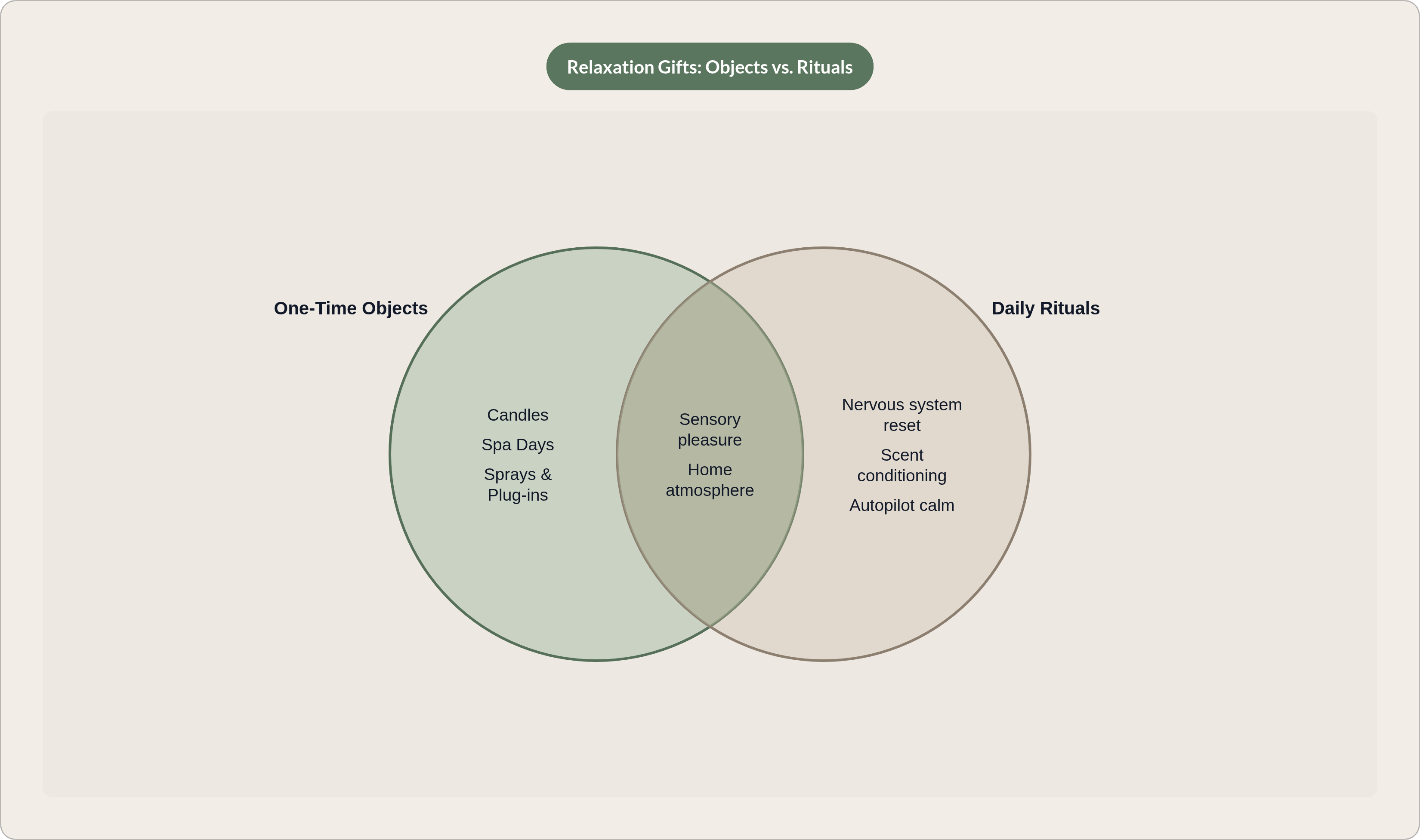
A spa day resets the body once, and by Tuesday her shoulders have crept right back up toward her ears. A daily ritual runs on a slower clock, nudging the nervous system's baseline down in increments so small she probably won't notice until a few weeks in.
The mechanism is less mystical than the candle aisle wants you to believe. Brains run on pattern recognition, and repeated sensory input, at the same time, in the same spot, turns into a cue. Eventually the brain answers the cue on autopilot: calm settles in, focus sharpens, one part of the day quietly hands off to the next. Associative conditioning does most of the heavy lifting that candles and soft lighting usually get credit for.
The pattern shows up reliably in practice: pair a scent with a consistent morning moment, and within weeks the scent alone begins to signal the shift. The brain builds routines without asking many questions about how they got started.
Fragrance is having a moment in the home right now, and the reason isn't complicated: everyone spent an unreasonable stretch of time staring at their own four walls a few years back and started noticing what those walls smelled like. The shift has moved from scent as a finishing touch for guests toward scent as something people keep for themselves. Watching a room-freshening category quietly admit it's actually about the person standing in the room, not the person walking through the door, is a strange thing to see happen in real time.
Why scent anchors a home ritual better than most wellness tools
Most wellness tools want something from you. A journal wants you to write in it, a meditation app wants ten minutes and your full attention, and a yoga mat wants you on it after a ten-hour day, right when there's zero bandwidth left, which is a lot to ask of someone who mostly wants to lie on the floor and stare at the ceiling for a while.
Fragrance asks for almost nothing. Flip the diffuser on and it runs itself, with no habit stack, no willpower, no app pinging her into a breathing exercise she has zero interest in doing tonight or, frankly, ever. Passive isn't a dirty word when someone's running on fumes.
There's an actual anatomical reason this works, not just a nice-smelling coincidence. The olfactory system is the only one of the five senses with a direct line into the limbic system, the brain's emotional and memory center, while sight, sound, and touch get routed through more processing before feeling shows up. Smell skips the line entirely, which is why the same scent in the same bedroom, night after night, trains the brain to wind down more reliably than a phone alarm ever managed.
This opens up something a single candle can't offer: intentionality by room. Warm, grounding notes suit a bedroom, while something brighter, alert but not sharp, suits a home office. Citrus or something marine-adjacent fits a bathroom that wants to feel like a spa instead of a chore list. People who already lean on scent in daily life will tell you, without much prompting, that it's doing real emotional work, not just covering up yesterday's cooking.
Layer it room to room, complementary instead of competing, and a house stops feeling like scattered candle-scented pockets and starts feeling like one place. That's more than any single candle, however nice, was ever built to deliver on its own.
What cold air diffusion actually delivers that candles and sprays cannot
Candles are pretty, and there's a small ceremony to lighting one that I won't take away from anyone. But they ask a lot in return: an open flame that needs babysitting, soot creeping up the jar and onto the wall behind it, an uneven burn if nobody trims the wick, and zero tolerance for being left alone for more than a few hours. That's a lot of maintenance for something billed as relaxing.
Sprays and plug-ins fail differently, with a big burst of scent, then nothing an hour later, then spraying again. That's upkeep, and it wears on a person in a way nobody quite says out loud, mostly because complaining about a room spray feels like a genuinely unserious problem to have.
Ultrasonic diffusers, the water-based kind, dilute the fragrance oil with mist, so what reaches the room is thinner than what the perfumer originally blended. The added humidity can also do a slow number on nearby wood surfaces or electronics over months of use, and nobody notices until the finish on a dresser starts looking a little off.
Cold air diffusion works differently. It uses air pressure to break the fragrance oil into fine particles, with no heat and no water, and skipping the heat means the oil's chemical structure never gets altered. What reaches the room is the same layered, complex scent the perfumer actually built, and coverage runs wider than a candle or an ultrasonic unit can manage, too, which matters if the floor plan is open or the goal is filling a whole room instead of glowing warmly near one coffee table.
Output stays level instead of spiking and fading. Commercial cold air systems run this way in hotel lobbies and retail spaces, quietly doing a job nobody notices until it stops working, and that tech has trickled down into home units now, usually with a timer, adjustable intensity, and app scheduling, so the thing runs itself: morning ritual, evening wind-down, weekend atmosphere, set once and left alone.
Choosing a fragrance that matches how she actually wants to feel
The better question isn't which scent smells nicest. It's what state she needs to get into, because a good fragrance gift does its job before it decorates anything.
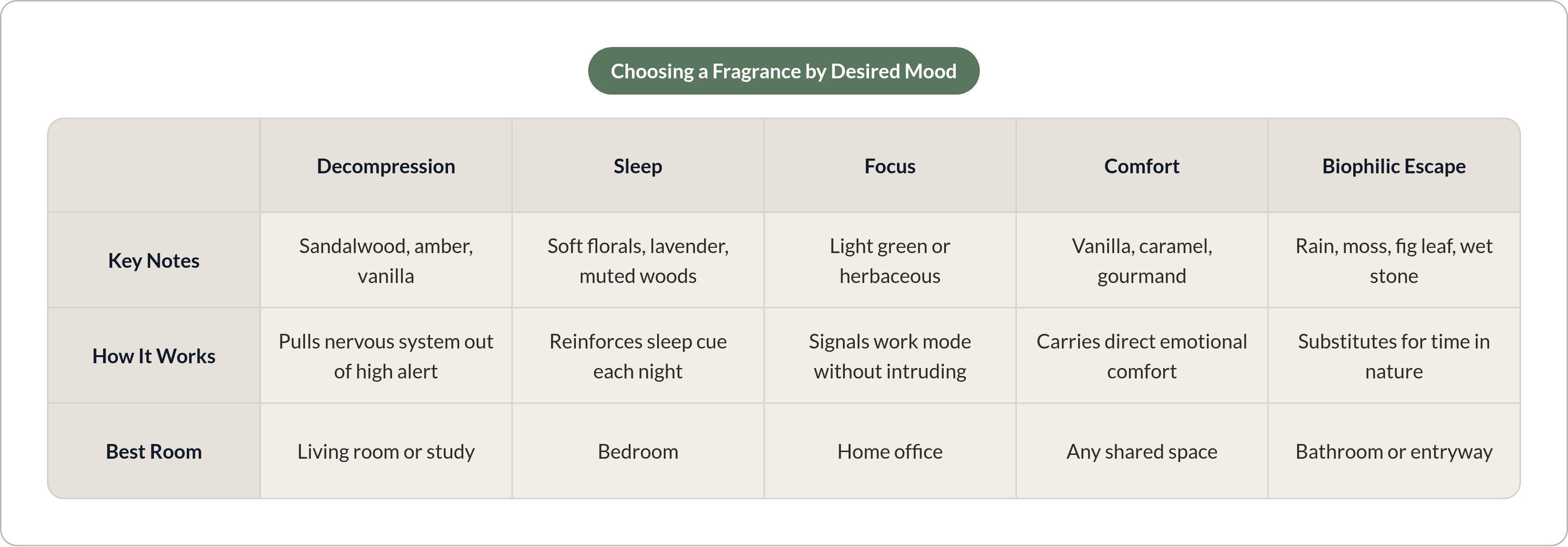
Think in rough moods, not precise categories. For decompression after work, warm base notes like sandalwood, amber, and vanilla pull the nervous system down out of high alert, felt more than consciously noticed. For sleep, soft florals and lavender-adjacent blends with muted woods work as a bedroom cue that gets stronger with each repeated night. For focus without overstimulation, light green or herbaceous notes sit quietly in the background, just enough to signal "work mode" without becoming the main event. For genuinely rough days, gourmand notes, vanilla, caramel, anything with a faint dessert quality, carry real emotional weight; the home fragrance category has grown broadly enough that this kind of comfort is clearly not a niche indulgence anymore.
There's a newer lane worth watching, too: biophilic scents, the rain-moss-fig-leaf-wet-stone family, which have been gaining noticeable ground. For someone who hasn't had a real walk in the woods since sometime last spring, that's about as close a substitute as a bottle gets, which says something a little sad about modern life and something useful about what to buy her.
Destination-inspired fragrance deserves a mention as well, less as escapism and more as a daily permission slip. A Mediterranean herbaceous blend can just mean thirty seconds of somewhere else before the inbox reopens.
The practical move, if you're buying: pair the diffuser with two oils, one for weekdays, one for slower evenings, so it arrives as a finished ritual instead of a device waiting for someone else to complete it. If pets or kids share the house, formulation actually matters, so look for oils that skip phthalates and parabens, which is one less label to squint at on a Tuesday night when you're tired and just want the room to smell nice.
How to size and place a diffuser so the gift actually works
Here's where well-meaning gifts fail quietly: the diffuser gets sized for a room smaller than the one it's going into. Drop a bedroom-sized unit into an open kitchen-and-living space and it does almost nothing, and she'll assume the product's broken. Really it's just bad math on someone's part, and that someone was probably rushing.
Manufacturers publish coverage in square footage for a reason. Read it before buying, not after unwrapping, which sounds obvious until you remember how gift-buying actually happens: in a hurry, usually two days before whatever occasion needs it.
Room shape complicates things further. High ceilings, open staircases, and HVAC vents all pull fragrance particles away faster than a closed, boxy room would, so a modest room with a fourteen-foot ceiling might need more power than the square footage alone suggests.
Placement has its own small, unglamorous rules. Mid-height works best, since particles drift down and outward rather than up. Airflow matters, too, so pick a spot where air naturally moves, not a dead corner, and not directly under a vent that'll blast the scent away before it settles into anything. Keep it off a sunny windowsill or away from a radiator, since heat alters the oil before it's even diffused properly. In a bedroom, placing it near the door means the scent greets her the moment she walks in, before she's set her bag down.
Intensity should be a dial, not a switch. Start low and adjust from there; it's a lot easier to turn things up on day three than to walk into an overwhelming wall of scent on day one and quietly write off the whole gift.
If you genuinely don't know her floor plan, a mid-range unit in the living room or primary bedroom is the safe bet, and still a high-impact one. Good manufacturers list coverage per model specifically so that decision happens at checkout, not three days later when the box shows up and somebody's disappointed.
What makes a diffuser gift feel complete rather than considered
A diffuser, two fragrance oils, and a short note about which room it's for and which mood it's meant to hit: that reads as a finished ritual, not a device someone still has to figure out alone.
Multi-piece curated gift sets consistently read as more generous than the sum of their parts, because completeness itself signals thought. Nobody assembles four coordinated things by accident; that takes actual planning, the kind that shows without needing to be pointed out.
Framing matters more than people expect. Hand it over as "something nice for the house" and it competes with candles, throw blankets, and every other soft-furnishing item cluttering the gift table. Frame it as a daily decompression tool, which is genuinely what it is, and it lands differently, because that's the actual promise being kept.
A spa day needs booking, calendar-juggling, actual time off work, and the bottle of wine that came with it is gone by 9pm, while this is still running in March. Ask yourself honestly: is it the gasp at unwrapping that matters, or whether the thing's still switched on some random Tuesday three months later? That's the real test, and it isn't close.
Three tiers, if that helps with budgeting. Entry: a single cold air diffuser with one oil, matched to whichever room she actually spends time in. Complete: the diffuser plus two oils, weekday and slow-evening. Intentional: all of that, plus a handwritten note spelling out the ritual itself, something as plain as "run this for thirty minutes before you sit down tonight."
Clean, vegan, cruelty-free formulation means none of it shows up with an asterisk about pets or sensitivities, and there's no fine print buried in the gift tag, no follow-up text three days later asking if it's safe around the dog.
A good relaxation gift earns its place through repetition, not through the moment it gets opened. It's the unglamorous, unphotographed version of her hitting the same button on some ordinary weeknight, because her body quietly learned what that scent means months back, without either of you noticing the exact day it happened. A cold air diffuser, sized right and stocked with oils she actually likes, clears that bar in a way most things sitting under a bow never get the chance to.