Housewarming Gifts That Create a Lasting Sensory Experience
Scent shapes how a new home feels more than any other sense.
A cold-air diffuser is a housewarming gift that keeps working long after the ribbon comes off. Most gifts solve for a single afternoon; scent, delivered right, resets a home every day it runs. I've spent enough years around fragrance oils and diffusion hardware to have opinions about why that happens, and some of those opinions involve chemistry, some involve plain observation, and one or two involve plain observation about why a pricey candle can still smell wrong once it's burning in a real room.
Smell has a direct line to the brain's memory and emotion centers. Vision and hearing travel through multiple relay stations before reaching conscious awareness; smell arrives more directly. That's the actual biological reason a new room feels wrong before it ever looks wrong, and no amount of tasteful furniture arranging fixes it, because the nose got there first.
Ask anyone who just moved: what do you actually want from the place? You want it to feel like yours, which is a slower and stranger process than picking paint. The walls are neutral because the last tenant chose eggshell, not because anyone alive loves eggshell. Boxes sit half-unpacked for three weeks longer than planned. Choosing a signature scent turns out to be one of the first real acts of ownership a new resident makes, and it does more work than its size suggests: the entryway, the bedroom, the kitchen, all of it starts reading as "home" once a scent settles in and stops announcing itself as new.
The Global Wellness Summit flagged functional fragrance as one of the more telling trends in wellness right now, and the shift it points to is real: people increasingly buy scent for how it makes them feel, alongside how a room smells to a guest. Morning eucalyptus and mint for clarity, evening lavender and chamomile to wind down, cedar and vetiver in the living room to ground things. None of that reads as exotic anymore. It's closer to a shared vocabulary at this point, and a fragrance gift ends up functioning like a small toolkit for adjusting a room's mood on command.
So here's the actual stakes for anyone standing in the gift aisle: you're handing over the ability to shape how a home feels, repeatedly, for as long as the gift keeps running.
Why the home fragrance market has moved well beyond candles and sprays
Home and living sits at position five among gift categories, worth $28 billion according to Mintel's 2025 data. Most of what actually gets bought inside that category, though, is either decorative or consumable: candles, wine, a cutting board nobody asked for. It gets used up or shelved within weeks, which is the gap this whole piece keeps circling back to.
Average housewarming spend runs $30 to $50 per gift, per the Emily Post Institute's 2025 figures. That's not a lot of room to work with if you want something that reads as meaningful rather than obligatory. Wine gets drunk. Flowers wilt on schedule. These solve for one moment, and a new home has needs that stretch well past that moment.
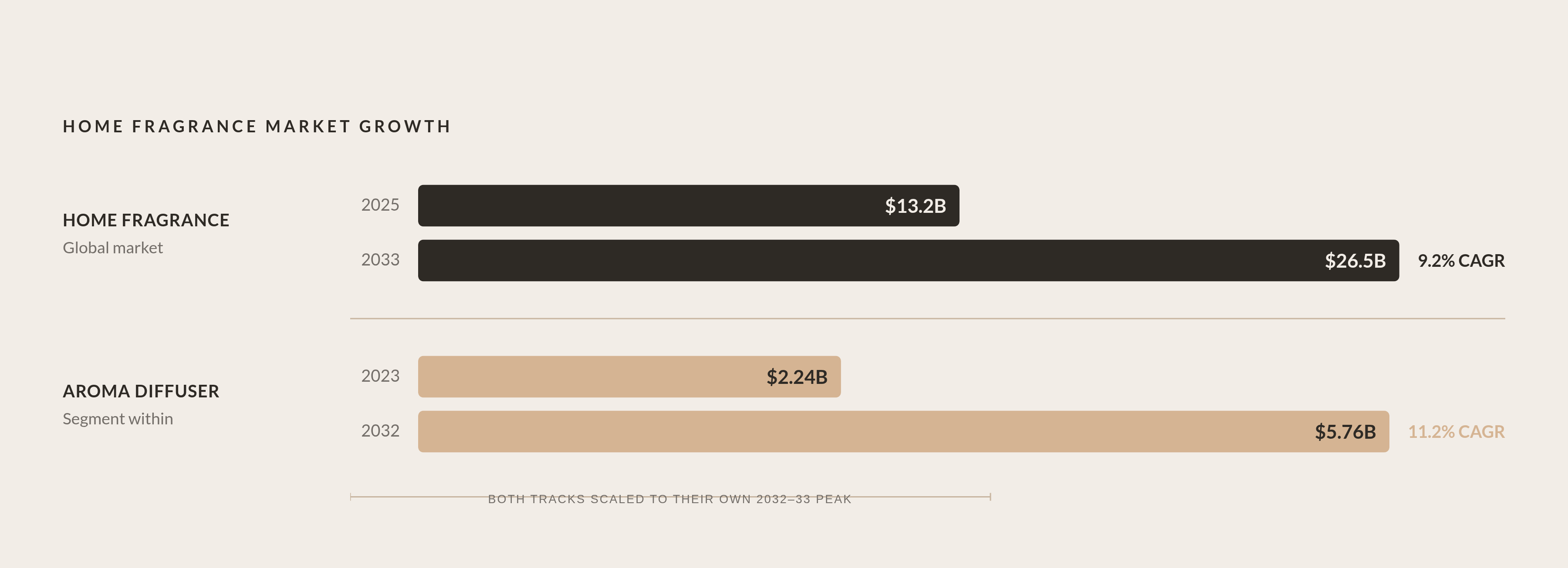
The global home fragrance market itself was valued at $13.2 billion in 2025 and is projected to hit $26.5 billion by 2033, a 9.2% compound annual growth rate according to Grand View Research. A market growing that fast is being pulled by demand, not pushed by supply hunting for buyers. North America holds 28.8% of global revenue share in 2025 by that same estimate, and gifting is doing real work inside that number.
What's actually driving growth past the candle aisle? Awareness of chemical exposure pushed a lot of buyers toward plant-based, refillable, clean-formulation products instead of whatever smelled fine on a shelf under fluorescent lighting. Wellness and self-care gifts overall grew 34% since 2021 according to Mintel, the fastest-growing gift category they track, and home fragrance sits inside that trend. In the US alone, home fragrance accounts for something like $4.3 billion in annual gift revenue on its own.
Sustainability matters here too, more than people expect. Deloitte's 2025 research found 41% of millennials picked a gift specifically because the brand had solid sustainability practices, and Eventbrite's 2025 data shows 62% of Gen Z consumers view consumable and experiential gifts, home fragrance included, as more sustainable than physical objects sitting on a shelf. That's a market rewarding refillable systems and recyclable packaging over the next disposable scented trinket, and it's not subtle about it.
The problem with candles, sprays, and plug-ins as housewarming gifts
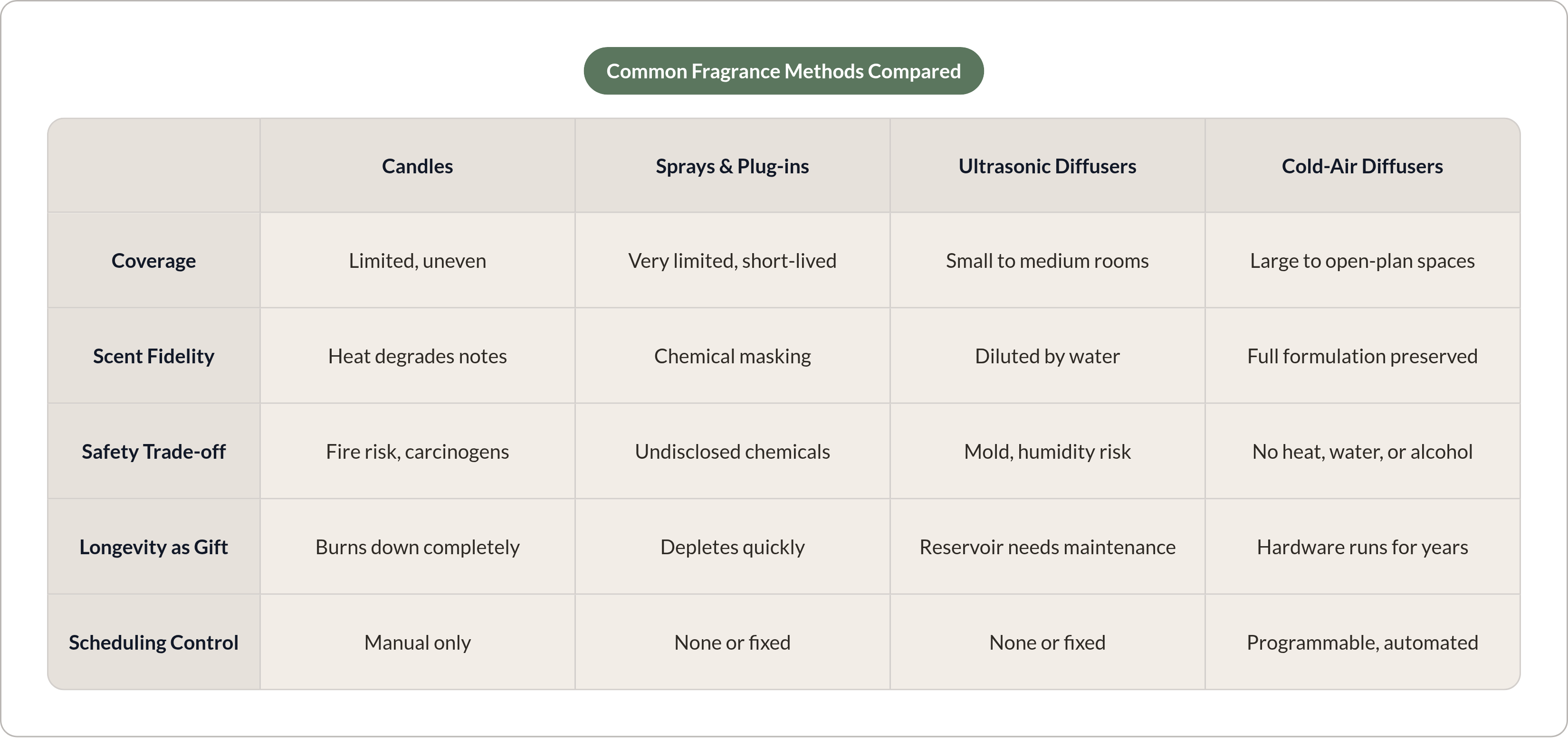
Candles are the most-given fragrance gift and also the most limited one, which is a strange pairing when you actually sit with it. Burning any candle produces some carcinogens through the smoke itself, regardless of how clean the oil inside claims to be, and that risk climbs when the wick or wax is cheap. Coverage tops out fast too: no candle fills a large open-plan room with even scent, no matter how long you let it burn. Even multiple candles burning at once in a large open-plan room rarely produce even coverage. The result is a warmer room, not a better-scented one.
There's also the supervision issue nobody puts on the box. A candle can't run while everyone's asleep or out at work, so the whole experience depends on someone being home and paying attention. Once it burns down, the gift is gone; the giving moment and the gift's useful life end up roughly the same length, which is a strange thing to accept about an object you paid a fair amount for.
Sprays and plug-ins carry a different problem. Some fill the air with undisclosed chemicals that lower indoor air quality, and in sensitive people that shows up as headaches or allergic reactions. Delivery is uneven by design, too: the room smells right for twenty minutes after a spray, then nothing, which fights against the ambient, always-there quality most people actually want.
Reed diffusers and plug-ins solve the fire risk and introduce a passivity problem instead. No scheduling, no intensity control, no scaling up for a bigger room. A reed diffuser does fine in a small, still bathroom; put the same reed diffuser in an open kitchen with a ceiling fan running and it may as well be decorative.
Water-based ultrasonic diffusers look like the fix until you check the fine print. They dilute fragrance oil with water before it ever becomes airborne, which weakens the scent and can leave residue on nearby surfaces. They also add humidity, a genuine concern around hardwood floors, artwork, and electronics, and if the reservoir isn't cleaned on a strict schedule, mold becomes a real possibility rather than a theoretical one. The pattern across nearly every conventional option is the same: consumable, inconsistent, or carrying a safety trade-off that quietly eats away at the gift's long-term value.
How cold-air diffusion works and why it preserves fragrance better than heat or water
Cold-air diffusion runs through a specialized atomizer that breaks fragrance oil into microscopic particles and pushes them into the room on a stream of cool, filtered air, with no heat, water, or alcohol involved anywhere in the process. That absence turns out to matter more than it sounds like it should.
Fragrance oils are built in layers: top notes, middle notes, base notes, each meant to unfold in sequence over hours. Heat wrecks that structure. Citrus top notes can turn bitter under warmth, florals go flat or sharp, base notes like musk or amber lose depth and go muted. A candle's flame is, functionally, cooking the fragrance oil a little each time it burns, the same way overcooking a steak flattens everything that made it worth eating. Cold-air diffusion skips that step entirely and preserves the full arc, from opening lift to lingering base.
Water dilution creates a related but separate problem: ultrasonic diffusers cut the oil with water before it becomes airborne mist, so what actually reaches the room is a thinner, less accurate version of the real formulation. Add the humidity issue on top, and you've got a device working against the fragrance and the hardwood floors at the same time.
The coverage numbers back this up plainly. Cold-air diffusers can cover substantially larger spaces than a candle, reed diffuser, plug-in, or ultrasonic device can manage, and some systems handle up to 10,000 square feet, which starts to make sense for a real open-plan home rather than one bedroom. What you get is a consistent ambient layer, distinct from the spike-then-void rhythm that sprays and candles both fall into.
No residue, no added humidity, which means the technology runs continuously around hardwood, textiles, and electronics without the maintenance anxiety a water reservoir creates. The global aroma diffuser market backs the uptake: valued at $2.24 billion in 2023, projected to reach $5.76 billion by 2032 at an 11.2% compound annual growth rate according to Grand View Research. That's an audience that already showed up.
What makes a cold-air diffuser a gift that keeps working long after the housewarming
A diffuser doesn't disappear the way a candle burns down to nothing or a bouquet wilts on a predictable clock. It becomes infrastructure instead, folded into a home's daily rhythm without anyone thinking about it much.
The hardware itself runs for years. The oil is the actual consumable, which means the original gift keeps shaping how a home feels well past the week it was given, sometimes long after the giver forgot they gave anything at all. Smart scheduling lets a diffuser turn on at set times, morning, evening, the moment someone walks through the door, without anyone needing to remember to flip a switch. Newer systems continue to add scheduling and automation features, expanding the ways a home's scent profile can be managed without manual input.
That always-on, evenly distributed quality is exactly what consistent cold-air diffusion produces, and it's the same principle behind any space where scent is managed rather than left to chance.
Fit matters, obviously. Compact units suit bedrooms and studies, larger ones handle open-plan living areas, and the well-made ones run quiet enough that nobody notices the hardware, only the effect it's having. Paired with a rotating handful of fragrance oils, the recipient gets to shift scent by season or mood the way they'd swap a playlist. A lot of people end up layering: diffuser running in the hallway all day, a candle lit only in the evening for the ritual of it, a fabric mist for the couch cushions on weekends. The diffuser tends to be the anchor holding that whole layered habit together, whether the person realizes it or not.
For whoever's doing the buying, this also lands well financially. A diffuser in the $75 to $150 range sits inside what Coresight Research's 2025 benchmark identifies as the corporate gifting sweet spot, the band where a gift reads as considered rather than grabbed off an end-cap on the way to checkout.
Choosing clean fragrance oils to pair with the gift
None of the engineering above matters if the oil inside is junk. A premium diffuser running a synthetic, undisclosed-ingredient fragrance undercuts the entire point, both the sensory experience and the safety case that makes cold-air diffusion worth the extra cost in the first place.
Clean fragrance has an actual definition, not just marketing gloss. It means explicit exclusion of phthalates, parabens, formaldehyde donors, and synthetic musks; full ingredient transparency instead of "fragrance" doing duty as a catch-all term for whatever's inside; non-toxic carriers like fractionated coconut oil or sustainably harvested squalane. Some retailer clean standards prohibit more than fifty suspect ingredients, giving shoppers something to check a bottle against instead of taking the label's word on faith.
This matters more for a housewarming gift than it does for a candle you buy for yourself, because you probably don't know everything about the household you're gifting into. Maybe there's a toddler crawling around the living room floor. Maybe there's a dog with allergies. Maybe the recipient gets migraines from synthetic musk and has never quite pinned down why. A vegan, cruelty-free, pet-safe formulation removes that risk rather than leaving it to chance, and it's worth remembering that conventional air fresheners and heavily synthetic candles are exactly the products already linked to headaches and respiratory irritation in sensitive people.
A few scent families make reliable starting points. Cedar, amber, vetiver, and tonka read as grounding, good for living rooms and entryways. Eucalyptus, green tea, mint, and lemon verbena feel clean and bright, suited to kitchens and bathrooms. Lavender, oakmoss, chamomile, and hinoki lean calming, a natural fit for bedrooms or an evening wind-down routine. Pair the diffuser with two or three of these and the recipient has a small fragrance wardrobe to start experimenting with on day one.
How to match the diffuser to the home it's going into
Room size is the biggest variable, and it's also where most gift-givers stumble without realizing it. Hand someone with a wide-open loft a diffuser built for a bedroom, and they'll barely notice it's running. Hand a studio-apartment dweller a high-output unit built for 2,000 square feet, and the scent turns cloying within a day.
A rough sizing guide helps. Compact diffusers suit bedrooms, studies, and bathrooms, small enclosed spaces where low output still holds a steady level. Mid-range units cover standard living rooms and home offices. High-output units make sense for open-plan spaces, large master suites, or combined kitchen-living layouts, and this is exactly where cold-air diffusion's coverage edge over candles and ultrasonic units stops being theoretical and starts being obvious.
Layout counts for as much as raw square footage. An open-plan home needs the unit placed somewhere central, where natural airflow carries scent through the space instead of pooling it in one corner. High ceilings and heavy ventilation both call for more output than the floor plan alone suggests, since extra air volume dilutes scent faster than a closed, low-ceilinged room ever would.
If there's no way to know the layout ahead of time, the safe move is a mid-range unit with adjustable intensity, letting the recipient dial output up or down rather than being stuck with a fixed setting wrong for their space. Worth checking too: the noise specs, since a diffuser humming louder than expected in a bedroom defeats half the point of giving one. A short note tucked into the card, something like "place it near a vent or fan, out of direct sunlight, at a height that lets the mist spread instead of settling," goes a long way toward making sure the gift actually performs from day one.
What a complete cold-air diffuser gift actually includes
Put all of this together and a complete gift looks less like a single box and more like a small starter kit. At the center sits the diffuser itself, sized to the home as best as anyone can guess, with adjustable intensity as insurance against guessing wrong. Around it: two or three clean, transparently labeled fragrance oils covering a couple of different moods, cedar and vetiver for grounding, lavender for evenings, maybe a citrus blend for mornings when nobody wants to be awake yet.
A short placement note earns its keep too, since even a well-chosen diffuser underperforms tucked into a closet or left sitting in direct sun. Because the device is built to run for years rather than weeks, the gift quietly includes an invitation to come back for oil refills later, which turns a one-time purchase into an ongoing relationship with how that home smells.
A candle marks an occasion, and then it's gone, wick and wax and all. A cold-air diffuser, paired thoughtfully with the right oils and matched honestly to the space it's entering, keeps doing its job long after the wrapping paper's been recycled, quietly resetting how a home feels every single day somebody lives in it.