Seasonal Scent Transitions for a Year-Round Fragrance Wardrobe
Swap your home fragrance seasonally like you rotate your closet.
Home fragrance stopped being a candle you buy once and forget. The global market hit USD $13.2 billion in 2025 and is projected to reach USD $26.5 billion by 2033, growing at a 9.2% compound rate between 2026 and 2033. Fragrance outperformed most beauty and home categories in 2024, per Circana, becoming the second-largest prestige beauty category for two years running. And functional fragrance, the stuff marketed for sleep or focus or stress relief, grew 23% year-over-year in North America and Western Europe in 2025. Put those numbers together and you get a pretty clear picture: people are building habits around scent. This piece is about what happens once you take that habit seriously and start treating home fragrance the way you'd treat a closet, something that rotates, adjusts, and responds to the actual conditions of the room and the season, a decision revisited across the year rather than made once in 2019.
What a scent wardrobe actually means for a home
The wardrobe metaphor is an accurate description of what a lot of people are already doing. You don't wear the same jacket in July and January, so why would you run the same fragrance oil in a sealed, heated living room in February that you ran with the windows open in June? Gen Z and millennial buyers are already practicing what BeautyMatter calls "scent wardrobing," building small collections of fragrance for different contexts instead of locking into one signature scent for life.
Here's the good news: a workable home collection runs on one or two oils per season, so four to eight total, plus a couple of bridge scents for the awkward weeks in between. That's it. That's the whole wardrobe.
There are two ways to think about building it, and neither is more correct than the other. One is straightforward seasonal rotation: you swap fragrance families as the year turns, citrus in June, spice in October, and so on. The other is what I think of as the hotel lobby model, a signature anchor scent that defines the home's identity year-round, with smaller seasonal adjustments layered around it. Walk into a nice hotel in April and December and the lobby smells like the same hotel, just slightly warmer or cooler at the edges. Both approaches work fine, and a good cold air diffuser supports either one without wasting oil or overcomplicating your life.
There's a third axis worth naming here too: scent zoning, or running different fragrance families in different rooms at the same time. Your bathroom doesn't need to match your living room. More on that later.
How seasons actually change the way a scent behaves in a space
Temperature changes how the actual molecules move through a room. Warmer air speeds up diffusion and pushes lighter top notes forward; cooler air slows dispersion down and rewards deeper, more concentrated profiles that can hold their own without fast-moving air pushing them into your nose all at once.
There's a useful parallel in personal fragrance. An Eau de Toilette, sitting around 5% to 15% oil concentration, performs well in warm weather because it doesn't need much push to project. An Eau de Parfum, at 15% to 20% concentration, holds up better in cool, dry air where a lighter formula would just fade. The same logic governs a diffuser's intensity setting. A dry winter room with the heat running and the windows sealed concentrates scent very differently than a humid July afternoon with a cross breeze. Run the exact same intensity setting in both, and the balance that worked in July will feel too strong by January. Intensity control and seasonal rotation aren't two separate decisions, they're the same decision made twice.
That said, it's worth resisting the urge to treat seasonal fragrance rules as gospel. Master perfumer Christophe Laudamiel told BeautyMatter that the old strict boundaries, heavy scents only in winter, fresh scents only in summer, are eroding fast, pushed along by social media, climate change, remote work, and people traveling between hemispheres and seasons more than they used to. So take the framework in the next section as a starting point, not a rulebook. If you want to run amber in July because that's what your nose wants that week, nothing in this article, or in nature, is stopping you.
Which fragrance families belong to which seasons and why
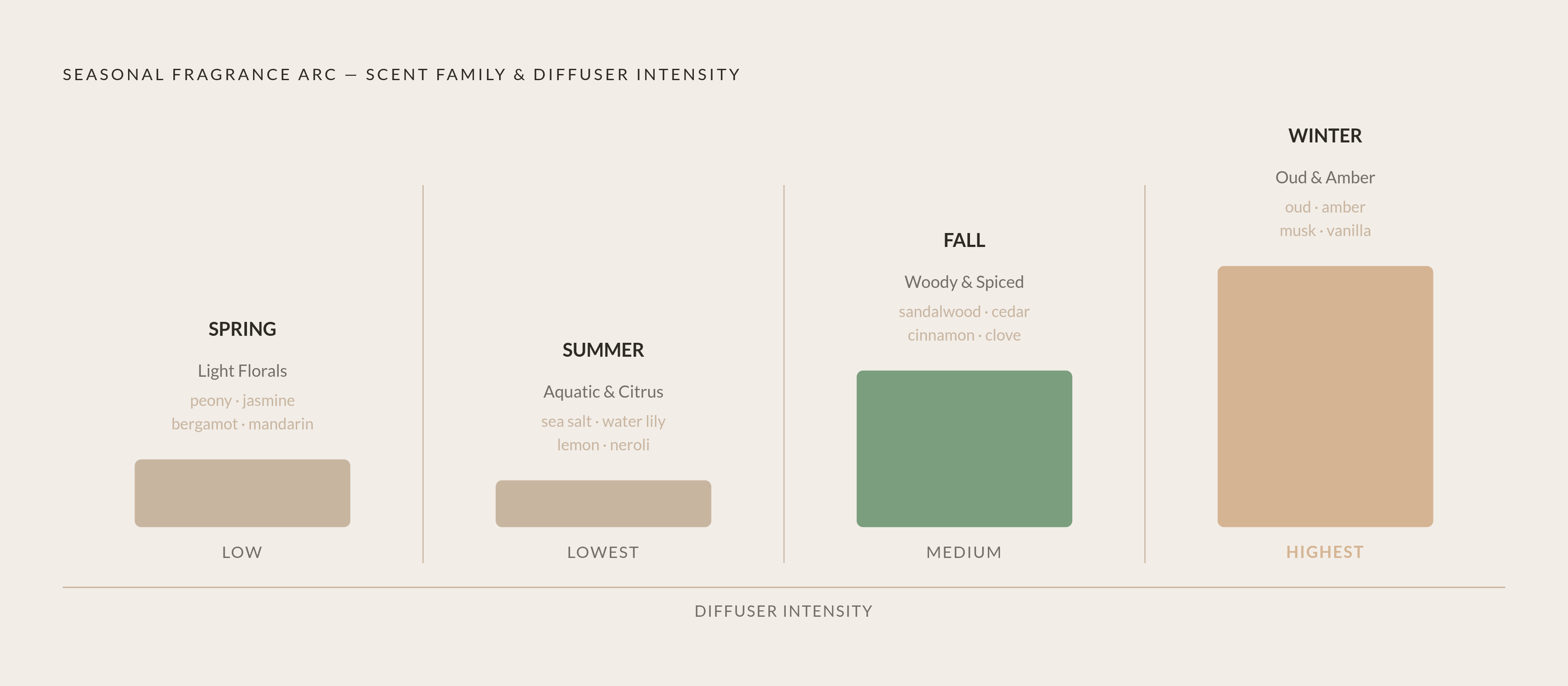
Spring calls for light florals: peony, jasmine, bergamot, mandarin. These mirror the season's increasing daylight and general sense of things waking up, and they pair naturally with lower diffuser intensity once windows start opening and outside air starts doing some of the diffusion work for you.
Summer wants aquatic and citrus profiles, sea salt, water lily, lemon, neroli, run at low projection. These work especially well in kitchens, bathrooms, and entryways, spaces that get a lot of foot traffic and don't need a heavy hand.
Fall shifts toward woody and spiced compositions: sandalwood, cedar, cinnamon, cardamom, clove. This is the seasonal turn from green to warm, and it's usually the point where a slightly richer base note starts to make sense again.
Winter belongs to oud, amber, musk, and vanilla, dense and cozy profiles built for sealed, heated rooms where a light floral would just get lost. Gourmand notes specifically, vanilla, caramel, baked goods, coffee, made up 34% of new home fragrance launches in the first quarter of 2026, according to NPD and Circana data. People clearly want their houses to smell like dessert in the winter.
One category worth watching outside the seasonal grid entirely: biophilic scents, rain, moss, fig leaf, tomato vine, wet stone. These grew from 8% to 15% of new launches year-over-year, and they work precisely because they don't read as tied to any calendar date. And single-note "soli" fragrances, soliflores, soliwoods, soliteas, are gaining ground for a related reason: a single, clean note is just easier to slot into a rotation and layer with something else than a complex fifteen-note composition is.
Room by room, some of this gets easier because certain spaces just don't need to rotate at all. Your entryway wants bright citrus or airy florals regardless of season, since it's the first impression and doesn't benefit from seasonal subtlety. The living room can carry your seasonal anchor at moderate intensity. The bedroom does better with calming profiles, lavender-vanilla, cashmere musk, that stay fairly consistent all year, because nobody wants their sleep environment reinvented every three months. The kitchen wants clean, crisp, non-food-competing scents, think linen or light herbals, year-round, and the bathroom wants spa-fresh eucalyptus or mint or clean citrus at low intensity, consistently, forever. So really, only your living room and maybe one other space are doing the heavy seasonal lifting.
How to handle the awkward weeks between seasons
Late August into September. Late February into March. These are the two stretches of the year where a scent wardrobe actually gets hard, because neither the outgoing season's profile nor the incoming one quite fits the actual weather outside your window.
Two strategies handle this reasonably well. The first is a bridge composition: a citrus or green top note paired with a woody or spiced undertone, fresh enough to survive a warm afternoon, substantial enough to hold up once the evening cools off. The second is layering, running a lighter oil at reduced intensity alongside a warmer one, which only really works if your diffuser lets you control output with any precision. A light floral paired with a touch of warm vanilla or woody musk reads as intentional and transitional; the same two scents run at full blast simultaneously just reads as confused.
One habit worth borrowing straight from personal fragrance: try new seasonal oils in small amounts before committing to a full-size bottle. Decants exist in the perfume world for exactly this reason, so you're not stuck with sixty milliliters of something that seemed like a good idea in a warm store and a bad idea in your actual living room. The diffuser's precise intensity dial makes all of this practical rather than theoretical. Dial down a heavy winter oil during an unexpected warm week in March, dial up a light spring oil on a genuinely cold morning, and you never have to swap the bottle just because the temperature shifted for a few days.
Why clean fragrance oil matters more when you're running a diffuser year-round
It matters more what's in an oil you diffuse daily, twelve months a year, than in one you run once a month, and this is where the wardrobe idea starts having real stakes.
Running a diffuser across four seasons means cumulative daily exposure, not the occasional Tuesday-night candle. And the regulatory picture here is worth knowing plainly: the US home fragrance industry has no mandatory ingredient disclosure requirement. The single word "fragrance" on a label can legally stand in for thousands of undisclosed synthetic compounds, and there's no law forcing a brand to tell you which ones.
A few ingredients worth knowing by name, without turning this into a scare piece. Phthalates get used to extend how long a scent lasts and are known endocrine disruptors. Synthetic musks have been linked to skin irritation and possible bioaccumulation over time. Paraffin combustion, relevant mainly to candles rather than cold air diffusion, releases volatile organic compounds worth knowing about even if it's off-topic for this particular delivery method.
It's also worth being precise about a distinction that gets muddled constantly: natural doesn't automatically mean safe, and synthetic doesn't automatically mean harmful. Plenty of botanical ingredients aren't actually safe at the concentrations used in diffusion, and plenty of synthetic compounds go through rigorous toxicological review before they ever reach a bottle. So the useful filter is IFRA compliance, NPA certification, full ingredient transparency, and an explicit statement that phthalates and synthetic musks are excluded. Some oils are formulated to be vegan, cruelty-free, and safe around people and pets, which matters most exactly in the scenario this article describes: year-round use in a home with kids or animals wandering through the same rooms every single day. And cold air diffusion itself helps here, since there's no combustion and no heat degradation, meaning nothing gets introduced into the oil's chemistry during use that wasn't already in the bottle.
Why cold air diffusion is the delivery method that makes a year-round wardrobe practical
Cold air diffusion uses air pressure, not heat and not water, to break fragrance oil into a fine mist. That distinction sounds technical, but it's the whole reason this delivery method works for a wardrobe that has to perform across four different seasons instead of just one favorite month.
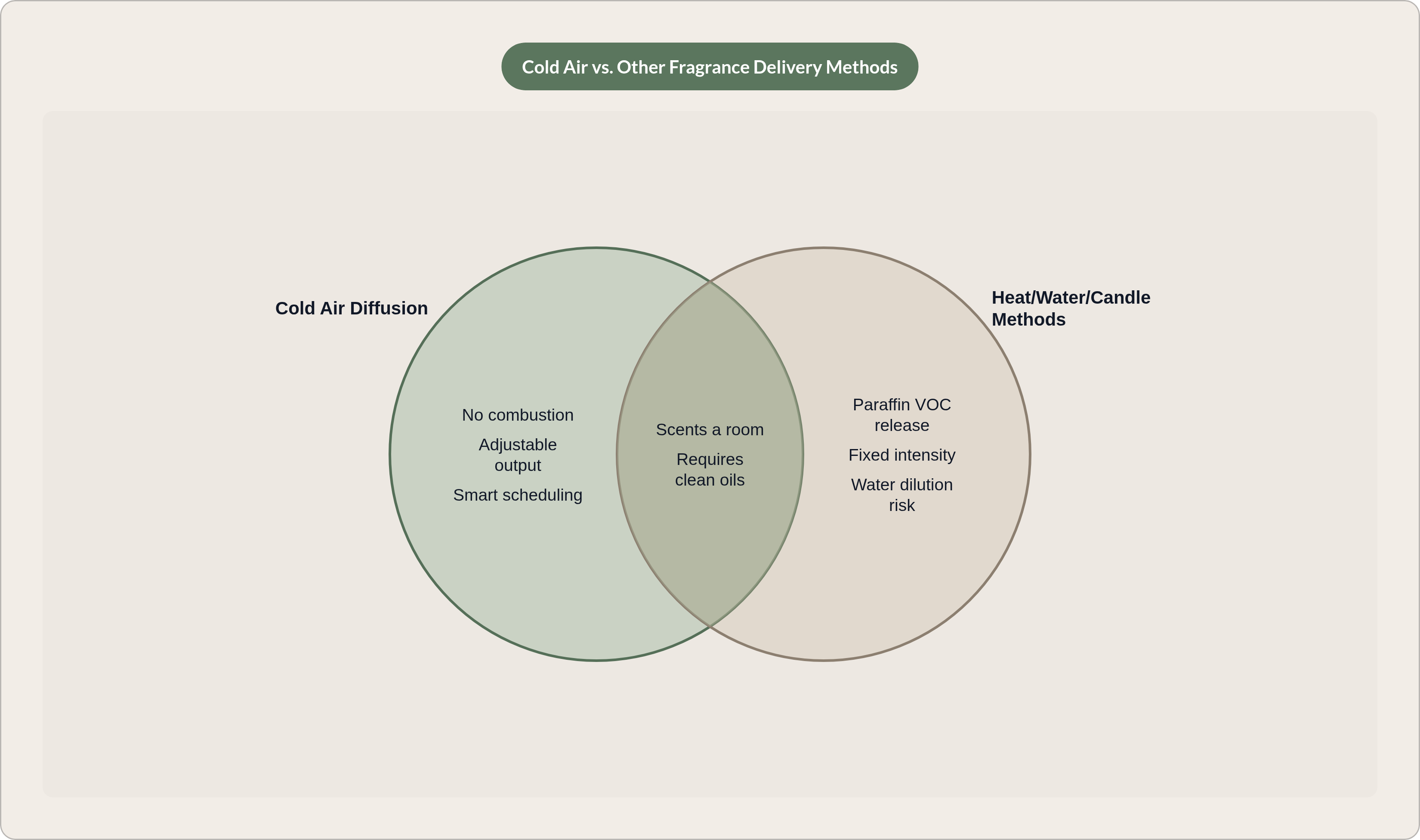
Compare it to the alternatives. Heat-based diffusers alter fragrance chemistry as they warm the oil, and some notes degrade or turn acrid once temperature climbs high enough. Water-based ultrasonic diffusers dilute the oil's concentration and, depending on your climate and the season, can invite moisture and mold into a space that didn't need either. Candles and wax melts involve actual combustion, and paraffin releases VOCs including benzene, with an open flame giving you exactly one fixed intensity and zero control over it. Room sprays give you a quick hit of scent and then nothing, no sustained presence, which is fine for a bathroom emergency but not for building an atmosphere that lasts.
For a seasonal wardrobe specifically, waterless cold air diffusion earns its keep in three ways. Fragrance fidelity: the oil smells the way it was formulated to smell in every season, not a heat-warped or water-diluted version of itself. Adjustable output: you dial intensity to match the room, lower with the windows open in summer, higher in a sealed winter space. And smart scheduling: timer controls cut down on wasted oil and let different rooms shift scent at different times of day without you standing there manually adjusting a dial every morning. According to Mintel's 2025 research, 56% of diffuser buyers say no open flame is their primary reason for choosing a diffuser over a candle, a year-round safety consideration once you're running the thing daily in a house with kids or pets.
How to build and maintain the collection without overcomplicating it
Start with four to eight oils total. One or two per season, plus one or two bridge scents to cover the transition weeks. That's the entire framework, and resisting the urge to expand it is honestly the hardest part.
Buy in this order: start with whatever season you're currently in, add the next season's anchor scent just before the transition hits, and only bring in bridge oils once the core four-to-eight collection already feels solid. Store everything cool and dark, since heat and light degrade fragrance oil between uses, and proper storage is really what makes seasonal rotation an economical habit instead of a wasteful one where half your collection has gone flat by March.
Diffuser maintenance belongs inside the rotation routine, not off to the side as a separate chore. Clean the diffuser whenever you're switching between meaningfully different fragrance families, heavy winter spice to light spring floral, for instance, so the outgoing scent doesn't bleed into the incoming one. Skipping this step undoes the entire point of a deliberate, intentional rotation; you end up with spring florals that carry a faint, confusing trace of last November.
Assigning scents by room also cuts your workload down considerably, since bedrooms and bathrooms can hold one consistent year-round profile and never need to rotate at all. And if the whole four-season framework still feels like more than you want to manage, the anchor approach works just as well: pick one understated base scent, soft woods, clean tea, a subtle musk, run it year-round through the main living spaces, and rotate lighter, cheaper oils through secondary rooms instead. A simplified version of the hotel lobby model, sized for a household instead of a building.
One more thing worth saying plainly: personal enjoyment is still the top reason people buy home fragrance in the first place, cited by 68% of buyers in NPD Group's 2025 research. So everything in this article is meant as infrastructure alongside enjoyment, not obligation in place of it. If the wardrobe framework helps you get more consistent enjoyment out of your home, use it. If it starts to feel like homework, ease off the structure and remember the point was the smell of your own house.