Scent and Mood: What the Research Actually Says
Smell reaches your brain's emotion centers before you've consciously identified the scent itself.
Scent changes mood because of anatomy. The nose is wired directly into the brain's emotional circuitry, skipping a filtering step every other sense has to go through, and that wiring explains why a whiff of something can make you feel a certain way before you've even figured out what you're smelling.
How odor pulls memory into the present (and why the effect is stronger than other sensory triggers)
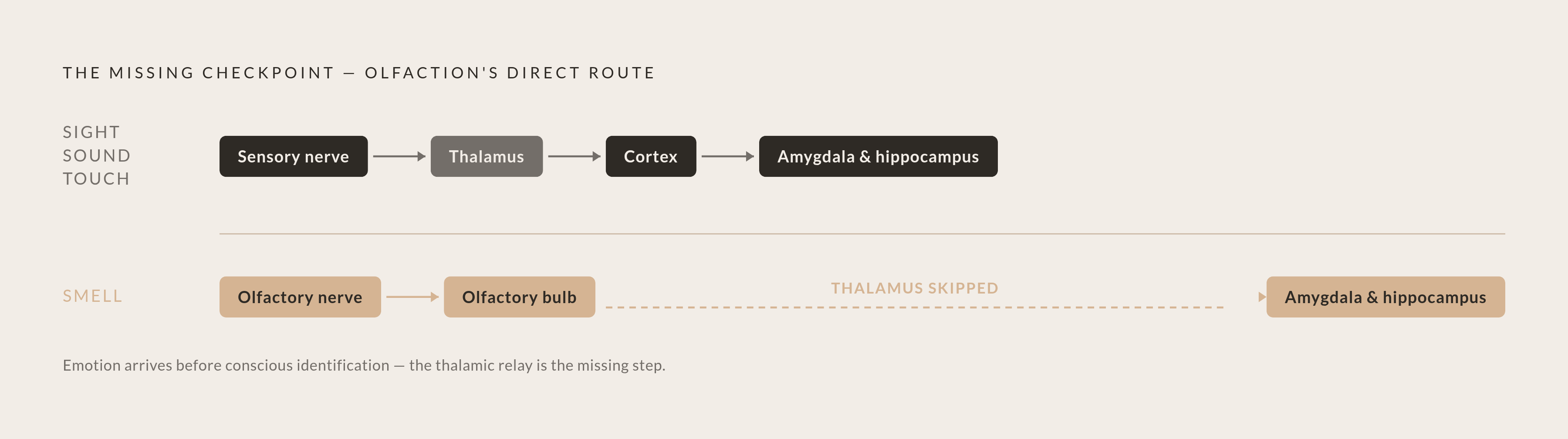
Every sense except smell has to check in with the thalamus first. Sight, sound, touch: all of it gets routed through this central relay station before the brain decides what to do with the information. Olfaction skips the line entirely. The pathway runs from the olfactory nerve to the olfactory bulb and straight into the amygdala and hippocampus, no intermediary, no checkpoint. Venkatesh Murthy, who studies olfaction at Harvard, has described how quickly these signals reach the limbic system once they arrive, and the speed itself is the point worth sitting with.
The amygdala handles emotional response, the hippocampus handles memory encoding, and nearby structures — the insula, the anterior cingulate cortex, the orbitofrontal cortex — all get pulled into the same unfiltered pathway. What that means in practice is a little strange when you sit with it: the feeling can arrive before the label does. You react before you've consciously identified the smell as "cinnamon" or "pine" or "that one candle from your aunt's house." The recognition catches up after the emotion's already moved in and started rearranging the furniture.
Worth separating this from the wellness-aisle version of the claim. This is a description of neural architecture, the same way saying reflexes bypass conscious thought is a description of the spinal cord. That distinction matters for every claim that follows in this piece, because the practical guidance later only holds up if the mechanism underneath it is real.
Odor triggers emotion, and it also drags memory into the present tense, more reliably than a photograph or a song does. Researchers call it the Proust Effect, borrowed from the madeleine scene in Swann's Way, but it stopped being a literary reference once neuroscience started measuring it directly.
A study by Arshamian and colleagues compared memories triggered by an actual odor against memories triggered by the verbal label of that same odor, the word for it rather than the smell itself. The odor-triggered memories showed more activity in limbic structures. They also lit up regions tied to visual vividness more strongly, meaning smell doesn't just retrieve a feeling; it retrieves a scene. The kitchen, the weather, who was standing where.
That has a sort of quiet consequence for anyone running a diffuser at home. A scent introduced consistently into a room isn't neutral wallpaper. Over weeks and months it gets encoded with whatever emotional texture that room usually holds, so choosing a scent on purpose is also, whether anyone thinks about it this way or not, choosing what atmosphere gets reinforced every time the machine clicks on.
But here's the honest complication: this cuts both directions. The same encoding mechanism that lets a calming scent become "the smell of a calm room" will just as happily attach itself to a bad afternoon, a fight, a stretch of insomnia. Personal scent history isn't a footnote. It's load-bearing. A scent with a rough personal association isn't going to behave like the population average no matter what the literature says about it in aggregate.
What peer-reviewed research actually shows for specific scents
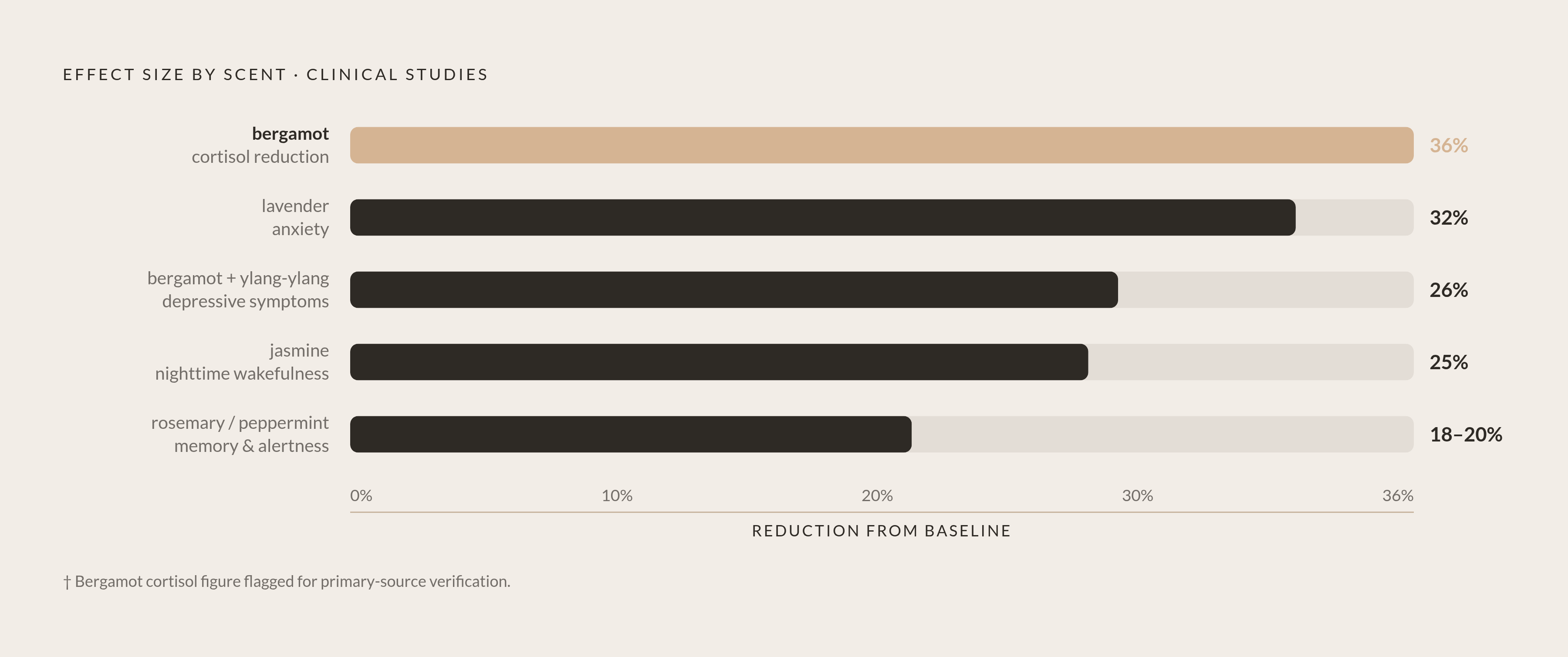
Lavender has the most solid footing of any scent in this conversation. A randomized controlled trial published in Frontiers in Psychology found lavender essential oil reduced anxiety symptoms by 32% in patients waiting for minor surgery, with corresponding changes in heart rate and blood pressure. The physiology moved in the expected direction, not just the self-reports.
Bergamot has a cortisol story attached to it: a 2023 study out of the University of Melbourne's Centre for Integrative Medicine reported a 36% reduction in cortisol among participants dealing with chronic stress. Worth flagging that this figure is traveling secondhand through other sources, so the primary citation deserves a second look before anyone treats it as settled. Same caveat applies to a 2025 study on rosemary and peppermint diffused in office settings, which reported memory recall and alertness improving 18 to 20%, alongside less reported mental fatigue. Promising, plausible, and still worth chasing down to the original journal article.
On depression, a clinical study found elderly participants using daily bergamot and ylang-ylang aromatherapy saw a 26% drop in depressive symptoms, along with better sleep and more social engagement. And on sleep specifically, a 2025 Sleep Research Society report tied to a smart diffuser study found jasmine improved sleep efficiency and cut nighttime wakefulness by 25%, another figure that should get checked against its primary source before it gets repeated as settled fact.
Zoom out and the pattern holds even when individual numbers stay soft. A 2026 narrative review in the journal Women, covering 47 studies, found the strongest evidence clustering around lavender, bergamot, rose, chamomile, clary sage, and ylang-ylang. A separate large-scale 2025 meta-analysis of more than 70 studies found something that probably deserves its own conversation: gender differences in scent responsiveness, with women and men showing distinct patterns in how they respond emotionally to different fragrance profiles. Worth noting the primary source for this one deserves a direct look before treating those details as settled.
None of this proves as much as it might sound like it proves. Most of these studies are small, run over short windows, and lean on self-report, which is a polite way of saying "people telling researchers how they feel" rather than something a machine measured independently. Sensory adaptation (the brain simply tuning out a smell it's gotten used to) can also blur outcomes over longer study periods, and so can memory decline in older populations. None of that erases the pattern; it just means treat effect sizes as directionally useful rather than gospel. The direction is consistent even where the magnitude wobbles, and given the anatomy covered earlier, that consistency isn't surprising.
Where aromatherapy fits (and where it stops) in mental health support
The backdrop here is large enough to be sobering. One in eight people globally, something like 970 million, dealt with a mental health disorder in the past five years, and nearly 44% will experience one at some point in their life. Depression leads the disease burden; anxiety is the most common diagnosis. That scale is part of why functional scent has quietly become part of daily self-care for a lot of people: one low-friction tool sitting alongside better sleep habits, therapy, exercise, the usual list.
Clinical adoption is real, if still modest. Therapists have started folding aromatherapy in as a companion to cognitive behavioral therapy and mindfulness work, working alongside both rather than in place of either. Some clinical practitioners have begun incorporating specific scents such as chamomile and orange into guidance for generalized anxiety disorder, which reflects a broader shift toward complementary approaches within mainstream practice. The 2026 MDPI review mentioned earlier also singles out aromatherapy as a growing complementary approach during hormonally sensitive life stages, menstruation, pregnancy, postpartum, menopause, partly because of legitimate worry about medication side effects during those windows.
There's a generational thread here too. Younger consumers, Gen Z in particular, have started using scent deliberately for mindfulness, as a way to physically reconnect after long stretches of screen time. A grounding use case, distinct from simply making a room smell nice.
But the line has to stay firm: complementary means alongside, never instead of. Nothing in the peer-reviewed record anywhere in this piece supports swapping fragrance in for clinical treatment. That line matters because it's the reason the rest of this article can be trusted at all. A piece willing to admit where the evidence stops is a piece worth listening to on where the evidence actually holds.
Why the delivery method determines how much of the research benefit reaches you
Here's a question worth sitting with: if a study measured the effect of lavender oil, and the device in your bedroom doesn't deliver the same chemical profile as that oil, are you actually getting what the study found?
Heat is the first problem. Essential oils are mixtures of dozens of molecular components, and heat causes those components to evaporate at different rates. A warmed or burned oil doesn't release the same blend that went into the bottle; it releases whatever evaporates fastest, which skews the chemical profile reaching your nose away from what researchers actually tested.
Water-based ultrasonic diffusers dodge the heat problem but introduce their own trade-off: they dilute the oil in water before dispersing it, and they add humidity to the room in the process. Both of those change scent concentration and character, and the added moisture is its own headache in a room that's already humid. Sprays and candles have a different issue: they deliver scent in short bursts or through combustion byproducts, neither of which gives the steady, controlled concentration that most of these studies were actually designed around.
Cold-air diffusion works differently. It uses air pressure to break fragrance oil into very fine particles, without heat, water, alcohol, or flame, which keeps the dispersed scent closer to its original chemical makeup. That matters directly for the research question: if the studies on lavender or bergamot involved inhaling the intact oil compounds, a delivery method that alters those compounds before they leave the device may simply not reproduce what the study measured.
Coverage and consistency matter almost as much as the delivery mechanism itself. Cold-air systems tend to be built for larger areas at a stable concentration, and steady dosing is a variable the research literature treats as genuinely important, not incidental. Smart scheduling adds one more lever: programming on and off cycles lets scent line up with the hours it's actually meant to help, winding down before bed, staying sharp during focus blocks, rather than running nonstop and inviting the brain to simply stop noticing it's there.
What "clean" fragrance actually means and why ingredient transparency matters for this use case
A 2023 peer-reviewed study in Chemosphere evaluated 28 glass and multipurpose cleaning products plus two air freshener products and found that common household products can emit volatile organic compounds. Fragrance-free products marketed as "green" came out looking potentially less harmful than their conventional counterparts. That's a useful data point for anyone assuming a home fragrance product is automatically benign just because it smells pleasant.
Conventional air fresheners commonly contain phthalates, VOCs, and petrochemical derivatives, ingredients that can compromise indoor air quality and, in some cases, interfere with endocrine function. Worth being precise here rather than alarmist: this is a documented category of concern, not a claim that every air freshener on a shelf is a health hazard waiting to happen.
Here's the part that trips people up, though: natural doesn't automatically mean safe. Botanical origin is not a safety certificate. Essential oils can cause skin sensitization or phototoxic reactions at high concentrations, and some synthetic fragrance molecules have actually been through more rigorous toxicological review than their "natural" counterparts. It's a counterintuitive point, but a useful one, sort of like discovering the organic apple and the regular apple went through very different amounts of scrutiny before landing in the same produce aisle.
Even well-regarded natural compounds have a gray zone. Limonene, the citrus compound, and linalool, found in lavender, are both generally considered safe, but ingredient safety can shift with concentration and ventilation conditions — worth knowing rather than assuming away.
Transparency in practice means full ingredient disclosure instead of "fragrance" doing all the hiding on a label. Retailer and industry clean standards that restrict suspect ingredients offer one useful reference point for what that looks like in practice. Independent third-party certifications give signals beyond a brand's own marketing copy vouching for itself. Vegan and cruelty-free formulation matters here as well, and it's part of what actually separates a premium clean fragrance product from a conventional one rather than just being a sticker on the box.
This connects directly back to delivery method. Cold-air diffusion avoids combustion byproducts and heat-degraded molecules, but only if the oil going into the machine was clean to start with. Diffuser quality and oil quality aren't separate purchasing decisions; they're the same decision viewed from two angles.
Translating the science into a practical scent strategy for the home
Match the scent to the job, not just to preference. Lavender and chamomile belong in the bedroom before sleep, given where the evidence clusters, rosemary or peppermint make more sense in a home office during hours that demand focus, and bergamot or ylang-ylang fit living spaces where the goal is general mood support. Pointing the research at the room it's actually relevant to matters more than picking a favorite scent.
Room size and diffuser output aren't style choices, whatever the packaging implies. Coverage has to match square footage, or concentration drifts into a range where effects are either undetectable or, at the other extreme, overwhelming. Placement matters just as much: breathing height, away from direct airflow vents, distributes scent evenly, while a spot near a return air vent burns through oil faster than intended and wastes it before it ever does its job.
Sensory adaptation is a real, documented phenomenon, not a myth people use to justify buying a fancier diffuser. Run a scent continuously and the brain stops registering it within a fairly short window, which is exactly why scheduled on and off intervals hold up better over time than nonstop output. More isn't better here either. The concentrations used in most of the studies cited above sit at a moderate background level, not a wall of fragrance the second you walk in, so intensity control functions as a practical tool worth having, not a luxury add-on.
Personal history still overrides population data, and it's worth repeating because it's the point most easily forgotten in a piece full of percentages. These studies describe tendencies across groups, not guarantees for any one person, so a scent carrying a bad memory for someone isn't going to deliver the average calming effect promised in the aggregate. Choice has to account for that, quietly, on a case-by-case basis.
One more number worth sitting with: according to dsm-firmenich, appreciation of scent rose from 56% in 2020 to 72% in 2024. That's a real shift, fragrance moving from passive background toward something people choose on purpose, the way they'd choose a playlist or a lighting setup. The science covered here doesn't hand anyone a specific bottle to buy. It makes the case that the choice is worth making with some care, because the path running from what enters the nose to how a person actually feels afterward isn't a metaphor. It's a nerve.