Non-Toxic Home Fragrance Options Compared by Delivery Method
Combustion turns even certified clean fragrances into a source of indoor air pollution.

Flip a candle over and scan the back. You'll probably see one word: "fragrance."
Brands that meet the full standard of explicit phthalate-free labeling and third-party certification vary by delivery method. For candles, MBur Room Service discloses 100% pure beeswax, a wooden wick, and phthalate-free fragrance; Fontana carries MADE SAFE certification with a beeswax-coconut blend; Grow Fragrance uses a certified plant-based soy-coconut formula with a refillable system. Across all delivery methods, the certifications that verify ingredient-level transparency rather than marketing claims are MADE SAFE, EWG Verified, EPA Safer Choice, and Sephora Clean. EWG Verified specifically prohibits hiding ingredients behind the word "fragrance" and requires full compound disclosure, making it one of the more useful filters when evaluating reed diffuser and cold-air diffuser oils as well. Explicit phthalate-free language on the label, combined with one of those certifications, is the combination that clears the bar.
That single word can legally represent any combination of nearly 4,000 undisclosed chemicals. U.S. trade secret law doesn't require manufacturers to tell you which ones they used. Around 3,000 chemicals are actively used in fragrance manufacturing today. A few worth knowing by name:
- Phthalates. Used to make scent linger. Associated with hormonal disruption at high or chronic exposure.
- Toluene. A solvent linked to neurotoxicity and developmental harm.
- Formaldehyde. Already banned from fragrances in the EU. Still legal here.
- Benzene. A documented carcinogen with gene-level effects under chronic exposure.
None of those need to appear on the label. All of them can legally hide behind "fragrance."
So when a brand calls itself clean, what does that actually mean? Nothing is stopping a company from printing "natural" on a bottle of compounds it has no legal obligation to name. The word means whatever the brand wants it to mean.
Actual transparency looks like this: every compound named, explicit phthalate-free labeling, and third-party certification from organizations like MADE SAFE, EWG Verified, EPA Safer Choice, or Sephora Clean. These aren't feel-good marketing badges. They're the closest thing to a verifiable standard that currently exists.
But knowing what's in the formula only answers half the question. The other half is what happens to those compounds once they hit the air. And that depends entirely on how the fragrance gets delivered.
What Combustion Does to Even a "Clean" Fragrance Formula
You can source a fully transparent, certified, phthalate-free fragrance formula and still meaningfully degrade your indoor air quality by lighting it on fire.
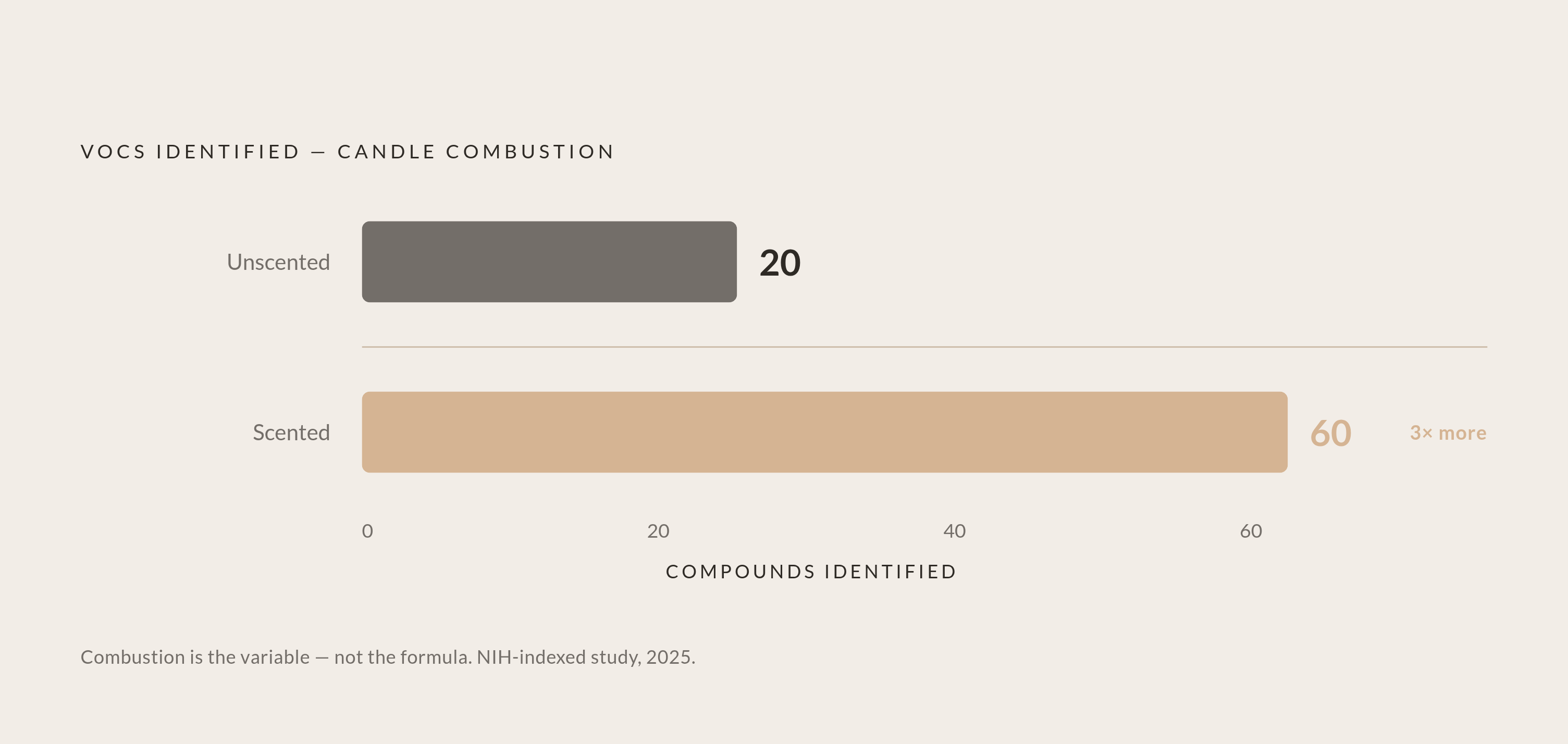
A 2025 NIH-indexed study evaluated VOC emissions from scented candles under realistic indoor conditions. Unscented candles produced 20 identified VOCs. Scented candles produced 60. Combustion transforms the chemistry — what you breathe in is no longer what was in the formula. That's the part "clean candle" marketing almost never touches.
Burning any candle also produces carbon monoxide, sulfur dioxide, and nitrogen oxides as a baseline. Incense is its own category of concern: it produces roughly four times as much particulate matter as an equal weight of cigarettes, according to reporting from The Conversation. In a non-smoking home, candles and incense can quietly become the primary source of indoor particulate pollution.
Short-term exposure to candle smoke has been linked to reduced cognitive function. Chronic incense smoke exposure has been associated with cognitive decline over time.
So maybe the "clean candle" conversation is asking the wrong question. "What is this wax made of" matters, but it matters a lot less than "what does this wax actually produce when it's lit."
How Wax Type and Wick Choice Shift the Combustion Risk Inside Candles
If candles are still part of your routine, wax type and wick choice are both worth understanding. They address different parts of the risk, and they don't cancel each other out.
Wax, by what it actually produces when burned:
- Paraffin. The most common wax by volume. A petroleum byproduct that emits benzene, toluene, formaldehyde, acrolein, naphthalene, and PAHs when burned. Its soot produces ultrafine PM2.5 particles comparable in size and composition to diesel exhaust, per a University of South Florida study cited by IQAir. This is the baseline everything else gets measured against.
- Soy wax. Significantly less soot than paraffin. Renewable, biodegradable. Worth knowing: some soy is GMO-derived, and some brands quietly blend soy with paraffin without disclosing it. Look for organic or non-GMO certification.
- Coconut wax. Burns cleanly with good scent throw. Often blended with soy. Tends to be the priciest plant-based option, and is also sometimes blended with paraffin without notice.
- Beeswax. Burns hotter and more completely, producing very little soot. Can offer over 110 hours of burn time versus roughly 60 hours for paraffin equivalents. Not vegan, and it holds added fragrance less effectively than softer waxes.
Wick is a completely separate variable. Cheaper wicks can contain lead or heavy metals. The safe standard is pure cotton or untreated wood. Check the product description specifically, because wick composition is rarely disclosed on the label itself.
A few brands worth referencing as examples of what full disclosure actually looks like: MBur Room Service uses 100% pure beeswax with a wooden wick and phthalate-free fragrance. Fontana carries MADE SAFE certification and uses a beeswax-coconut blend. Grow Fragrance uses a soy-coconut blend with certified plant-based fragrance and a refillable system.
Even with the best wax and the cleanest wick, combustion is still combustion. The upgrade is real. It is not elimination.
Reed Diffusers and Ultrasonic Diffusers: Passive and Water-Based Options Without Heat
Remove combustion from the equation and two alternatives come up: reed diffusers and ultrasonic diffusers. Both are genuine improvements over burning. Neither is without its own issues.
Reed diffusers are the passive option. No heat, no electricity, no combustion byproducts. Fragrance wicks through natural reeds at room temperature, and a well-made version can scent a room for up to 12 weeks. The ingredient loophole problem still applies though. The delivery is clean, but the oil still needs to be vetted. An open vessel of concentrated fragrance oil sitting at floor or table level is also a common source of accidental pet exposure. More on that in the next section.
Ultrasonic diffusers use vibrations to break water and diluted fragrance or essential oil into a fine mist. No heat involved. Dilution in water reduces the concentration of any given compound reaching the air compared to undiluted passive release.
Two practical limitations apply. First, they add humidity, and in a poorly ventilated space, consistent use can promote mold or mildew growth. Second, the water reservoir requires frequent cleaning to prevent bacterial buildup.
That raises an important question: does a cleaner delivery mechanism automatically make the oil safer? It doesn't. "Natural" essential oils can still trigger sensitivities in people and animals. The how of delivery matters, but it doesn't override the what.
Why Cold-Air Diffusion Is the Most Controlled Delivery Method for Non-Toxic Fragrance
Cold-air nebulizing diffusers work differently from everything else in this category. No heat, no water, no carrier liquid. Pressurized air atomizes the fragrance oil directly into micro-particles that disperse through the room.
Because nothing in that process applies heat, the fragrance formula isn't chemically transformed the way combustion changes even a well-sourced wax. What's in the bottle is, much more reliably, what enters the air.
No open liquid pool means the pet-contact risk associated with reed diffusers is removed. No water reservoir eliminates the humidity and mold concern from ultrasonic diffusers. Most cold-air systems also allow precise control over diffusion schedule and intensity, which means you can manage how much fragrance enters the space and when.
But the delivery method's advantage is only as strong as the oil being used. A cold-air diffuser paired with a poorly sourced fragrance oil is still dispersing that oil into your air. The hardware solves the combustion and humidity problems. It does not solve the ingredient problem. Both conditions have to be met.
Pet and Child Safety: Where Every Delivery Method Has a Different Failure Mode
This is the part most product marketing skips entirely.
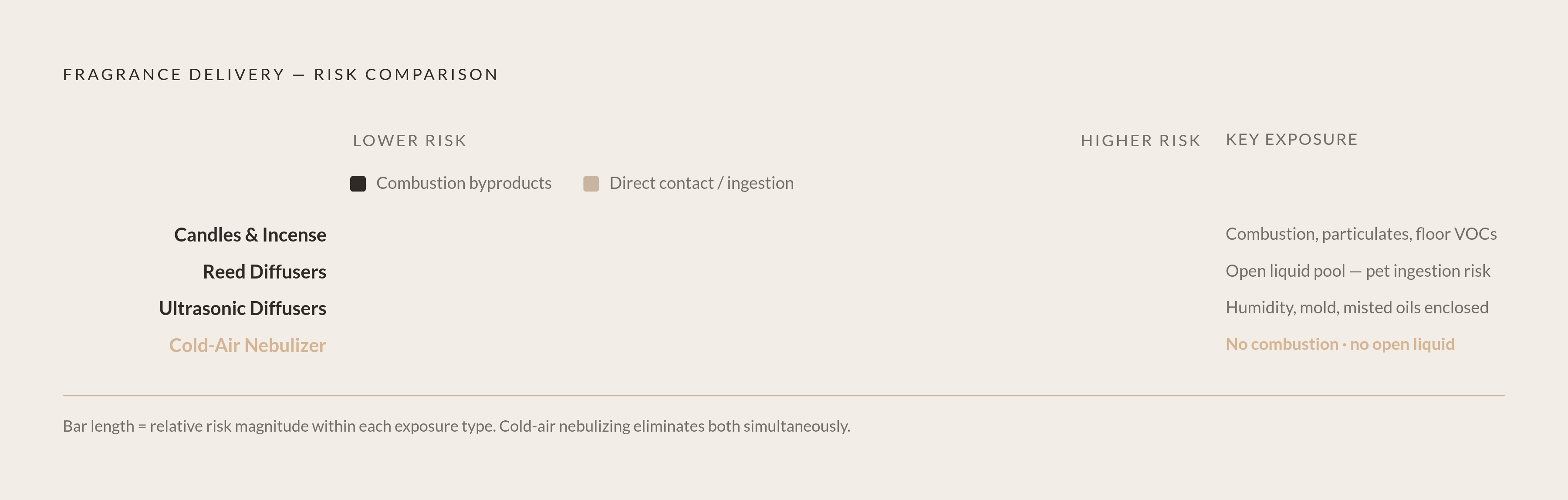
Combustion methods (candles, incense) present the broadest risk. Particulate matter, VOCs, and carbon monoxide circulate at floor and breathing level. That's exactly where children and pets spend most of their time. Cats and birds are especially sensitive to airborne compounds because of their respiratory physiology. A "natural" soy candle still produces combustion byproducts regardless of what the wax is made from.
Reed diffusers eliminate combustion risk but introduce a different one. Several essential oils commonly used in reed diffuser blends, including tea tree, eucalyptus, and certain citrus oils, are known to be toxic to cats and dogs. A reed diffuser at floor level in a home with a curious dog is a direct exposure risk.
Ultrasonic diffusers mist oils into the air. In an enclosed room, even diluted oils can accumulate to concentrations that irritate or harm sensitive pets. Diffuse in a well-ventilated space the animal can freely leave. Don't run it continuously in a closed room.
Cold-air diffusers with a closed reservoir and scheduled, intermittent operation reduce both contact risk and airborne accumulation. The closed vessel removes the ingestion pathway. The oil still needs to be vetted for the specific animals in your home.
A practical framework for households with pets or small children:
- Combustion. Eliminate it, or reserve it for well-ventilated spaces the animal cannot access.
- Open oil access. Eliminate it. Reed diffusers need to be genuinely out of reach, not just on a shelf a cat can clear.
- Oil ingredients. Vet them against known sensitivities for the specific animals you live with. "Natural" is not a safety signal here.
- Ventilation. This remains a consistent variable regardless of delivery method.
Which Certifications Actually Verify a Non-Toxic Fragrance Claim?
"Natural" and "fragrance-free" are unregulated marketing terms. Anyone can print them on a label.
Certification is the only verifiable signal, and even then, you need to know what each certification actually covers. Because not all of them cover the same thing.
Certifications worth understanding, and what they actually verify:
- MADE SAFE. Screens against known toxic ingredients across the full formula. One of the most rigorous standards currently available.
- EWG Verified. Requires ingredient-level hazard scoring and full disclosure. No hiding behind "fragrance."
- EPA Safer Choice. Screens for safer chemical ingredients, including fragrance components specifically.
- Sephora Clean. A retailer-enforced restricted ingredient list. Meaningful because compliance is required at point of sale.
- Leaping Bunny. Cruelty-free certification only, not ingredient safety. It addresses a different standard entirely.
- USDA Organic. Applies to agricultural-derived ingredients only. Does not cover synthetic fragrance components.
Full ingredient disclosure means every compound is named. Not "fragrance," not "essential oil blend." And phthalate-free stated explicitly, not implied by a vague "clean" claim.
A fully certified oil does not clear the bar if it's being combusted. The formula and the delivery mechanism both need to hold up.