Cold-Air Diffuser vs. Ultrasonic Diffuser: Real Performance Differences
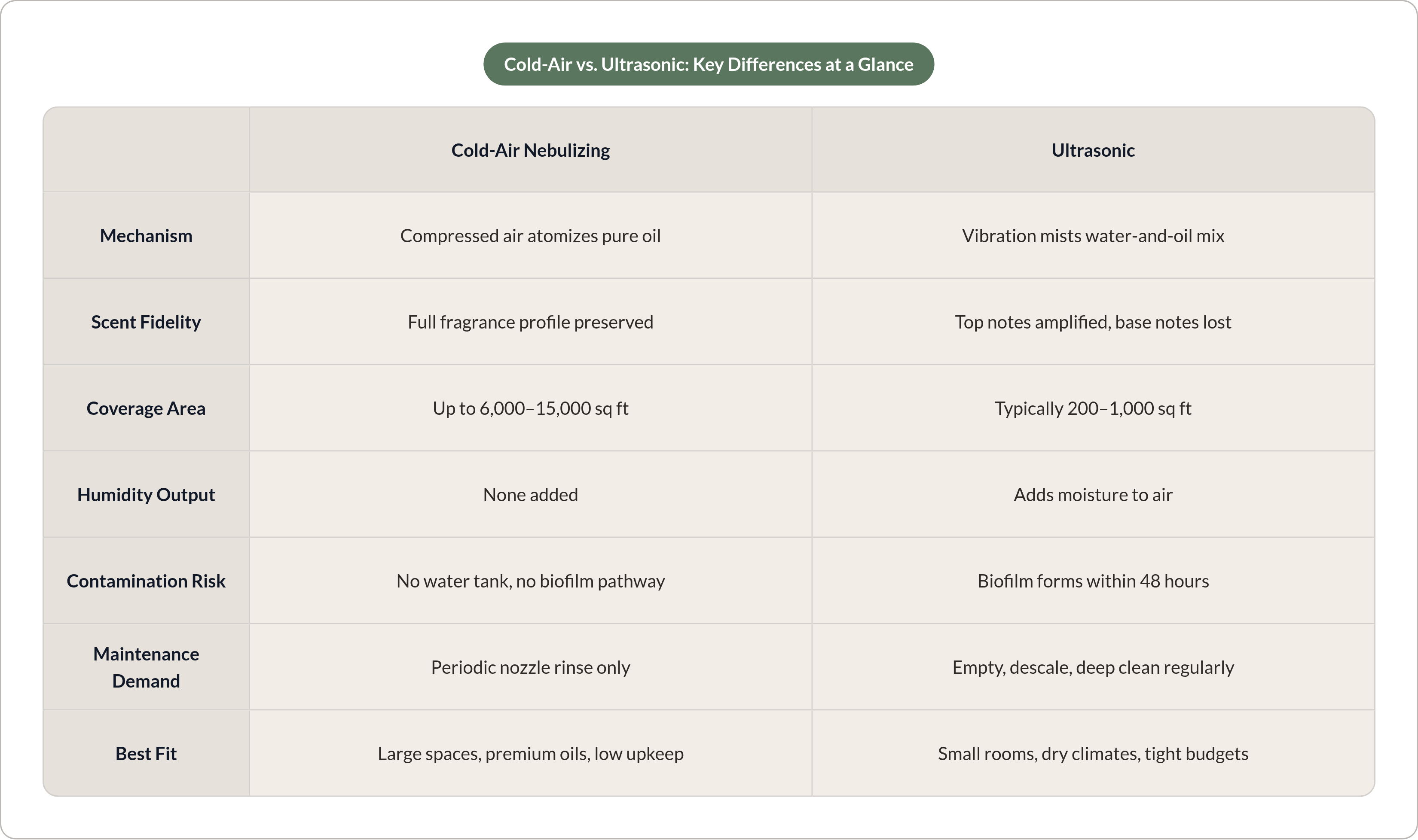
Cold-air diffusers deliver purer scent over wider spaces than ultrasonic models.

You've probably seen a perfume bottle with a little rubber bulb on the side. Squeeze it, and air rushes through a narrow tube fast enough to create a vacuum, which pulls liquid up and into the stream. That's not fancy engineering. That's physics doing its thing.
Cold-air diffusers use the same principle, just with more precision. Compressed air passes through a narrow nozzle at high velocity, pressure drops, and fragrance oil gets pulled up from its reservoir and shattered into droplets. We're talking 1 to 10 microns in diameter. For context, a human hair is roughly 70 microns wide.
Why does that size matter? Because droplets that small are nearly weightless. They don't fall. They hang, drift, and fill a space. Think smoke, but instead of ash it carries fragrance — a ghost of scent haunting a room long after the source has gone quiet.
Nothing gets added to the oil. No water. No heat. The fragrance disperses at room temperature in its pure, undiluted form.
That has real consequences for scent fidelity and coverage, which we'll get into.
How Ultrasonic Diffusers Work, and What the Water-Plus-Vibration Mechanism Trades Away
Ultrasonic diffusers work on a completely different principle. A small plate vibrates at very high frequency (typically around 2.4 MHz), agitating a mix of water and essential oil until it breaks into a fine mist. That mist carries both fragrance and moisture into the air.
Power draw is modest. Oil consumption is low. And the output looks great — that cool, visible mist feels like it's doing serious work.
The water isn't incidental to how an ultrasonic diffuser operates. The water is the mechanism. The oil is diluted before it ever leaves the device. What that dilution does to the fragrance you paid for is addressed in the next section.
First, though, there's a compatibility issue that almost never comes up in marketing materials.
Oils are not interchangeable between these two technologies:
- Waterless fragrance oils (formulated for cold-air systems) will clog an ultrasonic diffuser
- Water-compatible oils (formulated for ultrasonic use) won't nebulize properly in a cold-air system
The diffuser technology determines the oil formulation you need. Buy the hardware first, then buy the oils. Getting that backwards is an expensive mistake, and it happens constantly.
Scent Fidelity: What Heat and Water Do to a Fragrance's Molecular Structure
Perfumers build fragrance in layers. Top notes are the first thing you smell — light, volatile, and gone within minutes. Middle notes are the heart of the scent. Base notes are the slow-burning foundation that lingers longest. The final product is a precise ratio, and disrupting that ratio changes the experience.
Cold-air diffusion doesn't disrupt it. Room temperature, no water, no heat. The molecular bonds stay intact and the ratio holds. What the perfumer designed is what you get.
Water dilution is a different story. When oil is mixed with water before dispersal, the more volatile top notes disperse faster and in higher proportion. The citrus that was supposed to open the scent arrives louder than intended. The base notes that were supposed to anchor it arrive quieter or not at all. It's all introduction and no resolution — like reading only the first chapter of a novel.
Heat makes this worse. Thermal energy can break molecular bonds in fragrance compounds, altering the scent profile before it even reaches the air. Some of those altered compounds are also associated with respiratory irritation in sensitive individuals.
If you're buying a premium fragrance oil for its complexity, the delivery mechanism has to let you experience it. With ultrasonic diffusion, the answer is often no. The top notes perform. The rest gets lost.
Coverage Area in Practice. What Each Technology Can Realistically Scent
Let's put actual numbers on this.
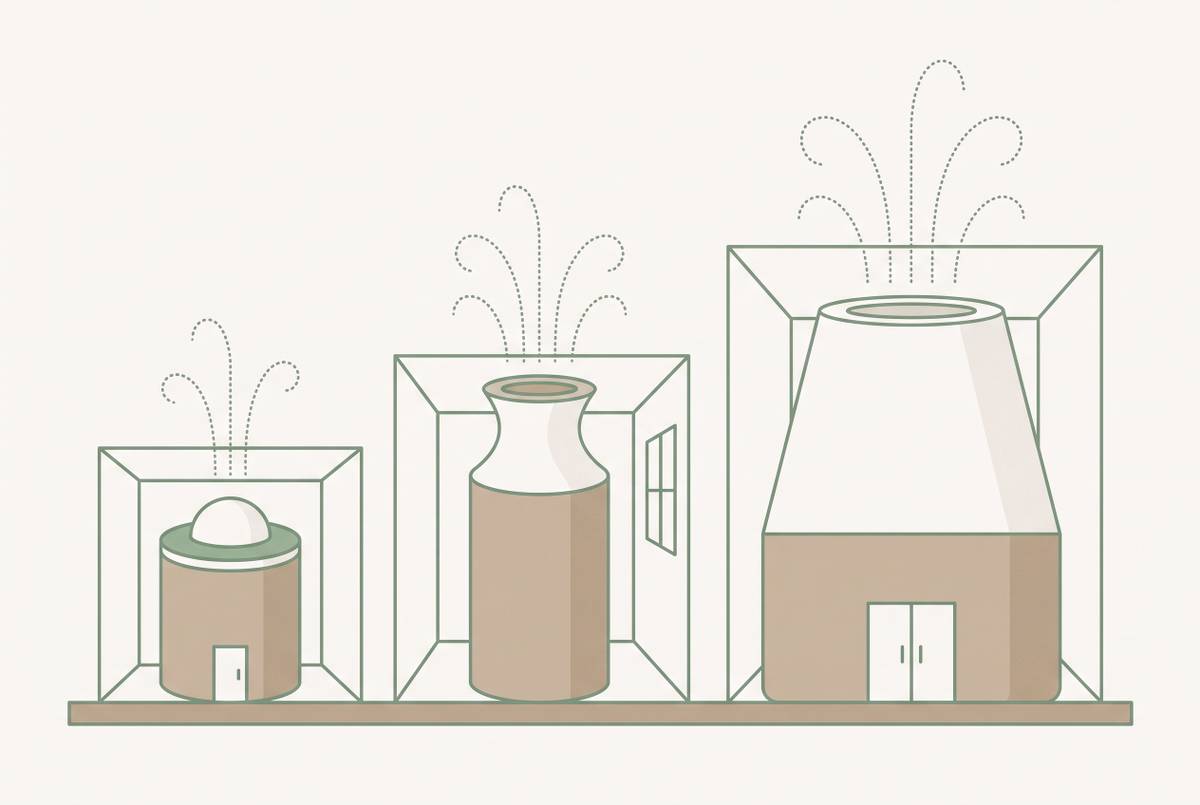
Ultrasonic diffusers effectively cover roughly 200 to 400 square feet. Premium models can push toward 1,000. Cold-air nebulizing diffusers can reach 6,000 square feet from a single unit. HVAC-integrated cold-air systems can handle up to 15,000.
That's not a marginal gap. That's a structural one.
The reason comes back to the output itself. Dry microdroplets of undiluted oil travel farther and stay suspended longer. A water-heavy mist settles faster and loses its scent load quickly.
Here's a rough map for real spaces:
- Bedroom, home office, small apartment: Ultrasonic can technically cover the square footage. But coverage isn't the only variable — scent fidelity and air quality become the deciding factors.
- Open-plan living areas, large primary suites, multi-room use: Cold-air covers the space. Ultrasonic likely doesn't.
- Whole-home or HVAC integration: Cold-air only.
That ambient, consistent scent you walk into at a well-designed hotel lobby? That's cold-air diffusion at scale. Ultrasonic units can't produce it. The physics won't allow it.
One honest trade-off: pure oil at full concentration is potent. In a smaller room, shorter diffusion cycles are smarter than running a cold-air unit continuously.
The Humidity Output Ultrasonic Diffusers Add. Benefit in One Season, Liability in Another
There are real conditions where the moisture output from an ultrasonic diffuser is an advantage. Dry climates. Winter heating season, when forced air pulls moisture out of your home until the air feels like a parking structure in August. In those contexts, a cool mist that adds humidity and fragrance simultaneously is useful.
Ultrasonic diffusers also run quietly. That matters for bedrooms and workspaces where ambient noise is a consideration.
But adding moisture to a space changes the indoor air quality equation. The EPA recommends keeping indoor relative humidity between 30 and 50 percent. Sustained levels above 60 percent raise the risk of condensation on windows, walls, and inside ductwork. And wherever condensation accumulates, you get conditions that favor mold, dust mites, and bacteria.
Cold-air diffusers add no moisture. In most climates and during warmer months, that's the safer default. The humidity benefit of ultrasonic diffusion applies in specific seasonal or geographic conditions. Outside those conditions, you're not getting a bonus feature. You're taking on a risk.
What Grows Inside an Ultrasonic Diffuser's Water Tank. and How Fast
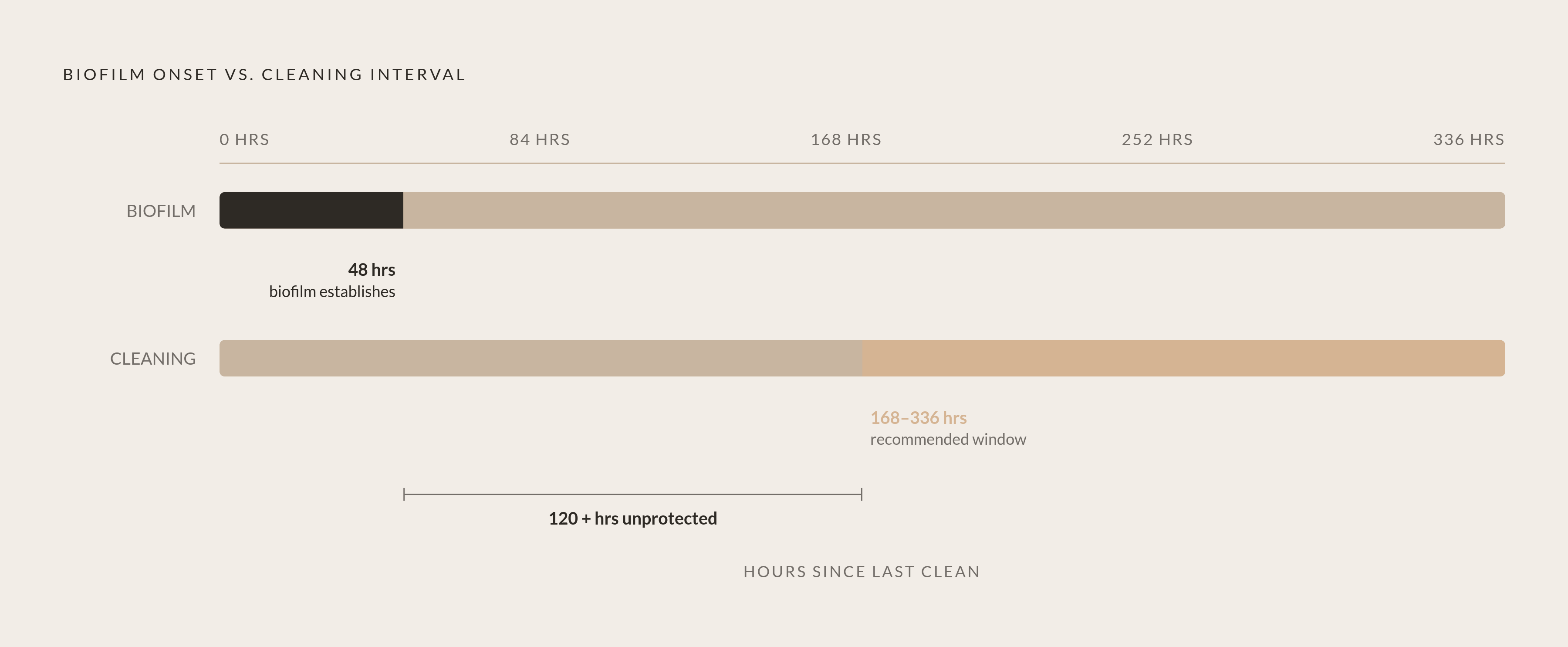
Here's a timeline diffuser marketing almost never mentions.
Biofilm (a living colony of microorganisms) can begin forming inside a water tank within 48 hours of use. When the ultrasonic plate runs, it aerosolizes everything in the water, including whatever has colonized the tank. That mist goes into the air you and your household breathe.
Three structural factors make this worse:
- Standing water that is rarely fully emptied between uses
- Room temperature that is not high enough to kill pathogens on its own
- Internal geometry with corners that are hard to reach and dry
Most manufacturers recommend cleaning every one to two weeks. Biofilm establishes in 48 hours. Those two timelines don't match, and that gap is where the real risk lives.
A 2024 conference paper published through Society. Integration. Education (Rimdjonoka et al., Vol. 2) found that ultrasonic diffuser use can keep particulate levels within acceptable ranges over a four-hour window. The same research documented an increase in nanoparticle concentrations for which current health guidelines don't yet have specific recommendations. Not a verdict. An open question that deserves acknowledgment.
There's also a material issue. Low-cost ultrasonic units are often made from cheap polymers. Regular water exposure can cause those materials to degrade, releasing compounds into the water and eventually into the air.
The U.S. EPA has stated that microbial contamination risk in cool-mist units is difficult to eliminate without boiling the water first. Cold-air diffusers have no water tank, so the contamination pathway doesn't exist.
Maintenance Burden Over Time. What Each Technology Actually Asks of the Owner
Here's what ownership actually looks like for each technology, without the optimistic framing.
Ultrasonic upkeep:
- Empty and rinse after each use
- Descale regularly to manage mineral buildup (more often with hard water)
- Deep clean weekly, typically with white vinegar
- Monitor for plastic degradation over time
- Most consumer units noticeably decline within a year or two
That maintenance isn't just about keeping the device running. It's the mitigation strategy for everything in the previous section. Skip it and you're not just running a dirty machine — you're potentially aerosolizing the contents of a neglected water tank.
Cold-air upkeep:
- Periodic nozzle rinse
- Occasional wipe-down to clear oil residue from atomization components
- No water tank, no mineral buildup, no biofilm, no descaling
Fewer moving parts and no water contact means cold-air units are built for a longer functional life. The sticker price doesn't show that difference, but total cost of ownership over two or three years often does.
Which Diffuser Fits Which Household. Mapping the Real Performance Gaps to Actual Buying Decisions
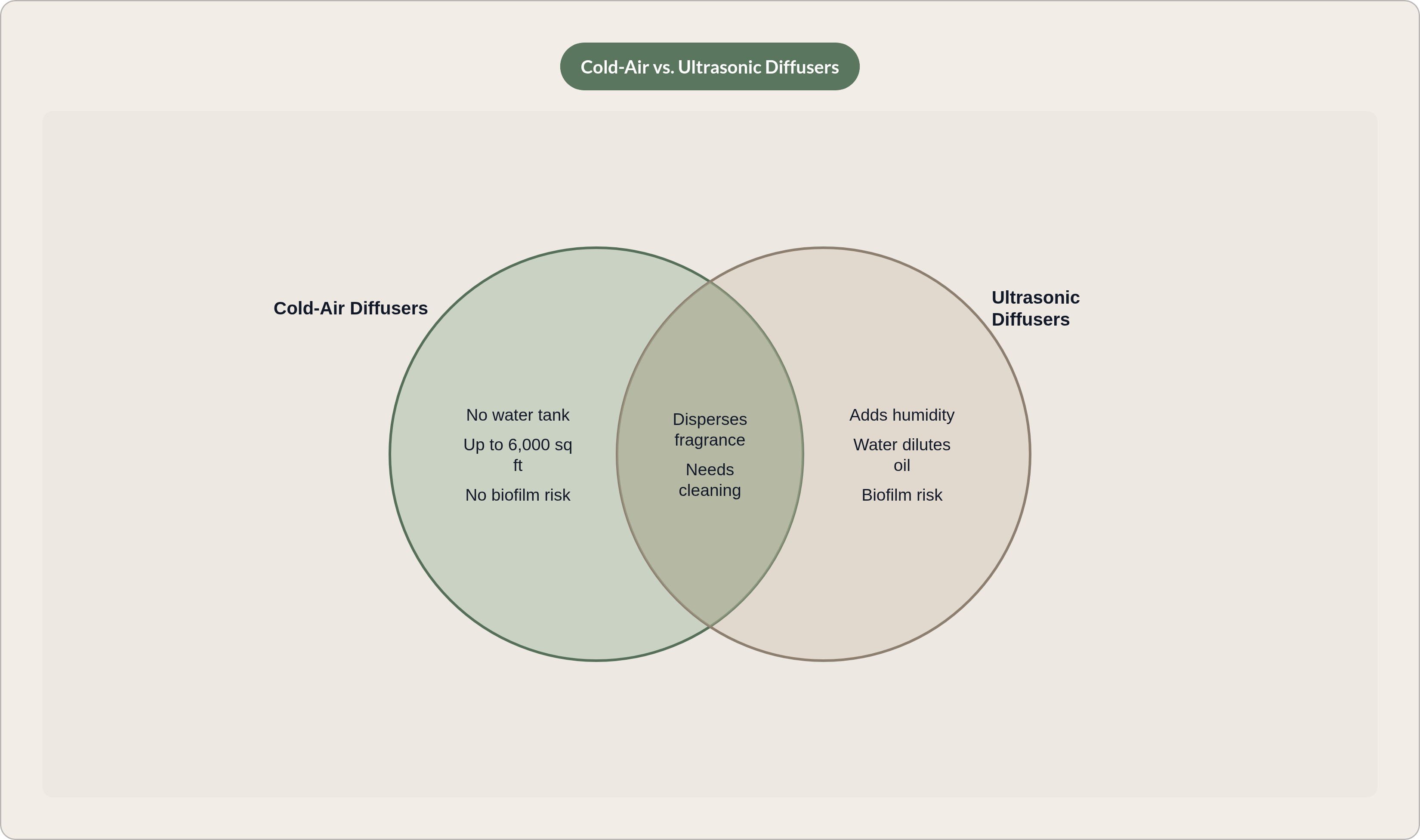
Someone reading this far might reasonably conclude that this whole piece is a case against ultrasonic diffusers. It's worth pushing back on that a little, because it's not quite right.
The case for ultrasonic is legitimate under specific conditions:
- Small, enclosed space where coverage isn't the constraint
- Dry climate or winter heating season where added humidity is wanted
- Budget is the primary consideration
- You are diligent about cleaning every 48 hours. Not every week or two. Every 48 hours.
If all four of those apply to your situation, an ultrasonic diffuser is a reasonable choice.
The case for cold-air is stronger in most other scenarios:
- Open floor plans, large living areas, or multi-room coverage
- Households with pets, children, or members with respiratory sensitivities
- Premium fragrance oils where the full composition actually matters
- Low daily maintenance and longer device life are priorities
- You're building a consistent ambient scent environment, not just occasional use
Aura House cold-air diffusers run without water or heat and pair with Sephora Clean-certified fragrance oils formulated for cold-air atomization. Aura House also directs a portion of each purchase toward mental health services through a partnership with To Write Love On Her Arms.
The answer here isn't "which technology is objectively better." It's which technology matches the space, the household, and the scenting goals you actually have.