Bergamot in Home Fragrance: Uses, Benefits, and Safety
The chemistry behind bergamot's longevity and mood-boosting potential.

Most people smell bergamot for the first time and reach for "citrus." Then they pause. Something is off. Not wrong — just slightly off. It is brighter than orange, less sharp than lemon, and there is something underneath it that neither of those oils carries. A softness. A faint floral warmth you almost miss on the first pass.
That "something" has a name, and actually it has a few.
The chemistry of bergamot comes down to three main characters:
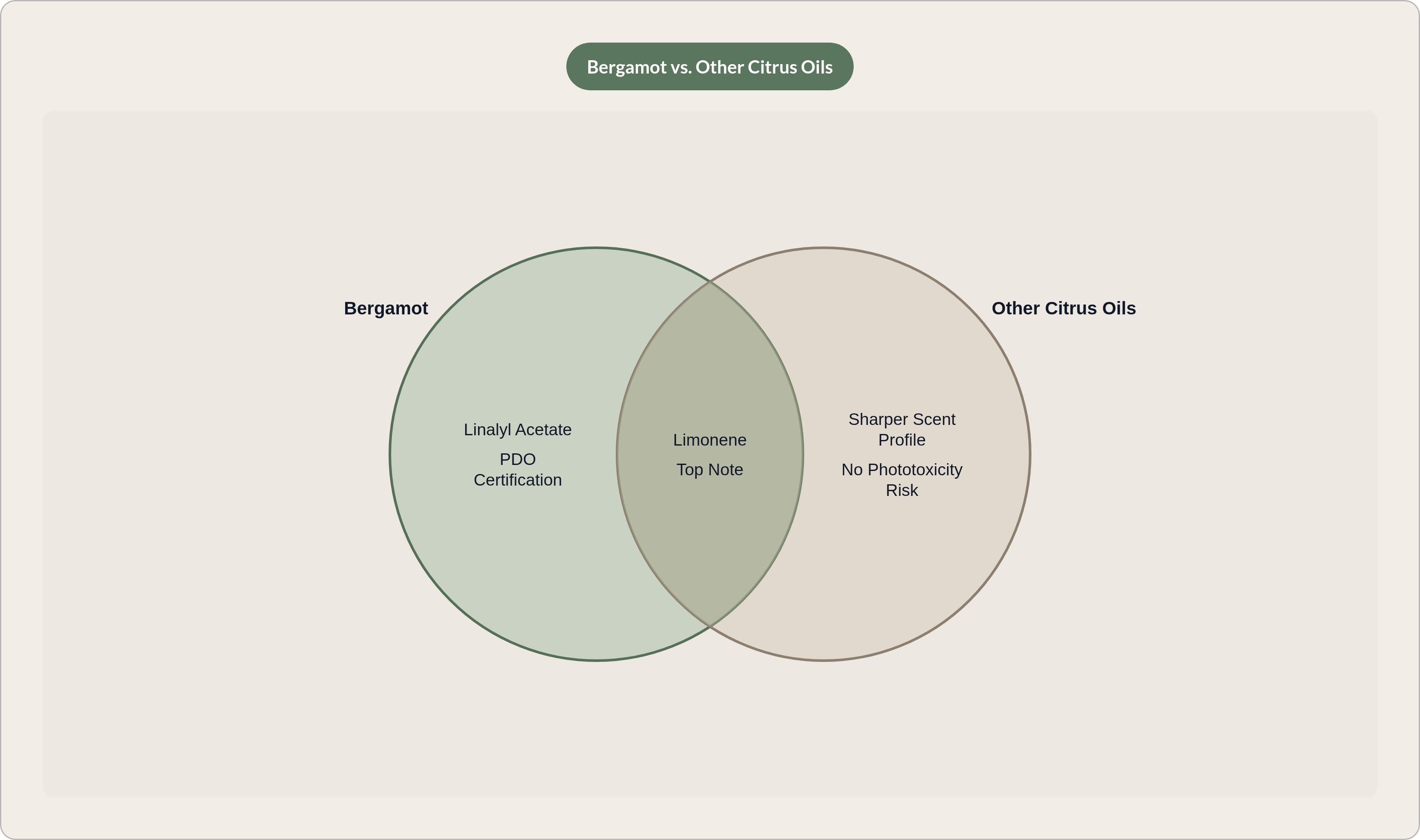
- Limonene. The bright, recognizable citrus lift — the part your brain immediately files under "fresh."
- Linalool and linalyl acetate. Linalyl acetate makes up roughly 30% of the oil. This is where the calm, slightly floral, almost powdery quality lives. It is what separates bergamot from every other citrus rind oil on the shelf.
- Bergapten and related furanocoumarins. These create phototoxicity risk, which we will get to later.
In perfumery, bergamot is classified as a top note. It opens the door. But most citrus top notes evaporate fast. Fifteen, maybe twenty minutes, and they are gone. Bergamot lingers. It acts as a fixative, extending a fragrance's life in ways that are notable for a citrus oil, which is why houses like Chanel, Dior, and Guerlain have leaned on it as a natural anchor for decades.
Why does it linger? It comes back to that linalyl acetate-to-limonene balance. Most citrus oils are limonene-heavy and linalyl acetate-light. Bergamot is comparatively rich in both. That ratio also explains why cold-press extraction matters. Heat degrades linalyl acetate specifically. Get the extraction wrong and you lose the very compound that makes bergamot what it is. What you are left with is flat and dull — lemon that gave up halfway through.
I have smelled enough bergamot products over the years — good ones, cheap ones, mislabeled ones — that this flatness is immediately obvious now. Once you know what the real thing is supposed to feel like, the imitations announce themselves.
How Bergamot Became a Foundation of Fine Fragrance and Why It Still Dominates
Here is a date worth knowing: 1709.
That is when Giovanni Maria Farina, writing from Cologne, described a new scent he had created — one that recalled "oranges, lemons, grapefruits, bergamots, cedars, the flowers and aromatic herbs" of an Italian spring morning. That fragrance became Eau de Cologne. It was the first major Western fragrance to combine bergamot with other citrus oils at high alcohol concentration, and it set a template perfumers are still working from more than three hundred years later.
Most trends in fragrance come and go, but bergamot has stayed. Why?
Part of the answer is range. Look at two contemporary examples that could not smell more different from each other:
- Acqua di Parma Blu Mediterraneo Bergamotto di Calabria uses it as the luminous center of a whole Mediterranean story.
- Guerlain Aqua Allegoria Bergamote Calabria treats it almost as a solo statement — a study in what one ingredient can do when you stop competing with it.
Same key ingredient, entirely different emotional registers. That kind of flexibility is uncommon in a single material.
For home fragrance, this history carries weight beyond aesthetics. About 90% of the world's bergamot essential oil comes from the Province of Reggio Calabria in southern Italy. The clay-limestone soil there, fed by snowmelt from the Aspromonte mountains, produces a chemical profile that growers in Argentina, Brazil, Ivory Coast, and Turkey have tried to replicate and cannot quite match. The linalyl acetate-to-limonene balance in Calabrian oil is measurably richer. The oil carries a PDO designation: "Bergamotto di Reggio Calabria – Olio Essenziale DOP," which legally ties quality to origin. Locals call it "Green Gold" — not as marketing copy, but because geography is doing something real, and it is the kind of thing worth knowing when you are standing in front of a shelf of options.
There is even a real tourist route along that coast called the Via del Bergamotto, where perfumers and enthusiasts have made pilgrimages for generations. When you diffuse bergamot, you are using an ingredient with a specific sense of place built into it. That context does not disappear when you drop oil into a diffuser.
What the Research Says About Bergamot's Effects on Mood, Anxiety, and Stress
Worth being direct here: there is real research, and there are real limits to it.
A human pilot study at a mental health treatment center in Utah had 57 participants inhale bergamot essential oil for fifteen minutes. Those participants reported positive feelings 17% higher than the control group. A 2023 randomized crossover trial with 48 university students found meaningful improvements in depression, anxiety, and stress scores. Sleep quality markers improved when participants used bergamot before bed and upon waking. These are real results from real people.
The mechanism research is getting more specific too:
- Bergamot essential oil appears to bind to GABA receptors and influence the HPA axis, two established biological pathways for anxiety reduction.
- Limonene seems to improve mood through BDNF receptor expression via monoamine neurotransmitters, producing something like an antidepressant effect in models.
- A 2025 neuroscience study identified a specific neural circuit involving glutamatergic neurons in the anterior olfactory nucleus projecting to the anterior cingulate cortex. That is the most granular mechanistic evidence yet for how inhaled bergamot actually produces its effects.
A literature review covering 47 studies published between 2000 and 2025 placed bergamot among the most substantively supported essential oils for anxiety, depression, and stress, alongside lavender, rose, and chamomile.
But most of the human studies are small. Animal and in-vitro findings are promising without being clinical proof. So what do you actually do with that? The signal is consistent enough to take seriously, but not consistent enough to replace anything prescribed or clinically managed. If you are curious, try it and pay attention to how you feel. The research is worth following, not worshipping, and those are not the same thing.
Using Bergamot Intentionally at Home — Rituals That Match Its Effects to the Moment
If the research points anywhere specific, it points to timing.
Morning. The bright, limonene-forward quality makes bergamot a natural fit for lifting mood at the start of the day. The 2023 sleep study found participants reported feeling more refreshed when they used bergamot in the morning. Think of it as the olfactory version of opening a window.
Evening. The linalyl acetate content and documented cortisol-lowering effects make it a solid fit for winding down. A simple bedtime blend from aromatherapy practice: 3 drops bergamot, 2 drops lavender, 1 drop frankincense — three ingredients working in the same direction.
Bergamot also blends unusually well across categories without disappearing into the mix:
- With florals (jasmine, rose, neroli) for something soft and spa-adjacent
- With woods and resins (sandalwood, vetiver, frankincense) for grounded warmth
- With other citrus or herbs (lemon, basil, eucalyptus) for a crisp, energizing feel
Now here is the part people skip over: delivery method matters more than it sounds. Heat-based diffusion (candles, wax warmers) can degrade linalyl acetate, which carries most of the calming character. Cold-air diffusion disperses the oil intact. If you are buying bergamot for what is actually in it, how you put it in the air is not a minor logistical question — it is, arguably, the central one.
The Safety Facts About Bergamot That Actually Matter for Home Use
The main risk with bergamot is phototoxicity. The bergapten and related furanocoumarins in the oil can cause burns or lasting pigmentation changes if you apply it to skin and then expose that skin to sunlight.
That risk is real and specific. It requires skin contact followed by UV exposure. Diffusing bergamot in a room does not create a phototoxicity hazard. If you are blending bergamot into a body product, look for FCF (furanocoumarin-free) oil. For home diffusion, phototoxicity is simply not the relevant concern.
General diffusion common sense applies regardless:
- Use in ventilated spaces
- Avoid running a diffuser continuously for hours in a sealed room
- Handle undiluted oil carefully to avoid skin contact during setup
Pets deserve specific attention here.
Cats are more vulnerable to essential oils than dogs. They lack a liver enzyme (glucuronyl transferase) needed to metabolize certain aromatic compounds, and bergamot is among the oils worth being careful with around them. High-concentration or direct exposure is the real concern. Ambient diffusion at normal levels in a ventilated room is a different situation, but different does not mean ignore it.
If you have cats:
- Diffuse in a room the cat can leave freely
- Keep ventilation going
- Do not apply oils directly to animals
- When uncertain, make a five-minute phone call to your vet — it is worth the time.
One more thing on formulations broadly: phthalates and parabens are the synthetic compounds carrying the highest documented health concerns in fragrance products. Reading an ingredient list before buying costs about thirty seconds.
How to Evaluate a Bergamot Home Fragrance Product Before Buying It
Start with origin. For most ingredients, provenance is interesting but optional. For bergamot, it is a quality signal. Calabrian-sourced oil with PDO certification is the benchmark. Products that do not specify origin are likely using oil from secondary growing regions where the chemical profile is thinner. Ask directly. If the brand cannot answer, that tells you something.
Check what is absent from the ingredient list as much as what is present. Phthalates, parabens, artificial colorants, synthetic fixatives. The market is moving away from these, and brands that have made that shift are usually not shy about saying so.
Delivery method shapes the experience in ways that go beyond preference.
- Cold-air diffusion preserves aromatic integrity and produces no combustion byproducts. It is the best choice if you are buying bergamot specifically for its chemistry.
- Reed diffusers and sprays offer lighter, intermittent scent without heat, which makes them reasonable for ambient use.
- Candles and wax warmers introduce heat that can alter volatile compounds. Worth knowing if the linalyl acetate content is part of what you are actually paying for.
On labeling. "Fragrance oil" and "essential oil blend" signal different things about what is in the bottle. It is worth asking whether the bergamot content comes from actual essential oil or a synthetic analog. Brands that source transparently will tell you without hesitation. Brands that hedge or pivot deserve more scrutiny.
Aura House, a home fragrance brand, offers smart cold-air diffusers alongside non-toxic, clean fragrance oils formulated without phthalates or parabens, designed for interiors where aesthetics and air quality both matter. Cold-air delivery is the right call for bergamot specifically, given what heat does to linalyl acetate. Whether or not you buy from them, that pairing of diffuser type with oil chemistry is exactly what you should be looking for in any product.
The broader point is simple enough to state plainly. Bergamot rewards attention. Pay attention to where it comes from, how it is extracted, how it reaches the air, and what it is blended with. The difference between a flat, forgettable citrus note and something interesting becomes clear pretty quickly once you know what you are looking for.