Essential Oils for Sleep and Relaxation
Research shows lavender and bergamot can improve sleep through specific brain pathways.

Sniffing lavender to fall asleep sounds like advice stitched on a throw pillow. Soft. Decorative. Not something you'd bring up around anyone who takes sleep science seriously.
That reaction is fair. Most wellness claims don't survive contact with actual data.
But some of these do, and that surprised me too.
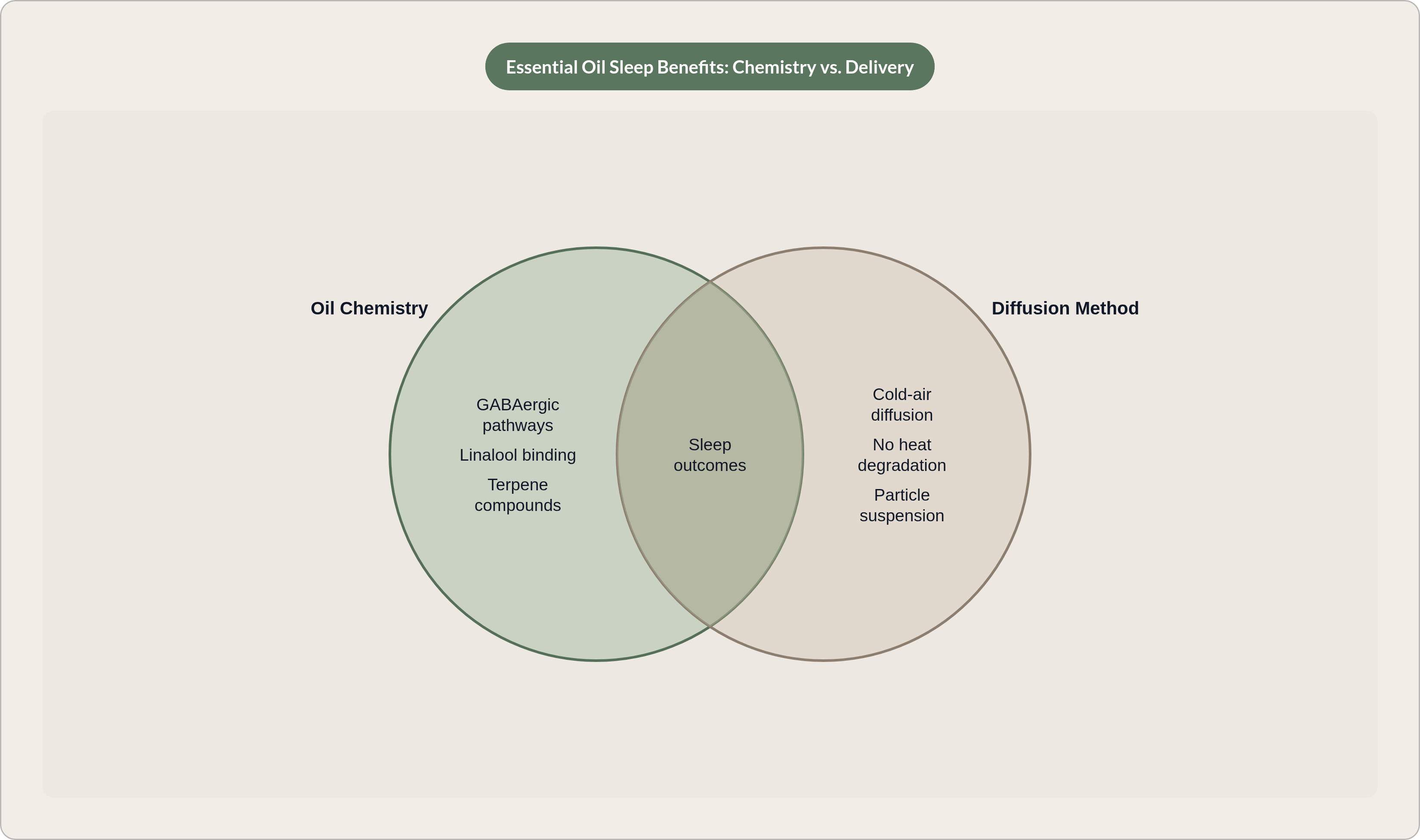
To understand why, you have to look at how smell actually works in the brain. When you inhale a scent, those molecules hit the limbic system faster than any other sensory input. Faster than touch. Faster than sound. The olfactory pathway skips steps the other senses can't skip, which is why a smell can shift your heart rate before you've consciously registered what you're smelling. Certain terpenoid compounds can cross the blood-brain barrier through the nasal route, acting on the cerebral cortex, thalamus, and limbic system directly. Some of them interact with GABAergic pathways. GABA is your nervous system's primary "settle down" signal. Common sleep medications target the same pathway. That's not a trivial overlap.
Lavender is the most studied by a wide margin. A 2026 systematic review and meta-analysis in Holistic Nursing Practice pooled 11 randomized controlled trials and 628 adult participants. Sleep-enhancing effect: statistically significant. The active compound, linalool, binds to those same GABAergic receptors. Single-scent lavender inhalation appears more effective for insomnia than mixed-aroma approaches — a finding that changes how you'd think about building a blend.
Bergamot lives mostly in anxiety and mood research. But if you've ever lain awake at 2am mentally rehearsing tomorrow's calendar, you already know that anxious thinking is upstream of sleep problems. Lavender-bergamot blends have produced measurable decreases in pulse rate and blood pressure compared to controls. A Japanese clinical trial found elderly patients using bergamot and ylang-ylang daily showed a 26% reduction in depressive symptoms, with improved sleep as a secondary outcome.
A 2025 pilot study in the Australian Journal of Herbal and Naturopathic Medicine tested a blend of ylang ylang, orange, and rosewood. Ten subjects, Pittsburgh Sleep Quality Index plus salivary cortisol, four weeks. Small sample, but clean methodology for a pilot. A 2026 narrative review of 47 studies on anxiety, depression, and stress flags chamomile, clary sage, and rose. Bergamot, cinnamon, and rosemary appear in studies tracking sleep quality and duration.
The evidence is real. It's also inconsistent across individuals. Genetic differences in olfactory receptor sensitivity, personal scent associations, psychological expectation — all of it shapes whether a given oil does anything for a given person. Treat the research as a real starting point, not a guarantee.
How Diffusion Method Shapes Whether the Benefits Actually Reach You
People buy a well-researched oil, run it through a wax warmer, feel nothing, and write off the whole category. Wrong conclusion. But it's an easy mistake when nobody on the product listing explains what actually happened.
Almost every clinical study that produced those sleep results used inhalation as the delivery route. Dispersed into air, not absorbed through skin, not ingested. That distinction matters more than most product descriptions let on.
Here's the problem with heat diffusion: it degrades terpene chemistry. The same compounds that interact with GABAergic pathways are temperature-sensitive. Run an oil over a heat plate or a candle warmer and you're cooking off the active constituents before they reach you.
Cold-air diffusion, whether nebulizing or ultrasonic (water and sound vibration, no heat), preserves the oil's active constituents. Particles stay suspended in air. That's the mechanism the studies were actually testing.
There's also a consistency argument. Sporadic use produces weaker effects. A diffuser running 30 to 60 minutes before sleep, timed to shut off, more closely mirrors the study protocols than oil dabbed on a pillowcase every few nights when you remember.
The delivery method is not a fine-print detail. It's the difference between accessing a documented benefit and just making the room smell pleasant.
The Case for Clean, Non-Toxic Oils in a Bedtime Context Specifically
Think about the actual situation here. A bedroom is an enclosed space with limited air exchange, and you're spending seven or eight hours in it. That changes the math on ingredient quality in a way that a living room used for an hour doesn't.
Some conventional fragrance products contain formaldehyde, benzene, phthalates, and parabens. These have documented respiratory and endocrine effects. Not alarmism. Just the research.
But "natural" is not a safety guarantee either. Some botanicals cause sensitization or phototoxicity. What actually tells you more is what's absent: phthalate-free, paraben-free, formaldehyde-free. Those negatives are more useful than the word "natural" on a label.
There's also a 2025 research note worth sitting with: terpenes in natural scents can react with indoor ozone to form secondary nanoparticle pollution. Even clean diffusion carries some level of risk. The profile differs from combustion-based sources, but it isn't zero. Good ventilation and reasonable diffusion duration belong in any honest protocol.
For a bedtime context, the standard worth holding fragrance to: non-toxic formulation, no combustion byproducts from the delivery method, third-party verification where you can get it. Third-party certification programs that screen out the most concerning ingredients do work that a marketing claim simply cannot.
Using Essential Oils for Sleep When Pets Share the Bedroom
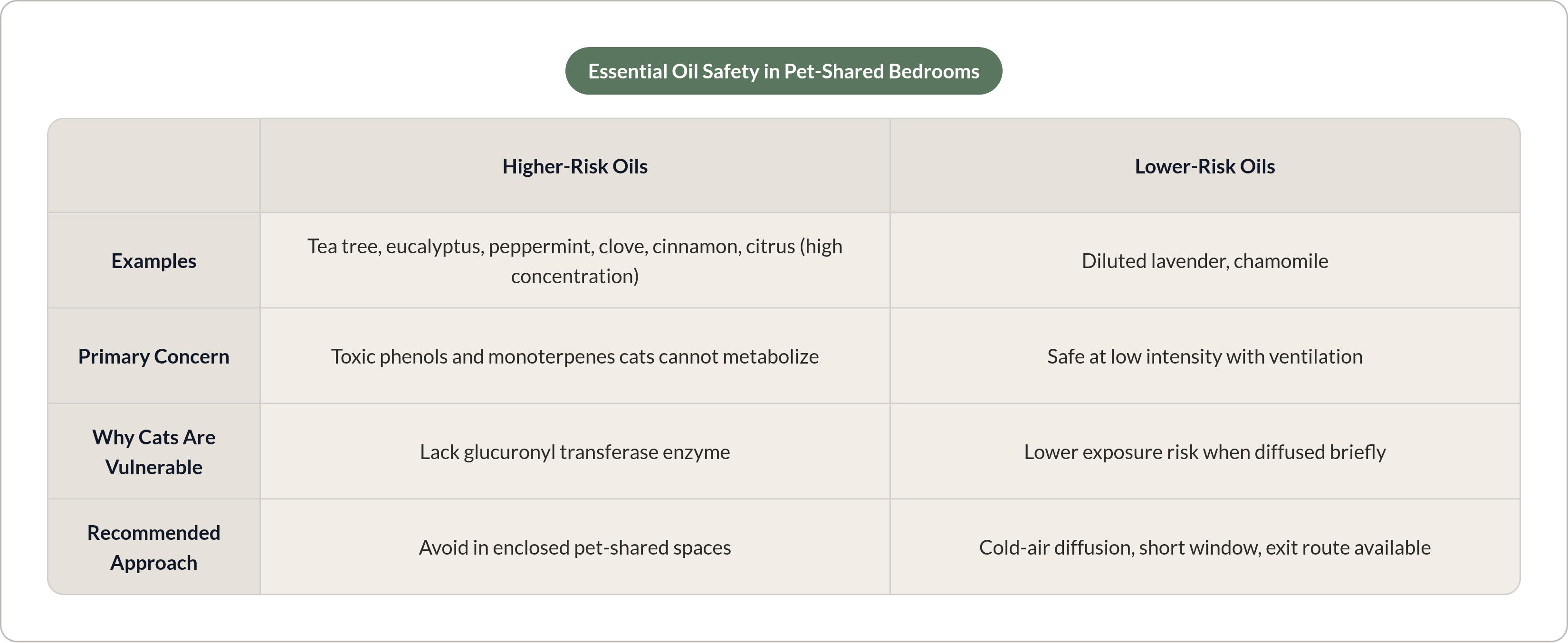
Dogs and cats metabolize compounds differently from humans. Some oils that are safe for human inhalation are toxic to pets at concentrated or direct-exposure levels. This isn't overcaution. It's just chemistry.
Cats are especially vulnerable. They lack the liver enzyme (glucuronyl transferase) needed to process certain phenols and monoterpenes. Those compounds show up in tea tree, eucalyptus, and peppermint.
Oils to avoid in pet-shared spaces:
- Tea tree
- Eucalyptus
- Cinnamon
- Clove
- Citrus oils at high concentration
- Peppermint
Lower-risk options for diffused use around pets:
- Diluted lavender (diffused, not applied to skin or fur)
- Chamomile
The operative words in that second list are "diluted" and "diffused." Direct application or concentrated inhalation is a different risk category entirely.
A workable approach: cold-air diffusion at low intensity, in a room with air circulation and an exit route for the pet, for a limited window before everyone settles in for the night. That's meaningfully different from running a diffuser sealed in a small space until morning. You don't have to choose between your sleep and your pet's safety, but you do have to think it through rather than assume "natural" means universally safe.
Building a Bedtime Scent Ritual That Conditions the Relaxation Response
This is the part most people skip, and it's where most of the long-term value lives.
The GABAergic and limbic mechanisms activate on each exposure. Repeated pairing of a specific scent with sleep behaviors does something additional: it builds a conditioned cue. Over time, the brain starts associating that scent with that state, and the scent itself begins triggering relaxation before the chemistry even has time to work. That's not a metaphor. It's how conditioned responses work.
Rotating oils randomly works against this. One scent, one window, repeated consistently — that's what strengthens the cue.
A workable structure:
- Diffuser on 30 to 60 minutes before sleep
- Paired with consistent wind-down behaviors: low light, no screens, stable temperature
- Same scent, same timing, repeated regularly
Scent memory is also deeply personal, which is something the clinical studies don't fully capture. Cedar, sandalwood, coastal air — place-based scents carry associative weight layered on top of the direct chemistry. The right sleep scent is both biological and biographical.
Consistent method, clean ingredients, conditioned timing. That's what closes the gap between interesting research and something that actually changes how you sleep.