Setting a Signature Scent for Dinner Parties and Home Entertaining
Fragrance should set the mood, not fight the food you're serving.
Your guests decide how they feel about your dinner party before the coats come off. Scent hits the limbic system faster than sight or sound, so the hallway is already doing work the entree hasn't earned yet. This piece looks at the part of hosting almost nobody plans for on purpose: how a room smells, and how you keep it from becoming a second, uninvited dish at your own table.
I got interested in this after a dinner where someone lit a candle that smelled exactly like birthday cake, frosting and all, in the dining room, of all places. Two guests asked when dessert was coming. It was short ribs. Nobody had done anything wrong exactly, the candle was probably nice in isolation, but it had picked a fight with the food and the food didn't even know it was fighting. Ever since, I've been half-consciously auditing other people's living rooms, which is either a professional habit or a mild personality flaw, I haven't decided which.
The non-negotiable constraint: the scent must never compete with the food
Food and fragrance run through the same pipeline in your brain. Your nose doesn't file "ambient room scent" in one folder and "what's coming off the roast chicken" in another; it just processes smell, and if the ambient layer gets loud enough, it steps on the thing it's supposed to be quietly supporting.
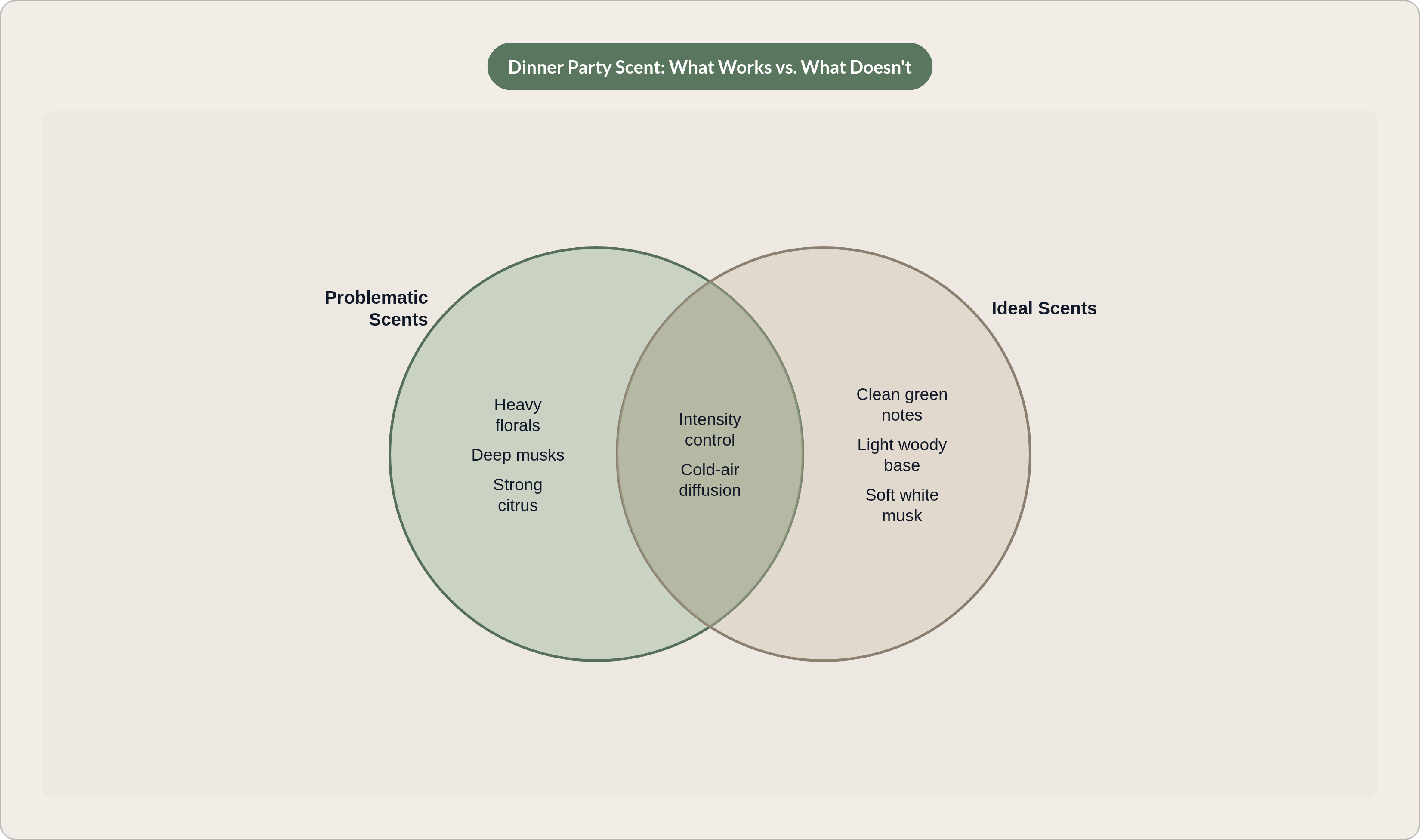
So here's the rule, easy to say and constantly broken anyway: by the time food hits the table, whatever's in the air needs to have faded to background noise. Heavy florals are the usual culprit. At dinner-table range, a big floral stops smelling like a nice room and starts smelling like perfume left on the back of a chair. Gourmand notes, vanilla, caramel, anything from the bakery aisle, cause their own kind of trouble; a dining room that smells like dessert while people are still on their entree confuses the palate fast. Deep musks and incense linger and can coat the back of the throat after an hour in a warm room. Citrus at real strength picks a fight with wine and anything acidic on the plate, and wine usually wins that argument in the glass but loses it in your nose.
What works is quieter than people expect. Clean green notes, a light woody base, a mild herbal blend, soft white musk kept low. You want the scent present enough to register and transparent enough that nobody could describe it back to you if you asked them to. Push a perfectly reasonable fragrance too hard, though, and it turns into the exact problem you were trying to dodge.
How cold-air diffusion gives a host precise control over both scent and room safety
Delivery method decides how much control you actually have. This is where most home setups fail quietly, long before anyone rings the bell.
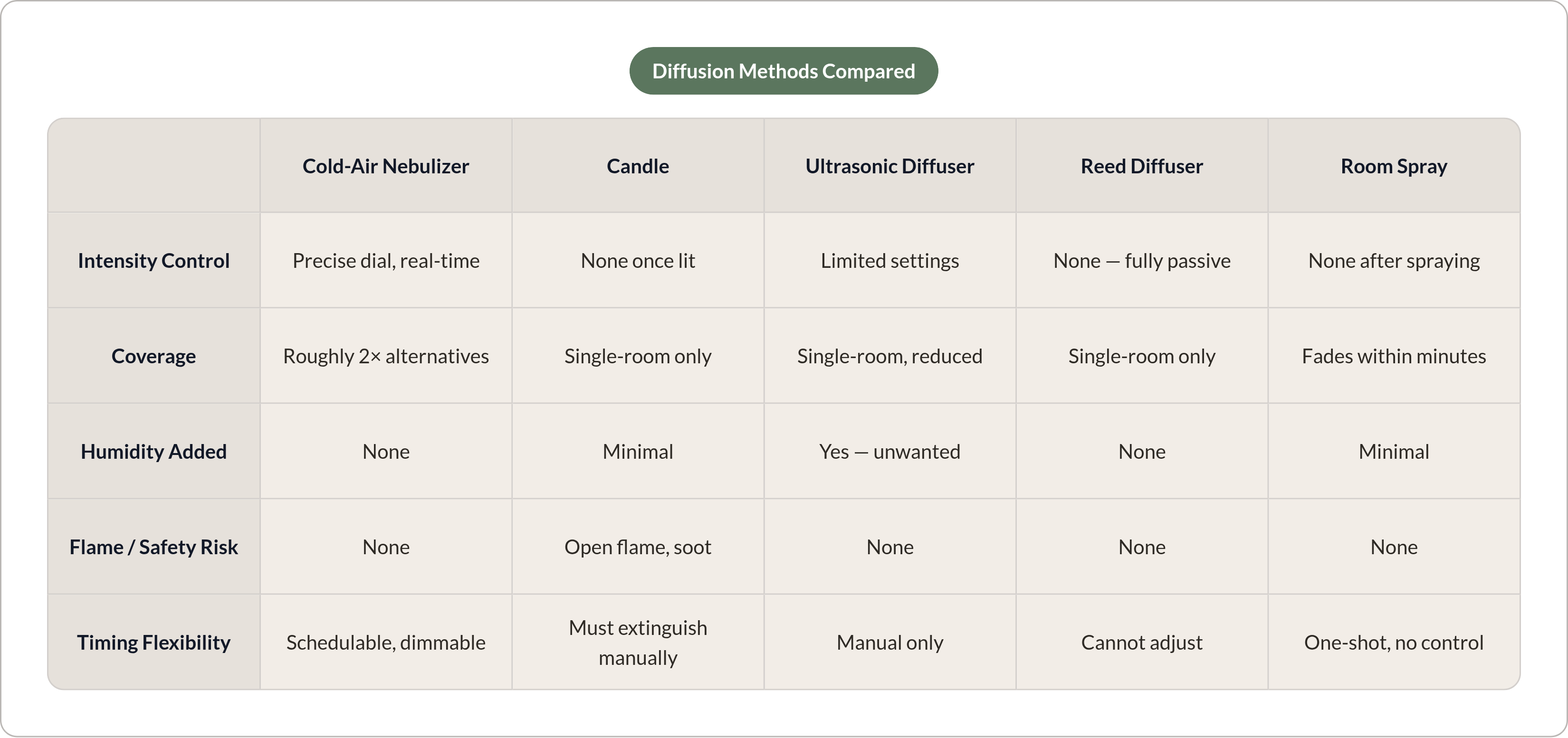
Cold-air nebulization breaks fragrance oil into microscopic dry particles with an atomizer and pushes them out on cool air, with no heat, no water, and no flame involved. That sounds like a spec sheet line until you're mid-dinner-party and realize what it buys you: crank it before guests arrive, dial it down the second food comes out, all without leaving the table or interrupting a conversation. The units run close to silent, with no hiss and no visible haze fogging up the candlelight. Because there's no water involved, you're also not adding humidity on top of body heat, wine glasses, and a room full of people already working against your hardwood floors.
Coverage is the other edge worth knowing about. Cold-air units generally cover something like twice the square footage of a candle, reed diffuser, or plug-in, so one unit handles an open kitchen-dining-living layout instead of forcing you to stack three products and hope they don't clash somewhere near the doorway. HVAC-integrated systems can handle coverage up to 10,000 square feet, which tells you more about where the ceiling sits than anything relevant to a normal house party.
Set that against the alternatives. Candles bring open flame and soot into a room full of people in nice clothes, and paraffin wax throws in its own combustion byproducts for free. Ultrasonic water diffusers dilute the fragrance and add humidity you didn't ask for. Room sprays give you a burst that's gone in ten minutes. Reed diffusers are passive by design, so once they're set, there's no dial to turn down when the entree lands, which is precisely the moment you need one.
The residential cold-air category has gotten crowded enough that there's real choice across price points now, with brands like Arozen, Scent Décor, and Viascent among others working the same corner of the market. Enough options exist that comparing a few before buying is worth the twenty minutes.
Matching diffuser placement to the arc of a dinner party
Where the unit sits matters almost as much as what's loaded into it. A diffuser tucked behind the couch doesn't distribute like one sitting at standing height near real airflow, and this is the detail most hosts skip without realizing they've skipped it.
Start at the door. The entryway is where a signature scent registers first, before anyone's taken in the living room, and that's the moment it lands psychologically, whether you planned it that way or not. Wherever pre-dinner drinks happen can run a little hotter, since that's the space where people are meant to consciously notice the atmosphere. The dining room flips the logic: lowest setting, or off, and let the scent already sitting in the air do whatever work is left.
Airflow deserves its own thought. Put the diffuser where natural circulation, an HVAC vent, an open window, ordinary foot traffic, carries the scent into the room instead of straight out of it. Park one next to a kitchen exhaust fan and you've built an efficient system for making sure nobody ever smells it. The same problem shows up in reverse if you put it directly over the dining table: concentrated diffusion right above people's plates undoes the whole point. Mid-height, a shelf, a console, a sideboard, tends to work best, roughly where people actually breathe. Floor level loses too much on the way up; ceiling height scatters it before it reaches anyone.
If guests move through multiple rooms over the night, consistency beats novelty. One fragrance at different intensities per zone reads as considered. Three different scents fighting across three rooms just reads as confusion with better lighting.
Choosing the right fragrance for the occasion, season, and menu
The best scent for a dinner party is the one nobody can name afterward. Guests should feel welcomed without ever clocking that they've been scented, which is a strange thing to optimize for, but there it is.
Season drives the first cut. Spring and summer want light herbals, green aquatics, soft citrus kept low, maybe a whisper of white floral, paired with brighter menus. Autumn and winter lean toward warm woods, cedar, soft amber, cashmere musk, matched to heavier food. Even then it's worth resisting sweet gourmand notes, since dessert shouldn't have to compete with the room it's served in, cold weather or not.
The menu deserves its own pass, too. Seafood nights should avoid marine or oceanic fragrance notes entirely; the overlap doesn't harmonize, it just muddles, so a clean green or woody profile is the safer lane. Spice-forward or aromatic cuisines run into a similar wall with heavy spice or incense-based fragrances, where the kitchen and the diffuser end up competing over the same territory and nobody wins. A transparent base note stays out of the way instead. For wine-forward evenings, intensity should sit at its lowest point during the meal, full stop, because wine appreciation depends on a neutral backdrop and there's no version of a loud diffuser that helps that along.
There's a slower payoff worth mentioning. A host who repeats the same fragrance across gatherings starts building something close to an identity, the same instinct luxury hotels follow when they commission a signature lobby scent. Guests start associating that particular smell with that particular house. Warm notes like vanilla and orange are often associated with comfort, which can be useful if the goal is putting people at ease quickly, though even those need intensity control so they don't drift into gourmand territory and start elbowing dessert out of the way.
Whatever you land on, look for fragrance oils built for cold-air diffusion that disclose their full ingredient list and skip phthalates and synthetic musks. They behave more predictably, and in a room where a dozen people breathe the same air for three hours, predictable earns its keep.
Timing the scent across the arc of the evening
Think of the night in three phases: arrival, the meal, and the wind-down after. Each phase wants a different intensity, and some of them want a different amount of attention from you.
Run the diffuser at full or moderate output for 30 to 60 minutes before anyone arrives, so the room smells lived-in instead of freshly sprayed. Hold that through arrival and cocktail hour, since the brain's response to a new space is sharpest in those first few minutes through the door. Then, before food goes out, pull it down. Olfactory adaptation, the way your nose stops registering a smell after sustained exposure, sets in relatively quickly, so if the unit has scheduling built in, program that dip ahead of time instead of trying to remember it with a wine glass in one hand and a guest mid-sentence in the other.
During the meal, keep it at the lowest setting or pause it in the dining zone altogether. The food does the aromatic work at the table now, the same rule from the first section, just showing up here as something you actually do rather than something you agree with in theory. Once people drift to the living room for dessert or a second round of drinks, bring the intensity back up a notch. That return signals a shift in pace, a small second act starting, even if nobody could tell you why they feel it.
Scheduling turns this into something that happens without you standing over it. Preset the intensity by time of night and you never have to excuse yourself from a conversation to go fiddle with a dial. Doing this also burns less oil overall, since the diffuser isn't running full blast for hours it doesn't need to.
Pet safety and clean-ingredient considerations when guests and animals share the space
A lot of dinner parties happen in houses that also belong to a cat or a dog. That changes the math some.
Ventilation comes first, whatever format you're running. A crowded room with the windows shut builds up fragrance concentration faster than most hosts expect, especially once body heat and a few hours of conversation get added to the mix. Ingredient transparency matters here beyond the usual clean-beauty marketing gloss, too. A label that just says "fragrance" tells you nothing. Full disclosure lets you actually check for known sensitizers, phthalates, or essential oil compounds flagged as risky for animals in the room.
Cats are the specific case worth knowing about. Veterinary guidance flags certain essential oil compounds as particularly risky for them, reason enough to keep essential-oil-heavy fragrances out of whatever room the cat has claimed as home base. That's reason enough to keep essential-oil-heavy fragrances out of whatever room the cat has claimed as home base. Dogs have a different problem: their sense of smell runs so far past ours that a level barely registering for a guest could overwhelm a dog stationed under the table all night, patiently waiting for a dropped short rib. Low intensity, plus one unscented room for pets to retreat to, solves most of this without much effort on your part.
Pick fragrance oils that are fully ingredient-disclosed and free of compounds flagged as risky for animals, run them low to moderate, and let the room actually breathe. That's most of it.
What guests take away: scent as the lasting impression of the evening
Smell and memory sit closer together in the brain than any other sense pairing manages. Scent and memory sit unusually close together in the brain, which is why one specific scent from one specific night can resurrect an entire evening years later, fully formed, down to who said what to whom. Nobody's dinner party needs to hit that hard. Yet it's the reason the choices in every section above matter beyond just keeping fragrance out of the entree's way; they shape what actually sticks after the dishes are done and everyone's gone home.
A signature scent, repeated gathering after gathering, starts attaching itself to the feeling of your house: warmth, generosity, care taken. It's the same trick a luxury hotel plays with a proprietary lobby scent, just smaller and considerably warmer at your dining table than in a marble lobby with a fountain in it.
Ask anyone what they remember about a great dinner party and they'll reach for something vague. It felt warm. It felt like the whole place was made for them that night. That feeling comes from more than the wine, or who got seated next to whom, though both help. Scent is usually the quiet, unnamed piece doing a disproportionate share of that work, running the whole time nobody was looking directly at it. Used well, a diffuser announces nothing; it shapes how the room feels and then gets out of the way, which is exactly what that birthday cake candle should have done and, as far as those short ribs were concerned, did not.