How to Use a Fragrance Diffuser for the Best Scent Coverage
Placement, room size, and timing matter more than the oil itself for even scent distribution.

There's a version of this where you plug in a diffuser, drop in some oil, and your home smells like a luxury hotel within minutes. That's the promise, right? And then reality: you walk into the room twenty minutes later, the diffuser is humming away, and the scent is somewhere near the unit, maybe. The rest of the room smells like your house.
Here's the thing. That gap isn't the diffuser's fault. It's almost never the oil's fault, either. It's a handful of decisions that most people skip because nobody told them the decisions existed. Placement, room sizing, run schedules, and oil formulation all play a role. Get those right, and the difference is not subtle.
Let's actually work through them.
How Cold-Air Diffusion Actually Moves Scent Through a Room
To understand why placement and timing matter as much as they do, you need a rough picture of what's actually happening inside the machine.
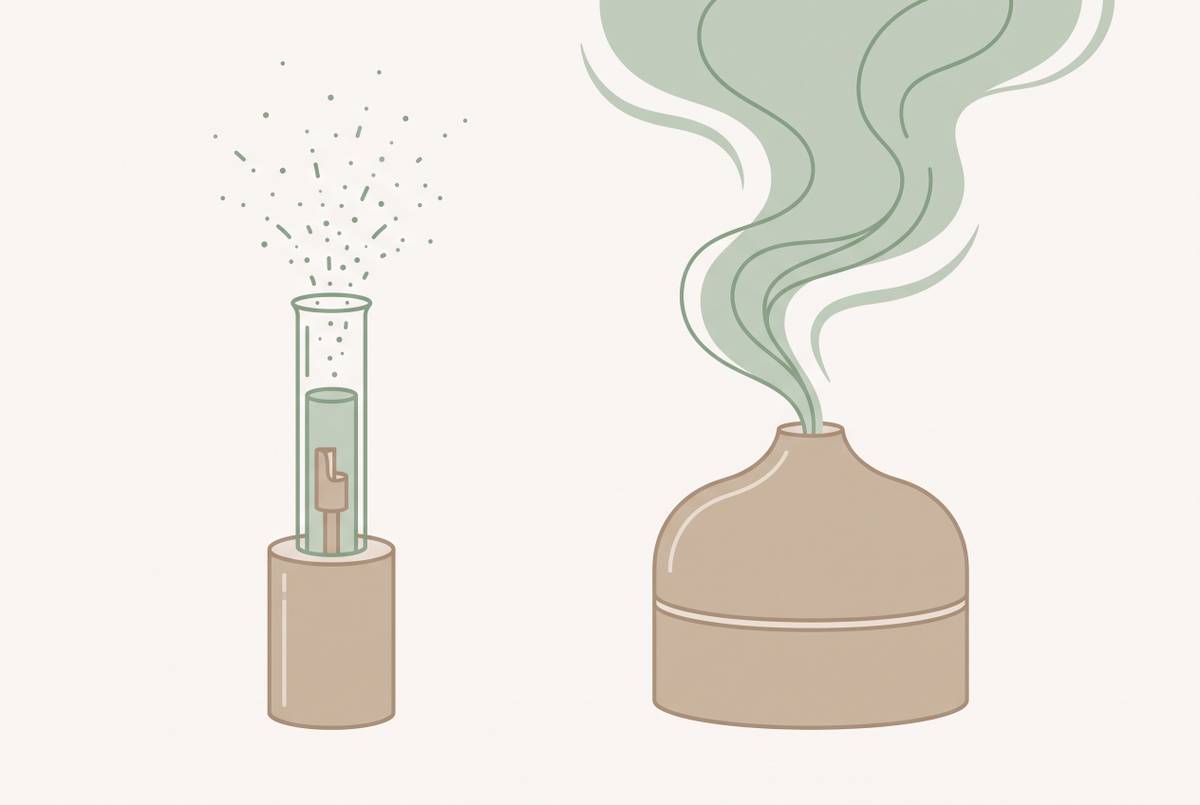
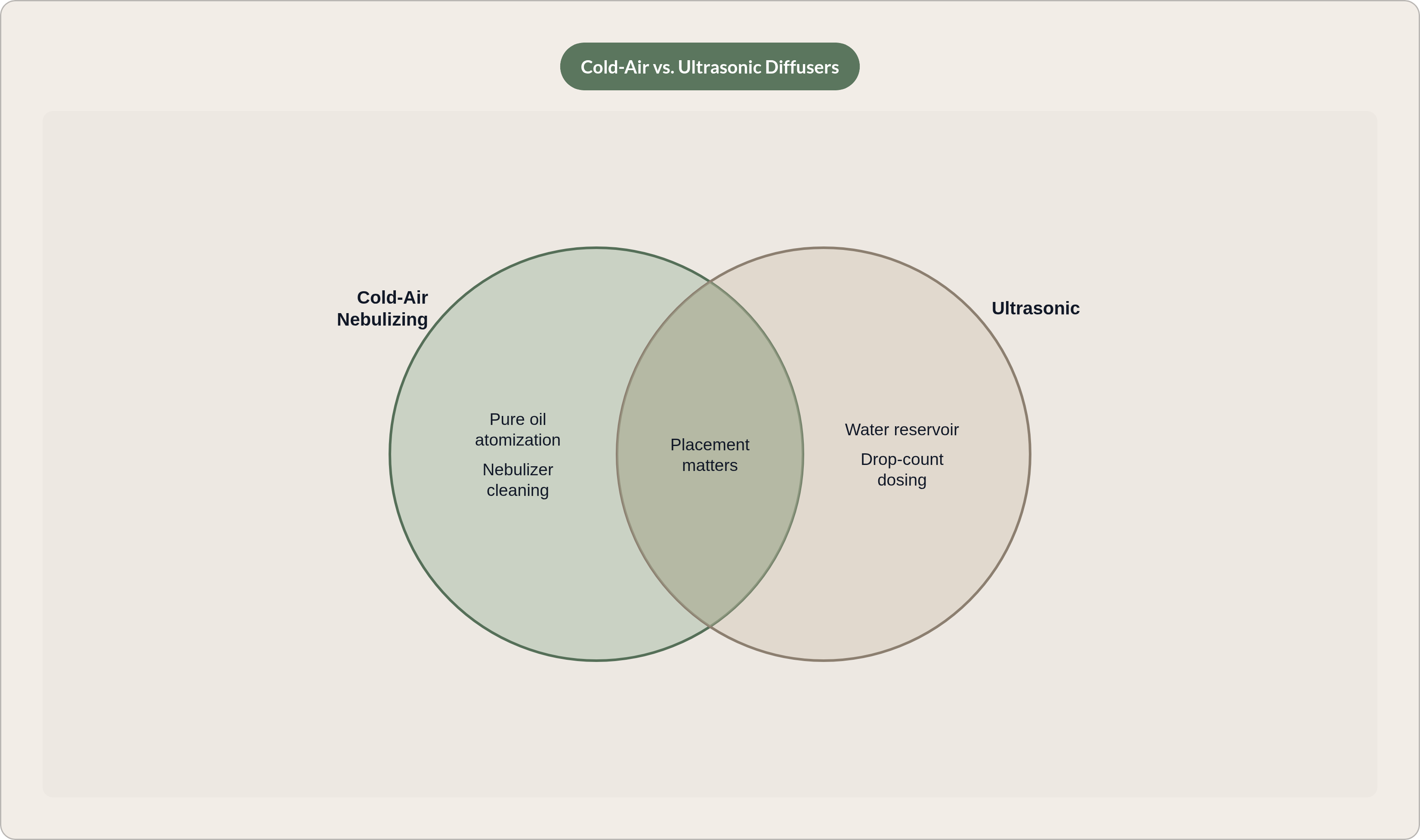
Three technologies dominate the diffuser market. Fan-based units circulate air over a scent pad. They're simple, but the scent is thin and burns off fast. Ultrasonic diffusers vibrate water into a fragrant mist. They work, but require water management, and a reservoir left sitting can grow mold. Cold-air nebulizing diffusers are different. They use air pressure to atomize pure fragrance oil into ultra-fine dry particles. No heat, no water dilution.
Why does that matter? Because heat and water both change the fragrance. Heat can alter the chemical structure of certain aromatic compounds. Water dilutes the concentration before it ever reaches the air. Cold-air diffusion sends the oil into the room essentially intact. The dry micro-particles stay suspended longer and travel farther than wet mist does.
Here's the physics piece that actually drives the placement decisions later in this guide. Because the particles are dry and extremely fine, gravity isn't really the main force acting on them. Airflow is. Which means the shape of the scent cloud in your room is mostly determined by how air is already moving in that space, not by where the diffuser is pointing.
That said, one honest caveat. Cold-air diffusion is especially powerful in medium-to-large spaces. In a very small, enclosed room, the concentration can tip from ambient into overwhelming. That's not a defect. It's physics. A small room just needs less output.
Matching Diffuser Output to Room Size Before Doing Anything Else
Before you touch placement, do this first.
Every cold-air diffuser has a rated coverage area. That number is a specification, not a suggestion. Running an under-powered unit in a large room is the single most common reason scent feels weak or uneven. It's almost never the oil.
A few things people get wrong here:
- Match the diffuser to the room, not the house. A unit rated for 800 square feet doesn't cover an 800-square-foot floor plan if you're running it in one room with the door closed. It covers the space where the air actually circulates.
- Open-plan spaces count as one zone. A kitchen that opens into a living area functions as a single coverage calculation. A connected hallway is a separate one.
- "Coverage" doesn't mean equal intensity everywhere. It means the scent is detectable and pleasant at the farthest point from the unit. Some gradient is normal.
A practical test: if scent is strong near the diffuser but essentially absent across the room, try sizing up before changing anything else. Adjustable output settings on most cold-air units can help you compensate slightly for high ceilings or very open layouts. But adjusting output is fine-tuning. It's not a replacement for the right unit in the first place.
Where to Place a Diffuser So Scent Reaches the Whole Room
Okay, so you have the right sized diffuser. Now where does it go?
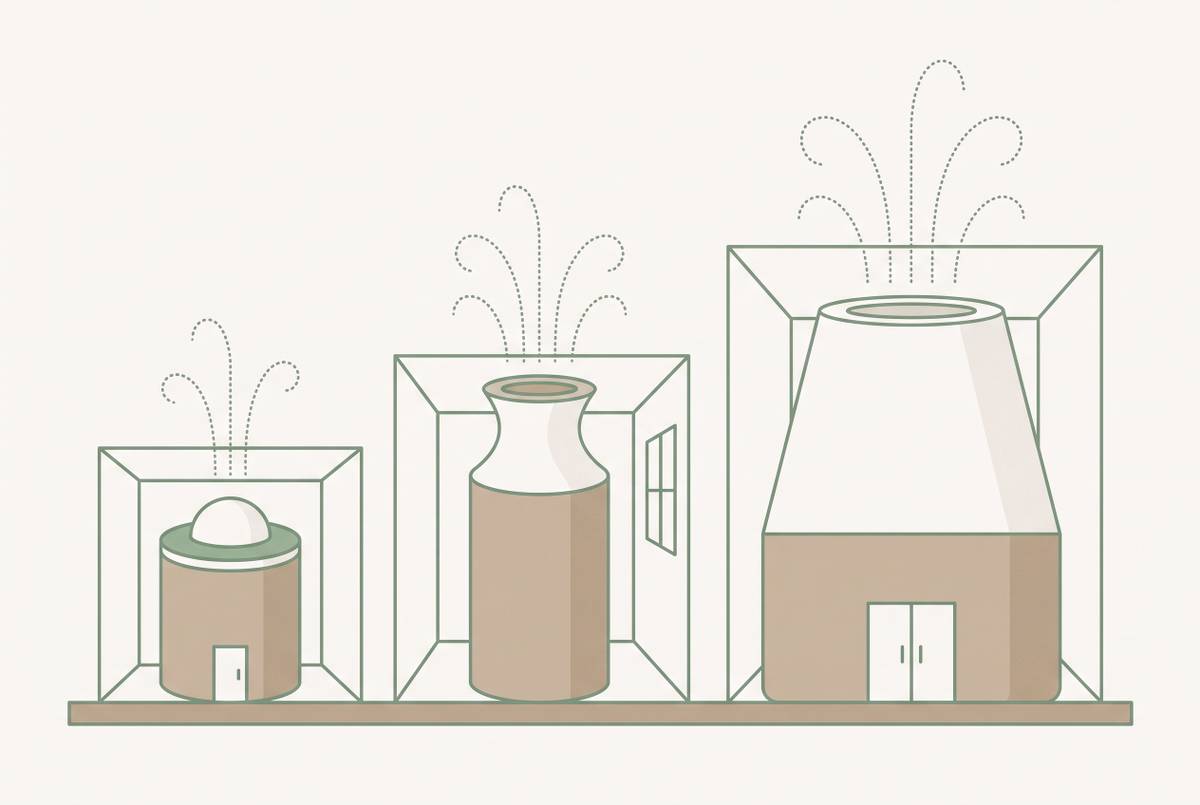
Height first. Elevated placement on a shelf, a console table, or a side table works best. The micro-particle mist descends and circulates naturally when it has somewhere to fall from. Put the diffuser on the floor and the scent stays low and localized. It's not wrong, exactly. It just wastes most of what the unit is doing.
Airflow second. Remember: in cold-air diffusion, airflow is the dominant transport mechanism. Existing air circulation in the room (from an HVAC vent, a ceiling fan, even a doorway) will carry the scent further and distribute it more evenly. But there's a version of this that backfires. Place the diffuser directly in front of a vent, and the airflow blasts the scent out of the room before it has a chance to disperse. You want to use the airflow, not fight it. Position nearby, not flush against it.
Center versus corner. Center placement gives you even radial distribution. Corner placement concentrates scent in one zone. Neither is wrong. They serve different goals.
A few room-specific notes that save a lot of trial and error:
- Entryway: Near the front door, not flush against it. A high shelf creates an immediate impression when someone walks in.
- Bedroom: Nightstand or dresser, away from the bed's direct airflow. Present, not overwhelming.
- Living room: Mid-height on a media console or bookshelf, positioned to broadcast toward seating. If it's aimed at the wall, you're losing it.
- Home office: At desk height or slightly above, to one side. You want it in the space without sitting directly in your breathing zone all day.
One more thing. Open windows near the diffuser will vent fragrance out rather than in. Obvious in hindsight, but less obvious when you're troubleshooting why the room doesn't smell like anything. An interior door left slightly open, on the other hand, lets scent drift into adjacent spaces. That one tends to work in your favor.
If coverage is disappointing after getting placement right, look at airflow before adding more oil.
How to Dial In Oil Concentration and Run Time Without Overshooting
This is where most people go sideways. More is not more.
Cold-air diffusers use undiluted fragrance oil. Concentration is controlled through the diffuser's output setting and run schedule, not drop count. That's a meaningful difference from ultrasonic units, where you're literally adding drops to water. If you're still using an ultrasonic diffuser: a small tank around 100 mL, start with two to four drops; a medium tank in the 200 to 300 mL range, four to eight drops. Wait ten minutes before deciding you need more. Patience first.
For cold-air units, the variable is timing. And here's where nose blindness becomes the hidden saboteur.
The human nose adapts to a continuous scent after roughly 15 to 20 minutes of exposure. The room that smells perfect to a guest who just walked in? You've stopped noticing it. That's not a sign the diffuser stopped working. It's a sign your nose did its job. The instinct to add more oil at that point is almost always wrong.
The practical fix is intermittent scheduling. Running a cold-air diffuser on something like a 30-minutes-on / 30-minutes-off cycle does two things. It preserves your nose's ability to detect the scent when the unit cycles back on. And it extends oil life significantly. Most modern cold-air diffusers have built-in timers. Aura House diffusers, for example, include adjustable intensity and timer settings. The point isn't the specific product. It's that the technology is designed for calibrated, intermittent use. Continuous blasting is not the intended mode.
Two more calibration notes:
- In warm months, fragrance molecules volatilize faster. You may need less output than you'd expect.
- In winter, drier indoor air can make scent feel flatter. A modest bump in output compensates.
Choosing a Fragrance Oil That Performs Well in a Diffuser, Not Just a Bottle
Smell a fragrance in the bottle and decide you love it. Put it in a cold-air diffuser and get something duller, shorter-lived, or just wrong. This happens more than it should.
Not all fragrance oils are formulated for cold-air diffusion. Oils with heavy carrier bases or thick viscosity don't atomize cleanly. They can clog nebulizers over time, and they produce a weaker scent throw because the delivery mechanism can't break them down into fine enough particles.
Note structure matters too. Top notes (citrus, light florals) hit first but disperse quickly. Heart and base notes (woods, musks, resins) build and linger. A well-blended oil gives you a full arc. A poorly composed one gives you a burst of citrus and then nothing. When you're evaluating an oil for diffuser use, you're really asking: does this have staying power, or is it front-loaded?
Then there's the formulation question. And this one is worth taking seriously, especially if you're diffusing in a bedroom or a home office where you're in the space for hours.
Regulations allow a long list of compounds to be grouped under the single word "fragrance" on a product label. Per peer-reviewed research, this includes phthalates linked to hormone disruption and various volatile organic compounds. None of them need to be individually disclosed. Indoor VOC concentrations can already run significantly higher than outdoor levels. What you diffuse directly affects that number.
Phthalate-free, VOC-conscious oils with transparent ingredient lists atomize more consistently because the aromatic molecules aren't competing with inert chemical filler. If you have pets or children in the home, this isn't optional.
A third-party certification, like Sephora Clean, provides a benchmark you don't have to evaluate yourself. It's a starting point for knowing what you're actually putting into the air.
Matching Scent to Room Function to Get the Mood Effect You Actually Want
Here's the part that feels softer but is actually grounded in pretty solid science.
Smell connects to the limbic system faster than any other sense. That's the brain's memory and emotion center. Which is why a fragrance can shift the register of a room within minutes, not hours. This isn't aromatherapy marketing. It's neurology.
And there's clinical backing for the specific applications. A randomized controlled trial published in Frontiers in Psychology found lavender essential oil reduced anxiety symptoms by 32% in patients awaiting surgery. A 2025 study found rosemary and peppermint in office environments improved memory recall and alertness by 18 to 20%. These aren't anecdotes.
That raises an important question. If scent has real functional effects, shouldn't the choice of scent track the function of the room?
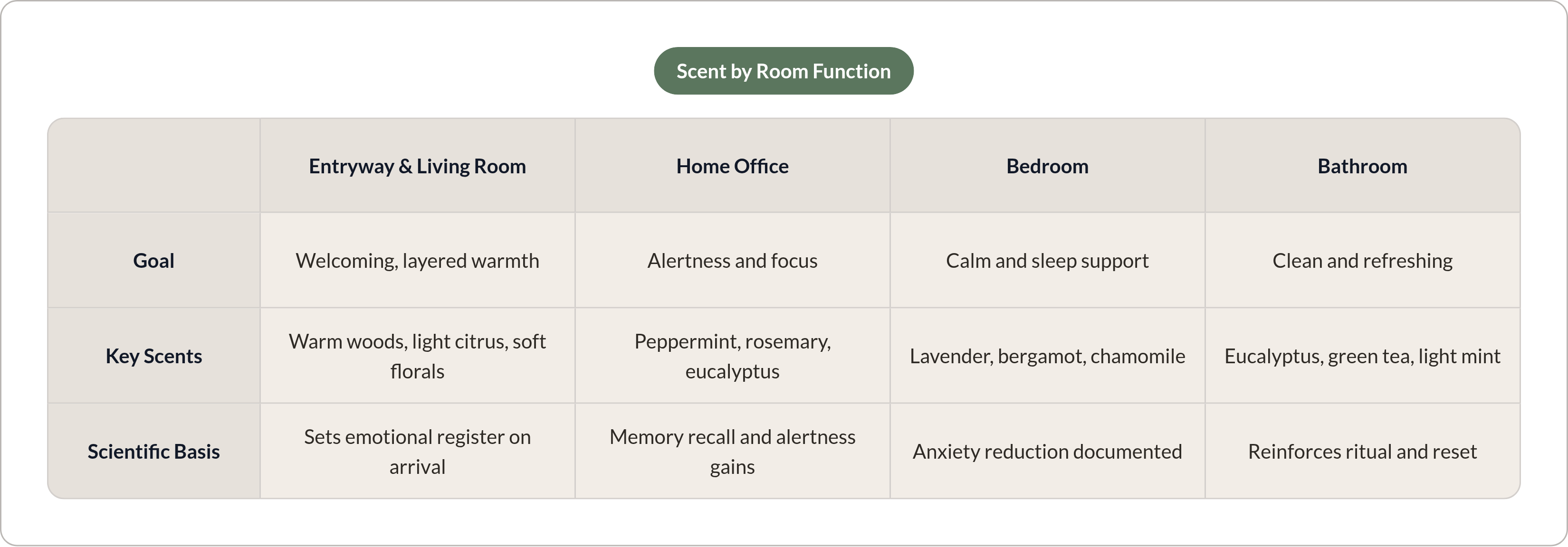
Here's how that logic plays out:
- Entryway and living room: Welcoming, layered. Warm woods, light citrus, soft florals. Sets the emotional register for the whole home.
- Home office: Alertness-supporting. Peppermint, rosemary, eucalyptus. The memory and alertness research applies directly here.
- Bedroom: Calming, sleep-supportive. Lavender, bergamot, chamomile. The anxiety-reduction finding is directly relevant.
- Bathroom or spa zone: Clean and refreshing. Eucalyptus, green tea, light mint. Reinforces the sense of ritual and reset.
Destination-inspired fragrance collections do a lot of this work for you. An oil built around a coastal morning or a mountain lodge already has a mood architecture built into the blend. Rotating scents by season or time of day also extends your nose's sensitivity. A home that always smells the same eventually smells like nothing.
Keeping a Diffuser Running Well So Coverage Stays Consistent Over Time
Everything above works until the diffuser starts performing worse than it used to. Then people assume something is wrong with the oil.
Usually, it's the nebulizer.
Residual oil builds up in the atomization chamber over time. That buildup narrows the output, reduces particle production, and drops scent throw noticeably. The diffuser isn't broken. It needs cleaning.
A brief alcohol flush between oil changes handles most of this. It prevents cross-contamination between scents and keeps atomization consistent. The minimum is a wipe-down after each oil changeover. At higher use intensities, more frequent cleaning pays off.
A few other things that quietly affect performance over time:
- Changing oils: Let the diffuser run briefly on the new oil before evaluating coverage. The transition period isn't representative.
- Room layout changes: Furniture rearrangement and seasonal HVAC shifts alter airflow. What worked in one layout may need adjustment after you move things around.
- Oil storage: Fragrance oils degrade with UV exposure and heat. A cool, dark location preserves the aromatic compounds that drive both mood effect and diffusion performance.
Simple diagnostic: if a well-placed, right-sized diffuser suddenly feels weaker without any other change, clean the nebulizer before assuming the oil is the problem.
But the hardware and the oil are only as good as the setup around them. Get the room sizing right. Get the placement right. Schedule intermittent runs. Choose oil formulated for the delivery method. Those decisions compound. And once they're dialed in, you stop troubleshooting and start just enjoying the room.