Gifts for Relaxation and Stress Relief Under Fifty Dollars
Scent science shows why diffusers beat candles for delivering calm on a budget.
Most sensory information takes a detour through the thalamus before the brain processes it. Scent skips that entirely. It connects directly to the limbic system, the part of the brain that handles emotion and memory, faster than any other sense. That's why a familiar smell can shift your mood before you've even registered what you're smelling — scent is the only sense that doesn't knock before it enters.
This isn't folk wisdom. Published research in the Public Health Policy Journal has documented how essential oils stimulate neurotransmitter release and activate the autonomic nervous system. Lavender has one of the stronger bodies of evidence behind it. A PubMed review found support for lavender-based aromatherapy reducing anxiety across multiple groups: nursing students, pre-surgical patients, people in clinical settings.
But not all scents work the same way for everyone. Meta-analysis data suggests women tend to respond more strongly to floral and sweet scents for emotional relief, while men report greater calming from woody or musky notes. That distinction is actually useful when you're choosing something for a specific person, not just grabbing whatever's in stock.
A rough working guide:
- Wind-down: lavender, chamomile, eucalyptus
- Energy and focus: citrus, peppermint, rosemary
- Grounding and calm: sandalwood, cedarwood, vetiver
The scent choice matters. So does how you deliver it. Those two things are more connected than most people realize.
What "Clean Fragrance" Actually Means and Why It Matters at This Price Point
"Clean fragrance" is one of those phrases that gets stretched in every direction depending on who's using it. At its core, it means formulations free of phthalates, parabens, artificial colorants, and other flagged synthetics. Transparent labeling. You should be able to read the ingredient list and understand what's actually in the product.
Why does this matter for a $40 gift? The Environmental Working Group has raised concerns about toxic compounds in conventional fragrance products. Standard air fresheners and cheap fragrance oils often rely on synthetic ingredients that aren't fully disclosed. You might shrug at that for yourself. But if the person you're giving this to has pets, kids, or any respiratory sensitivities, it stops being a wellness footnote and starts being a real consideration.
What to look for on the label:
- Phthalate-free
- Paraben-free
- Plant-derived or natural-based ingredients
- Full ingredient disclosure (not just the word "fragrance" listed alone)
One useful shorthand: Sephora Clean is a retailer-created certification that signals transparent formulation. It's not the only signal worth trusting, but it has consistent standards and it's easy to spot. Clean indie fragrance brands now compete effectively in the under-$50 range, which wasn't really true five years ago. Premium clean fragrance no longer requires a premium price. That matters when you're working within a real budget.
Why a Diffuser Outperforms a Candle as a Stress-Relief Gift
Candles are nice. This isn't an argument against candles. But when you give someone a candle, what are you actually giving them?
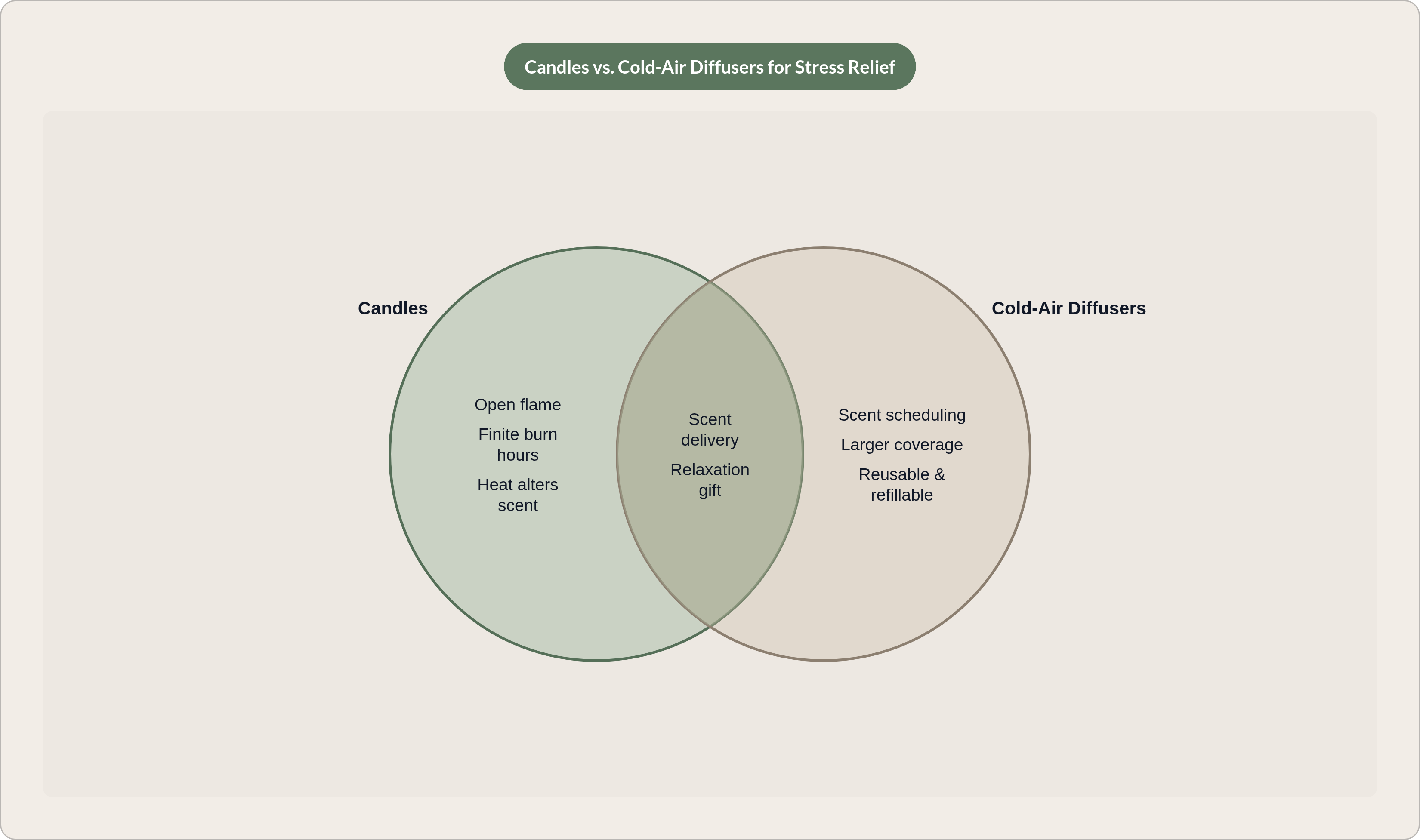
A finite number of burn hours. An object that requires active supervision because it's an open flame. And here's the part that tends to get skipped over: heat alters the chemical composition of fragrance oils. You're not necessarily getting the full scent profile you chose. Some of the compounds that give lavender its calming properties get degraded in the process. The warmth of a candle is real. Some of what you paid for isn't making it into the room.
Cold-air diffusion works differently. It atomizes oil using pressurized air, no water, no heat, no alcohol. The oil enters the air largely intact. If you chose lavender because lavender has demonstrated calming effects, you want those compounds preserved, not burned off before they reach anyone.
There are practical advantages beyond the chemistry:
- Coverage: Cold-air diffusers can scent significantly larger spaces than candles or reed diffusers.
- Consistency: The mist is dry and even, with no humidity concerns for wood floors, art, or electronics nearby.
- Control: Smart-connected models allow scent scheduling and intensity adjustment. Nose-blindness is real. You stop noticing a familiar scent after extended exposure. A timer handles that automatically.
Entry-level cold-air diffusers now sit within the under-$50 range. That's a relatively recent shift in the market, and it puts the technology directly in reach for this budget.
The gifting logic is simple once you see it: a diffuser is reusable, refillable, and creates a daily habit the recipient returns to on their own. A candle burns down. A diffuser sticks around.
The Best Scent-Forward Relaxation Gifts Under Fifty Dollars
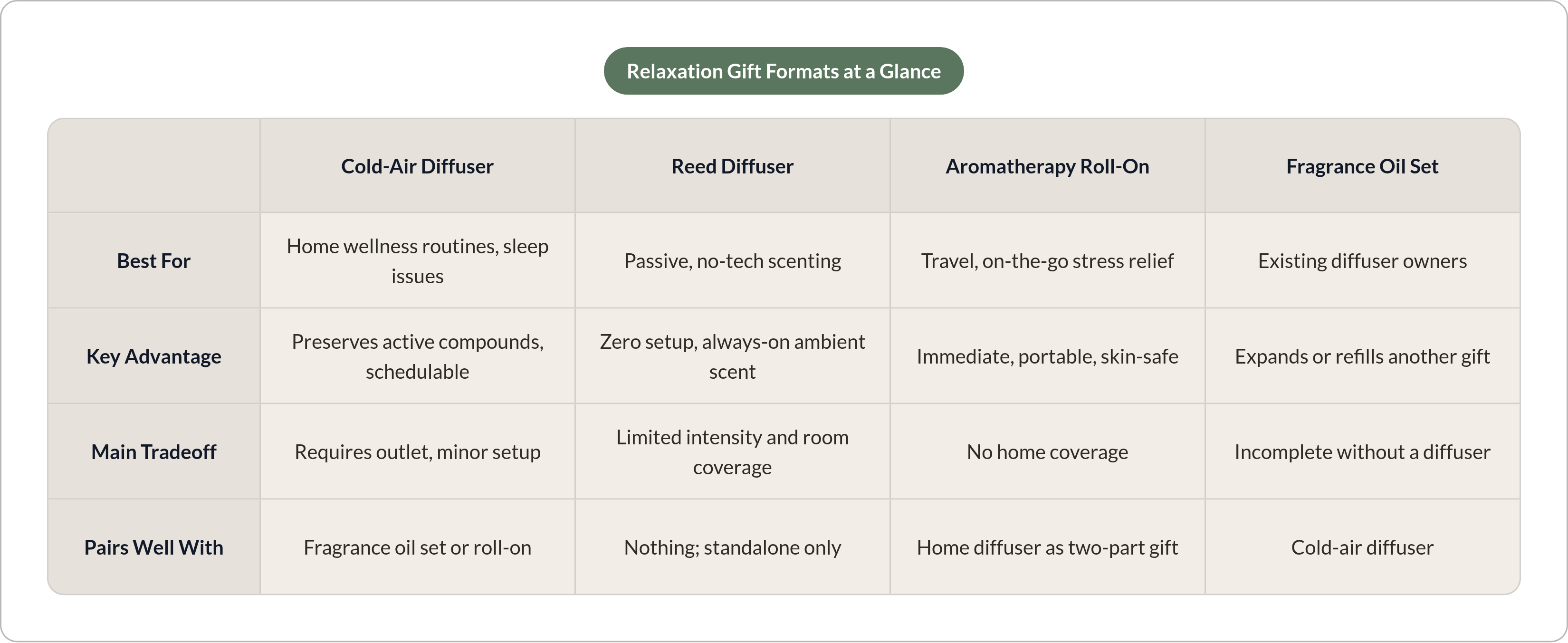
"Best" depends entirely on who's receiving it, so here's a breakdown by format and use case rather than a ranking.
Cold-Air Home Diffusers
Who this suits: Anyone building a home wellness routine, work-from-home setups, people dealing with sleep issues or ambient anxiety.
Entry-level cold-air nebulizing diffusers are the format to prioritize. Simple plug-in models exist under $50 with no app required. Smaller coverage area, but a solid starting point for someone new to the format. For a recipient ready for more, smart-connected models with scheduling and intensity control deliver a meaningfully different experience. Some options in this category pair cold-air technology with clean, phthalate-free fragrance oils and a vegan and cruelty-free certification, and certain brands donate a portion of sales to mental health services.
Fragrance Oil Sets and Refills
Who this suits: Recipients who already own a diffuser, or as a companion to a diffuser gift.
Essential oil starter sets built around lavender, eucalyptus, and chamomile are widely available at accessible prices. These are among the most-studied options for anxiety reduction and sleep support. One thing to avoid: anything labeled "fragrance oil" without a phthalate-free claim or ingredient disclosure. If the label just says "fragrance," that's a flag.
Reed Diffuser Sets
Who this suits: Recipients who prefer a no-tech, passive option, or live in smaller spaces.
Clean versions with natural-based carrier oils and phthalate-free fragrance exist at modest price points. The tradeoff is real, though. Less intensity control, no scheduling, slower to fill a room. For someone who wants ambient scent with zero setup, this works. For someone who wants consistent therapeutic effect across a full room, it's a secondary choice.
Aromatherapy Roll-Ons and Personal Inhalers
Who this suits: The traveler, the commuter, the person whose stress happens outside the home.
Portable and immediate. Lavender and chamomile blends in skin-safe carrier oil bases are among the most-studied for on-the-go anxiety relief. Often available in gift-ready sets at low price points, and they pair naturally with a home diffuser as a two-part gift that covers both contexts.
Relaxation Teas and Herbal Bath Sets
Who this suits: Recipients with scent sensitivities who can't use fragrance products.
Chamomile, valerian, and ashwagandha blends are useful and widely available. These are consumable, one-time treats. They're the right answer for a specific recipient. They're not a default.
Weighted Eye Masks and Acupressure Tools
Who this suits: A complement to a scented environment, not a standalone stress-relief gift.
Some eye masks include lavender inserts, which pairs nicely with a diffuser gift. Under $30 widely. Think of these as add-ons rather than the main event.
How to Match a Relaxation Gift to the Specific Person Receiving It
Most gift-givers stop thinking too early. Before you click buy, run through these:
- Do they have pets or young children? Clean, phthalate-free fragrance becomes non-negotiable. Some essential oils are harmful to cats and dogs at certain concentrations. Fully disclosed, plant-derived formulations are the only safe call.
- Do they live with others? A scent one person finds calming can feel overwhelming to a housemate. Mild, broadly liked options like lavender, cedarwood, and eucalyptus are safer bets than bold or niche blends.
- How large is their space? A cold-air diffuser in a studio apartment behaves very differently than in an open-plan home. Coverage range matters. Check it before you buy.
Beyond the logistics, think about how this person actually experiences stress:
- The candle person: A cold-air diffuser is a meaningful upgrade, not a duplicate. Frame it that way when you give it.
- The chronic overthinker or poor sleeper: A lavender-forward oil set paired with a diffuser, with a note about scent scheduling at bedtime. You're giving them a ritual, not just a product.
- The WFH recipient: Rosemary or peppermint for focus during the day, a calming blend for end-of-day decompression. Two moments, one gift.
- The traveler: An aromatherapy roll-on or personal inhaler paired with a home diffuser covers both contexts.
One more thing. Include a brief handwritten note explaining the scent's intended effect. Calm. Focus. Sleep. That one sentence transforms a fragrance gift from "something that smells nice" into "something chosen specifically for me." It's a small move that changes how the whole gift lands.
What Makes a Relaxation Gift Last Beyond the First Week
Most relaxation gifts don't stick. And the reason is pretty consistent: they sit outside the recipient's existing routine instead of slotting into it. Think of it like a houseplant placed in a room nobody enters — no matter how carefully you chose it, it quietly gets forgotten.
Think about what already happens in someone's day. Coming home. Getting ready for bed. Sitting down to work. The gifts that keep getting used are the ones that attach to those existing moments. They don't demand a new behavior. They make something the person already does slightly better.
Scent is well suited to this because it's ambient. It works without demanding attention. You don't have to remember to use it if it's already running. That's why the scheduling function on a smart diffuser matters more than it sounds on paper. It's the difference between a ritual that sticks and one that fades after two weeks because the recipient kept forgetting to turn it on.
One device can cover multiple moments in the same day:
- Morning: citrus or rosemary to support alertness
- Midday reset: peppermint or eucalyptus for focus
- Bedtime wind-down: lavender or chamomile on a timer
The same diffuser serves all three. Its value compounds over time rather than burning down.
Refillability matters for the same reason. A gift that can be replenished keeps going. Fragrance oils are a natural follow-on that extends the original gift months later. Aura House, a clean home fragrance brand, pairs its cold-air diffusers with non-toxic, vegan oils designed for exactly this kind of ongoing use. The $40 diffuser you gave in December is still part of someone's morning routine in April. For a gift in this price range, that's unusual. Most things you buy for $40 are long forgotten by then.