Best Scent Diffuser for Home Offices and Small Rooms
Waterless diffusers and proper sizing make small spaces smell pleasant without overwhelming the air.

Picking the best scent diffuser for a home office or small room comes down to four decisions: coverage match, diffusion technology, noise level, and intensity control. Get those four right, in that order, and a compact space smells consistently pleasant.
Why small rooms make diffuser selection harder, not easier
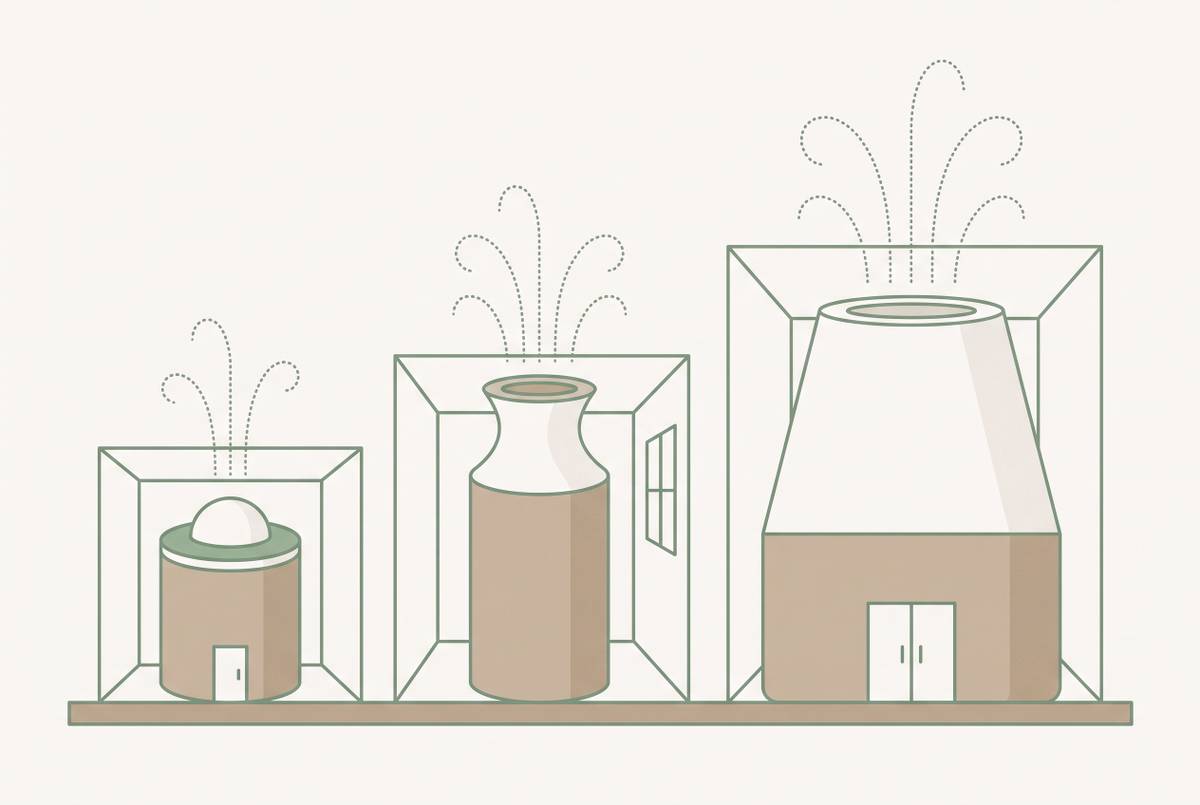
A 400-square-foot living room forgives mistakes that a 150-square-foot office will not. Fragrance concentrates faster in a small, enclosed volume of air, so the gap between "pleasant" and "I need to step outside for a minute" shrinks to almost nothing. That narrow margin is what most diffuser advice fails to account for, because most of it is written with open floor plans in mind. Four decisions resolve this: how much space the diffuser needs to cover, what diffusion technology it uses, how much noise it makes while running, and how finely its intensity can be adjusted.
Matching diffuser coverage to a home office or small room
Coverage rating is the specification to check first, because it decides whether everything else about the diffuser even has a chance to perform. Neither mistake is minor, and both come from treating coverage as a hard constraint that the device's rated specification defines.
The practical rule, when a room falls between two rated coverage levels, is to size up and run the device at a lower intensity setting. For a typical home office, a small bedroom, or a studio alcove, anything under roughly 200 square feet, the target is a diffuser rated for that footprint running at a moderate setting, not a whole-home unit dialed down to its lowest notch. A whole-home diffuser at minimum output is still a whole-home diffuser, engineered around a different airflow problem.
Square footage alone doesn't finish the job, either. Two rooms with the same number on the floor plan can behave completely differently once a diffuser is actually running in them, so square footage sets the starting point, and layout adjusts it from there.
How diffusion technology determines scent quality
The mechanism inside a diffuser doesn't just move fragrance into the air; it decides whether what reaches the air is a faithful copy of what's in the bottle. In a small room, any degradation in that fidelity is obvious almost immediately, because there's no volume of air to dilute a flat or muddy scent profile.
Cold-air nebulizing diffusers atomize pure fragrance oil into a dry micro-mist using air pressure alone, with no water and no heat involved anywhere in the process. Heat-based and ultrasonic methods, by contrast, mix oil with water before dispersing it, and that mixture changes the fragrance before it ever leaves the device: water dilutes concentration, and heat breaks down the more volatile top notes that give a scent its initial character.
Ultrasonic diffusers remain the most common affordable entry point, and they deserve a fair hearing. In a small, enclosed workspace occupied daily, a maintenance gap of even a few days has real consequences for the air a person is breathing at a desk. A waterless cold-air device sidesteps the problem by removing the reservoir entirely: no standing water means nothing for mold or bacteria to grow in and nothing to aerosolize into the room.
For anyone managing allergies, asthma, or chemical sensitivities, that waterless mechanism also removes concerns about mineral deposits and steam that are built into water-based designs.
Noise level in a working environment
A diffuser in a home office runs next to video calls, deep-focus work, and sometimes an afternoon nap on the office couch, so noise is not a comfort preference but a functional requirement. Ultrasonic diffusers generate sound from a vibrating plate, usually described as a low hum or a form of white noise. Others find it crawls right into the microphone during a call.
Testing at Homes & Gardens measured the Asakuki ultrasonic diffuser operating below 23 decibels, a level the tester called audible in a quiet room but close enough to silent not to notice during normal use. No other model in that same roundup reported a figure below 20 decibels, so the Asakuki's sub-23dB rating stands as the quietest documented result in that comparison. That tells buyers ultrasonic diffusers can run quietly at the low end of the market, though the noise floor isn't zero and it varies meaningfully between models.
Waterless cold-air diffusers use air pressure atomization instead of a vibrating plate, and that mechanical difference tends to produce less operating noise at comparable output levels, a real advantage for a device sitting a few feet from a desk. That said, a 2026 roundup of home office scent machines found that waterless diffusers aren't automatically quieter than their water-based counterparts: noise depends on the specific model and the specific technology inside it, and some entry-level waterless units trade quiet operation for a narrower range of intensity settings.
A decibel figure on a spec sheet also tells only part of the story. It describes peak operating noise, not the character of the sound, and a low-frequency hum at 22 decibels can prove more distracting on a call than a higher-pitched but intermittent sound rated at the same level. The number is a starting point for comparison, and independent notes on sound character are worth weighing alongside the stated dB figure.
Intensity control in a small room
A diffuser can be sized correctly, built on the right technology, and whisper-quiet, and still fail in a small room if it has no way to turn itself down. Coverage, technology, and noise set the stage; intensity control decides whether the performance on that stage actually works for the room it's in.
The same oil that smells balanced on a medium setting in a 150-square-foot office can turn cloying within thirty minutes if the device has no way to reduce how often or how strongly it releases fragrance. A living room has enough air volume to absorb that kind of overrun. An office does not. Adjustable output, in other words, isn't a convenience feature tacked onto the higher-end models; in a compact enclosed room, it's close to a requirement.
The most useful forms of that control for home office use are programmable schedules and intermittent cycling, which let a diffuser run in timed bursts. The practical value of scheduling goes beyond comfort, too. Running a device in bursts rather than nonstop also cuts down on oil consumption, a real cost consideration for something operating eight or more hours during a workday. For buyers who don't need full app integration, built-in intermittent cycling, on and off timed mist modes, offers a lower-cost version of the same protection against oversaturation, and some ultrasonic models include it even at entry-level prices.
The four decisions converge on one class of device: a compact, waterless cold-air diffuser with programmable output, sized to the room. That's the standard the next section measures real options against.
Aura House and other cold-air options measured against the four criteria
Four criteria, applied consistently, narrow the field fast: coverage matched to a compact space, cold-air waterless technology, low operating noise, and intensity that can be programmed.
Aura House's cold-air diffusers are built around that exact specification. The product line treats the diffuser as a piece of home technology with deliberate, adjustable settings, not a passive object that just happens to smell nice, and that framing lines up directly with what a home office setup needs. The fragrance oils themselves are formulated without harsh chemicals, a detail that matters more in an enclosed, occupied room than it would in a hallway or entryway.
Other waterless cold-air devices on the market take different approaches to the same four criteria.
Further down the coverage spectrum, a 2026 home office roundup lists the Aromadd Smart Waterless Diffuser, which uses cold air technology and a dual-nozzle, 2×200ml design to cover up to 2,000 square feet in a black titanium housing, alongside the AirScent Waterless Diffuser, a compact 4.05-ounce, 6-watt cold-air unit built for use across homes, offices, hotels, and spas. A third, more budget-accessible entry from the same roundup, the Waterless Scent Diffuser, covers up to 1,200 square feet and adds a remote control, an LED light, and a timer, reaching a wider area at a lower price point while staying in the waterless, cold-air category.
Ultrasonic diffusers haven't disappeared from the conversation, and they shouldn't. The Asakuki diffuser, sold in 150ml, 300ml, 500ml, and 700ml sizes, shows up across multiple tested roundups as a dependable, quiet option for small-to-medium rooms. The Homes & Gardens guide names the Asakuki Essential Oil Diffuser, priced at $26.99, as its best all-round pick for a 300-square-foot coverage area, praising its near-silent operation while also flagging that it needs almost-daily refills due to fast water consumption and that condensation buildup is a reason some buyers pass on it. Those are real tradeoffs, not disqualifications, and a buyer prioritizing low upfront cost over maintenance-free operation can reasonably choose an ultrasonic model with eyes open.
What fragrance oil selection adds to the small-room equation
The diffuser is only half the system. In a small, enclosed office, the fragrance oil itself behaves like its own variable, and the wrong oil, or the right oil run at the wrong intensity, produces the same disappointing result as a poorly matched device.
Ingredient transparency belongs at the center of that choice. An oil labeled only as "fragrance," with no breakdown of what's actually in it, gives a buyer nothing to evaluate for VOC load, allergen risk, or pet safety. A full ingredient list or a Safety Data Sheet is the baseline a brand should be able to provide; a brand that publishes neither is asking for trust it hasn't earned with information. Aura House's fragrance oils are formulated to be clean, vegan, and cruelty-free, though full per-product ingredient disclosure isn't publicly available, a gap that matters for a product running in an occupied room eight-plus hours a day, even as the broader clean-formulation claim stands.
Scent character interacts with room size in ways that are easy to overlook. A sensible starting point in a compact office is a lighter profile at a modest intensity, with room to shift toward warmer or heavier notes only after the device's actual cycling behavior in that specific space is understood. That's less a rule than a way of running a small, low-stakes experiment before committing to a full bottle of something heavy.
Pet owners have an additional layer to consider. A cold-air waterless diffuser removes the physical hazards tied to hot water and steam, but it doesn't make oil selection irrelevant. The device and the oil form one system, and both halves need deliberate choices for the system to actually work.
Placement and maintenance as the two factors that determine real-world performance
Everything up to this point, coverage, technology, noise, intensity, oil selection, can be chosen correctly and still underperform if the diffuser ends up in the wrong spot or goes uncleaned. Placement and maintenance aren't afterthoughts tacked onto the buying decision; they're where that decision either holds up or falls apart over time.
Height affects how directly a diffuser reaches the breathing zone. A diffuser set at desk height or just above it releases fragrance directly into the breathing zone, where a person actually sits, rather than into dead air near the floor or along a high shelf where it has to drift down before anyone notices it. Airflow matters just as much: a diffuser placed near a vent, a fan, or an open window gets its output pushed out of the room before it has a chance to distribute evenly. A corner position, clear of direct airflow but not tucked into a dead-air pocket, tends to produce the steadiest result.
Maintenance governs both scent purity and how long the device keeps performing the way it did on day one. Waterless cold-air units need the nebulizer or atomizer cleaned periodically to keep oil residue from building up and muddying the character of whatever fragrance comes next, particularly for anyone switching between scent profiles. Ultrasonic units carry a stricter requirement: the water reservoir needs cleaning every few days, and skipping that lets mold and mineral deposits accumulate and get aerosolized right alongside the fragrance, a particularly unwelcome outcome in a small room someone sits in all day. That difference in upkeep is itself a practical point in favor of waterless designs for a busy home office, since less frequent intervention means less room for the maintenance gap to turn into an air-quality problem.
A diffuser that's placed well, cleaned on a reasonable schedule, and paired with a compatible oil can run at a lower intensity setting and still perform consistently, proof that more fragrance running more often isn't the same as better fragrance. Coverage, technology, noise, and intensity get the room smelling right on day one, while placement and maintenance keep it that way in the months and years after the purchase.