Natural Oils for Diffusers: What to Look For and What to Avoid
Full ingredient disclosure matters more than whether diffuser oils are natural or synthetic.

Full ingredient disclosure is the baseline, and it is rarer than it should be. A transparent diffuser oil lists every component by its recognized chemical or botanical name, without hiding compounds behind "fragrance," "parfum," or "aroma." Those words are legal placeholders, not descriptions. A single instance of "fragrance" on a label can represent dozens of individual compounds, none of which the manufacturer is required to name. Under US law, fragrance formulas are protected as trade secrets, allowing manufacturers to list "fragrance" without disclosing individual components (US Fair Packaging and Labeling Act, 15 U.S.C. § 1451 et seq.).
Sourcing clarity is where transparency often goes performative. "Plant-derived" without specifying extraction method, origin region, or cultivation practice is marketing copy dressed up as information. Steam distillation, cold pressing, and solvent-free extraction produce meaningfully different chemical profiles. A brand with nothing to hide about its supply chain will just say so plainly, because it costs them nothing to do so.
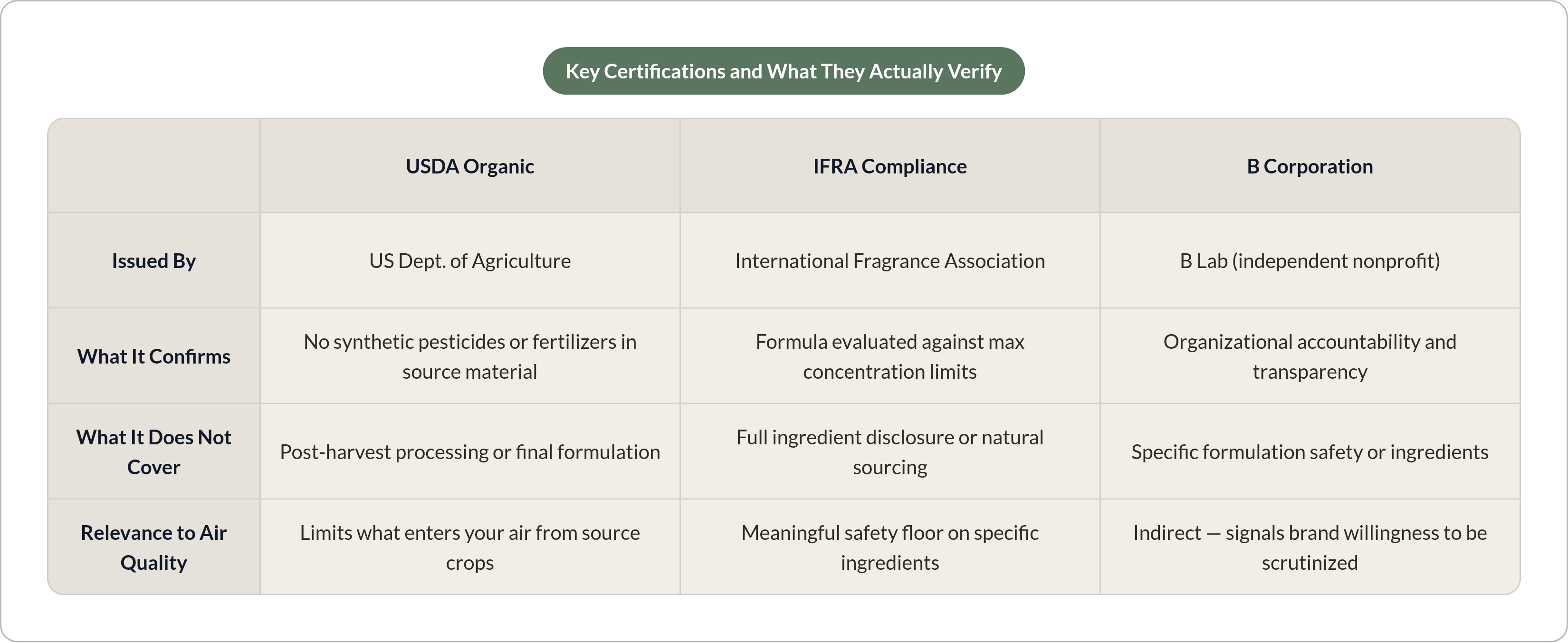
Certifications offer external verification, though not all carry equal weight. USDA Organic ensures the source material was grown without synthetic pesticides or fertilizers, which matters for what ends up suspended in your air. IFRA compliance, issued by the International Fragrance Association, means the formula has been evaluated against established maximum concentration limits for specific ingredients, a meaningful safety floor, even if not a ceiling. B Corporation status speaks more to organizational accountability than to any specific formulation, but it signals a brand willing to subject itself to scrutiny it could just as easily avoid.
That raises a question: does the natural-versus-synthetic framing even matter here? Some well-studied synthetic compounds have cleaner toxicological profiles than certain botanicals. Clean fragrance lives at the intersection of full ingredient disclosure, established safety data, and the deliberate exclusion of endocrine disruptors and respiratory irritants. A formulation can be natural and entirely opaque, or synthetic and fully disclosed — like a book with a beautiful cover that refuses to open, versus a plain one whose every page is legible.
Disclosure is the variable that actually matters. The origin story is secondary.
The chemicals worth avoiding and what they actually do in the body
Phthalates are among the most consequential ingredients most diffuser oil labels will never mention. Added to synthetic fragrance blends as fixatives, certain phthalates are classified as endocrine disruptors by major regulatory bodies, including the US EPA and the European Chemicals Agency, meaning they interfere with hormonal function at the biochemical level. They are routinely sheltered behind the word "fragrance." The label does not need to say "contains phthalates" because it is not required to say what "fragrance" contains. That is a regulatory gap, not an oversight.
The European Chemicals Agency and the US EPA have both flagged specific fragrance ingredients as substances of very high concern for carcinogenicity and reproductive toxicity (ECHA Candidate List of Substances of Concern; US EPA Safer Choice Program documentation). When two independent agencies, one European and one American, flag the same category, it is worth taking seriously rather than deferring to the label.
Volatile Organic Compounds, VOCs, are released into the air at room temperature by both synthetic and natural oils. In poorly formulated synthetic blends, this category can include toluene and benzene. VOC emissions degrade indoor air quality in a way that is largely invisible: the room smells pleasant while the air quality measurably deteriorates. That is an uncomfortable mismatch — a bit like putting fresh flowers on a table that is quietly rotting underneath.
But what if the label already says "phthalate-free"? The problem is not necessarily resolved. Reformulated products that remove phthalates often replace them with alternative fixatives carrying substantially less toxicological data. The absence of one named chemical is not evidence of a clean formulation. It is evidence of a clean answer to one specific question, which is not the same thing.
Practical red flags are consistent: "fragrance," "parfum," "aroma," and "luxury scenting" as standalone label terms indicate a formulation that either cannot or will not disclose its contents. The two scenarios have different implications for the brand. For the buyer, they lead to the same place.
Why "natural" does not automatically mean safe or diffuser-appropriate
Pure essential oils are not inert. They release measurable VOCs, and those VOCs interact with indoor chemistry in documented ways. Terpenes, present in lavender, pine, citrus, and many other botanically sourced oils, react with indoor ozone to form secondary nanoparticle pollution. This has been documented in peer-reviewed research, including studies published in Environmental Science & Technology. The fact that a compound originated in a plant does not exempt it from atmospheric chemistry.
Citrus-derived oils carry phototoxicity risk when applied to skin, and certain florals and spice oils cause sensitization with repeated exposure, meaning the body's reaction can intensify over time rather than diminish. Concentration matters as much as origin: an oil that is safe at trace levels is a different formulation problem at continuous ambient exposure. Diffusers are engineered for sustained, repeated use in enclosed spaces, which is a fundamentally different risk context than applying a diluted topical product once and washing it off.
Household composition changes the calculation further. Cats lack the liver enzyme glucuronyl transferase required to metabolize many terpene compounds, and this applies to botanically sourced oils as readily as synthetic ones (ASPCA Animal Poison Control Center). Infants and individuals with asthma or chemical sensitivities require more conservative use regardless of what the label says about origin. A healthy adult in a well-ventilated room faces a lower-risk exposure scenario. Most households are not exclusively populated by that person.
One argument holds that natural ingredients, being familiar to biological systems over millennia, carry inherent safety advantages over synthetic alternatives. It is a reasonable intuition. It is also not how toxicology works. Dose, duration, concentration, and delivery mechanism determine risk, not etymological origin. "Natural" on the label provides no enforceable guarantee of either purity or safety at diffuser concentrations. The more useful question is whether all ingredients are disclosed, studied, and formulated at concentrations with established safety data. That standard is more demanding than "natural," which is precisely why it is more useful.
How cold-air diffusion interacts with oil quality and why the delivery method changes the calculation
Cold-air diffusion, specifically nebulizing technology, uses air pressure to atomize oil into microscopic particles without heat, water, or alcohol. The particles are small enough to remain suspended in the air and inhaled deeply into the respiratory tract. That is the source of its scent performance, and it is also exactly why oil formulation matters more in this format, not less.
Heat-based diffusers alter compounds through thermal breakdown; what enters the air is chemically different from what was in the bottle. Cold-air nebulization involves no such transformation. What is in the oil is what enters the air, intact and at full potency. A poorly formulated oil, delivered this way, delivers its actual ingredients with high efficiency. That is the argument for scrutinizing the formulation before the reservoir is filled, not after you have already been breathing it for a week.
The waterless mechanism removes a separate category of concern. Ultrasonic diffusers dilute oil in water and use vibration to create mist; water reservoirs can harbor mold and bacteria, and mineral deposits accumulate over time. These are maintenance concerns independent of oil quality that affect overall air cleanliness. Cold-air systems have no reservoir and no thermal component, which removes those variables from the equation.
It is also worth considering the diffuser itself as a material object. BPA-free and ceramic construction reduces the risk of the device contributing to airborne chemical load when its components interact with concentrated oil repeatedly over time. The container is part of the formulation problem.
Cold-air systems engineered for residential use can cover substantial square footage from a single unit, with programmable intervals that reduce both olfactory fatigue and oil consumption.
What to check when evaluating a specific diffuser oil before buying
Start with the ingredient panel. Can every component be named specifically, or does "fragrance" or "parfum" carry the formulation in obscurity? If you cannot identify what is in the bottle from the label alone, that absence is a data point, not a gap to fill with brand goodwill.
Check for explicit exclusions, stated directly rather than implied by "natural" positioning. Does the brand name what it leaves out: phthalates, synthetic fixatives, undisclosed carrier ingredients? A brand confident in its formulation will name its absences as readily as its contents, because transparency is only credible when it extends in both directions.
Look for third-party verification. USDA Organic certification, IFRA compliance documentation, or recognized clean-beauty certification provides external confirmation of claims that would otherwise be entirely self-reported. Ask whether a brand will provide IFRA documentation on request. Reluctance to share it tells you something worth knowing before you buy, not after.
Assess concentration and intended use. Is the oil formulated for cold-air or nebulizing diffusion, or pre-diluted for ultrasonic use? An oil optimized for water-based diffusion does not perform correctly in a waterless system, and that distinction matters for both efficacy and, depending on formulation, safety.
Consider household composition before selecting fragrance type. Pet-safe labeling should be explicit, not inferred from "natural" marketing language. Cats are a specific physiological case, not a general sensitivity, and the relevant oils are well documented.
According to the Research and Markets 2023 Global Aromatherapy Market Report, the home fragrance market has grown substantially as consumers treat scent as central to mood and environmental experience. That growth has outpaced regulatory clarity, which means the burden of evaluation lands on the buyer rather than the label. The brands that meet a reasonable transparency standard will show you the full ingredient list without being asked. That willingness is, in itself, the first answer to most of your remaining questions.