Nebulizing Diffuser Technology Explained for Home Buyers
Compressed air and physics reveal which diffuser actually delivers the scent you paid for.

Home fragrance has quietly turned into an engineering problem, and nebulizing diffusers are the clearest evidence of that shift. These devices use compressed air and a principle from fluid dynamics, not heat or water, to break fragrance oil into a fine, dry mist. Understanding that mechanism, not the marketing copy printed on the box, is what actually tells a buyer whether one belongs in their home.
The stakes are bigger than a candle aisle these days. The global home fragrance market was valued at $13.2 billion in 2025 and is projected to hit $26.5 billion by 2033, growing at a compound annual rate of 9.2%. North America leads that growth, holding a 34.79% share in 2025. A February 2026 feature in the Dallas Morning News quoted a scent professional describing what people are actually asking for now: "citrusy, fresh, clean-cotton smells" meant to help them unwind. Scent has stopped being about covering up odors and started functioning as a daily reset button, on par with a five-minute walk or a cup of coffee. That reframing is why the mechanics behind the device matter. If fragrance is now a ritual, the tool producing it deserves the same scrutiny as the coffee maker or the shower head.
What a nebulizing diffuser is, and how it differs from the broader diffuser category
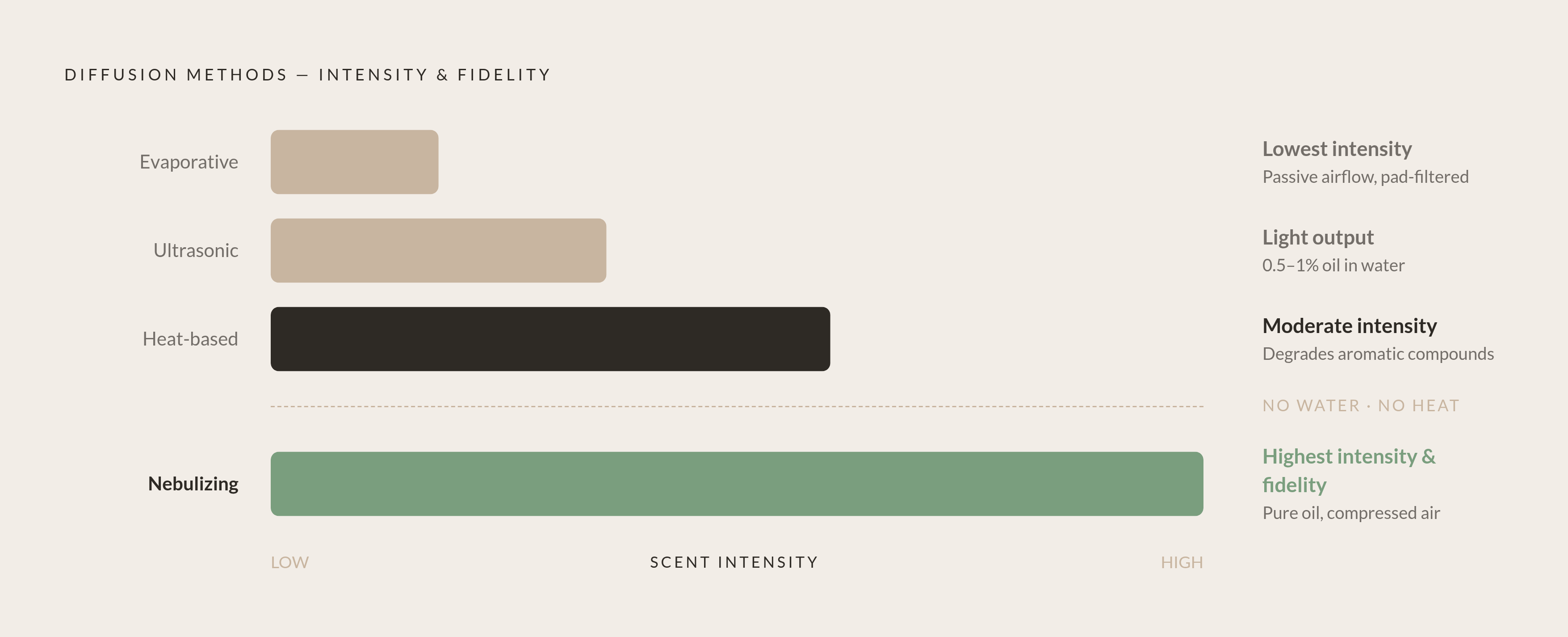
"Diffuser" is a category encompassing many different technologies, and lumping them together is a little like calling every powered vehicle a "car" and leaving it at that. There are four distinct operating methods on the market: ultrasonic (vibration), evaporative (air pushed through a filter), heat-based, and nebulizing.
Nebulizing and cold-air diffusion get used interchangeably in product listings, and that's fine, because they describe the same mechanism: pure oil atomized by pressurized air, with no water and no heat involved anywhere in the process. That puts nebulizing in a different bucket entirely from ultrasonic diffusers, the most common and least expensive type on shelves, which require oil to be mixed into a water bath before a vibrating plate turns the mixture into mist. It's also distinct from heat and candle-based diffusion, where a flame or heating element does the work of evaporating the oil. Three different physical processes, one shared vocabulary word. No wonder buyers get confused at checkout.
The physics behind nebulization: how Bernoulli's principle turns liquid oil into airborne particles
The party trick comes down to a principle taught in most introductory physics courses: in a fast-moving fluid stream, pressure drops at the point of highest velocity. Daniel Bernoulli described this in the 18th century while thinking about pipes and water, not essential oils, but the math doesn't care what century it's applied in.
Inside the diffuser, compressed air gets forced through a narrow tube. That constriction increases the air's velocity, and Bernoulli's principle explains that this drops the pressure right at the exit point. The pressure drop creates suction, and that suction pulls oil up a separate siphon tube toward the fast-moving air stream. When the oil reaches the top, it collides with that stream and shatters into micro-particles rather than dripping or pooling. Those particles fill the glass reservoir and get emitted as a dry mist, no water carrier, no heat involved at any stage.
What happens to the oil that doesn't atomize cleanly on the first pass? It gets thrown against the reservoir wall, falls back down, and re-enters the cycle. That is not a flaw in the design; it's the design. The recycling loop means oil consumption is self-regulating rather than wasteful, since only properly atomized particles leave the chamber. Adjusting the air pump's velocity adjusts how aggressively oil gets pulled up the siphon and shattered, which is the entire mechanism behind intensity settings. No dilution required, no watered-down scent, just a faster or slower stream of air doing more or less shattering.
Cold-air atomization's effect on scent quality, coverage, and oil efficiency
Particle size determines how a scent behaves in a room, and cold-air atomization produces particles small enough to stay suspended in the air for extended stretches rather than settling onto furniture within minutes. That's the coverage advantage in a sentence.
Scent fidelity also determines the quality of the output. Since no heat touches the oil at any point, the aromatic compounds a perfumer originally blended arrive in the air unchanged. What's on the label matches what comes out of the reservoir, which is not something every diffusion method can promise once heat enters the picture (more on that in the next section).
Efficiency numbers back this up in a way that's hard to argue with. On a 15-second-on interval, a 15 ml bottle of oil can run a nebulizing diffuser for 80 to 100 hours. At a 120-second-on interval, the same bottle lasts 10 to 12.5 hours. Compare that to a typical ultrasonic device, which uses 3 to 5 drops of oil diluted into a water reservoir, producing a concentration of just 0.5 to 1%. That's a meaningfully weaker scent that fades fast, because most of what's being diffused is water vapor, not fragrance.
A comparison of nebulizing diffusers to ultrasonic, heat, and evaporative alternatives
Four methods, four sets of tradeoffs, and none of them is objectively "best" outside the context of a specific room and a specific buyer's patience for maintenance.
Ultrasonic diffusers dominate the market by sheer numbers because they're cheap and simple: a vibrating plate agitates a water-and-oil mixture into mist. The tradeoff is that dilution, that 0.5 to 1% concentration, means the scent throw is lighter and fades quicker. They also add humidity to the room, which is unwelcome in already-damp climates, and the water reservoir needs regular emptying to keep mold and mildew from setting up shop. Once oil is mixed into the water, switching scents mid-cycle isn't really an option. What ultrasonic diffusers do have going for them is price and compatibility with the essential oil drops sold at every drugstore.
Heat-based and candle diffusers rely on a flame or an electric heating element to evaporate oil. Heat breaks down the same volatile aromatic compounds that give a fragrance its character, which can flatten or alter the scent compared to what was originally bottled. An open flame also introduces an actual fire risk, which matters more in homes with toddlers or a cat that treats every flat surface as a personal runway.
Evaporative diffusers are the simplest of the bunch: air passes through a filter or pad soaked in oil, and the oil evaporates passively into the room. No heat, no water, minimal moving parts, and correspondingly the lightest scent output and the smallest effective coverage area of any method here.
Nebulizing diffusers are at the top end of intensity and control: pure oil, no water, no heat, full scent fidelity, and the broadest coverage potential of the group. Air pump speed settings and programmable on-off cycles give a level of granular control the other three methods can't really match, which is part of why the format gets associated with the kind of consistent, engineered scent environment found in high-end hotel lobbies. That control comes at a cost, literally: nebulizing units run more expensive up front, and they're pickier about what oils they'll accept, which is its own conversation.
Oil compatibility: why nebulizing diffusers require specifically formulated fragrance oils
That pickiness isn't arbitrary. Nebulizing technology depends on a precise oil viscosity to function at all, since the oil has to be thin enough to move through the diffuser's internal passages and atomize cleanly. Pour in the wrong oil and the mechanism either underperforms or clogs.
Waterless fragrance oils built specifically for cold-air diffusers are typically concentrated at 3 to 5 times the strength of oils meant for ultrasonic devices, and they contain fixatives that help the scent carry and persist over hours of use. That same concentration and viscosity profile is what makes those oils incompatible with an ultrasonic plate. So the two product categories aren't interchangeable in either direction. This raises an obvious question for anyone shopping around: does the oil on the shelf actually say what device it's formulated for? Thick carrier oils, the kind cut with fractionated coconut oil or jojoba for use on skin, can clog a siphon or atomizer nozzle fast. Checking the oil's specifications before purchase isn't optional; it's the whole ballgame.
Why fragrance oil ingredients deserve scrutiny and what clean formulation means in practice
In a certain country's market, the single word "fragrance" on a label can legally stand in for more than 3,000 synthetic chemicals that a brand has no obligation to disclose, the regulatory baseline rather than a loophole. That is not a loophole; it's the regulatory baseline.
Conventional fragrance formulations recur with a few compounds that raise concerns. Phthalates are used to extend how long a scent lingers, and they're classified as endocrine disruptors, which may interfere with hormonal signaling in the body. Synthetic musks can accumulate in body tissue over time and have been detected in human tissue and in breast milk. Formaldehyde and other volatile organic compounds contribute to indoor air pollution and have been linked to headaches, dizziness, and respiratory irritation. A national survey found that more than 34% of respondents in one country's population. respondents reported health problems, including migraines and breathing difficulty, after exposure to fragranced products.
That said, "clean" doesn't mean "chemical-free," and pretending otherwise does the reader a disservice. Even naturally derived essential oils have been found to contain volatile organic compounds. So the case for cleaner fragrance formulation isn't about achieving some mythical zero-risk product, it's about relative harm reduction and, just as importantly, knowing what's actually in the bottle. Transparency is the win here, not purity.
Matching a nebulizing diffuser to room size, layout, and usage patterns
Because nebulizing diffusers output oil at full concentration with nothing diluting it, matching the unit's output capacity to the actual square footage of a room is the single most important buying decision after confirming oil compatibility. Undersize it in a large open-plan living area and the scent barely registers. Oversize it in a small guest bathroom and the scent becomes overwhelming, sometimes literally a headache.
Open-plan layouts and rooms with high ceilings need either more output or longer run intervals than a closed room of identical floor area, since the mist has more volume to fill and fewer walls helping to contain it.
Placement matters almost as much as sizing. The device should sit somewhere the dry mist can disperse freely, not tucked into a corner or set on the floor where airflow gets restricted before the scent even has a chance to spread. Central placement near natural air circulation, an HVAC return vent or a ceiling fan, does a lot of the distribution work passively. Keep the unit out of direct sunlight and away from heat sources too, since temperature swings can affect the oil's viscosity sitting in the reservoir, and viscosity is a key variable the atomization mechanism depends on.
Most nebulizing diffusers come with interval settings built in for a reason: running the device in short bursts rather than leaving it on continuously conserves oil and helps avoid olfactory fatigue, which is the fancy term for the nose simply tuning a smell out after prolonged exposure.
Routine cleaning and maintenance: what the mechanism requires to keep performing
The same tight tolerances that make nebulizing diffusers effective also make them fussy about buildup. Oil residue collecting in the siphon or atomizer nozzle narrows the passage over time, and a narrower passage means weaker, less consistent atomization, even if the oil itself is perfectly fresh.
The fix is straightforward: flush the reservoir and atomizer with a small amount of high-proof isopropyl alcohol, then run the device briefly to clear whatever residue is left behind. How often that needs to happen depends on how heavily the diffuser gets used and how frequently the oil gets swapped out. Switching from something heavy, like a woody blend, straight to something light, like citrus, without cleaning in between tends to produce an unplanned mashup of both scents in the air. That's not a performance issue so much as a hygiene one, though nobody wants their fresh-linen diffuser smelling faintly of cedar either.
Where a model uses a glass reservoir instead of plastic, inspection gets a lot easier, since buildup is visible at a glance rather than hidden inside an opaque chamber. Glass also carries less risk of off-gassing over time, which is a small but real point in its favor when comparing models side by side.