Electric Home Fragrance Diffusers Compared by Room Size
Matching diffuser power to room size beats style or budget for actually filling a space with scent.
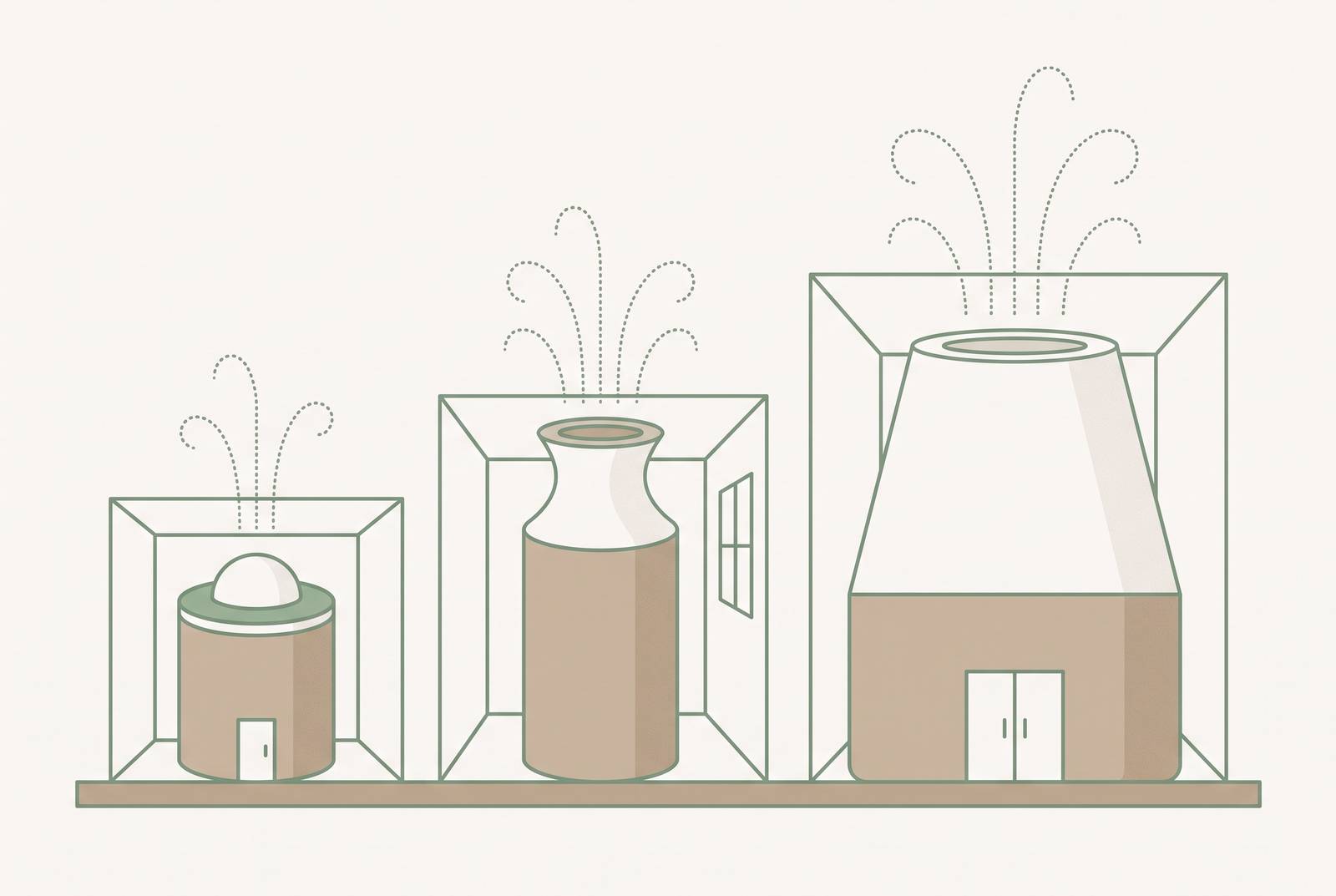
Choosing an electric fragrance diffuser comes down to one variable most people skip past: matching the machine's actual output to the square footage and airflow of the room it's going into. Most buyers pick based on price, looks, or brand name, which is exactly why the most common complaint about diffusers is scent that's either too weak to notice or so strong it drives people out of the room. Bigger is not safer, and buying a diffuser rated above what the room needs is the single most expensive mistake in this category. It happens because people assume more coverage capacity can only help. It can't, and this piece works through the mismatch room by room, since size, not style, decides whether a diffuser does its job.
More than 45% of households now run some kind of fragrance diffuser, and 56% of buyers cite safety — no open flame — as their primary reason for choosing diffusers over candles. Safety already made the decision for a lot of people. What nobody handed them on the way out of the candle aisle was a way to figure out which diffuser fits which room, and that's the gap this guide tries to close.
How diffusion technology determines how far a scent can actually travel
Start with the mechanism, because it sets a hard limit on everything that follows. Cold-air diffusion runs fragrance oil through an atomizer that breaks it into microscopic dry particles, then pushes those particles out on a stream of cool air. No heat, no water, no alcohol involved. Because the oil never gets diluted or warmed, the fragrance keeps its full concentration all the way to the edge of the room, and there's no added humidity to worry about if the space has hardwood floors, framed art, or electronics nearby that don't love moisture.
An ultrasonic diffuser works differently, and worse, if range is the goal. It needs water to generate that visible mist cloud, which by definition dilutes the fragrance oil and shrinks the area it can cover. The mist looks dramatic for about twenty minutes, then it's gone, and so is most of the scent. Heat-based plug-ins have a related problem: warmth speeds up evaporation, but it also cooks the aromatic compounds in the oil, changing how the scent smells over time and capping how far it travels. Under matched conditions, cold-air diffusers cover substantially more area than candles, reed diffusers, plug-ins, and ultrasonic units. Anyone buying an ultrasonic unit for a space bigger than a powder room is fighting the machine's own physics, full stop. If the goal is a scent that reaches the hallway instead of one that stays trapped over the nightstand, cold-air is the only mechanism on this list built for that job.
Nebulization, the process of turning oil into an extremely fine dry mist with no residue left behind, is doing the heavy lifting here. It's why premium cold-air units can throw scent across more air and have it still smell like something an hour later, instead of fading into a vague, unplaceable candle-ish note. Aura House, a non-toxic home fragrance brand built around cold-air diffusers, is one example of that approach applied to design-forward homes. Newer units add smart scheduling and app controls so intensity can be dialed down through the day. That matters more than it sounds: cranking a diffuser to full output in a small room doesn't get more fragrance, it gets a headache and an empty oil bottle by Thursday.
Small rooms up to 400–500 sq ft: bedrooms, bathrooms, and home offices
A bedroom, a bathroom, a home office: contained spaces, limited air movement, scent that concentrates fast. The failure mode here isn't weak coverage, it's the opposite, and it's worth naming directly. Buy something rated for a great room, run it at full blast in a 150 square foot bedroom, and the space turns from cozy to overwhelming before anyone notices what happened. Oversizing is the mistake at this tier, not undersizing, and it's the one salespeople almost never warn against. A bigger unit costs more, and nobody's commission depends on talking a customer down to the smaller model.
What actually matters at this size is intensity control, low noise (nobody wants a diffuser humming next to the bed at 2am), portability, and an oil reservoir sized for how long the room gets used. A 20ml reservoir does the job for a bedroom or office running overnight or through a workday. Buying something bigger just burns through oil faster than the room needs it.
A few examples at this tier: the Hotel Collection Loft Portable Scent Diffuser uses waterless cold-air dry mist, covers up to 400 square feet, and pairs with a 20ml oil, small enough to move between a nightstand and a desk without any HVAC connection. The Hotel Collection Studio Scent Diffuser is built for standalone use in that same 400 square foot range. On the plug-in side, the JCLOUD 2025 Plug-in Diffuser covers up to 500 square feet, runs $69.99, and is built for home, office, or spa settings.
Placement counts for more than people assume. Put a small-room diffuser near a window or a doorway and the scent escapes before it ever fills the space, so open wall space with some natural airflow above it beats a corner behind a door every time.
Medium rooms from 800 to 1,200 sq ft: open-plan living areas and primary suites
Medium rooms are where the math stops being simple. An open kitchen-living combo, a primary suite with a walk-in closet attached, a loft with twelve-foot ceilings: these spaces have higher ceilings, more airflow from HVAC returns and kitchen vents, and no walls to hold scent in place. A diffuser rated for 800 square feet in a sealed room can genuinely underperform in a 600 square foot open floor plan, because the square footage number on the box assumes still air in a boxed-in room, and an open kitchen is neither of those things.
Layout changes the math again. A 1,200 square foot space that's really three connected zones (kitchen, dining, living room) might need a higher-output unit than the floor plan alone suggests, or a second diffuser placed in the zone farthest from the first.
Options scale accordingly. The Hotel Collection Tower Scent Diffuser covers up to 800 square feet, sized for a smaller open-concept home around 40 by 25 feet. Step up to the Hotel Collection Penthouse Scent Diffuser and coverage reaches 1,200 square feet, roughly a 28 by 28 foot room, built for a one or two bedroom apartment or a home with mid-sized living spaces. There's also a cold-tech smart scent machine rated to 2,000 square feet that compresses cold air to break down essential oils into a dry micro-mist, no water or heat involved, sitting at the upper edge of medium or the entry point into large-space territory.
Smart scheduling stops being a nice-to-have here. It becomes the thing that keeps the room from getting oversaturated during peak hours while still conserving oil overnight. Placement strategy shifts too: put the unit where air naturally moves through the room, not right next to a return vent (it'll just get pulled away) and not near a doorway (it'll just leak out).
Large and whole-home spaces above 4,000 sq ft: when portable devices reach their limit
This is where a lot of people waste money, and the position here is unambiguous: no portable, non-ducted diffuser, no matter how large its rated coverage number, will fill a multi-room home evenly once square footage climbs past a certain point. Buy one big portable unit expecting it to scent the whole first floor, and it'll do fine in the room it's sitting in and next to nothing everywhere else. That's not a flaw in the product, it's physics. Air doesn't travel through walls and around corners the way it moves through a duct system, and no coverage rating printed on a box changes that fact.
The fix at this scale is a nebulizing cold-air system that ties directly into the home's HVAC ductwork, so the same air handler pushing heat or air conditioning through every room also carries fragrance along with it. Some large-space cold-air units, priced in the mid-hundreds of dollars, cover this tier, though stock availability can vary. HVAC-integrated cold-air systems, priced in the thousands of dollars, span from 4,000 square feet up to 15,000 square feet. The Magic Scent TMS 1000 handles up to 10,000 square feet, runs up to three separate scent programs a day, and can operate through its own built-in fan or by installing directly inside the HVAC system.
For a home without ductwork set up for this yet, the workaround is multiple medium-capacity cold-air diffusers placed in high-traffic zones, not one oversized portable unit doing double duty as a space heater's evil twin. And yes, HVAC-integrated systems cost real money. But price that against buying five or six portable units for every major room in the house, plus the oil and maintenance on each one, and the ducted system stops looking like a luxury. It starts looking like the only option that actually works at that scale.
What room size alone doesn't tell you: ceiling height, layout, and airflow as coverage modifiers
Square footage is a floor-area number. It says nothing about how much air is actually in the room, and air volume is the number that matters for diffusion. A room with 12-foot ceilings holds significantly more air than the same floor plan with 8-foot ceilings, so a diffuser rated for 800 square feet at a standard ceiling height will come up short in a lofted room of identical footprint. The box doesn't know the ceiling is tall. It only knows the floor plan, and that gap is where most buyers get burned.
Open layouts lose scent faster than compartmentalized ones, for the same reason a shout carries farther in an empty gym than in a closet: nothing's there to contain and reflect it. A 600 square foot open kitchen-living room may need a diffuser rated meaningfully above its floor area just to hold its own. Running the central heat or air conditioning complicates things further. It moves air around, which sounds helpful, but it also dilutes concentration, and a diffuser sitting right next to a supply vent risks having its output dispersed before it can settle into the room. Placement away from vents, somewhere the air settles instead of rushing through, performs better.
High-traffic spots (hallways, entryways, kitchens) get hit with constant air disturbance from doors opening and cooking exhaust running, so the rated coverage on the box is a best-case number rather than a promise in real-world conditions. So size up: if a room has high ceilings, an open layout, active HVAC, or heavy foot traffic, go one tier above what the floor plan alone suggests. Intensity controls close some of that gap without buying new hardware. Start low, watch how the scent behaves over a few days, and adjust before assuming the unit itself is wrong for the space.
Fragrance oil choice and concentration interact with room size in ways coverage specs don't address
The diffuser is only half the equation, and this is where the coverage number on the box quietly stops telling the truth. Coverage ratings assume an oil with standard viscosity and concentration, so a heavier or thicker oil may not perform as well with the machine's atomizer, which can affect the effective range no matter how well the machine is rated. That's a mechanical problem before it's ever a scent problem.
Fragrance ingredients aren't fully regulated, so a company can list dozens of undisclosed compounds under the single catch-all word "fragrance" on a label, including phthalates (known endocrine disruptors) and volatile organic compounds tied to respiratory irritation. That's a health question first, but it's also an equipment question: oils with synthetic fillers or added junk raise quality concerns that can affect how well the machine performs over time. For a household with pets, kids, or anyone with sensitivities, a clean formulation without synthetic fillers cuts down on the health risk for sensitive households. Skimping here to save a few dollars on a bargain oil is the second most expensive mistake in this category, right behind buying too much diffuser for too small a room, and it's worth being blunt about that ranking.
Concentration and diffuser output work as a pair, not separately. A heavily concentrated oil run at full intensity in a small room will overwhelm the space even if the diffuser itself is correctly sized for that room, while a light, delicate blend run at low intensity in a large room will vanish before it reaches the far wall. Match oil richness to room size the same way output capacity gets matched to it: bolder, more complex formulations belong in larger spaces where the scent has room to unfold, and lighter blends work best in small, contained rooms where they won't build up and turn cloying. Two labels worth looking for on the bottle: EPA Safer Choice, meaning EPA scientists independently reviewed the formulation, and IFRA compliance, meaning the formulation follows industry fragrance standards, though compliance itself is self-certified by the fragrance supplier, not independently audited case by case.
A room-size reference guide for choosing the right electric diffuser
For small rooms up to 400 to 500 square feet (bedrooms, bathrooms, home offices), go with a portable cold-air or plug-in waterless diffuser. Prioritize intensity control, quiet operation, portability, and a small oil reservoir in the 20ml range. The Hotel Collection Loft Portable Scent Diffuser and Studio Scent Diffuser both cover up to 400 square feet, and the JCLOUD 2025 Plug-in Diffuser covers up to 500 square feet at $69.99. This is the tier where oversized units do the most damage, not the tier where weak coverage is the risk, so run at lower intensity and watch for over-saturation in the smallest rooms in the house.
For medium rooms from 800 to 1,200 square feet (open-plan living areas, primary suites, one or two bedroom apartments), a standalone cold-air diffuser with app or timer control makes more sense, with higher output capacity and adjustable scheduling as the priority features. The Hotel Collection Tower Scent Diffuser reaches 800 square feet, the Penthouse model reaches 1,200, and the cold-tech smart scent machine rated to 2,000 square feet covers the upper end or a transitional space between medium and large. Open-plan layouts and active HVAC both push a room up a tier from what the floor plan alone would suggest.
For large and whole-home spaces of several thousand square feet and up, a nebulizing cold-air system, ideally integrated with HVAC, is the only approach that scales. Priority features shift toward HVAC compatibility, multi-program scheduling, and professional installation support. Large-space cold-air units run in the mid-hundreds of dollars, HVAC-integrated systems cover up to tens of thousands of square feet at several thousand dollars, and the Magic Scent TMS 1000 handles up to 10,000 square feet across three daily programs. Drop one expectation entirely: a single portable device, no matter how well reviewed, will not scent an entire house, and no amount of intensity dialing changes that.
Two modifiers apply across every tier in this guide. High ceilings, open layouts, or strong airflow mean sizing up one coverage level from whatever the floor plan suggests. And the diffuser is only as good as the oil running through it: correct sizing only pays off when it's paired with a clean, appropriately concentrated formulation built for the volume of air it actually has to fill.