Layering Multiple Scent Zones in an Open-Plan Home
Scent layering balances distinct aromas across open spaces without letting them clash.

Scent zoning is a simple idea: put intentionally chosen scents in specific areas to reinforce what each area is actually for.
Why does it work at all? Biology, mostly. The scent impression of a space forms within seconds of entering — faster than any visual detail registers consciously. Before you've clocked the furniture arrangement or the paint color, your nose has already filed a report and made a judgment call. That means scent isn't a décor add-on. It's a primary driver of how people feel in a space, often without them being able to say why.
Luxury hotels figured this out decades ago. They call it scent-scaping, and they deploy it with the same deliberateness as lighting design. The home is only now catching up.
But here's the question that actually matters in an open floor plan: if scent travels freely through connected space, how do zones work at all?
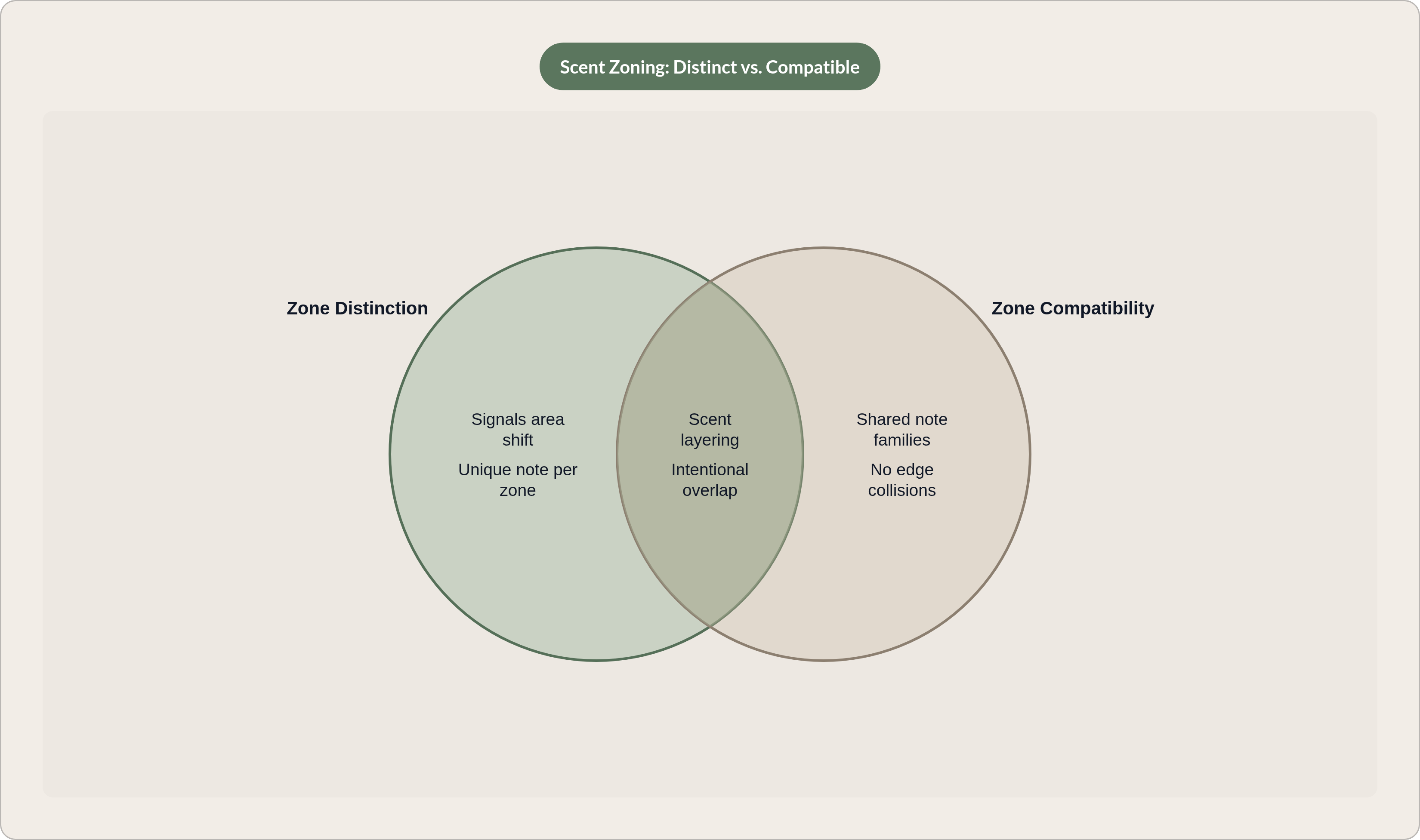
The answer is distinction and compatibility working simultaneously. Zones don't need to be sealed off. They need scents distinct enough to signal a shift as you move through the space, and compatible enough not to fight each other at the edges. When that balance breaks down, you get one of two outcomes. Olfactory monotony: one flat note blanketing the whole floor. Or olfactory chaos: two or three scents colliding somewhere near the kitchen island, creating something nobody planned and nobody particularly wanted.
There's a word for the intentional version: layering. Each zone has its own chapter, but they're written in the same genre — like instruments in an orchestra that each carry their own melody but still belong to the same composition.
The core design rule: match scent character to zone function
The scent in a zone should support what people actually do there.
Here's how it breaks down across a typical open plan:
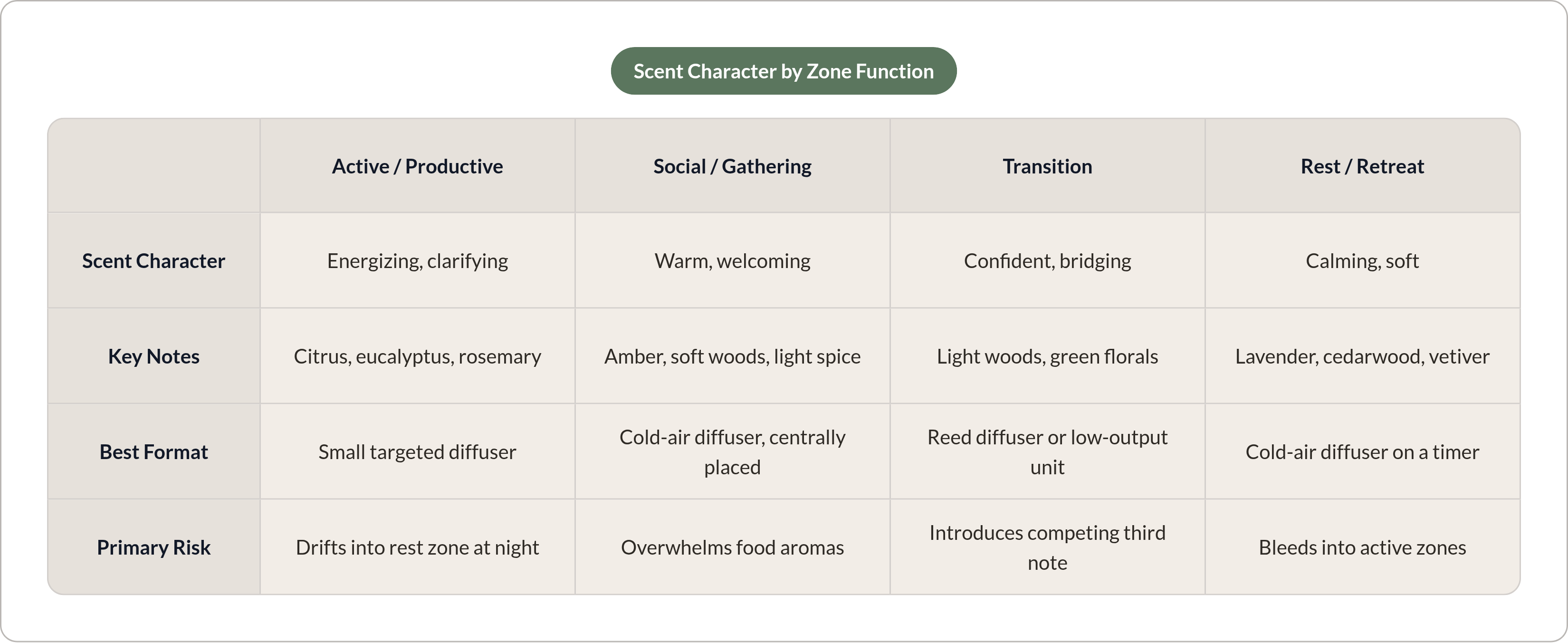
- Active and productive zones (kitchen counter, home office corner): energizing, fresh, clarifying. Citrus, green notes, herbaceous profiles. Bergamot, eucalyptus, rosemary. Light mental sharpness, not a perfume statement.
- Social and gathering zones (living area, dining space): warm, welcoming, conversation-friendly. Woods, amber, light spice, soft florals. Nothing so assertive it competes with food aromas or the natural presence of people in a room.
- Transition zones (entry, hallway, stair landing): the first impression. Needs presence and a confident opening note, but shouldn't foreclose what comes next. An invitation, not a declaration.
- Rest and retreat zones (bedroom end of a loft, reading nook): calming, soft, sleep-supportive. Lavender, chamomile, sandalwood, vetiver. If there's any zone where scent can meaningfully shift behavior, it's this one.
The underlying logic is that scent primes behavior. A kitchen scented with something fresh and herbaceous subtly supports the activity there, not just the aesthetics. Small nudge. But those nudges accumulate across a whole day of living in a space.
What happens when you ignore function? A deeply relaxing scent bleeds into the workspace and you spend the afternoon foggy. A sharp citrus cuts into the sleeping end of the floor plan at 10 p.m. Neither is catastrophic. Both are friction you didn't need to create.
Planning scent compatibility before placing a single diffuser
This is where most plans fall apart. Someone finds a scent they love for the kitchen. A different scent they love for the living room. They place both. Then they stand at the kitchen island, exactly at the midpoint between the two zones, and something has gone wrong and they can't quite explain it.
The problem is they chose two great individual scents without asking what those scents smell like together.
In an open plan, you're not choosing scents in isolation. You're choosing scent pairs. Sometimes scent triads. The question isn't just "does this work in this zone?" It's "what does this smell like when it drifts toward the next zone?"
The compatibility rule is straightforward: scents in adjacent zones should share at least one note family. A woody base in both. A green herbal thread running through each. Something that lets the transition between zones read as a progression rather than a collision.
What clashes? A dark, smoky scent placed directly next to something very sharp or very sugary, with no shared note between them. The overlap point becomes unpleasant in a way that's hard to diagnose if you haven't mapped it out in advance.
The highest-risk collision zone in most open plans is the stretch between the kitchen island and the main seating area. That's where the two busiest zones meet. That's where compatibility decisions pay off most.
One practical approach that holds up well: start with one broad scent family across the whole floor plan, then vary intensity and specific notes by zone, rather than jumping between unrelated scent families entirely. It's harder to get wrong.
If that still feels like a lot of groundwork, collections designed with internal scent coherence have the compatibility work already done. Aura House builds their fragrance line around destination-inspired scent stories, with each fragrance designed to coexist with others in the collection. Choosing from within a line like that removes a significant amount of guesswork compared to piecing together scents from completely unrelated sources.
Choosing diffusion formats that give each zone the right presence
The format shapes how a scent occupies a zone just as much as the scent itself does.
A reed diffuser and a cold-air diffuser can hold the same fragrance oil and do completely different things in a large open space. So which does what?
- Reed diffusers offer constant, low-level ambient presence. Reliable, no management needed. Ideal for smaller or lower-traffic zones where you want a background note. A hallway. A reading corner. They are not the right anchor for a large open living area. Placing one in a wide-open space and expecting it to hold a zone is optimistic.
- Room sprays are fast and targeted. They reset a zone immediately after cooking, before guests arrive, whenever you need a rapid atmosphere shift. A tool, not a sustained anchor.
- Cold-air diffusers are the workhorse of a properly zoned open plan. They push fragrance oil through the air as a dry mist, without heat, without added water. No heat means the scent profile stays intact. No water means no humidity, which matters in rooms with hardwood floors, artwork, or electronics. Coverage is simply larger than what candles, reeds, or plug-ins can achieve in high-ceilinged or wide-open spaces.
For very large layouts, loft-style homes, or open plans that exceed typical room scale, HVAC-connected diffusion systems extend coverage across the whole home.
The format-matching principle is simple. Use the format whose range and daily rhythm fit the zone's size and use pattern. Match the tool to the space, not the other way around.
A zone-by-zone placement guide for common open-plan layouts
Entry / front door area
First-impression zone. The scent here sets the expectation for everything that follows. It doesn't need to be the loudest note in the home. It needs to be welcoming, present, and uncluttered.
Keep intensity moderate. Green florals, light woods, subtle citrus all work well here. Format: a cold-air diffuser on a timer, or a well-placed reed diffuser in a contained entry alcove. Avoid relying on sprays as the primary source. You want continuity, not a performance.
Kitchen / dining zone
The highest olfactory competition zone in any open plan. Cooking smells, food aromas, foot traffic. Whatever you place here coexists with all of that, whether you plan for it or not.
Choose scents that complement food rather than fight it. Citrus, fresh herbs, light florals. Avoid heavy musks or complex florals that clash with savory cooking. Position the diffuser away from the stove's heat. Cold-air diffusion is the right call near a cooking surface. Heat-based formats near a hot stove degrade the scent profile and introduce unnecessary risk.
Living / seating area
Usually the social anchor of the open plan, and often the zone guests would describe when they say your home smells a certain way. Warm, grounding notes work best: amber, sandalwood, light spice, soft woods.
It's also typically the largest zone, which means the largest coverage need. A cold-air diffuser is the right anchor here. Position it centrally within the seating cluster, elevated if possible, away from HVAC vents or windows that will pull scent out of the zone before it settles. A room spray works as a fast-layer tool before guests arrive. The cold-air diffuser does the sustained work.
Home office corner or study nook
Even within an open plan, this zone benefits from a distinct, focused sensory signal. Energizing and clarifying: eucalyptus, rosemary, peppermint, bergamot. Not subtle, but not overwhelming.
Use a smaller, targeted diffuser here rather than a zone-wide unit. The goal is to keep the effect local to the work area. Broadcasting it across the whole floor defeats the point.
Bedroom end or sleeping zone
In a loft or studio layout, this is the zone most in need of sensory separation from everything active on the other side of the floor plan. Calming notes: lavender, chamomile, cedarwood, vetiver.
The most effective tool here is a timer. Schedule the diffuser to activate in the evening hours. The scent transition signals wind-down as effectively as dimming the lights.
Transition corridors, hallways, stair landings
Bridge zones. The scent here should connect what's on either side, not introduce a third competing note. A reed diffuser or a small cold-air unit on low output is exactly right. Function here is continuity, not statement.
Why clean, non-toxic fragrance matters more in a zoned, always-on setup
One reed diffuser in a guest room is low exposure. Multiple diffusers running simultaneously across a connected, shared air volume is a meaningfully different daily air-quality situation.
The regulatory gap is real. "Fragrance" or "parfum" on a product label can legally cover dozens of individual chemicals. Phthalates, used as fixatives in many synthetic fragrances, are known endocrine disruptors. Certain synthetic musks and preservatives are common allergens. In a single-zone, occasional-use setup, that's a low-level concern. Scaled across an always-on, whole-home setup, it compounds.
Burning formats add a separate problem. Candles and incense introduce fine particulate matter, carbon monoxide, and volatile organic compounds to the air. In an open plan with shared air volume, combustion products from one zone travel to all zones.
Cold-air diffusion avoids combustion byproducts entirely. But terpenes in fragrances, including natural ones, can react with indoor ozone to create secondary nanoparticles. So the meaningful standard is cold-air plus a clean, well-formulated fragrance oil, together.
What to look for:
- Full ingredient disclosure, not hidden behind "fragrance"
- Plant-derived or essential oil-based scents named specifically
- Third-party certifications like EWG Verified or MADE SAFE for ingredient safety, and Leaping Bunny for cruelty-free production
In a scent-zoning setup that runs every day, ingredient transparency isn't a bonus feature. It's a baseline requirement.
Avoiding the two most common mistakes in multi-zone scenting
Mistake one: olfactory overload
The nose adapts fast. What reads as rich and inviting for the first few minutes becomes background noise quickly. The instinct is to compensate by adding more. More diffusers, higher output, additional sources. In an open plan, that response creates a wall of scent rather than distinct zones. Everything blends into one assertive presence, and the zone-by-zone differentiation you built collapses into something nobody asked for.
The fix is staggered intensity. One anchor zone at full strength. Adjacent zones at lower output. Timers that stagger what's running at any given moment. The goal is enough presence in each zone to register when you're in it, not a cumulative volume that hits you the moment you open the front door.
Mistake two: clashing at zone edges
The overlap point between the kitchen zone and the living zone is where a sharp citrus and a heavy amber will actually meet in the air. If those are the anchors of each zone and they share no note family, the blend in the middle will be neither. It will be a third, unplanned thing.
The fix is the compatibility planning done before placement. Shared note families at adjacent zone edges. Map the overlaps on the floor plan first, before you buy anything.
One secondary trap worth naming: setting zones once and not revisiting them. Scent preferences and behavioral patterns shift with the seasons. A warm amber that works well in a winter living zone can feel heavy and airless in July. Rotating anchor scents seasonally keeps a home feeling aligned with the time of year. Usually a swap of one or two scents is enough.
One placement error to avoid regardless of season: positioning any diffuser near an HVAC vent, window, or ceiling fan. Airflow pulls scent out of its zone before it can anchor there. Position against a wall, or in the still center of a zone's air pocket.
Building a starting scent-zone plan from scratch
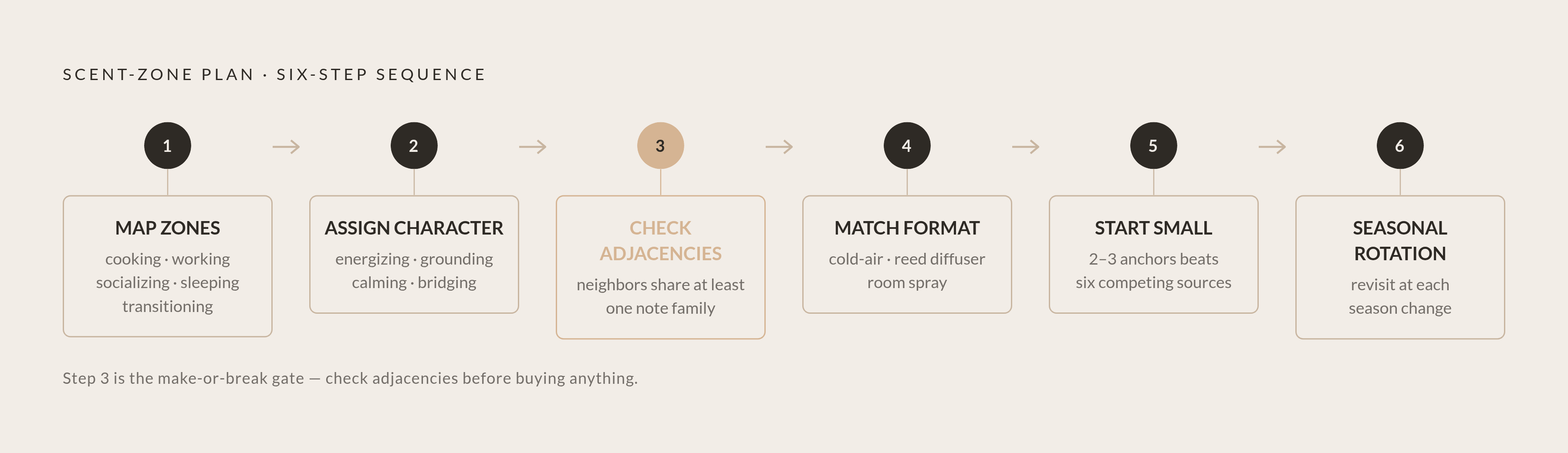
This doesn't need to be complicated. Here's a working sequence.
Step one: map the functional zones, not the rooms. Open plans don't have rooms. They have activity areas. Cooking, working, socializing, sleeping, transitioning. Mark those on the floor plan.
Step two: assign a scent character to each zone. Use the function-matching logic above. Energizing for active zones, grounding for social zones, calming for rest zones, bridging for transitions.
Step three: check adjacencies. Will neighboring scent characters bridge or clash? Adjust so adjacent zones share at least one note family before you buy anything.
Step four: match diffusion formats to zone size and use pattern. Cold-air diffuser for anchor zones. Reed diffuser for transitions and smaller areas. Room spray as a situational, fast-layer tool.
Step five: start smaller than you think. Two or three anchor points in a large open plan is more effective than six competing sources. Add a zone only when you feel a gap.
Step six: build in a seasonal rotation. Plan to revisit zone scents at each season change.
For anyone starting from zero, a collection designed with internal scent coherence removes the hardest part of the process. A line built so the scents coexist means the floor plan sketching step becomes about placement and intensity rather than hoping two arbitrary choices don't fight each other.
The goal isn't a home that smells like fragrance. It's a home where each area feels, without you quite being able to put your finger on why, distinctly and purposefully itself. That turns out to be much of what atmosphere actually is.