Fragrance Gift Sets vs. Standalone Diffusers: What to Buy
Cold air diffusion outperforms bundled alternatives for coverage and scent accuracy.

Buying fragrance for a room sounds like a small decision until you're standing in front of forty options that all promise to make your house smell like a five-star hotel lobby. Underneath the noise, the real choice is simpler than the shelf makes it look: are you buying an experience, or a piece of equipment? Mix up which one you actually need, and you end up with a $150 bundle you use twice and a drawer full of unopened oils.
A gift set bundles two or more product types, a diffuser plus oils, a candle plus a reed diffuser, sprays paired with lotion, organized around one scent story. A standalone diffuser is a single device chosen for how it disperses fragrance, how far that fragrance travels, and what oils it can run. One is built for a moment; the other compounds over time, closer to a good knife that gets better the more you use it than a decorative one that just sits on the block looking sharp. Underneath both sit different diffusion technologies (cold air nebulizing, ultrasonic, heat-based, reed), and confusing the box with the mechanism inside it is where most bad purchases start.
Why the home fragrance market's growth makes format choice harder, not easier
The home fragrance market was valued at $13.2 billion globally in 2025, with projections putting it near $26.5 billion by 2033. A category growing that fast throws new formats and new bundles onto shelves faster than most shoppers can figure out what they're actually looking at, and that pace is exactly why the decision feels harder now than it did a decade ago.
Gift sets get marketed as wellness tools these days, on top of their old job as presents. Diffusers get marketed as decor, parked next to throw pillows and coffee table books like they've always belonged there. Somewhere in that shuffle, the line between buying something because it works and buying something because it photographs well got blurry. Once that line blurs, figuring out what you're actually paying for gets harder too.
Clean fragrance complicates things further. The clean segment alone was worth $12.47 billion in 2024, which means a parallel market of "clean gift sets" and "non-toxic diffusers" now runs alongside the regular one. Nobody's checking those labels, though. Clean and non-toxic aren't regulated terms. Phthalate-free, paraben-free, natural origin: these deserve a second look rather than automatic trust, since a label can say whatever the marketing team decided sounded good that quarter.
Naturally derived doesn't mean safe, either, and how a fragrance gets released into the air matters as much as what's in the bottle. Heat a completely natural oil past its breaking point and it can turn into something you didn't sign up to breathe. So if you're shopping a set specifically because it says "clean" on the box, check the delivery method before the ingredient list. More claims just mean more places to get it wrong, and that's exactly why format and technology have to come before you start comparing brands against each other.
Where cold air diffusion separates itself from the other methods bundled into gift sets
Cold air, or nebulizing, diffusion breaks fragrance oil into an ultra-fine dry mist using pressurized air. No heat, no water. That's the whole mechanism, and it's simpler than most people expect given how different the output smells from everything else on the shelf.
Heat and water both mess with what a fragrance actually smells like, and not subtly. Heat can alter the chemical makeup of oils outright, breaking down aromatic compounds before they ever reach your nose. Ultrasonic devices mix oil with water to make that visible vapor cloud everyone finds so satisfying to stare at, but the dilution pulls concentration down and drifts the scent away from how it smells straight from the bottle. Nobody puts that on the box.
There's a humidity wrinkle too. Elevated indoor humidity from an ultrasonic diffuser running for hours in a closed room can create conditions that encourage mold growth without anyone noticing until there's a problem behind the couch. Cold air devices sidestep this almost entirely, since there's no water in the equation to begin with.
Coverage is the other piece. Cold air units generally cover more square footage than candles, reed diffusers, plug-ins, or ultrasonic devices, which matters enormously in an open-plan living room and barely at all in a powder room the size of a phone booth. Most gift sets ship with reed diffusers, candles, or ultrasonic units, not cold air systems, so if room coverage and scent accuracy are what you're optimizing for, a bundle is rarely where you'll find it.
Smart integration looks like the next dividing line. Bluetooth- and Wi-Fi-connected diffusers now offer scheduling, intensity control, and timer programming, features no gift set component I've come across includes. AI-powered scent devices have begun reaching the market, which is a decent signal of where standalone devices are headed. And for homes with hardwood floors, artwork, or electronics that don't love ambient moisture, the waterless nature of cold air diffusion lowers that risk considerably, a case a gift set built around an ultrasonic unit just can't make.
What a fragrance gift set genuinely does well
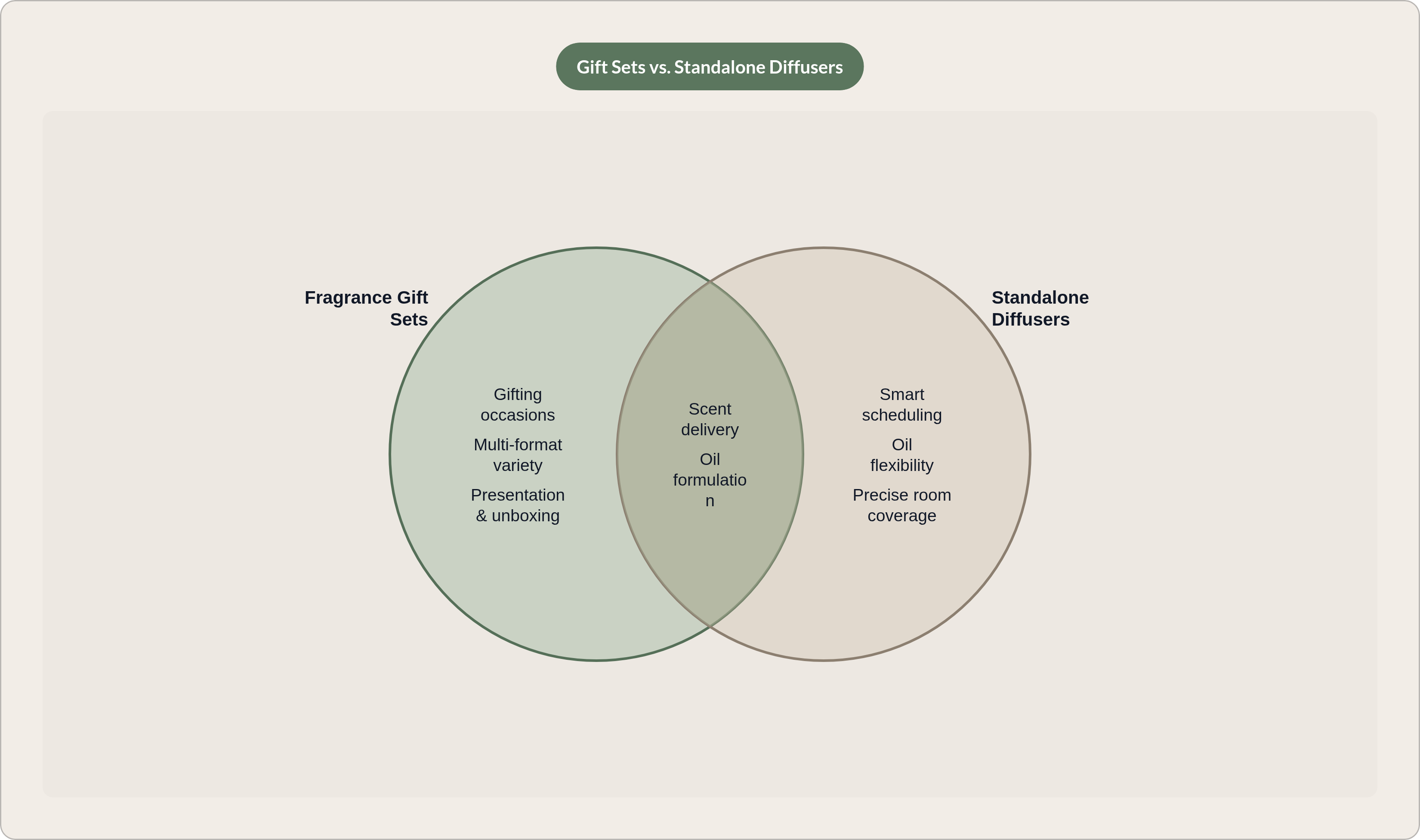
Gift sets earn their keep when matched to the right moment, solving a problem a diffuser was never built to solve. A candle for evening ambiance, a reed diffuser working quietly in the background all day, a room spray for a quick refresh before guests show up: together these build a scent arc across a day that no single device replicates on its own.
Sensory richness and presentation, that's the actual strength here. Housewarmings, holidays, milestone gifts: these are moments where unboxing something varied and well-arranged signals thought in a way that handing someone one plastic device doesn't quite manage.
A well-built set around a single fragrance family also lets the recipient layer the same notes across formats, a candle in the living room, a spray by the front door, and that consistency counts for something real.
Check the math every time, though, because sets tip either direction depending on what's actually inside the box. Best case, you get a full-size fragrance plus a complementary product for barely more than the fragrance alone would cost. Worst case, you get an undersized bottle bundled with a token trinket, priced above what the full-size version sells for on its own. Take the YSL Black Opium Luxe Edition, priced at $150.00: that sits close enough to a standalone 3-ounce bottle at $155 to $160 that the set could be a steal or a slight overpay, and which one it is depends entirely on what's actually packed inside. Read the fine print on volume before you read the price tag as a verdict.
The right buyer for a gift set is someone gifting for atmosphere and occasion. Someone trying to build a home fragrance system around precision coverage and oil flexibility needs a different purchase entirely, which is the whole subject of the next section.
How oil compatibility and long-term costs change the calculation for diffuser buyers
Gift sets lock you into one scent story. Fine for a gift, a real limitation if you're the one living with it every day. The oils or candles included often aren't refillable or compatible with anything else, so once they run out, whatever diffuser component came bundled with them just sits there gathering dust.
Standalone diffusers, cold air ones especially, run on a different premise: the device stays put, and the fragrance rotates by room, season, or mood. That's the clearest dividing line between the two formats, full stop.
Oil compatibility deserves its own callout. Cold air diffusers need fragrance oils formulated specifically for nebulization; thick carrier oils or badly formulated blends will clog the atomizer over time, no exceptions. Before buying oils from wherever's cheapest, confirm the viscosity and formulation actually match your device's spec sheet. Skip that step, and a modestly priced diffuser turns into a paperweight sitting on the counter, doing nothing.
Room matching matters just as much. A device's coverage rating should match the actual square footage it's running in. Underpowered for the space, and it runs constantly, burning oil faster than it should; overpowered in a small room, and it overwhelms everyone standing in it. Smart scheduling helps here too, since timer and intensity settings cut unnecessary diffusion in a way that adds up over months of daily use.
Maintenance is the cost nobody puts on the price tag. Cold air diffusers need periodic cleaning to keep the atomizer working and the scent output clean, and that's a time commitment as much as a line item at checkout. If the device runs regularly in one room with oils you plan to rotate, the standalone diffuser's flexibility justifies paying more upfront than a bundle priced for a gifting occasion. If it's only going to sit there occasionally, that math shifts, and the bundle might actually win.
How scent goals — mood, ritual, and room function — should steer the format decision
This is where the decision stops being purely practical. Roughly 80% of fragrance users see scent as essential to mood, and more people report caring about scent now than did five years back. Fragrance increasingly gets bought for how it makes someone feel, sometimes more than for how the room smells to a guest walking through the door.
That opens up a rough time-of-day framework. Mornings call for citrus, mint, green tea: energizing notes suited to kitchens and bathrooms. Focus periods lean toward rosemary, peppermint, eucalyptus, and there's research linking rosemary and peppermint diffusion to measurable gains in alertness and recall. Evenings shift toward lavender, chamomile, sandalwood, and lavender in particular has a decent research base behind it for reducing pre-procedure anxiety in clinical settings.
What does that mean for which format you buy? Someone who wants scent to shift by room and time of day needs scheduling, intensity control, and the freedom to swap oils, none of which a single-fragrance gift set handles well. Someone who wants one ambient scent in one defined space, a guest bathroom, say, or a bedroom that just needs a low-key consistent presence, is probably fine with the passive pieces a gift set typically includes.
There's a safety angle too, and it's worth taking seriously rather than treating as a footnote. Diffused oils from a cold air device, run in a ventilated room, cut down on contact and inhalation risk compared with an open flame, which matters more in households with pets or small kids underfoot. Oil transparency, no phthalates, no parabens, stops being a nice-to-have in those homes. If scent is a daily ritual with a morning beat, a focus beat, and a wind-down beat, the standalone diffuser with interchangeable oils is the one built to keep pace with all three.
Matching the right format to the specific buyer situation
Gift set, or standalone? Buy the gift set when the purpose is gifting, full stop: housewarmings, holidays, new homes, moments where presentation and variety do the work of signaling care. It also makes sense for someone who enjoys fragrance casually with no real coverage requirements, or someone brand new to home fragrance who'd benefit from sampling a few formats before committing to one. Just check the bundle math first. Would the included items cost more bought separately? Sometimes yes, sometimes surprisingly no.
Buy the standalone diffuser when it's for yourself, for a specific room with a known square footage, and consistent daily performance is the actual goal. It's the right call when oil flexibility matters to how you live day to day, rotating scents by season or mood, and when pets, kids, or air quality concerns make open flames or extra humidity something to avoid. It's also the right call if smart scheduling appeals to you, giving you set-it-and-forget-it control a candle can't offer, and if you'd rather invest in oils over time than keep repurchasing gift sets every few months.
There's a hybrid path worth mentioning before we close the book on this. A gift set can be a genuinely good entry point into cold air diffusion if it's built around a quality cold air unit with a curated oil selection alongside it, giving the recipient both the gifting moment and a device worth keeping running afterward. Look for sets where the diffuser is the centerpiece, not something stuffed in as an afterthought next to a bar of soap.
For a gift set, check item sizes (full-size versus token), ingredient transparency, whether the components share a scent family, and whether any included diffuser has real coverage specs listed anywhere at all. For a standalone diffuser, check the coverage rating against your actual square footage, oil compatibility requirements, cleaning demands, noise level, and whether smart controls come included or cost extra.
The diffuser market alone reached $1.5 billion in 2024. Buyers increasingly treat these things as household staples rather than novelties, the kind of purchase people plan for rather than something they grab off a shelf in December.