Non-Toxic Fragrance Gifts Safe for People with Sensitivities
Cold-air diffusers with labeled fragrance oil let sensitive people control what they breathe.

Fragrance sensitivity trips up more gift-givers than you'd think, and the reactions it causes run from a mild headache to actual respiratory distress. The fix comes down to three factors: what's in the product, how the scent gets into the air, and whether the person breathing it controls how much they get. A cold-air diffuser paired with clearly labeled, undiluted fragrance oil checks all three boxes in a way candles, sprays, and plug-ins mostly don't. I want to walk through why, because the "why" is where the useful stuff lives.
Here's the part nobody says out loud at gift-giving time: the person who reacts badly to your candle almost never tells you. They get the headache, or the sneezing fit, or that tightness in the chest, and quietly regift the thing. You never find out your thoughtful gesture ended up in a donation bin three towns over. A lot of this traces back to how most mass-market scented goods get made: combustion, synthetic loads stacked into one vague "fragrance" listing, ingredient blends nobody outside the lab actually knows the contents of. So here's the question worth sitting with: what would a fragrance gift look like if someone designed it for a sensitive nose instead of designing it to smell good under fluorescent lights at a big-box store?
What conventional scented products release into the air
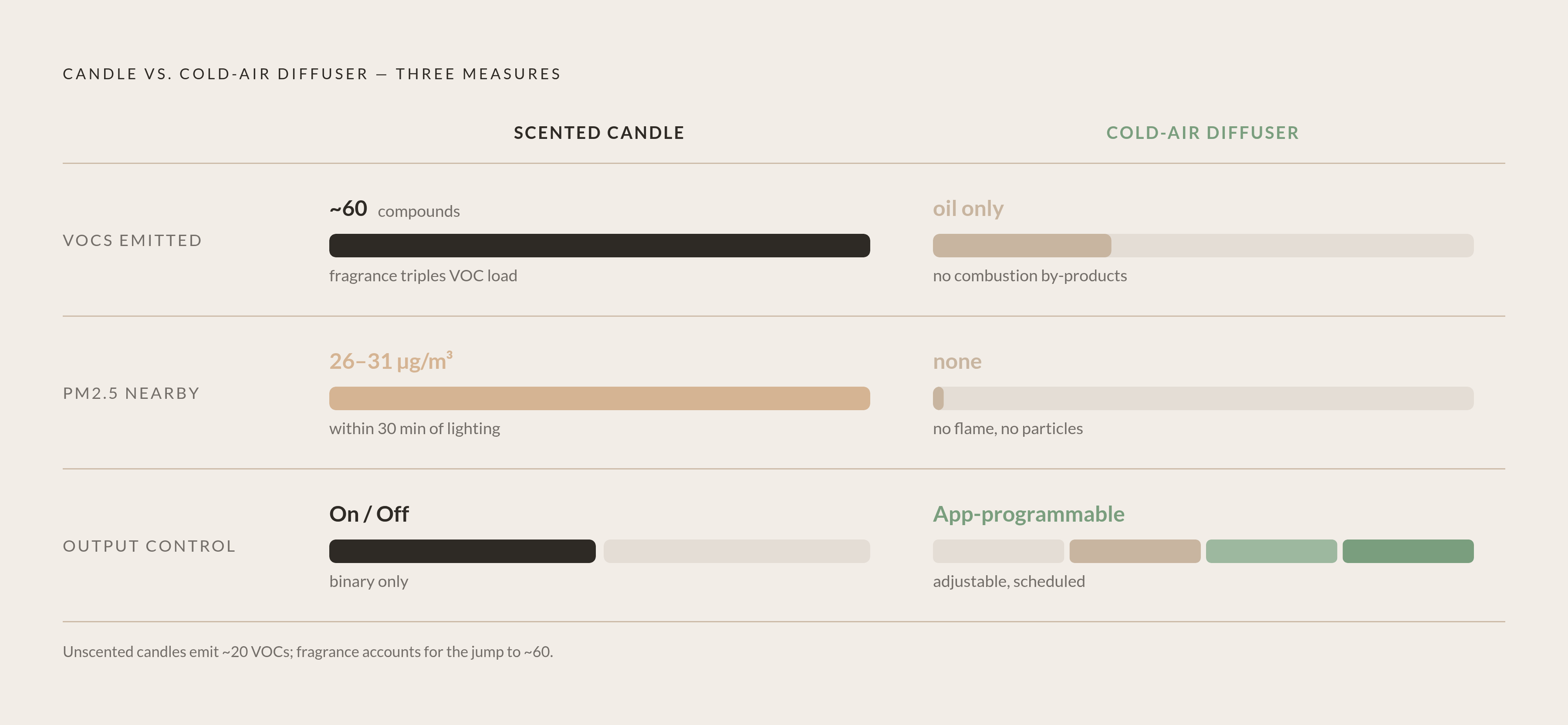
A 2025 study on scented candles gives a sense of scale. Burn one in a room and nearby PM2.5 concentrations climb to somewhere around 26 to 31 micrograms per cubic meter within half an hour. That's a real, measurable air quality event happening in someone's living room while they light a candle for ambiance on a Tuesday night.
Paraffin, the wax most conventional candles use, is petroleum-derived, and burning it releases volatile organic compounds including benzene and toluene. Neither needs an introduction if you've ever glanced at an OSHA fact sheet. Steinemann and colleagues found the average scented consumer product emits around 17 VOCs, with each product contributing somewhere between one and eight compounds classified as toxic or hazardous. Nearly 44% of the products studied generated at least one hazardous air pollutant with carcinogenic potential, the kind of chemical the EPA won't call safe at any exposure level. A separate study, published in 2026 in Environmental Science & Technology, found roughly 20 VOCs in unscented candles compared to 60 in scented ones. Fragrance itself, not the wax or the wick, is doing most of the chemical heavy lifting there.
Layer onto that the EPA's longstanding finding that indoor air runs two to five times more polluted than outdoor air, and the shape of the problem gets clearer. Indoor fragrance sources add to a baseline that's already elevated before anyone strikes a match. Short-term exposure to candle smoke has been linked to reduced cognitive performance; chronic incense smoke exposure has been associated with cognitive decline over time. Phthalates, used to make synthetic fragrance last longer on shelves and in the air, get tied to asthma triggers and hormonal disruption.
None of this makes candles evil. It does mean a beautifully packaged, expensive candle can be one of the worst possible gifts for someone with a sensitivity, and the giver has no way of knowing that from the label alone.
Why "natural" and "non-toxic" are not the same thing on a fragrance label
There's no legal definition governing what "clean" or "natural" means on a fragrance product. That gap is exactly the kind of thing marketing loves to fill quietly. "Natural fragrance," "aroma," "parfum," "luxury scenting," even the plain phrase "fragrance oil": all of these are, more often than not, describing something synthetic. Unless a product specifically says "100% essential oil," assume it isn't one.
Here's where it gets genuinely interesting, and where a lot of well-meaning shoppers trip. Essential oils aren't automatically safer just because they came from a plant instead of a lab; botanical origin was never a safety guarantee. Certain essential oils cause skin sensitization or phototoxic reactions with repeated exposure. Researchers have flagged, starting around 2025, that terpenes common in natural scent compounds can react with ordinary indoor ozone and form secondary nanoparticle pollution. That's a genuinely new wrinkle, and it undercuts the comfortable assumption that plant-derived means inert.
Meanwhile, a well-studied synthetic fragrance molecule that's gone through rigorous toxicological review can turn out safer than a poorly tested natural extract nobody has bothered to characterize. Provenance alone was never the right standard. What determines safety is full disclosure of formula contents, the absence of known endocrine disruptors and respiratory irritants, and testing against a recognized clean standard rather than a marketing claim someone invented for the box copy. The label's adjectives carry almost no weight here. The ingredient list carries the real information, assuming you can even find one.
The three things that actually determine whether a fragrance gift is safe for a sensitive person
So if labels can't be trusted at face value, what can a gift-giver actually check? Three things. Treat them as a framework, not a checklist you skim once and forget by the time you're at the checkout counter.
Ingredient transparency comes first. That means full disclosure of what's actually in the formula, rather than one catch-all word like "fragrance" standing in for dozens of undisclosed compounds. It means no phthalates, formaldehyde, or benzene derivatives, all known irritants with documented health associations. Vegan and cruelty-free formulation isn't a safety metric by itself, but it correlates with cleaner sourcing practices more often than not, and third-party certification gives you something to verify instead of taking a brand's word for it.
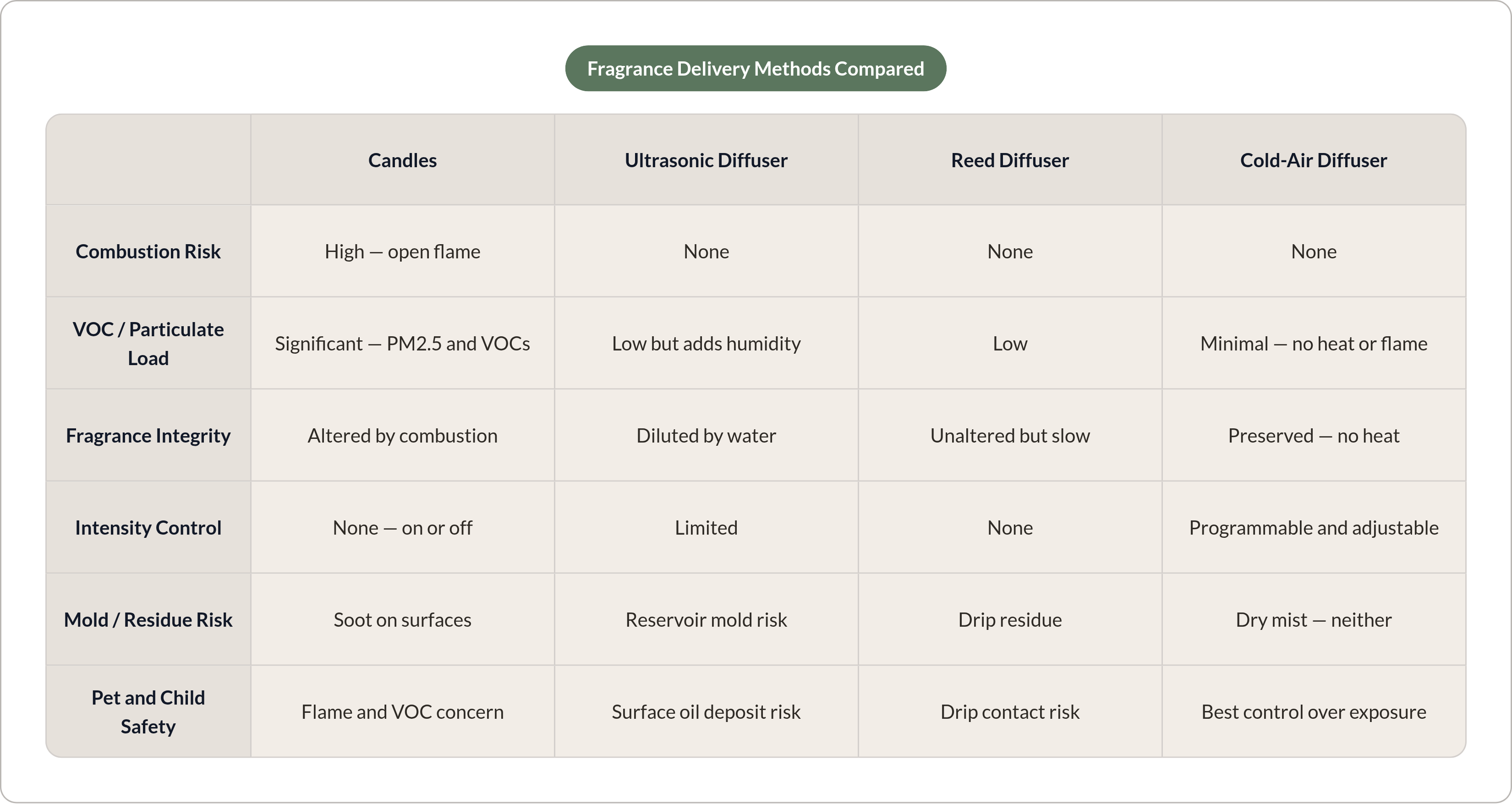
Delivery method matters just as much, maybe more, since it determines what byproducts end up in the air alongside the scent. Combustion, whether candle or incense, introduces particulate matter and VOC byproducts that have nothing to do with the fragrance and everything to do with the flame. Heat-based delivery, like wax warmers, can degrade fragrance compounds and alter their chemical makeup, so what reaches the nose reflects what the heat did to the oil as much as what was in the bottle to begin with. Water-based ultrasonic diffusers dilute the fragrance and add humidity, which invites mold in a reservoir that doesn't get cleaned as often as it should. Reed diffusers are low-tech and combustion-free, a point in their favor, but they give you almost no control over how much scent enters the room at any given moment.
Intensity control is the piece people underestimate most. Some brands built around cold-air diffusers treat this as a starting assumption rather than an afterthought. Over-scenting triggers sensitive individuals even when the scent itself is clean; a genuinely non-toxic fragrance oil at too high a concentration still causes headaches. Sprays and plug-ins offer little to no adjustment; you get what you get. A diffuser with programmable scheduling and adjustable output lets the recipient dial things in to what their own body can handle, and that's a kind of control most fragrance products just don't offer.
How cold-air diffusion addresses each of those three criteria
Cold-air diffusion is worth examining closely because it satisfies all three criteria at once, a function of how the mechanism works.
On ingredient transparency: cold-air diffusers use undiluted fragrance oil. Whatever's printed on that oil's label is exactly what disperses into the room. There's no combustion chemistry happening in between to generate new compounds you never signed up for. What you buy is what you breathe, full stop.
On delivery: the device pulls in filtered room air and uses it to atomize the fragrance oil into an extremely fine, dry micro-mist. No water, no alcohol, no heat, anywhere in the process. That means no thermal degradation of the fragrance compounds, so the scent profile stays close to what the chemist actually built. It also means no added humidity, so no mold quietly colonizing a reservoir somewhere behind the couch. The particles are fine enough to stay suspended in the air rather than settling onto furniture or fabric, so you skip the oily residue that ultrasonic and reed diffusers tend to leave behind over months of use. No open flame also means none of the combustion-related particulate and VOC load documented in the candle research above.
On intensity control: smart cold-air diffusers generally support app-based control, programmable scent schedules, and adjustable output. A sensitive recipient can start at the lowest setting, run it in short intervals, and build up tolerance gradually. That's an option a candle you either light or don't simply cannot offer. Scheduling also means the fragrance isn't running all day, which cuts cumulative exposure. Worth mentioning for gift purposes specifically: cold-air diffusers tend to cover larger rooms than candles, reed diffusers, or ultrasonic units, so the recipient isn't boxed into using it in one spot.
What to look for in the fragrance oils that go with the diffuser
The diffuser is only half the equation. Buy great hardware, pair it with a poorly formulated oil, and you've solved one problem while leaving the other one fully intact.
A sensitivity-appropriate fragrance oil discloses its full ingredient list rather than hiding behind "fragrance" as an umbrella term. It's free of phthalates, parabens, sulfates, and known endocrine disruptors, and ideally formulated vegan and cruelty-free. Worth checking, too, whether the oil has actually been tested for compatibility with cold-air diffusion specifically: viscosity and chemical composition affect how well an oil nebulizes, and not every oil performs the same way once it hits that mechanism.
The "natural doesn't automatically mean safe" point from earlier applies here with equal force. An oil labeled "essential oil blend" can still contain compounds known to cause sensitization in some people, so the natural-versus-synthetic framing matters less than transparency about the specific ingredients. For a gift-giver, pairing the diffuser with a small, curated set of clearly labeled, tested oils turns the whole thing into a complete gift. The recipient shouldn't have to go do their own homework on the fragrance oil market before they can safely use what you gave them. Starting with a lighter, simpler scent profile rather than a heavy, multi-note blend is the sensible move for someone trying this delivery method for the first time.
Household members who aren't the primary recipient — pets, children, and others with vulnerabilities
A fragrance gift doesn't go to one person. It goes into a household, and everyone breathing that air is affected whether they know it or not.
Cats and dogs have far more sensitive olfactory systems than we do, so a scent level that reads as mild to a person can feel overwhelming at nose height for an animal sniffing around the floor all day. Cats are widely recognized as more vulnerable to certain essential oil compounds than humans are, which means topical contact or a very high airborne concentration poses a real risk, not a theoretical one. Dogs generally tolerate well-diluted, diffused scent fine as long as the room has ventilation and the dog has somewhere else to go if it wants out. Cold-air diffusion has a practical edge here too. Its dry micro-mist doesn't deposit oil onto surfaces that a pet might walk across and later groom off its paws, which is more than you can say for ultrasonic units or reed diffusers prone to dripping.
Kids' respiratory systems are still developing, and combustion-source VOCs are a documented concern for that age group specifically. Intensity control and scheduling stop being a nice-to-have in a house with young kids and start being the actual point of the purchase.
Buying this for someone? Ask if anyone in the house has pets, young kids, or other sensitivities. That's thirty seconds of due diligence, and it meaningfully changes which oils belong in the box.
How to frame and present this kind of gift so it lands well
A diffuser and a box of oils doesn't explain itself sitting under a tree. A little framing turns it into something the recipient can use with confidence on day one, instead of something they Google at 11pm wondering if they set it up wrong.
A short note goes a long way: no phthalates, no hidden synthetic load, full ingredient transparency, delivered cold, without combustion or heat, so the scent is genuinely what the label claims. Give explicit permission to start low. Suggest the lowest intensity setting, short intervals at first, and mention the device can run on a schedule instead of all day. Room placement deserves a line too: a well-ventilated space for the first few uses, and holding off on an enclosed bedroom until they've found their own tolerance.
What this kind of gift signals goes a bit beyond the object itself. It tells the recipient that someone did the work to make sure the experience wouldn't hurt them, a different kind of thoughtfulness than grabbing the best-smelling candle off the shelf at checkout. Care that shows up in the formulation is arguably the whole point of giving something in this category at all. And the timing works in the giver's favor. Data shows 72% of people reported appreciating scent more in 2024 than they did in 2020, which suggests the person you're buying for probably already leans toward home fragrance as a category. The desire's already there. The job is just making sure what you hand them doesn't give them a headache by dinner.