Unique Romantic Gift for a Wife Who Works from Home
Cold air diffusion preserves fragrance molecules better than heat or water methods.

Cold air diffusers make a genuinely romantic gift for a wife who works from home, and the reasoning comes down to a mechanical fact most gift guides never mention: heat and water both degrade the fragrance oil they're supposed to deliver, while cold air diffusion leaves the molecule alone. That single distinction, tested against candles, sprays, and water diffusers, is the whole argument, and it's worth walking through because the difference shows up in her actual workday.
Her home office is three rooms stacked into one: professional environment, creative space, and the closest thing to a sanctuary she gets on a random Tuesday. Most romantic gifts get worn once, eaten in an evening, or unwrapped and filed under nice memory. This one sits on her desk every morning, doing something quieter than flowers ever could.
How scent actually shapes focus, mood, and stress (the science behind why this gift works)
Start with the wiring, because it explains everything downstream. Smell is the only one of the five senses with a direct line to the hippocampus and amygdala, the brain's memory and emotion centers, bypassing the usual filtering that most other sensory signals pass through before reaching conscious awareness. Sound and light get interpreted first, then routed. Scent goes straight to the machinery running memory and mood, which is why a smell can flood someone with a feeling before they've even named what they're smelling.
That shortcut is why fragrance-elicited emotional responses get linked, in research on the topic, to lower stress and a better overall mental outlook. For a wife working from home, that signal shapes how she drops into deep work at 9am, how she survives a tense client call at 2pm, and how she manages the exit from work mode once the day is technically over but her brain hasn't caught up yet.
Certain scent categories show up again and again in concentration research, and the why matters more than the list. Citrus notes like lemon, bergamot, and grapefruit, along with rosemary and eucalyptus, get cited repeatedly for supporting focus, the theory being that these sharper compounds trigger alertness the way caffeine does, minus the crash. Lavender's calming effect is among the most documented findings in the entire fragrance research space, with plant-based scents broadly shown to lower cortisol and heart rate. For the specific ritual of closing the laptop and stepping out of work mode, grounding notes like cedar, amber, vetiver, and tonka signal that this part of the day is over now.
A 2024 study found that continuous essential oil inhalation was associated with increased gray matter volume, which suggests scent exposure leaves effects on the brain that outlast the moment of smelling it. That finding sits inside a bigger shift in how fragrance gets studied. IFF's Science of Wellness research has spent more than four decades on fragrance perception and now pairs that work with AI and neuroscience to study scents that might energize or relax. The industry has started measuring mood as a metric in its own right.
Strip away the research-paper language and the actual value is quieter: consistent environmental conditioning running in the background of a day.
Why a cold air diffuser delivers that experience better than candles, sprays, or water diffusers
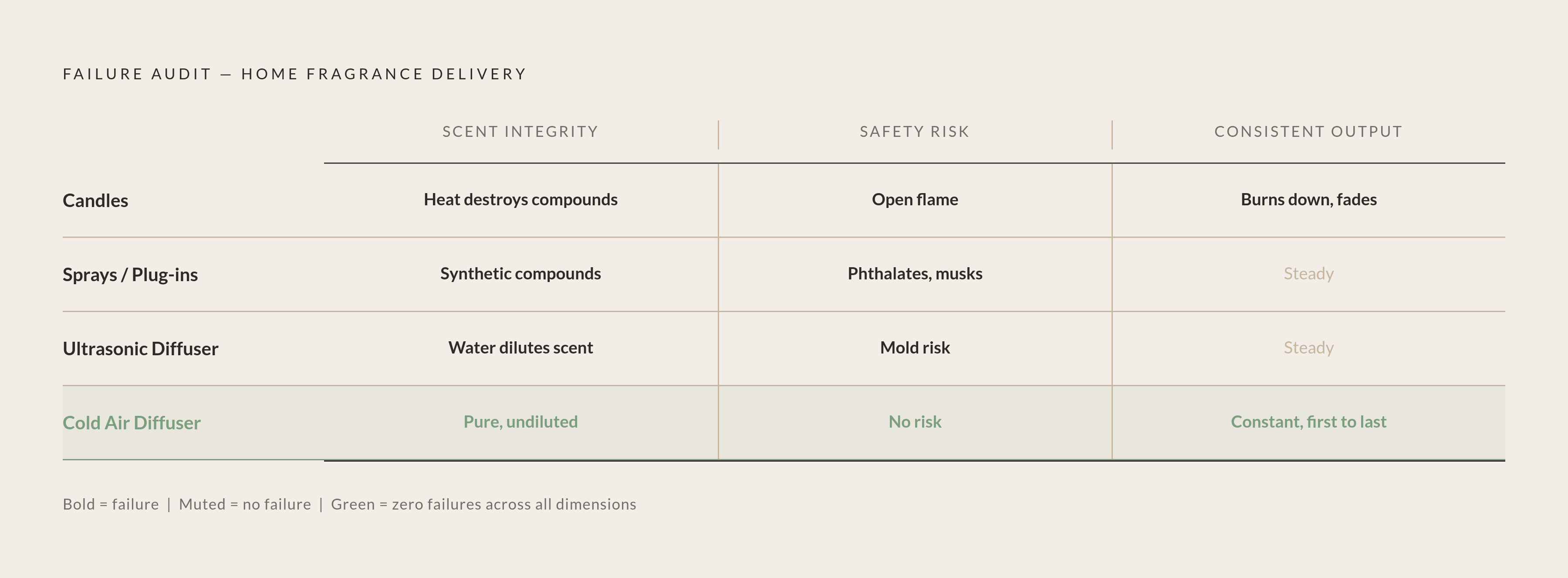
Consider skipping the candle. The mechanism backs it up: heat breaks aromatic compounds apart chemically, which is why a candle three hours into burning smells flatter and more one-note than it did fresh out of the box. Cold air diffusion runs fragrance oil through an atomizer that breaks it into microscopic particles, then pushes those particles into the air using cool, pressurized air, with no flame, no water, and no heat source anywhere in the process. What reaches the nose stays close to the oil's true molecular structure, something no heat-based method reproduces as faithfully.
Candles also carry problems that have nothing to do with scent quality. Burning anything, no matter how "clean" the wax claims to be, produces some soot and combustion byproduct, and certain wick or wax materials make it worse. There's a plain hazard specific to a home office as well: an open flame near loose papers, tangled cords, and a workspace where attention is already split all day isn't a controlled environment by any definition worth using. The scent output is inconsistent on its face, too: strong when freshly lit, weaker as the wax pool deepens, gone once it cools.
Water-based ultrasonic diffusers dodge the flame problem and introduce a different one. They dilute the oil with water, which weakens the actual concentration reaching the air, and they add humidity to a room, a real concern near hardwood floors, electronics, or artwork (the exact three things that tend to sit in a home office). A water reservoir that isn't cleaned on a tight schedule turns into a place mold grows. Sprays and plug-ins carry their own baggage: synthetic delivery systems with limited scent control, often built on phthalates and synthetic musks that remain legal and widely sold in the US despite being restricted in several European countries.
Line up all four and cold air diffusion covers more square footage than a candle, reed diffuser, plug-in, or ultrasonic unit typically manages, using a fine, dry mist that stays suspended in the air instead of settling as an oily film on a desk, a monitor, or a keyboard. It runs safely near hardwood and electronics, and it puts out the same scent strength from the first minute to the last, since there's no burn-down curve to fight. Newer smart diffusers add scheduling that fits a work-from-home routine almost too well: app-controlled intensity and timing, so a citrus-forward focus scent runs from 9am to noon and a warmer wind-down blend kicks in around 5pm without anyone remembering to swap a cartridge.
What makes a cold air diffuser safe in the space where she works and lives
Fair challenge to the whole premise: if home fragrance affects the brain this directly, what's actually in the bottle matters quite a bit. A lot of conventional home fragrance still contains parabens, phthalates, and synthetic musks. Parabens can mimic estrogen in the body and have been linked to hormonal disruption. Phthalates are restricted across multiple European countries but stay legal in the US, which means "available at the store" and "vetted for long-term exposure" are two different claims wearing the same label. Synthetic fragrance loads can also trigger allergies, asthma, and general respiratory irritation, and that stops being hypothetical the moment someone sits in that same room for eight-plus hours a day, five days a week.
So the fragrance oil matters as much as the diffusion method (arguably more), and this is the part most buyers skip entirely. Look for oils free of phthalates, parabens, and synthetic musks, ideally vegan and cruelty-free, from a source that discloses what's in the bottle instead of hiding behind "fragrance" as a catch-all label that tells you nothing. Certifications from the International Fragrance Association or the Natural Products Association are a reasonable signal that a manufacturer's safety standards rest on something more than marketing copy, not a guarantee, but a signal worth checking for.
The market has already been drifting this direction on its own. Roughly two-thirds of consumers now say they prefer home air-care products that smell as natural as possible, and nearly half favor natural fresheners over synthetic ones outright. Cleaner, better-documented options are easier to find now than they were even a few years back, which removes most of the excuse for buying blind.
Cold air diffusion has a structural safety edge baked into how it works: no heat, no combustion, no smoke, no carcinogenic byproduct, no open flame anywhere near the process. In a house with kids, pets, or both, that's not a minor detail. Picking a diffuser from a manufacturer that actually publishes its ingredient standards is a small, checkable signal that the gift was chosen with some thought, rather than grabbed off an end-cap on the way to checkout.
How to choose the right diffuser for her home office (coverage, placement, and intensity)
Room size is the first thing to get right, and it's the variable most people skip entirely. A diffuser built for an open-concept living room will overwhelm a small enclosed office, turning a subtle ambient scent into something that hits everyone the second the door opens. Go the other way, undersize a unit for a larger studio-style workspace, and the scent never fills the room; it just hangs near the device with limited reach. Check the manufacturer's stated square footage coverage and be honest about the room in question, since a closed office door changes airflow completely compared to an open-plan setup where scent competes with air moving in from other parts of the house.
Placement does nearly as much work as the device itself. Position it around nose height or slightly above for the best dispersion, and keep it away from direct airflow like a vent, fan, or open window, since moving air scatters and dilutes scent before it settles into the room. Skip placing it next to electronics or anything generating heat. A central spot diffuses more evenly than a corner, where half the output just gets absorbed by nearby walls.
On intensity: a stronger setting doesn't necessarily make a better gift, and this is where most people get it backwards. A diffuser doing its job right creates a scent that's present but doesn't announce itself the second someone walks in, so adjustable output settings matter more than raw power. Noise matters too, arguably more here than in most rooms of the house, since she's on calls and doing concentration work, and a diffuser humming audibly in the background just becomes its own distraction.
Maintenance is the unglamorous variable that decides whether any of this gets used six months from now. Ask what cleaning the unit requires and how often. A diffuser that's a pain to clean quietly degrades in performance and eventually just stops getting turned on, while simpler upkeep means it stays in rotation instead of migrating to a closet.
Pair the device with the oils themselves from the start: a citrus or eucalyptus blend for focus hours, something warmer like cedar or lavender for the evening wind-down. That way the gift arrives ready to use, sparing her the trouble of researching and shopping for oils on her own.
Why this gift reads as romantic rather than practical
Whether this counts as a "practical" gift or a genuinely romantic one comes down to a distinction that's easy to miss: the value sits less in the object itself than in what the object proves someone noticed. A diffuser says something specific, that the giver clocked exactly where she spends her days and wanted that particular room to feel better, not just any room, that one.
It also doesn't end. A dinner out is wonderful and then it's over. Flowers are lovely and then they wilt in about eight days. A diffuser creates a small moment she returns to every single morning, so the gift compounds instead of fading. Given how directly scent ties into memory through that hippocampus-amygdala pathway, the fragrance she associates with her sharpest focused mornings or her calmest evenings becomes quietly linked to whoever gave it to her.
Signature scenting in hospitality exists for a reason: a considered fragrance environment reads as cared for, arrived at, intentional, the second someone walks through the door. Bringing that same feeling into her own home office hands her, on an ordinary Tuesday, something she might have only ever felt while traveling somewhere nicer than home.
Pair it with a note that says something specific, closer to "I know how hard you work in that room, and I wanted it to feel like yours" than a plain "love you." Specificity is the whole mechanism here; it's what separates a gift that says the giver noticed from one that just says the giver remembered a birthday was coming up. Giving her the diffuser alongside a curated set of oils, rather than dictating which scent she has to like, respects her actual sensory preferences and lets her build the atmosphere herself.
In the end, this is a gift that pays attention to her on a random Wednesday in March, a quieter kind of attention than the one day a year everybody remembers to show up for.