Smart Diffuser Scheduling for Morning and Evening Scent Routines
Scent's direct path to your brain makes timing it to your body's natural rhythms actually matter.
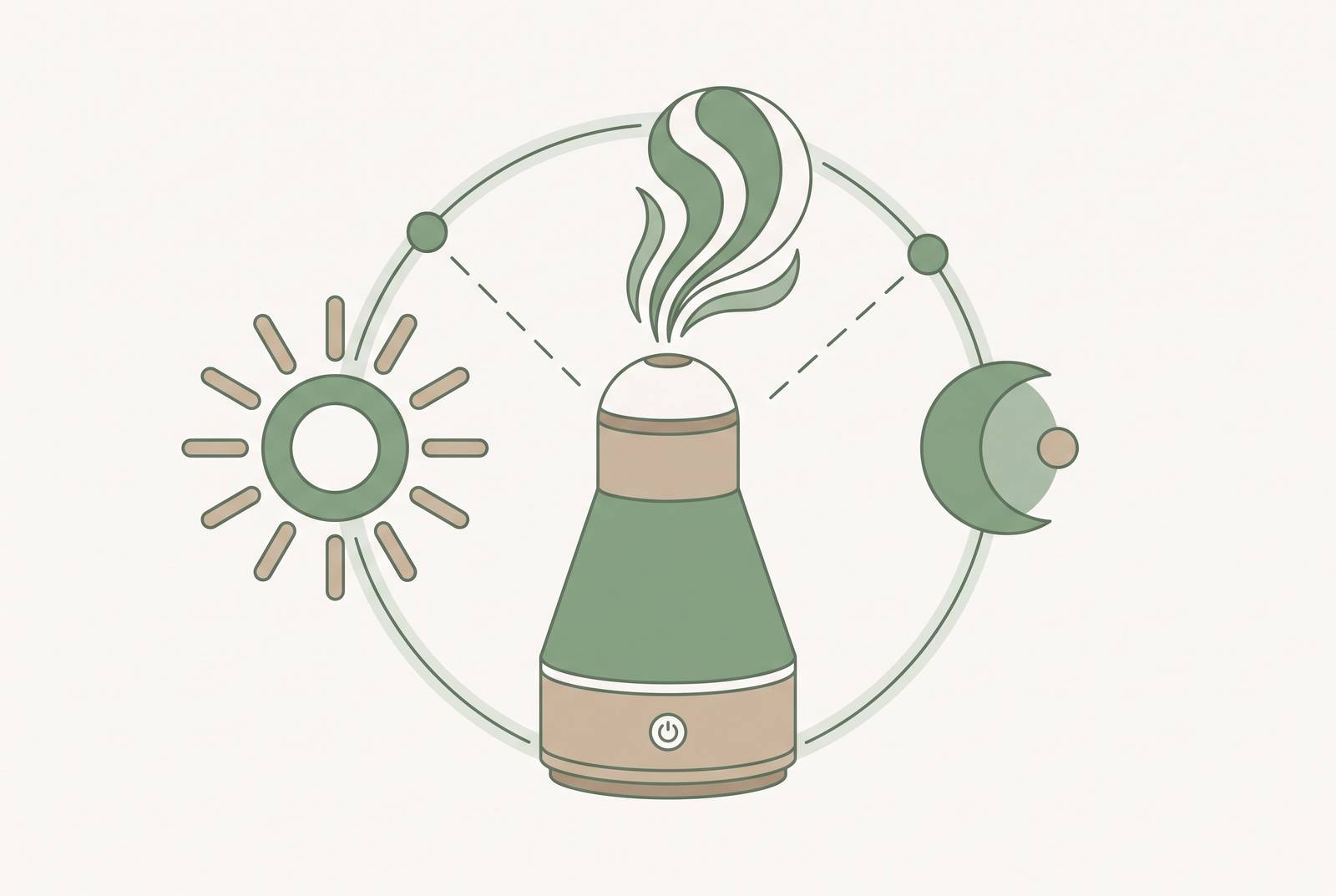
Smart diffuser scheduling is the practice of programming a home fragrance device to shift scent profiles across the day, energizing blends in the morning, calming ones at night, instead of picking one smell and running it on a loop. The idea sounds almost too simple to write an article about, but the mechanism behind it, and the amount of engineering now built into consumer diffusers to support it, is genuinely more interesting than the phrase "ambient fragrance" suggests.
Start with the biology, since that's what makes the whole thing more than a marketing angle. Cortisol, the hormone tied to alertness, peaks in the morning hours after waking. Melatonin, the one that signals the body toward sleep, climbs in the evening as light fades. These are not vague tendencies, they are the two most well-documented hormonal rhythms in human chronobiology. Scent, meanwhile, has a strange shortcut into the brain that no other sense gets: olfactory signals route through the limbic system, the same region that handles emotion and memory, more directly than most other sensory input does. Research highlighted in PMC suggests that smell and emotional experience are deeply intertwined at a neurological level, not two separate processes where one simply triggers the other. That's a stronger claim than "scent affects mood." It's closer to saying scent doesn't decorate an emotional state, it participates in creating one.
Put those two facts next to each other, a body that runs on a predictable daily hormone cycle, and a sense that talks directly to the brain's emotional wiring, and scheduling stops looking like a lifestyle gadget feature. It looks like matching an input to a rhythm that's already happening whether anyone plans for it or not. Fragrance industry data backs up how seriously people already take this: roughly 80% of fragrance users say scent is essential to mood management, and the share of the population that says it noticed and appreciated scent more in 2024 than in 2020 sits at 72%, a shift that lines up neatly with a few years of people spending a lot more time in their own homes. Most people already know their house smells different at 7 AM than at 10 PM. A smart diffuser schedule doesn't invent that experience. It just formalizes something the brain was already doing for free.
What smart diffusers actually do that manual ones cannot
A smart diffuser is a fragrance device controlled through an app, usually with voice assistant support through Alexa, Google Assistant, or Apple HomeKit layered on top. The "smart" part isn't the fragrance, it's the control layer, and that control layer is what makes scheduling possible at all.
A handful of capabilities matter here more than the rest. Time-of-day scheduling lets someone set exact start and stop windows, and split those windows by weekday versus weekend, so a Tuesday morning schedule doesn't have to look like a Saturday one. Intensity adjustment goes beyond on and off, letting a device run at a fraction of its output rather than full blast or nothing. Interval diffusion sends scent out in bursts, say 15 minutes of every hour, rather than continuous output, which turns out to matter more than it sounds like (more on that later). Some devices support gradual wind-down modes that taper an evening session rather than cutting it off abruptly. And some platforms offer location-aware triggering, so a diffuser can activate as a resident approaches home rather than starting cold on a fixed clock.
None of that is available on a manual diffuser, which is really just a switch. Flip it on, flip it off, hope you remember. The gap between a scheduled device and an unscheduled one isn't about scent quality, it's about consistency, and consistency is what turns aromatherapy from a good intention into an actual daily habit. Smart home integration pushes this further: according to a Grand Research Store market report, a "Good Morning" routine can trigger lights, music, and a citrus diffusion together, so scent becomes one layer in a coordinated wake-up sequence rather than its own separate chore. Considering that household penetration of Alexa and Google Assistant devices already exceeds 40% in several major markets per that same report, a lot of readers already own the ecosystem a smart diffuser would simply plug into.
Worth flagging: cold-air diffusion, a mechanism used by a number of these devices, breaks fragrance oil into microscopic particles using cool air rather than heat or water vapor. No humidity, no heat degrading the aromatic compounds. That matters specifically for scheduling, because a device running several short cycles a day for months needs to stay low-maintenance. A diffuser that needs a water refill every two days will break a schedule faster than any software bug will.
Fragrance profiles that suit morning energy and why they work
Morning scent choices should track the same goal cortisol is already chasing: alertness, mental clarity, a nudge toward motivation. Citrus oils, lemon, orange, grapefruit, show up constantly in aromachology literature tied to mood elevation, and they're the closest thing this field has to a default morning choice. Peppermint is widely cited in aromachology and diffuser scheduling guides as a reliable choice for focus and clarity, which is probably why it ends up in so many "morning blend" products rather than evening ones. Rosemary carries a similar reputation, tied more specifically to concentration. Eucalyptus rounds things out with a sharper, clearing quality that reads almost physical, like a cold splash of air for the nose.
Intensity is where a lot of people overcorrect. The instinct is to crank a new diffuser to maximum because more scent equals more wake-up, right? Not really. The goal in the morning is activation, and a room that smells faintly energizing is a nicer place to exist in than one that hits you like a wall of citrus before the coffee's even brewed. Start moderate. There's room to adjust after living with it for a week.
Timing matters as much as the fragrance choice itself. Setting the diffuser to start 10 to 15 minutes before an alarm means the scent is already present at the moment of waking, rather than lagging behind and catching up over the next twenty minutes. Let it run through the actual morning routine window, shower, breakfast, getting out the door, then scale it back or shut it off once the house empties out. For anyone working from a home office, interval mode earns its keep here: periodic bursts spread across the hour rather than continuous output, a pattern echoed in scheduling guides like the one published by saintdeland.com, keeps a room feeling alert without overwhelming the senses by 10 AM.
One more thing worth pausing on, since it's easy to skip past in an article about scent profiles: the actual oil matters as much as the fragrance family does. A morning oil running for hours in a bedroom or kitchen, spaces that are occupied and often under-ventilated overnight, should be free of phthalates, synthetic musks, and the broader category of volatile organic compounds that show up in cheaper fragrance oils. This is the moment to actually read the ingredient list instead of just sniffing the sample vial. Vegan, cruelty-free, and transparently formulated oils aren't a nice-to-have footnote here, they're the baseline standard for anything running on a schedule in a room where people sleep.
Fragrance profiles that suit evening wind-down and how to structure the transition
Evening scent has a different job: decompression, lowering anxiety, prepping the body for the melatonin curve that's already climbing. Lavender is the most heavily documented option in aromachology research for triggering a relaxation response, to the point where it's practically shorthand for "calming scent" the way peppermint is shorthand for "focus." Chamomile sits a notch softer and gentler, closer to sleep-adjacent than lavender's more assertive floral profile. Sandalwood brings a warm, grounding quality that seems to slow mental pace rather than sharpen it. Cedarwood, earthy and low, is associated with a grounding, quieting quality. Vanilla rounds the group out on the comfort end, tied more to stress reduction than to sleep specifically.
Here's a mistake worth naming directly: switching straight from a citrus-forward daytime scent to lavender at 8 PM sharp, no transition, like flipping a light switch. The nose and, more relevantly, the emotional state attached to it doesn't work on a hard cutoff. A step-down approach works better, either through a native fade-out timer some devices support, or by manually scheduling intensity to drop in stages, high to medium to low, over roughly 90 minutes. Early evening, somewhere in the 6 to 8 PM window, calls for transitional scents like bergamot or a light floral at moderate intensity, bridging the gap between work mode and actual rest. The pre-sleep window, 8 to 10 PM, is where the calming profile takes over at lower intensity, especially in the bedroom.
And then it should just stop. An auto-off via fade timer before deep sleep sets in isn't a minor feature, it's the whole point: continuous diffusion through eight hours of sleep does nothing for anyone and just burns oil into an empty, unconscious room. One diffuser platform, Aromadd, documents this exact pattern in its published guidance: program a calming lavender blend to run from 9 PM to 11 PM in the bedroom, then let it cut off automatically with zero manual intervention required. Intensity at night should generally sit lower than the morning setting anyway, since a closed bedroom with a sleeping body in it accumulates scent over time. Less output ends up reading as more presence, which is a slightly counterintuitive thing to explain to a diffuser dial, but there it is.
How to build the actual schedule: settings, intervals, and intensity by room
Scheduling is a set of decisions applied room by room, not one setting applied to a whole house. It's closer to room-by-room logic, because each room carries a different occupancy pattern and a different footprint. A bedroom needs a morning activation phase and an evening wind-down phase, with essentially nothing running while it sits empty all day. A kitchen or living area probably wants light or no scent during the day and a bit more presence in the evening, especially for entertaining or family time. A home office benefits from interval mode during work hours, periodic on-and-off cycles that keep the environmental cue present without tipping into the kind of olfactory fatigue where the brain just stops registering a smell it's been marinating in for six hours straight.
Before any of that works, the diffuser has to match the room. An undersized diffuser in a large room will run flat out on every schedule and still underwhelm, no matter how cleverly the timing is set. Go the other direction, an oversized diffuser in a small bedroom, and it'll overwhelm the space regardless of what schedule sits on top of it. Scheduling optimizes an already-correct hardware choice. It doesn't fix a mismatched one.
Intensity, once room size is sorted, breaks into three rough tiers. High intensity earns its place only in large open spaces, or as a short deliberate burst to reset a room's scent, not as a default morning or evening baseline. Medium is the standard for active-use rooms during the hours people are actually in them. Low suits overnight bedroom sessions or any spot where the goal is a background presence rather than a noticeable one.
Weekday and weekend schedules shouldn't be the same program repeating on a loop either. Aromadd's scheduling system, for instance, explicitly supports separate weekend profiles, so a lively living-room blend on Saturday morning can sit next to a sharper focus blend running weekday mornings in the same house. Geofencing offers an alternative for anyone whose schedule doesn't run on a fixed clock at all: rather than tying activation to a set time, the diffuser triggers off the homeowner's phone approaching the house. And the first week of any new schedule should be treated as a rough draft, not a finished product. Run it, notice where the scent shows up too early or too late or too aggressively, and adjust. Scheduling is iterative work, not a one-time setup.
How scheduling reduces oil waste and what that means for running costs
An unscheduled diffuser running continuously in an empty room is delivering fragrance to absolutely no one, which is a strange way to describe burning through a $16 to $20 vial of oil, but that's exactly what's happening in a lot of households right now.
The financial logic scales in a fairly straightforward way once fragrance oils sit at that per-vial price point. One data point worth sitting with: a single vial in a medium-sized room, running 6 to 8 hours a day at medium intensity, lasts about 22 days. Running two vials on an alternating schedule stretches combined life out to roughly six weeks, a real conservation effect that comes purely from scheduling smarter, not from buying a different device. Fewer hours diffused into an empty room translates directly into fewer vials bought over a year, and that's before factoring in interval diffusion, which extends oil life even further without hurting perceived scent quality. The nose adapts to continuous fragrance exposure and eventually stops registering it altogether, so pulsing the scent in bursts actually resets that adaptation and can make a lower total volume of oil feel just as present as a nonstop stream would.
Some platforms build the accounting right into the app. Aromadd's software includes usage analytics and low-oil notifications, which is worth looking for specifically when comparing devices, since visibility into how much oil is actually being consumed is the first real step toward not wasting it. Scheduling, in that light, is a core part of what makes the device worthwhile, not a luxury add-on tacked onto an already nice device. It's closer to the mechanism by which a higher-end diffuser earns back its price over time, compared to a cheaper unit left running on default settings around the clock.
The devices that support meaningful scheduling: what to look for and what the current options cover
A few technical questions separate a diffuser that supports real scheduling from one that just has an app for show. Can schedules be set by day of week, not just a single repeating daily block? Are intensity steps genuinely fine-tuned, or is it just a low, medium, high toggle dressed up in an app interface? Does it support interval cycling and fade-out timers, or only a hard on and off? Which voice assistants does it actually talk to? And does it run on proprietary fragrance cartridges or open essential oils, since that single choice affects both scent flexibility and long-term cost.
The current field covers a fairly wide spread. The Aera Smart Home Fragrance Diffuser sits at the premium end, priced around $190 to $200, using waterless technology and covering 500 to 1,000 square feet, with Alexa compatibility built in. On the more accessible side, the ASAKUKI Smart Wi-Fi Essential Oil Diffuser runs $35 to $45, holds 500ml, works with standard essential oils rather than a proprietary cartridge system, and connects to Alexa; it was hands-on tested in the Gabellioni buyer's guide and its larger tank suits longer uninterrupted sessions well. The Sierra Modern Home Smart Wi-Fi Essential Oil Diffuser lands in a similar price range, $35 to $45, with a 400ml capacity, Alexa and Google Assistant compatibility, and a wood grain finish, another budget-friendly option built around standard oils rather than locked-in cartridges.
For anyone dealing with a much bigger footprint, the Magic Scent TMS 1000 Plus (also sold as the TMS 1000 Pro WiFi) is a whole-building aromatherapy system built to cover spaces up to 10,000 square feet, running as many as three separate scent programs a day with adjustable intensity, clearly aimed at commercial or very large residential setups rather than a single bedroom. And Aromadd's waterless smart diffuser line, referenced throughout this piece, supports custom morning, night, and weekend schedules with granular intensity control, usage analytics, low-oil alerts, and battery monitoring on its cordless models.
Broadly, waterless cold-air diffusers tend to be the sturdier platform for scheduling specifically, since there's no water tank to run dry mid-cycle, no humidity side effects to worry about in a bedroom, and coverage that generally outperforms ultrasonic devices in larger rooms, all while running close to silent, which matters a lot when the thing is firing off on a timer with nobody standing next to it to notice a problem. Open-oil devices like ASAKUKI and Sierra Modern Home trade some of that polish for flexibility, letting any clean essential oil or custom blend slot into a schedule without being locked into one company's cartridge supply. Pricing and specs referenced here reflect the Gabellioni smart diffuser buyer's guide as of January 2026, a set of figures that will likely shift as the market does.
Putting the full-day schedule together: a practical template
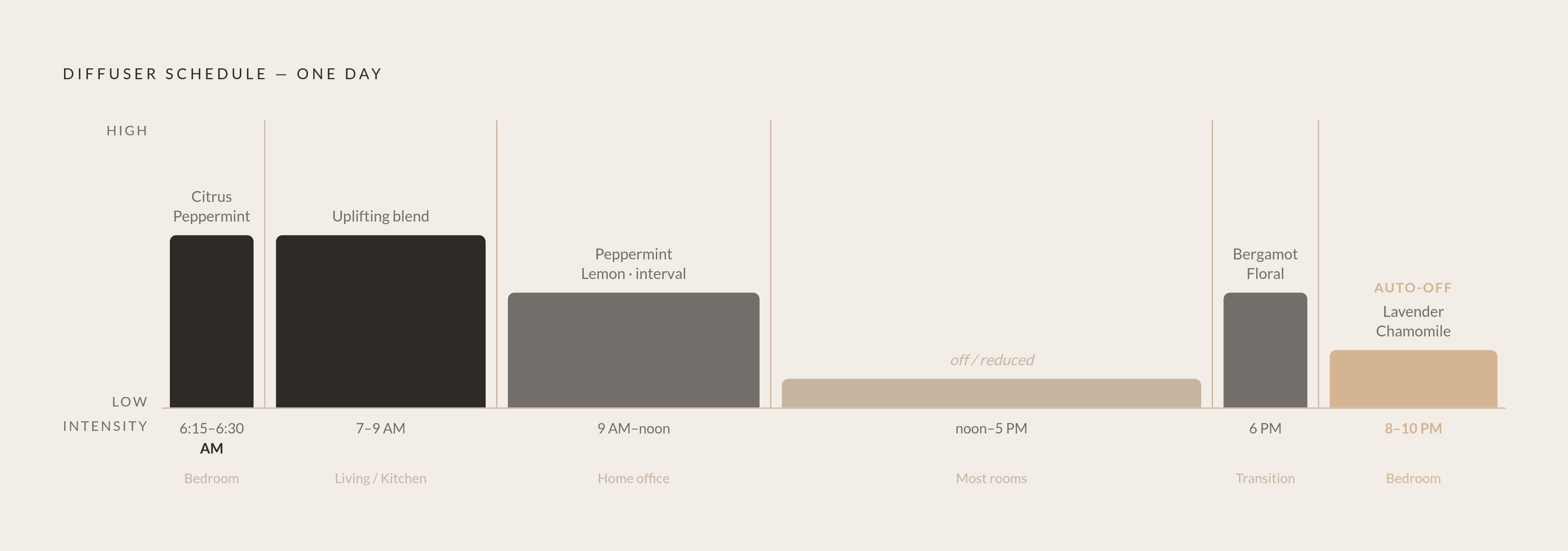
Laid out as an actual timeline rather than a list of scattered tips, a full day might look something like this. Between 6:15 and 6:30 AM, the bedroom diffuser activates 10 to 15 minutes ahead of the alarm, running a citrus or peppermint-rosemary blend at medium intensity. From 7 to 9 AM, the living area and kitchen schedule kicks in, carrying that same uplifting energy through the morning routine at moderate intensity. Between 9 AM and noon, a home office shifts into interval mode, 15 minutes on and 45 off, running a focus blend of peppermint, lemon, and eucalyptus at low-to-medium intensity.
Midday, from noon to 5 PM, most rooms should sit reduced or fully off if they're unoccupied, with an optional 2 PM interval burst for anyone working from home who needs a small afternoon lift. Then the evening transition begins around 6 PM, easing into a bergamot or light floral blend that bridges the gap between the day's focus and the night's calm, stepping down in intensity over the following hours until the bedroom settles into its lavender or chamomile pre-sleep window, and the whole system shuts itself off before anyone's actually asleep to notice.
None of this requires remembering anything once it's set. That's really the entire argument this piece has been building toward: the schedule does the noticing so the person doesn't have to, matching what the nose and the brain's emotional circuitry are already primed to expect at 7 AM versus 10 PM. The technology is reinforcing a rhythm that already exists. It's just finally paying attention to the one that was already there.
Sources
- Best Smart Diffuser for Your Home (2026 Buyer’s Guide) - Gabellioni
- Smart Scenting: How Aromadd Smart Diffusers Integrate with Your Connected Lifestyle
- Smart Home Aroma Diffuser Market, Global Outlook and Forecast 2025-2032
- Smell Is Emotion - PMC
- ellecadeaux.com
- ellecadeaux.com
- Aera® - Smart Scent Diffuser | Smart Diffuser for Home