Essential Oils for Stress Relief at Home
Brain scent receptors directly trigger the nervous system's calming response within seconds.
Smell is the only sense with a direct line to the limbic system. No digestion, no metabolic detour, no blood-brain barrier to negotiate. You inhale, and you're basically knocking on the brain's emotional processing center with no middleman.
That's not a metaphor — it's anatomy.
And it explains something most people have noticed but haven't quite understood: why a particular scent can shift your mood in seconds, faster than any supplement you've ever swallowed. Certain aromatic compounds nudge the autonomic nervous system toward its parasympathetic branch — the "rest and digest" side, not fight-or-flight. When that branch engages, stress hormone activity tends to drop. Heart rate slows. Breathing deepens.
But does that actually show up in measurable data, or is it just people saying they feel calmer?
A 2025 peer-reviewed study in Frontiers in Psychology used EEG to find out. Lavender inhalation increased alpha waves (relaxed wakefulness) and decreased beta waves (alertness, mental tension). Peppermint did the exact opposite. More beta, less alpha. More alertness, less sedation. These are quantifiable, directional changes in brain activity, not self-reported feelings.
That pathway also explains why delivery method matters more than most people realize. If the aromatic compounds break down before you actually inhale them, the mechanism gets interrupted before it starts. The olfactory-limbic pathway only responds to what actually arrives intact. We'll get to that.
The oils with the strongest evidence for stress and anxiety reduction
I want to be straightforward with you here, because this space has a serious credibility problem.
A lot of essential oil marketing leans on vague wellness language and cherry-picked anecdotes. And a lot of the foundational research is animal studies, which don't always translate cleanly to humans. A scoping review covering ten years of essential oil research found roughly 70 studies reporting antistress, antianxiety, cognitive, and autonomic outcomes. That's enough volume to see patterns. But the human trials vary significantly in scale and methodology, and the 2024 narrative review this field frequently references acknowledges outright that differences in methodology and oil composition make cross-study comparison difficult.
So here's what the human data actually shows, without the halo effect.
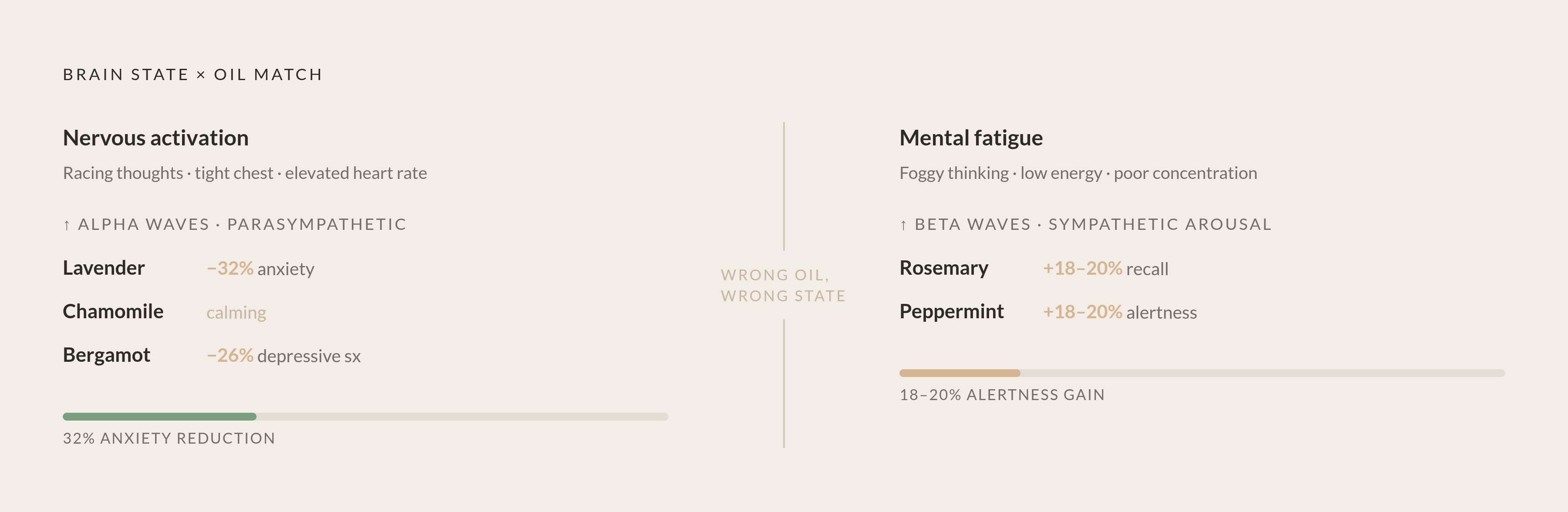
Lavender is the most-studied oil in human trials, and the evidence holds up better than I expected. A 2024 systematic review in Healthcare examined six trials across 413 pregnant participants and found significant improvements in anxiety, stress, and sleep quality with no adverse effects. A separate randomized controlled trial in Frontiers in Psychology found lavender essential oil reduced anxiety symptoms by 32% in patients awaiting minor surgery, with measurable reductions in heart rate and blood pressure. Lavender's primary active compounds, linalool and linalyl acetate, interact with GABA receptors. Those are the same receptor systems targeted by prescription anti-anxiety medications. That's not a small claim.
Bergamot has a Japanese clinical trial behind it: elderly patients using a bergamot and ylang-ylang blend daily showed a 26% reduction in depressive symptoms, along with improved sleep and social engagement. One practical note worth flagging: bergapten, a phototoxic compound in bergamot, matters for skin application in sunlight. For inhalation use, it's a non-issue.
Chamomile appears alongside lavender and bergamot in a 2024 narrative review as one of the leading anti-stress oils, with evidence pointing to effects on emotional processing and mood.
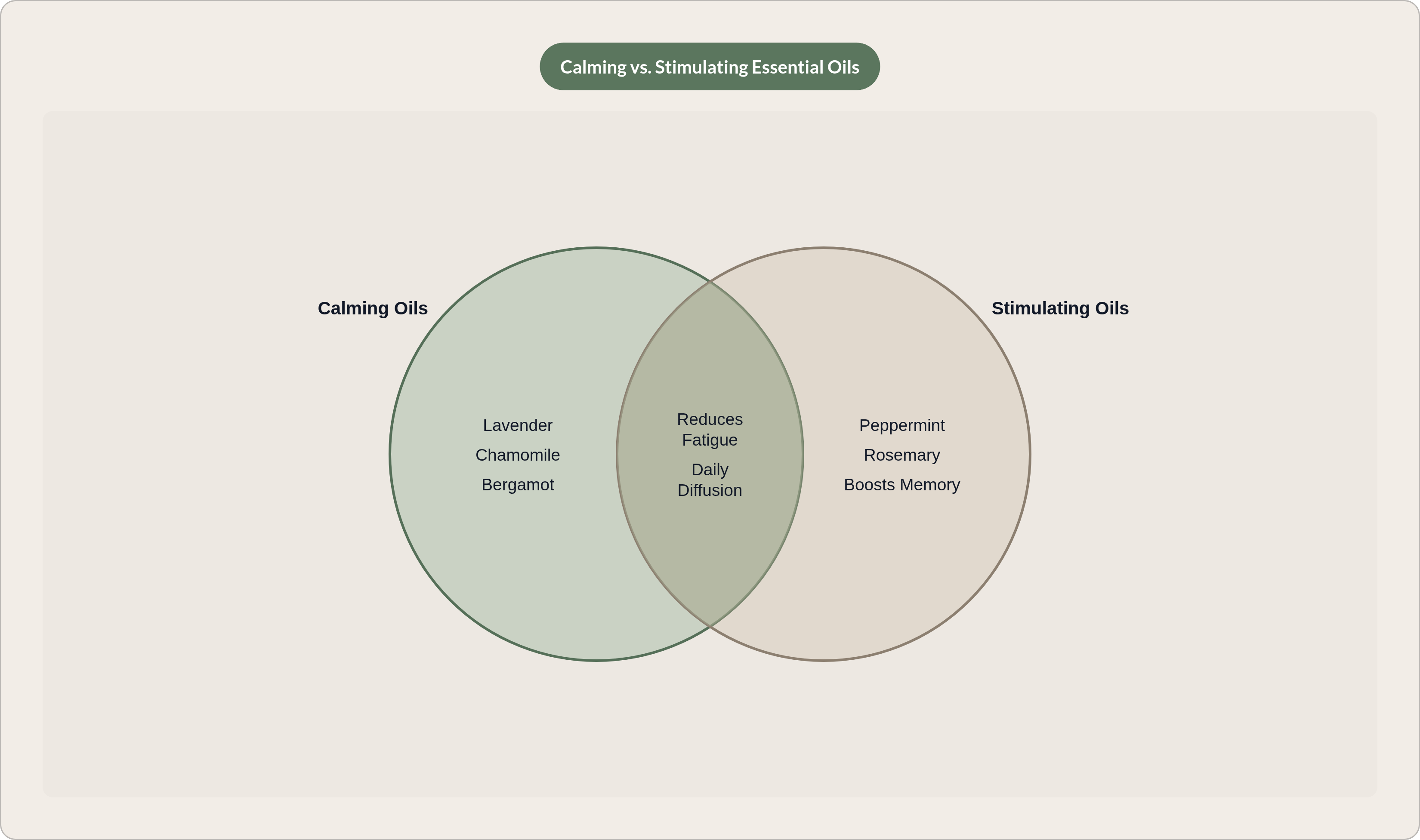
Rosemary and peppermint are not calming oils. I want to be clear about that, because they get lumped into wellness conversations as though all pleasant-smelling things do the same thing. A 2025 study in the International Journal of Environmental Research and Public Health found diffusing rosemary and peppermint in office environments improved memory recall and alertness by 18 to 20% and reduced reported mental fatigue. These oils address cognitive stress and mental exhaustion. They can make acute anxiety worse, not better.
Ylang-ylang shows up mostly in combination blends, and its isolated evidence base is thinner than the others.
Everything beyond this core group leans heavily on animal studies or small, non-randomized human trials. Worth knowing before you spend money on something exotic.
Reading a stress response: matching the right oil to the right moment
Stress is not one thing, and that's the part most people skip.
Acute anxiety is a different physiological state from mental exhaustion. And the oils that help one can actively worsen the other. So before reaching for whatever smells interesting, it's worth asking: what is actually happening in your body right now?
Racing thoughts, tight chest, elevated heart rate? That's nervous system activation. Lavender, chamomile, or bergamot promote alpha waves and activate the parasympathetic branch. The system needs to downshift.
Foggy thinking, low energy, can't concentrate? That's mental fatigue. Rosemary or peppermint restore alertness without sedating. That's what the office environment study was measuring.
The time-of-day logic follows from this:
- Morning or work hours: rosemary or peppermint to sharpen focus
- Evening wind-down: lavender or chamomile to begin the neurological shift toward sleep
- Transitional moments (end of the workday, before a difficult conversation, before hosting): bergamot, which appears to address both mood and physiological agitation at the same time
The bergamot and ylang-ylang combination in the Japanese clinical trial wasn't arbitrary. It was intentional, multi-pathway targeting.
One thing the research is consistent on: the anxiety reduction findings came from daily, consistent use. The autonomic nervous system responds to repeated contextual cues. Use the same oil, at the same time, in the same space, and you build an association that amplifies the effect. The nervous system learns, and we'll come back to that.
Why diffusion method determines whether the science translates to real-world benefit
This is where I think most people who've "tried aromatherapy and felt nothing" went wrong. And it's worth slowing down on, because the mechanism is actually pretty simple once you see it.
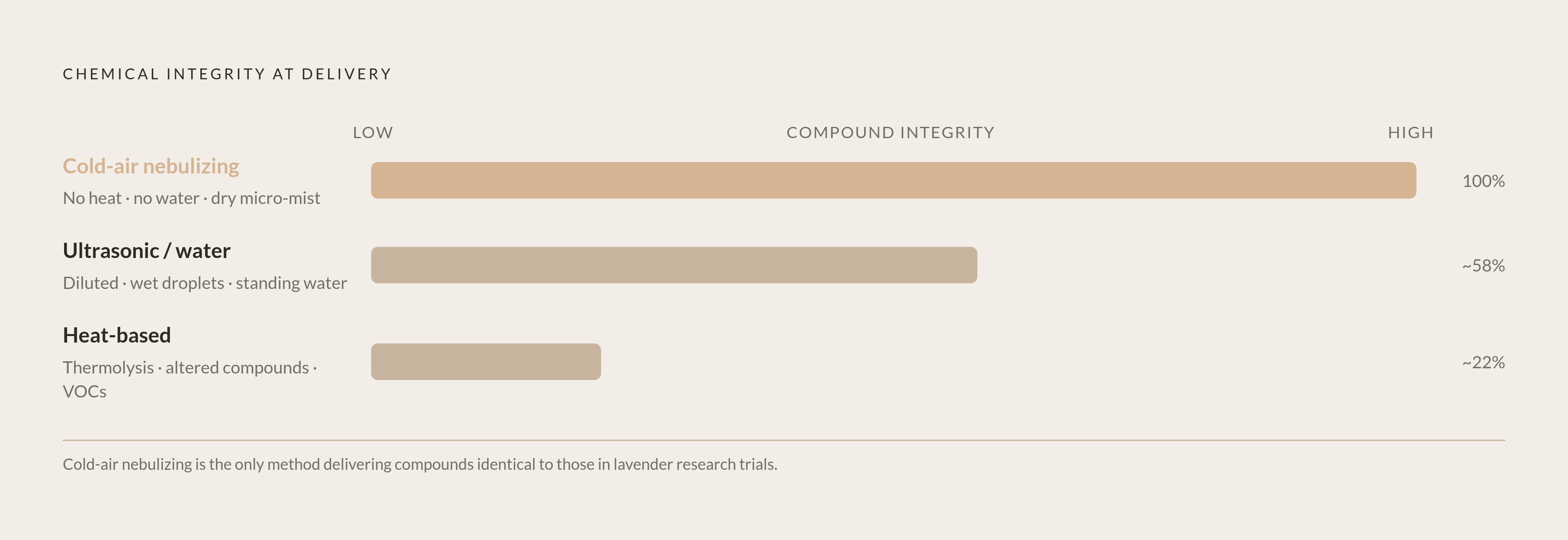
Essential oils contain hundreds of volatile organic compounds, and those molecular structures are fragile. How you disperse them determines whether they arrive in the air chemically intact.
Heat-based delivery (candles, wax warmers, electric warmers): heat causes thermolysis, meaning chemical breakdown of volatile compounds. What enters the air is not the same oil that was in the bottle. Heat-based diffusion can also increase VOC emissions and create irritating by-products.
Ultrasonic, or water-based, diffusers: these dilute the oil in water, which reduces aromatic concentration. They produce larger, wet droplets that settle on surfaces and on pet fur. Standing water in the reservoir can also harbor bacteria and mold if the device isn't cleaned consistently.
Cold-air nebulizing diffusion: uses filtered room air, no water, no heat, to disperse oil into a dry micro mist. The compounds studied in lavender trials are the same compounds entering the air. Output control allows for lower-concentration diffusion, which becomes relevant when we talk about kids and pets.
If you've tried this before and noticed nothing, the delivery method may have been the missing variable — not the oil, not the practice.
What makes a home fragrance clean, and why the distinction matters for daily use
"Natural" is not automatically safe. I want to say that upfront, because the wellness space has a habit of treating those two words as synonyms, and they're not.
Some natural oils cause photosensitivity, respiratory irritation, or allergic reactions at certain concentrations. The "clean" question is really about intentional formulation and transparent ingredients, not just whether something came from a plant.
That said, conventional air fresheners have a specific and documented problem. Many use synthetic compounds derived from crude oil or turpentine-based sources, with some formulas documenting synthetic content in the 95 to 100% range. They may also contain phthalates, formaldehyde, VOCs, and petrochemicals, often hidden under the single word "fragrance" on the ingredient label. That's a legal loophole covering potentially hundreds of undisclosed compounds.
Phthalates deserve particular attention. They're used to extend scent longevity, and they're classified as endocrine disruptors with documented links to hormonal interference and reproductive concerns. If you're diffusing something daily as a health practice, that's a real design flaw in the plan.
What to actually look for:
- Free from phthalates, parabens, and synthetic musks
- Certifications from the International Fragrance Association (IFRA) or the Natural Products Association (NPA)
- Sephora Clean certification, which requires formulations free from a defined list of potentially harmful ingredients and translates lab-level scrutiny into something a consumer can actually read on a label
Aura House fragrance oils carry Sephora Clean certification and are formulated as vegan, cruelty-free, and non-toxic for daily diffusion in homes with children and pets. The certification standard exists precisely so you don't have to take a brand's word for it.
Using essential oils safely around pets and children
Dogs and cats have olfactory systems far more sensitive than ours, and cats are in a different category entirely. They lack the liver enzymes needed to metabolize certain phenols and ketones found in oils like tea tree, eucalyptus, and clove. We're not talking about irritation — we're talking about real physiological harm.
Oils with a stronger safety profile in pet-present homes include lavender in dilute, well-ventilated diffusion, chamomile, and certain citrus oils. Even those require ventilation and the ability for pets to physically leave the room whenever they want.
For children, the concern is developing respiratory and neurological systems. Eucalyptus and peppermint are both documented to cause respiratory distress in very young children. Avoid both in homes with infants.
Practical rules that hold in a real household:
- Diffuse in well-ventilated spaces, not sealed rooms
- Give pets an unscented exit at all times
- Run diffusers intermittently, roughly 30 to 60 minutes on, then off, rather than continuously
- Start at low concentrations and watch for reactions before increasing
Cold-air diffusion's output control is useful here. Precise concentration settings and no combustion by-products make it a more sensible default when kids or animals are in the house.
Building a home stress-relief ritual that actually holds
The limbic system learns, and that's the part of this I find most interesting — it also happens to be the part that gets left out of most conversations about aromatherapy.
A particular scent, paired repeatedly with a particular context, can eventually signal safety and rest before the oil has even had time to cross the olfactory threshold. The association becomes the mechanism. This is why a single powerful session does less than a consistent, unremarkable routine.
A room-by-room approach grounded in the brainwave and hormone research:
- Bedroom: lavender or chamomile, diffused 30 to 45 minutes before sleep. The alpha-wave induction data is measurable, not speculative.
- Home office or workspace: rosemary or peppermint during active focus sessions. Reserve these for work hours only. Protecting the scent-to-state association is part of what makes it work over time.
- Living room or transition space: bergamot, or a bergamot-lavender blend, for the end of the workday, before social hosting, or during stretching or meditation.
Start with one oil, one time of day, one week. Build the association before adding complexity. This is the part people skip because it feels too simple, and then they wonder why nothing stuck.
But the product is secondary to the framework. The real question is whether you're matching the right oil to the right state, delivering it through a method that keeps the compounds intact, using a formula that doesn't introduce new risks, and doing it consistently enough for your nervous system to build the cue. Get those four things right, and the tool almost doesn't matter. Get them wrong, and no diffuser fixes it.