Calming Essential Oil Blends You Can Make at Home
Mix these science-backed essential oils to calm your nervous system in seconds.

You've probably had this happen. You walk into a room, catch a scent, and something in your body loosens before you've even registered what you're smelling. It's not a placebo. It's not poetic. It's anatomy.
When you inhale an essential oil, volatile compounds go straight to the olfactory nerves. Those nerves fire signals almost immediately to the brain, triggering the release of serotonin and endorphins. The olfactory pathway bypasses the blood-brain barrier entirely. Most substances, whether swallowed or absorbed through skin, have to fight through that filter. Inhaled compounds just don't.
That's why inhalation produces effects faster than nearly any other route — seconds, not minutes.
Calming oils work on two specific levers:
- Lowering cortisol. That dials back the fight-or-flight response.
- Stimulating the parasympathetic nervous system. That shifts the body toward rest and recovery.
So "calming" isn't just about smelling something pleasant. It's about moving the nervous system from sympathetic mode into parasympathetic mode. That's a measurable physiological shift, not a vibe.
Lavender is the most studied oil in this context. Research across ICU patients, dental patients, postpartum women, and students consistently shows real stress and sleep benefits from inhalation alone. A 2025 systematic review in the Journal of Essential Oil Bearing Plants confirmed this is active clinical inquiry, not folk wisdom that survived because it feels cozy.
The whole mechanism depends on intact volatile compounds actually arriving at your nose. If those compounds degrade before they reach you, the effect doesn't follow. Which means the quality of your oil and the integrity of your delivery method aren't just nice-to-haves. They are the mechanism. We'll come back to both.
The Oils Worth Building a Calming Blend Around, and What Each One Contributes
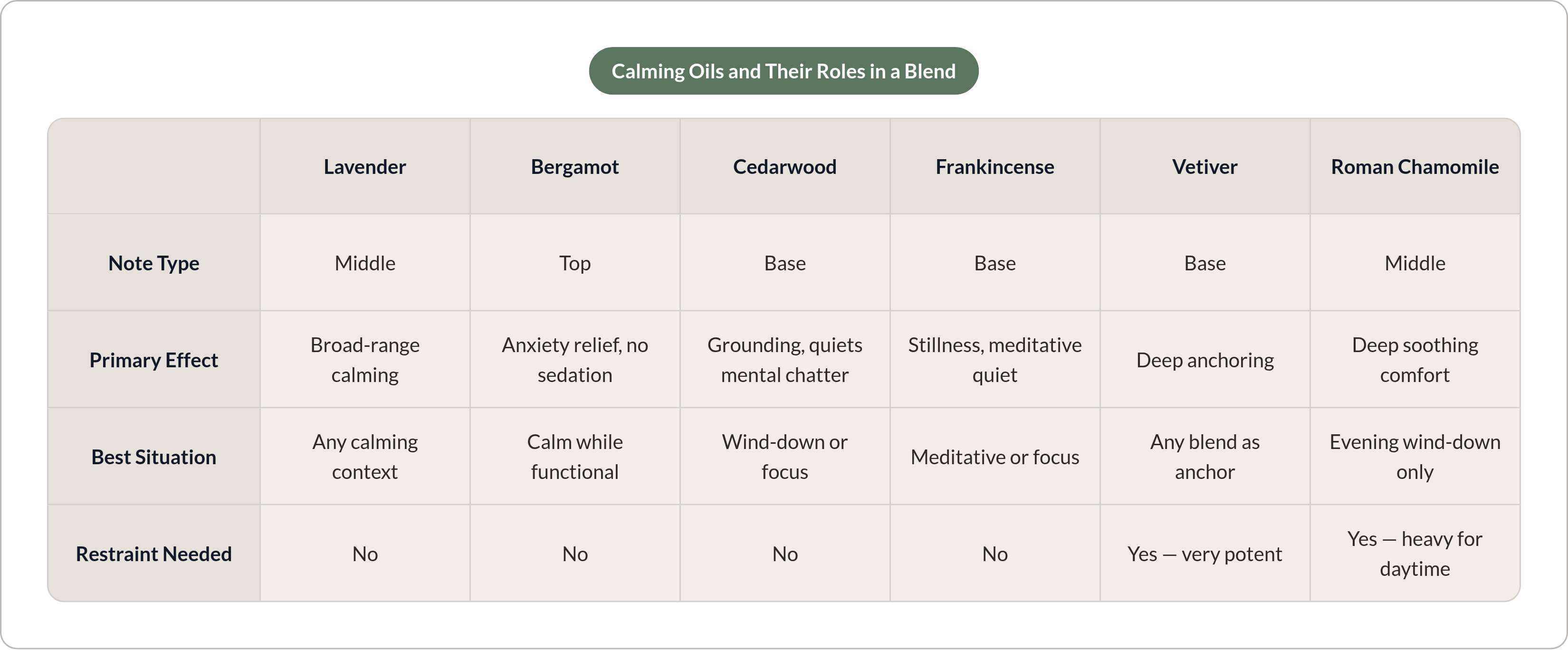
Not every oil that smells relaxing does something useful. And not every useful oil works in every situation. This is how I actually sort them, after years of blending and more than a few batches I'd rather forget.
Lavender is the anchor. Most widely used essential oil in the world, by a significant margin. Works across the broadest range of situations, from mild afternoon tension to full pre-sleep wind-down. Start here.
Cedarwood grounds and quiets mental chatter. It pairs naturally with lavender as a base note, adding depth without crowding anything out.
Bergamot is the mood-lifter of the calming palette. It reduces anxiety without sedating you, which is a specific and practically useful distinction. If you need to be calm but still functional, bergamot is your oil. It also adds brightness that keeps blends from collapsing into "just go lie down already."
Roman chamomile is deeply soothing but heavy. Best for wind-down blends. For daytime calm, it can feel like overkill — the olfactory equivalent of a weighted blanket at noon.
Clary sage handles accumulated stress with a slightly herbaceous edge. It sits heavier on the relaxation axis than lavender. Useful when lavender alone isn't cutting through a rough day.
Frankincense creates something different from the others. The goal isn't just absence of stress. It's stillness. Frankincense does that better than most oils on this list, and it's what I reach for when I want meditative quiet rather than just decompression.
Vetiver is the heaviest, most grounding note here. One drop too many and it becomes the only thing you smell. Used correctly, it anchors the whole blend. Restraint isn't optional with this one.
Ylang-ylang adds floral warmth and deepens relaxation. Also potent, also requiring restraint, for exactly the same reason.
Sweet orange and tangerine function as citrus bridges. They add lift and approachability without undermining the calming direction. Useful for anyone who finds straight lavender-and-cedarwood blends a little heavy or funereal.
Blue tansy is less common but earns its place. It releases tension and supports emotional balance, and it works best as a supporting note rather than a lead.
How to Proportion a Blend So It Actually Works
This is where most DIY blends quietly fall apart. Someone picks good oils, then uses equal parts of everything. The result is muddy, flat, with no clear center. You can smell effort, but not intention.
There's a framework from perfumery that applies directly here. Top, middle, and base notes. It's a practical description of how oils behave over time, not just a fancy way to talk about smell.
- Top notes (citrus, bergamot): first impression. They evaporate quickly.
- Middle notes (lavender, clary sage, Roman chamomile): the core. They carry the main effect and linger longer.
- Base notes (cedarwood, vetiver, frankincense, patchouli): they anchor the blend, slow evaporation, and give it staying power.
A practical starting ratio: 30% top / 50% middle / 20% base.
For a diffuser, 8 to 10 drops total is a reasonable starting point. Scale based on your diffuser's guidance and room size.
A few mistakes that wreck otherwise solid blends:
- Too much vetiver or ylang-ylang. In a 10-drop blend, one drop of vetiver is often enough — that is not a figure of speech.
- No base notes. The blend evaporates too fast and loses coherence. You're left with a top-note ghost.
- Equal parts of everything. Every oil competes and nothing wins.
Mix 10 to 15 drops in a small vial, let it sit for a few minutes, then evaluate. Ratios read very differently on paper than they do in the air. Also worth noting: these ratios assume unadulterated oils. Diluted or adulterated oils behave unpredictably, and the math stops holding if what's in the bottle isn't what the label claims.
Five Calming Blends With Specific Ratios and the Situations They Suit
A blend for sleep prep should not be the same blend you run during a focused afternoon of work. Context matters more than most blending guides admit. Each blend below is built around a specific moment.
Evening Wind-Down (sleep preparation)
- Cedarwood: 3 drops
- Lavender: 3 drops
- Roman chamomile: 2 drops
- Vetiver: 1 drop
Heavy on base notes by design. The goal is to slow the body toward sleep. Cedarwood and lavender carry the blend. Vetiver anchors without taking over. Roman chamomile adds a layer of comfort that makes this specifically a wind-down blend, not just a generic relaxation blend.
Afternoon Decompression (post-work, pre-evening)
- Bergamot: 4 drops
- Lavender: 4 drops
- Clary sage: 2 drops
Bergamot lifts mood without stimulating. Clary sage handles residual tension. Lavender bridges them. Brighter than the sleep blend. This is for calm, not sedation.
Grounded Focus (calm without sedation, suitable for work)
- Sweet orange: 3 drops
- Frankincense: 4 drops
- Cedarwood: 3 drops
The citrus top note keeps things alert and approachable. Frankincense and cedarwood provide steadiness without tipping into drowsiness. This one is for people who need to stay functional but want to stop feeling like they're running on fumes.
Full Relaxation / Stress Release
- Tangerine: 3 drops
- Sweet orange: 2 drops
- Ylang-ylang: 1 drop
- Patchouli: 2 drops
- Blue tansy: 2 drops
Citrus-forward opening, floral middle, earthy base. The ylang-ylang restraint is not a suggestion. One, maybe two drops maximum. More than that and it takes over the entire blend and you've just made ylang-ylang with some decorative additions.
Pet-Present Household
See the next section. This one genuinely needs context before the ratios mean anything.
What Changes When Pets Are in the Home
Several oils that work beautifully in calming blends are documented hazards for cats and dogs. This isn't a wellness preference. It's a safety issue, and one that gets glossed over constantly in DIY blending content.
Cats lack specific liver enzymes that process certain volatile compounds. Oils rich in phenols can accumulate to toxic levels in cats even at concentrations that smell perfectly pleasant to you. Dogs are more tolerant but still sensitive at high concentrations.
Avoid around cats in particular: tea tree, eucalyptus, clove, and phenol-rich oils broadly.
Lower-risk options: cedarwood (widely cited as safer), sweet orange at low concentration, and lavender used with real caution around diffusion distance and ventilation.
A practical pet-safer blend:
- Cedarwood: 4 drops
- Lavender: 4 drops
- Frankincense: 2 drops
Calming for the humans in the room, and all three carry lower-risk profiles relative to the oils on the avoid list.
Diffusion method is a safety question here, not just a quality one. Cold-air diffusion allows precise concentration control and can be run intermittently. Short sessions in a well-ventilated room, not an enclosed space where a pet can't leave. That matters when the one who can't advocate for themselves is a twelve-pound cat who will absolutely just sit there.
Why Diffusion Method Determines Whether a Blend Performs as Intended
Here's a frustrating pattern I've watched play out repeatedly. People put real care into sourcing good oils, proportion the blend thoughtfully, and then run it through a method that chemically alters the oils before they ever reach the air. The result smells like something. But it isn't what they blended.
Essential oils contain hundreds of volatile compounds with structures that are fragile. Change those structures and the aroma changes. The therapeutic potential goes with it.
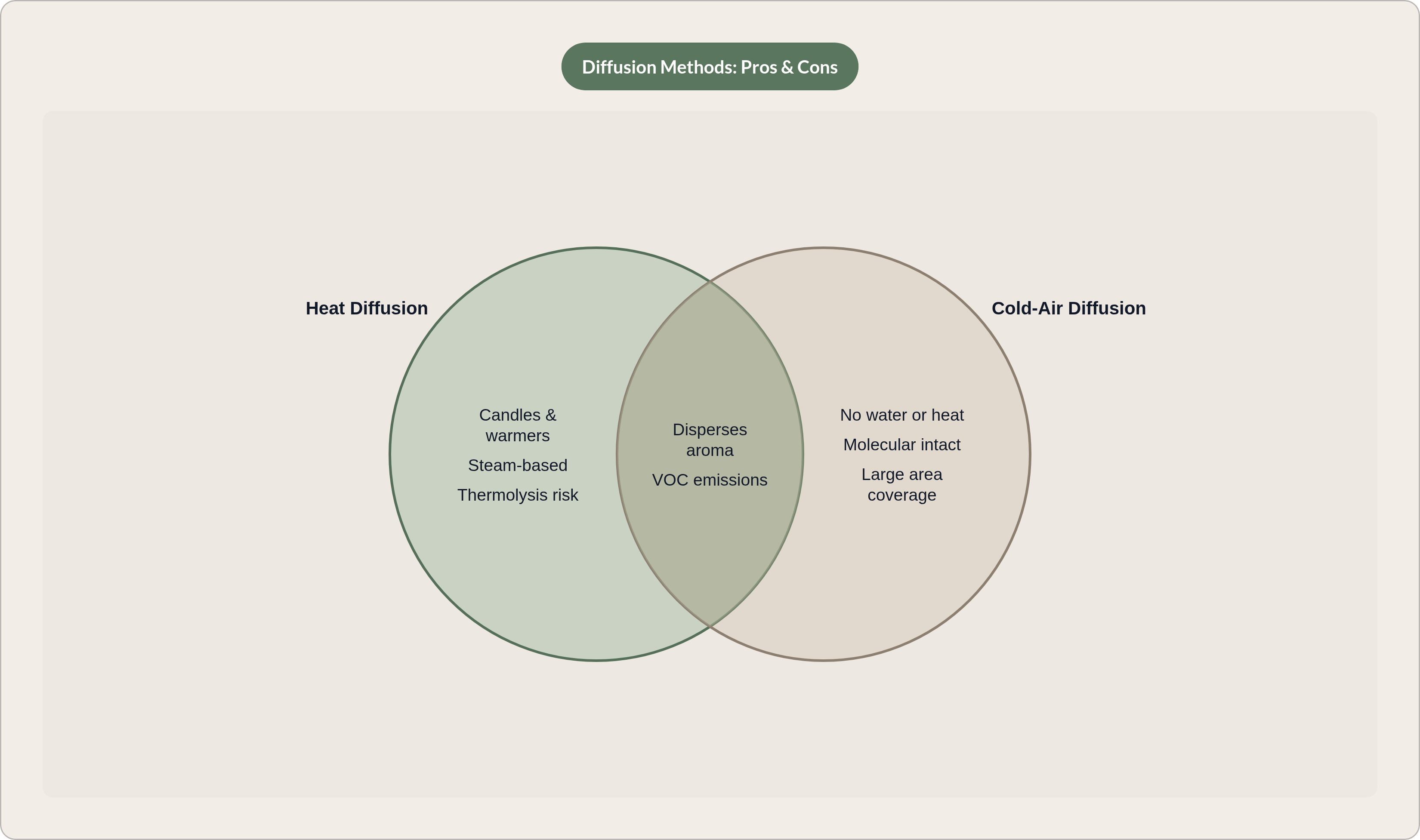
Heat-based diffusion (warmers, candles, steam) causes thermolysis: the chemical breakdown of active compounds under heat. You end up inhaling something structurally different from what you started with. Heat diffusion can also increase VOC emissions and produce irritating byproducts.
Ultrasonic diffusion avoids heat degradation but dilutes the oil in water, which reduces concentration and introduces humidity. Delivery ends up inconsistent.
Cold-air diffusion uses filtered, room-temperature air to create a micro-mist with no water, heat, or alcohol. The oil reaches the room with its molecular profile intact.
That last point connects directly back to what we covered in the first section. If lavender's active compounds are broken down by heat before inhalation, the nervous system effects documented in clinical studies don't reliably follow. The mechanism works when the compound arrives intact.
Cold-air diffusers also tend to cover meaningfully larger spaces than candles, reed diffusers, or plug-ins. For open-plan rooms, that's not a minor consideration.
Cold-air diffusers are built around this principle: no heat, no water, no chemical degradation between bottle and air.
Starting With Quality Oils Before Anything Else Is Blended
Everything above assumes one thing: that the oil in the bottle is actually what the label says it is. That assumption fails more often than most people realize.
The Environmental Working Group found that fragrance products contain, on average, 14 hidden chemicals not listed on labels, some linked to hormone disruption. That applies to products marketed as essential oil blends when synthetic fragrance is part of the picture.
What to actually look for:
- Botanical name on the label. Lavandula angustifolia, not just "lavender." Specificity signals that someone in the supply chain was paying attention.
- GC/MS testing available. Gas chromatography/mass spectrometry tells you what's actually in the bottle. A brand that publishes this data is one that knows what's in there.
- No added carriers, synthetic extenders, or unlisted diluents. Single-ingredient labeling is what you're after.
- Phthalate-free, paraben-free, synthetic musk-free. A brand willing to disclose this has thought seriously about formulation.
Sourcing and blending individual oils is more friction than most people want. That's fair. Curated fragrance oil collections formulated to clean standards — like those that are Sephora Clean-certified, vegan, and cruelty-free and designed specifically for cold-air diffusion — remove the sourcing guesswork entirely.
But whether you build a DIY supply chain from scratch or start with something pre-formulated, the principle doesn't change. Good oils, proportioned with intention, delivered through a method that keeps their molecular structure intact. Break any one of those links and the blend doesn't perform. That's where I'd start — with what's actually in the bottle, before anything else.