Lavender Aroma Oil Diffused vs. Applied: Key Differences
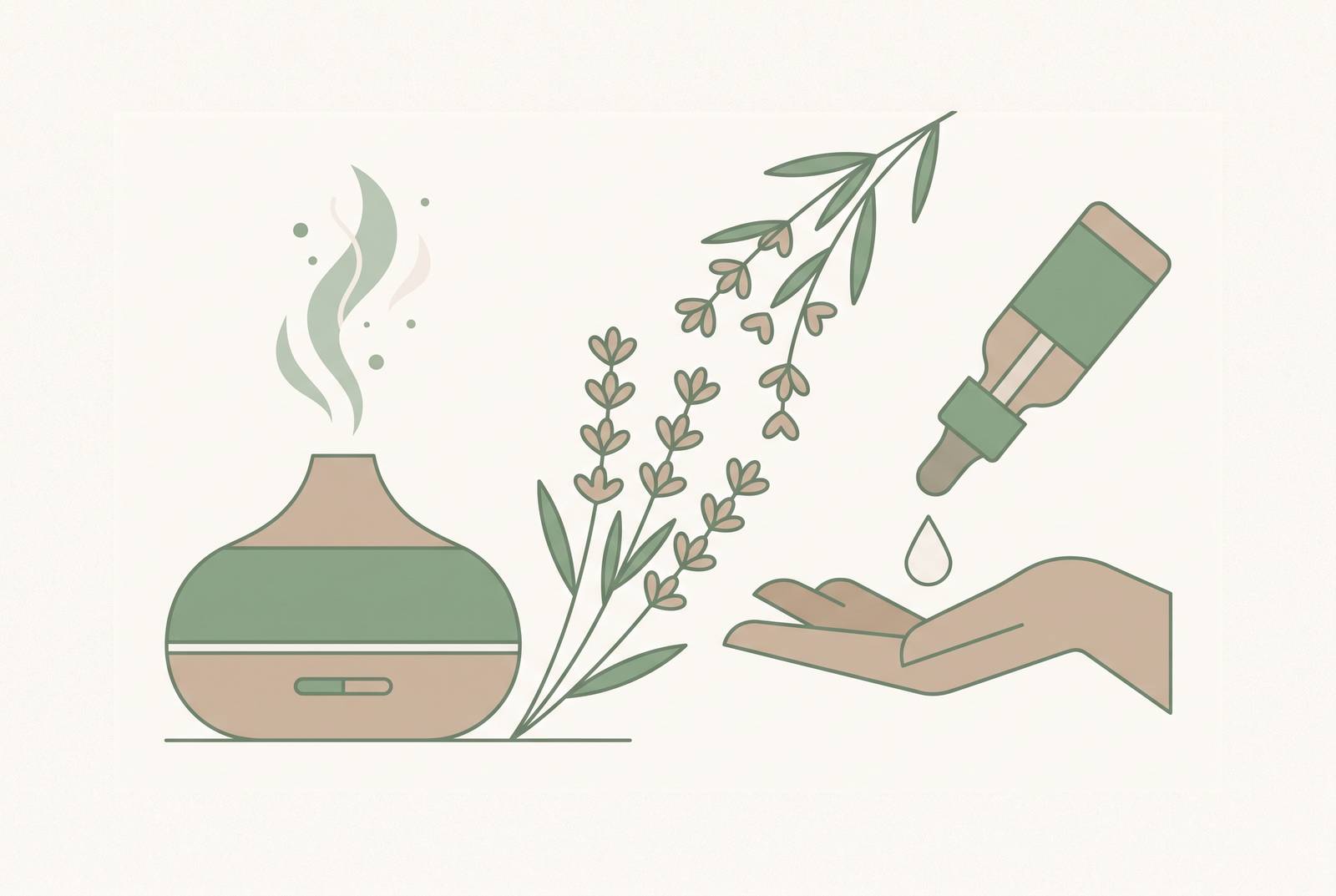
Whether lavender oil calms a room or calms a body depends entirely on how it gets into a person, and that single variable, air or skin, changes the dose, the speed, the risk profile, and the result. Most people treat "diffuse it" and "rub it on" as interchangeable habits, two roads to the same nap. The chemistry says otherwise.
Start with the plant itself, because the variety matters before the method even enters the conversation. Lavandula angustifolia, English lavender, is the soft, sweet, floral one, the variety behind most sleep rituals and calming blends. French lavender carries more camphor, so it reads sharper and more herbaceous, better suited to different applications entirely. Both varieties owe their effects to two compounds, linalool and linalyl acetate, which bind GABA-A receptors in the brain; that's the actual pharmacological mechanism behind lavender's reputation as a nervous-system dimmer switch. Here's the catch: both compounds are volatile. They break down, they evaporate, they degrade under heat, and that molecular fragility is exactly why delivery method stops being a matter of preference and starts being a matter of function. Lavender has roughly 1,500 years of documented use behind it and sits among the most-studied essential oils on record, with research touching sleep, anxiety, minor burns, scalp health, and headaches. None of that history matters much if the oil never reaches its target intact.
How diffusion works and what happens to lavender in the air
Diffusion turns liquid oil into a fine mist or vapor and lets it drift through a room. The entry point here is the nose.
Once inhaled, volatile molecules reach olfactory receptors that connect straight into the limbic system, specifically the amygdala and hippocampus, the brain's emotional processing and memory centers. Some research points to inhaled lavender bypassing the blood-brain barrier through the nasal-brain pathway entirely, acting directly on the cerebral cortex and thalamus along the way. That's a short commute for a molecule. The scent registers, and the calming signal seems to register almost as fast, which is part of why diffused lavender feels so immediate compared to a lotion.
But diffusion has a built-in feature that doubles as a limitation: it's ambient. Everyone in the room gets exposed, not just the person who wanted it. A diffuser doesn't know who asked for calm and who just walked in looking for their keys. That makes diffusion a spatial tool, not a personal one, and the distinction matters more once pets and kids enter the picture (more on that later).
Heat is the other variable that decides whether any of this works at all. Linalool degrades above 40°C, so the type of diffuser in use matters as much as the decision to diffuse in the first place. Cold-air, or nebulizing, diffusers atomize pure oil into particles under 5 microns without water, heat, or alcohol, which means the molecules arrive in the air roughly as intact as they left the bottle. Heat-based diffusers cook the very compounds responsible for both scent and effect, undercutting the whole point of using the oil. Ultrasonic diffusers split the difference: they dilute oil into water, which cuts aromatic concentration and can quietly reduce how much active compound actually reaches anyone's nose. Standard guidance for a diffusing session runs 6 to 10 drops, no carrier oil needed, since nothing here touches skin.
How topical application works and what lavender does once it enters the skin
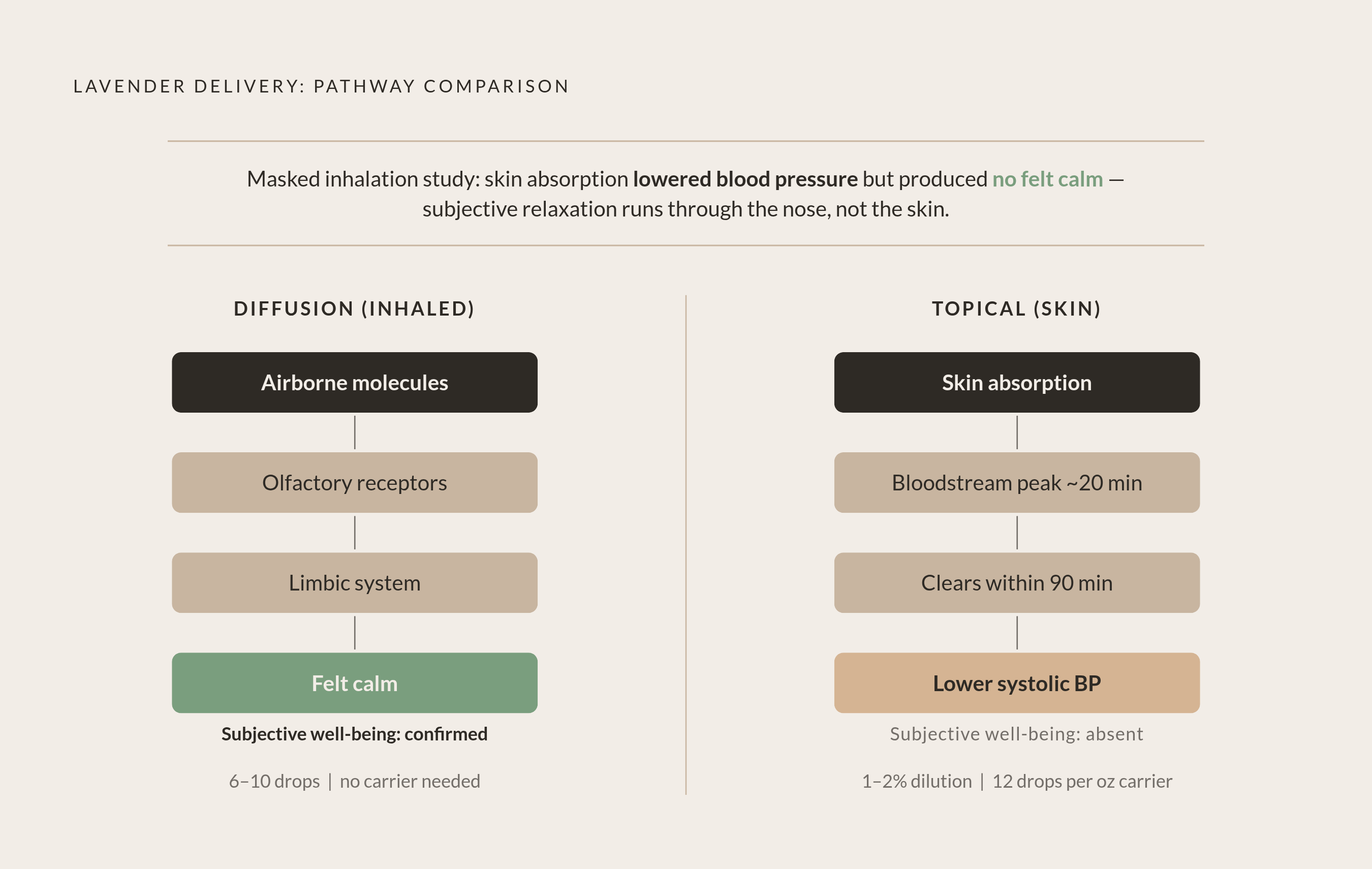
Topical application skips the nose (mostly) and routes the oil through skin instead, a slower and more localized process by design.
The timeline is fairly well mapped. Linalool and linalyl acetate show up in the bloodstream shortly after massage, peak around the 20-minute mark, and mostly clear the system within 90 minutes. That's a tight window of measurable presence, and researchers have used it to isolate what skin absorption does on its own, without any scent involved.
One study worth sitting with: 14 subjects wore breathing masks that blocked inhalation entirely while lavender oil absorbed through skin. Percutaneous linalool still lowered systolic blood pressure and nudged skin temperature down slightly compared to controls. So the body clearly registers something through skin contact alone. But here's the twist that reframes the whole conversation: with inhalation blocked, the same study found no improvement in subjective well-being. People's blood pressure ticked down, but they didn't feel more relaxed. The physiological effect and the felt effect turn out to be two different systems, and the emotional lift most people associate with lavender appears to run mostly through the nose, not the skin.
In practice, topical application rarely isolates one pathway anyway. Someone rubbing lavender oil onto their wrists is smelling it while it absorbs, so the relaxation response ends up being a blend of scent, touch, and absorption working together. Massage adds a fourth ingredient diffusion simply cannot replicate: the ritual of touch itself. That's what makes topical lavender a body-level intervention rather than a room-level one; it's personal, targeted, and tied to a specific act rather than a shared atmosphere.
Why dilution requirements for the two methods are so different
Undiluted essential oil on skin is a genuine irritation risk, not a theoretical one. Dermal sensitization from concentrated linalool is well documented, which is why topical use comes with hard limits that diffusion simply doesn't need.
For adults, the working ceiling sits at 1 to 2% concentration. A commonly cited ratio, 12 drops of lavender oil per ounce of carrier oil, lands right around 2%. Carrier oils like jojoba, sweet almond, or fractionated coconut oil slow absorption, cut irritation risk, and spread the oil evenly instead of leaving concentrated pools on skin. For children, the ceiling drops further, to somewhere between 0.5 and 1%, and bottles need to stay out of reach regardless of how diluted the contents are.
Diffusion plays by different math entirely. The 6-to-10-drop range added straight to a diffuser reservoir requires no carrier, because nothing is touching skin. Put those two numbers side by side and the practical lesson gets obvious fast: a concentration that's perfectly safe to breathe can be far too strong to rub on skin, and a topical dilution would barely register in a diffuser. Same bottle, same oil, two entirely different products depending on where it's headed.
The purity problem that affects both uses and why it hits diffused lavender hardest
Here's where things get less about botany and more about what's actually in the bottle. A 2024 peer-reviewed study in the Journal of Essential Oil Research tested twelve commercial lavender oils pulled from mainstream retailers. Nine of the twelve, 75%, were adulterated, cut with cheaper lavandin, synthetic linalool, or dipropylene glycol.
That number is worth sitting with for a second, because it upends the assumption most people bring to this whole topic: that the bottle contains what the label says. Adulteration punishes both delivery methods, though not equally. On skin, synthetic fillers and stand-ins raise the odds of irritation and sensitization, since the body reacts to what's actually there, not what the label promises. In a diffuser, the damage is quieter but arguably worse for the entire premise of aromatherapy: if the active compounds have been swapped out or watered down, inhaling the mist delivers little more than a pleasant smell. The GABA-A receptor pathway has nothing real to grab onto. The ritual is intact, but the underlying mechanism is not.
Cold-air diffusion preserves whatever chemistry is actually in the oil, since it skips heat and water entirely. But preservation only matters if there's something worth preserving; a nebulizing diffuser running compromised oil just disperses the compromise more evenly across the room. Look for single-origin sourcing, documented GC/MS testing, and clear ingredient disclosure. Those same purity markers matter whether the oil ends up on a temple or in a bedroom's air, and clean sourcing here is less a nicety than the baseline requirement for either method to do anything at all. Aromatherapy's real advantage over psychotropic medication is a much lighter side-effect profile; that advantage assumes the oil is what the label says it is.
Pet and family safety considerations that differ by delivery method
Diffusion, being ambient by nature, reaches everyone in the room whether they consented to aromatherapy or just wandered in for a snack. That includes pets, kids, and anyone unusually sensitive to scent, and it's worth treating that reach as a design constraint rather than an afterthought.
Cats deserve specific mention here, and not because of internet lore. Cats are widely regarded as more sensitive to essential oils than many other pets, given their limited ability to process certain compounds found in them. A diffuser running in a room with a cat inside is best used with ventilation and an available exit so the cat isn't trapped in the scented space. Undiluted lavender applied directly to a cat's skin or coat, or a concentrated mist inhaled at close range, carries far more risk than a diffuser running in a well-ventilated living room. Distance and dilution do a lot of the safety work here.
Topical use introduces its own pet-specific wrinkle: a cat or dog nuzzling against lavender-treated skin can pick up trace oil, whether through fur contact or a curious lick. Different exposure route, same underlying question of dose and distance.
For kids, the logic mirrors the dilution guidance already laid out. Lower concentration, better ventilation, shorter sessions. None of this requires a chemistry degree to apply; it just requires treating a shared room the way it actually functions, as a shared exposure zone, and adjusting placement, room size, and timing accordingly.
Matching the delivery method to the intended outcome
So which method actually fits the goal? That depends on what the goal is, which sounds obvious until someone's diffusing lavender at their desk hoping for the effect of a massage.
Diffusion earns its keep when the target is ambient and room-wide. A bedroom diffuser running for a set period before sleep, ideally on a timer so it shuts off automatically, fits this use case well. So does a diffuser running quietly through a stretch of work-from-home hours, or one set up to hold a consistent atmosphere in a shared space without requiring anyone to apply anything to their skin.
Topical application earns its keep when the goal is personal, targeted, or built around ritual. A post-workout massage blend, a dab at the temples or the back of the neck during a tension headache, a pre-sleep body oil worked into a deliberate wind-down routine, these all lean on touch and localized absorption in ways a diffuser structurally cannot. Portability matters too; a diffuser doesn't travel well, but a small roller bottle fits in a coat pocket.
The two methods work best together, in fact. The strongest relaxation response probably comes from combining them, scent and touch working in tandem, which is essentially what a massage with properly diluted lavender oil already delivers without anyone needing to plan for it. Room size and diffuser type shape the ambient side of the equation nearly as much as the oil itself; a cold-air diffuser sized to the room delivers steady coverage, while an undersized unit or a water-based ultrasonic model dilutes the effect before it ever reaches anyone's nose. Timer-based scheduling helps too, preventing over-saturation and stretching the oil supply further.
Strip it down to four questions and the decision mostly answers itself: who's the intended recipient, how fast does the effect need to show up, how big is the space, and are there pets or kids in it. Answer those honestly, and the choice between diffuser and dropper bottle stops being a guess.