Best Essential Oils for Stress and Anxiety
Smell reaches your brain's emotion center faster than any other sense.
Every other sense takes the scenic route. Vision, hearing, touch, taste: all pass through the thalamus before reaching higher processing centers. Smell does not. The olfactory nerve connects almost directly to the limbic system, the brain's emotional core, which governs memory formation, autonomic regulation, and the stress response.
That's not a minor anatomical curiosity. It means aromatic compounds can register in emotion circuitry within seconds of inhalation, faster than almost any other non-pharmaceutical input. The cognitive relay that filters vision and sound is simply absent from the pathway.
Two downstream effects matter specifically. First, autonomic response: certain inhaled compounds appear to slow heart rate and lower blood pressure, measurable physiological shifts that aren't reducible to the placebo of smelling something pleasant. Second, neurotransmitter activity: research suggests specific aromatic compounds influence GABA, serotonin, and dopamine systems, the same targets addressed by many conventional anxiety medications, though at considerably milder levels.
Lavender offers the clearest example. Aoshima and Hamamoto (1999), writing in Bioscience, Biotechnology, and Biochemistry, reported evidence that lavender enhances GABAergic activity, reducing central nervous system excitability. That's a specific, testable claim, and it's part of why lavender appears in more clinical trials than any other essential oil.
Accumulating effects appear with consistent exposure across weeks, which is consistent with broader neuroplasticity research. This matters for how anyone should think about building a practice, as opposed to diffusing once, noticing nothing dramatic, and concluding it doesn't work.
The olfactory epithelium requires fine, breathable particles. Scent suspended in water vapor or degraded by heat before it reaches you does not deliver the same molecular input. We'll return to this later, because it's not a logistical footnote.
Lavender: the most clinically tested oil for anxiety
Lavender is the obvious answer, which makes wellness circles instinctively suspicious. Novelty has somehow become a proxy for credibility, so the most-studied option gets treated as the boring one. But the evidence for lavender is substantially more robust than for most alternatives, and dismissing it because it lacks exotic appeal is exactly the kind of thinking that keeps people cycling through untested oils searching for something that feels more interesting.
The clinical breadth alone is striking. Lavender has been studied in the context of pre-surgical anxiety, exam stress, postpartum mood, and generalized anxiety disorders across diverse populations. See Braden et al. (2009) in the Journal of PeriAnesthesia Nursing, and Kasper et al. (2014) in the International Journal of Psychiatry in Clinical Practice. Most botanical interventions have one or two small studies behind them. Lavender has a comparatively larger body of evidence, with documented outcomes including reduced heart rate, lower blood pressure, and anxiety reduction on standardized scales.
The GABA mechanism is most thoroughly mapped for lavender, giving its effects more mechanistic credibility than oils that show only behavioral outcomes without a plausible biological explanation. EEG research adds an objective layer: lavender inhalation has been associated with increased alpha-wave activity, a brain-state pattern associated with relaxed wakefulness, as reported in Diego et al. (1998) in the International Journal of Neuroscience.
Effects appear to accumulate with regular exposure over two to four weeks rather than presenting acutely from a single session.
For practical blending: lavender pairs with cedarwood for sleep-oriented use and with bergamot for daytime calm that avoids drowsiness. Both are worth understanding in context, which leads directly to the next section.
Bergamot, ylang ylang, and clary sage: the supporting tier with real evidence
These three occupy a meaningful but more complicated evidential position. Each has legitimate clinical research behind it. Most of that research, however, uses combination blends rather than isolated oils, which makes individual attribution genuinely difficult. That methodological limitation doesn't invalidate the evidence; it just requires honest framing.
Bergamot has been studied in connection with cortisol reduction and depressive symptomology in clinical populations. Research involving elderly patients using a bergamot and ylang ylang blend daily showed improvements in mood, social engagement, and sleep (Hongratanaworakit, 2011, Natural Product Communications). But because the design involved a blend, bergamot's standalone contribution is harder to isolate. Practically, bergamot's citrus character makes it highly usable during daytime hours, pairing naturally with lavender without creating a heavy, drowsy atmosphere.
Ylang ylang appears most frequently as part of a trio with bergamot and lavender, a combination that showed cortisol reduction and measurable blood pressure improvement in a Korean clinical trial involving people with hypertension (Hwang, 2006, Journal of Korean Academy of Nursing). The signal is real. The attribution to ylang ylang specifically involves inferential work. One practical note: ylang ylang's scent turns cloying at higher concentrations. Diffuse it at a lower ratio than you would lavender.
Clary sage is associated with cortisol reduction and mild sedative effects in inhaled aromatherapy studies, see Lee et al. (2014) in the Journal of Alternative and Complementary Medicine. For people who find lavender too florid, clary sage can serve a similar evening function with a different olfactory profile.
But what if recommending individual oils when the evidence involves blends is somewhat misleading? That's a fair challenge. The counter is that these oils aren't evidentially equivalent to untested oils. They're studied in a context that reflects real-world use, where combination diffusion is common. Use them in blends. Just don't expect the depth of clinical support that lavender carries.
Lemon, rosemary, and peppermint: mood and mental fatigue rather than direct anxiety relief
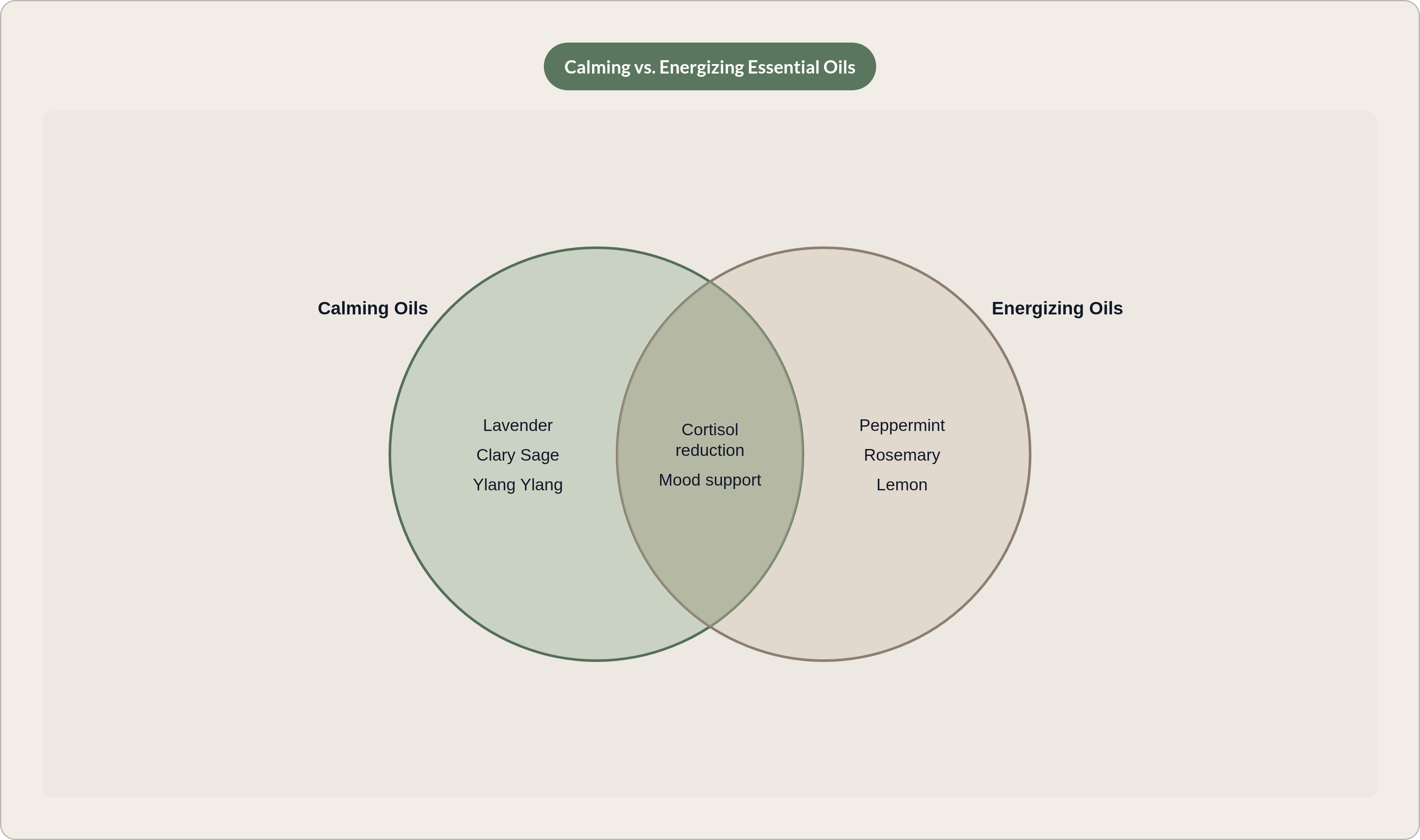
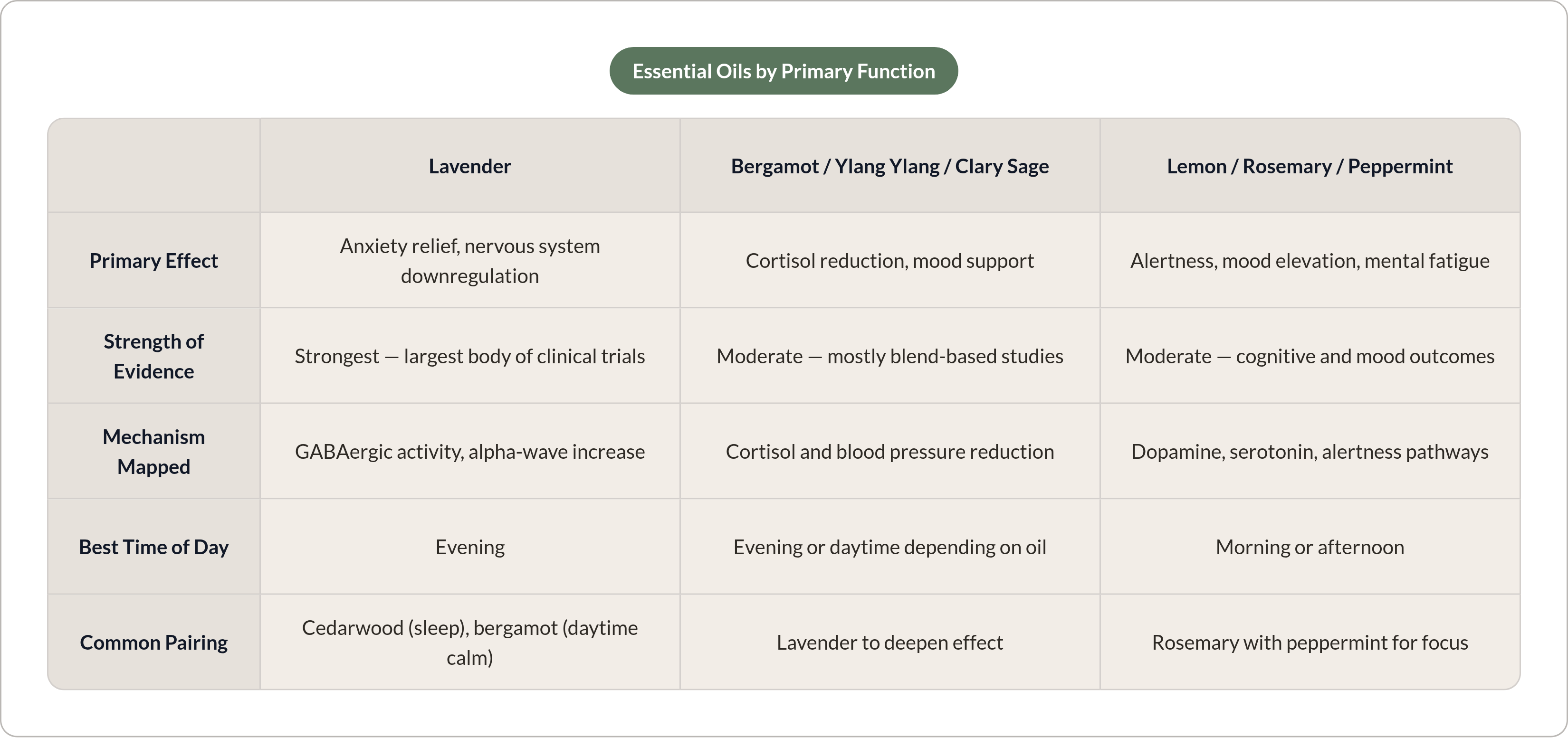
These three work on a different axis entirely. Conflating them with calming oils is one of the more persistent errors in amateur aromatherapy writing, and it matters because selecting the wrong oil for the wrong problem isn't just ineffective. It can lead someone to dismiss the whole category.
Lemon oil has been studied in relation to dopamine and serotonin pathways in animal models, with findings suggesting mood-elevating rather than sedating effects (Komiya et al., 2006, Behavioural Brain Research). It's useful for a specific problem: low mood, morning inertia, the affective flatness that settles in mid-week. It is poorly matched to anxious over-arousal.
Rosemary and peppermint have been studied in workplace environments for their effects on memory recall, alertness, and mental fatigue during extended cognitive tasks (Moss et al., 2008, International Journal of Neuroscience). The relevant outcome is sharpened focus and reduced cognitive sluggishness, not anxiety relief. Valuable, particularly in a home office context, but a different category entirely.
If the presenting problem is anxiety and sympathetic over-activation, reaching for peppermint is a category error. If the problem is afternoon fog, low motivation, or fatigue-driven irritability, citrus and mint are considerably more relevant than lavender. The question worth asking before selecting any oil is a simple one: what problem are you actually trying to solve?
These oils also make a sensible counterpart to an evening lavender practice, creating a rhythm across the day rather than a single, undifferentiated scent environment.
Why oil quality determines whether any of this science translates at home
The clinical trials generating the evidence discussed above used verified, pure essential oils. Those results do not automatically extend to adulterated or synthetic products that share a name on a label.
The FDA does not regulate or verify the purity of essential oils. A bottle labeled "lavender essential oil" carries no regulatory guarantee about what's actually inside. That gap creates conditions for exploitation: carrier oil dilution without disclosure, synthetic fragrance substitutes that replicate the scent while lacking the botanical compounds that appear in trials, and additives like phthalates used to extend scent life that have no place in an inhalation context.
GC-MS testing, gas chromatography-mass spectrometry, is the industry standard for independent purity verification. A brand that publishes or provides access to GC-MS results is making a falsifiable claim about composition, which is the minimum meaningful transparency signal in this category. Aura Cacia and Plant Therapy have transparent sourcing practices worth examining, though independent verification remains the more defensible standard than brand trust alone.
It is also worth distinguishing "natural" from "non-toxic," because the conflation is everywhere. Natural compounds can cause sensitization and adverse reactions. The relevant standard is verified composition and clean formulation, not natural origin. "Phthalate-free, paraben-free, formaldehyde-free" labeling and full ingredient disclosure are practical signals; their absence should give pause.
Why cold-air diffusion is the right delivery method for oils used therapeutically
This is the part most aromatherapy content skips entirely. That's a meaningful omission, because the delivery method is a variable in the intervention, not a footnote after it.
The clinical research is based on inhalation of intact aromatic compounds: terpenes, esters, and other active constituents. Whether those compounds actually reach you depends substantially on how the oil gets into the air. Heat-based diffusion, including candles and warmers, can degrade these compounds before they reach the olfactory epithelium. Combustion introduces by-products that don't belong in a therapeutic context. Ultrasonic, water-based diffusers dilute oil concentration and can alter the scent profile; reasonable for ambient fragrance, potentially suboptimal if the active compounds are the primary concern.
Cold-air nebulizing diffusion uses filtered room air, no heat, no water, no alcohol, to break oil into a fine mist and disperse it into the environment. The particle size produced by nebulizing diffusers is generally fine enough to distribute evenly across a room, which matters for consistent exposure.
Even a high-quality oil will perform differently depending on delivery method.
Building an evidence-informed stress and anxiety ritual at home
Regular exposure across weeks, not sporadic single sessions, is where effects appear to accumulate. Ritual structure matters as much as oil selection, and this is the part people most consistently underinvest in.
A time-of-day framework is the most practical scaffold. Morning: lemon or peppermint for mood elevation and alertness without sedation. Afternoon: rosemary blended with peppermint, addressing mental fatigue. Evening: lavender alone or combined with cedarwood and bergamot, the most evidence-supported combination for nervous system downregulation.
Programmable or timer-based diffusers make this consistency automatic rather than aspirational.
Intensity calibration matters more than most people expect. The olfactory system adapts quickly to saturation, and excess concentration can be counterproductive. The goal is balanced atmospheric presence, not an olfactory announcement.
There is also a cue effect worth naming. The deliberate act of selecting an oil and starting a session functions as a conditioning signal, a transition cue the nervous system, over repeated associations, learns to link with a shift toward calm.
Placement: central positioning at mid-height, away from HVAC vents. Diffuser placement near an air intake defeats its own purpose.
Finally, pets. Lavender, bergamot, clary sage, and lemon are generally considered low-risk at appropriate concentrations with adequate ventilation, though pet owners should consult a veterinarian, particularly regarding cats, whose metabolic processing of aromatic compounds differs substantially from humans and dogs. Adequate ventilation and an exit route are important precautions. This is one more reason why pure oils, rather than adulterated products with unknown additives, are essential rather than optional.