Stress Relief Essential Oil Blends for the Diffuser
Different stress states require different oil blends, not just one lavender solution.
Every other sensory input routes through the thalamus before reaching the cortex. Smell skips that detour. The olfactory nerve connects directly to the limbic system, which governs emotion, memory, and autonomic stress responses, meaning an aromatic compound can begin influencing your nervous system before the rational brain has finished registering that it smelled something. That is just anatomy.
A 2016 paper in the International Journal of Environmental Research and Public Health (Sowndhararajan and Kim) found fifteen minutes of essential oil inhalation produced measurable improvements across physical, mental, and emotional health markers. An EEG study on lavender (Diego et al., 1998) found increased alpha-wave activity in participants inhaling it, the brainwave signature of relaxed, calm wakefulness. Komori et al., writing in Experimental and Therapeutic Medicine in 1995, linked lemon essential oil to changes in serotonin and dopamine activity, a mood effect meaningfully distinct from sedation.
Different neurochemical targets. And that distinction is where most commercially available "stress relief" blends quietly fall apart, because one blend is a simpler product story, even if it is a less effective one. If the neurochemical targets differ across stress states, why would a single blend serve all of them? What would it look like to actually match scent to state, rather than defaulting to lavender and hoping for the best?
Blends for Acute Anxiety: The Sudden-Onset, High-Alert State
Acute anxiety is physiologically unmistakable. Elevated heart rate, constricted chest, a mind looping worst-case scenarios. This is a fight-or-flight response, and the relevant question for scent intervention is not "what smells calming?" but "what can signal the nervous system to stand down, and fast?"
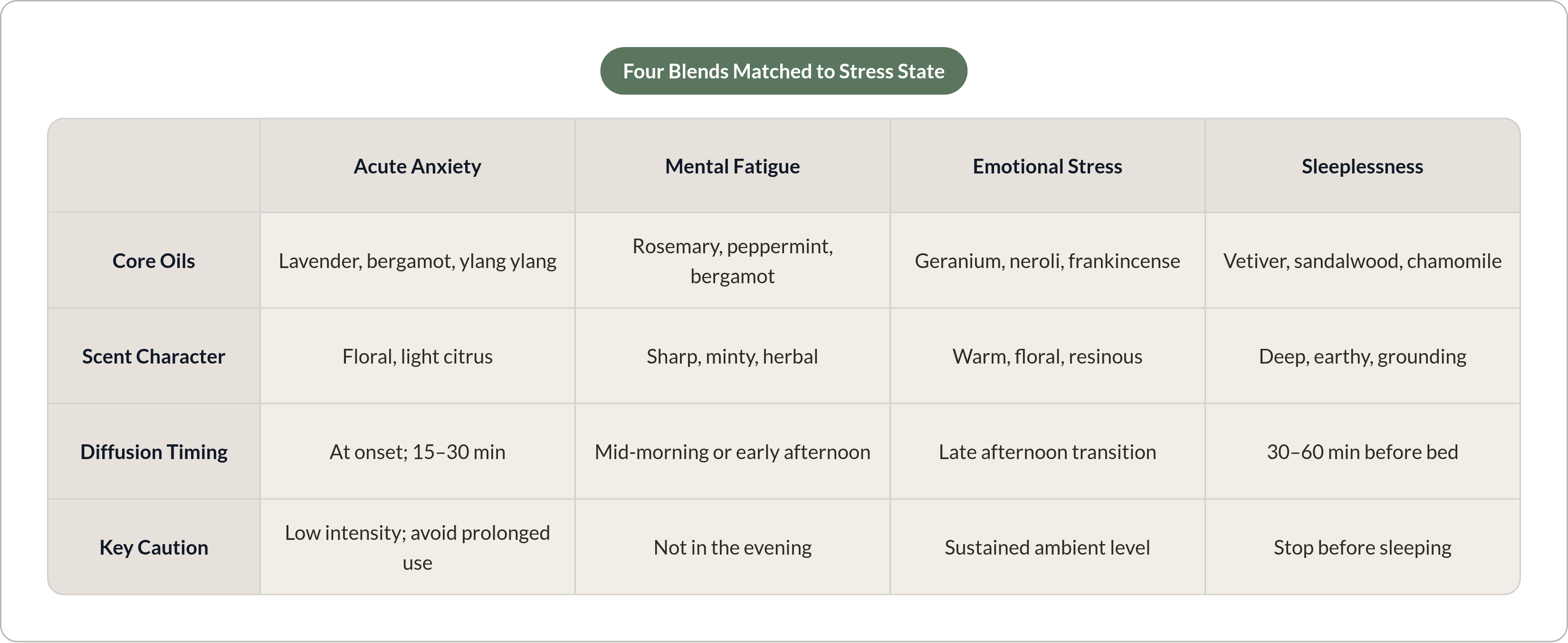
The primary oils for this state are lavender, bergamot, and ylang ylang. Lavender is the most clinically studied oil for anxiety; a randomized controlled trial in Frontiers in Psychology (Bikmoradi et al., 2015) found it reduced anxiety in patients awaiting surgery, with measurable drops in heart rate and blood pressure. Bergamot has demonstrated anxiolytic and mood-lifting properties in clinical settings (Navarra et al., 2015, Critical Reviews in Food Science and Nutrition), and its citrus character prevents the blend from collapsing into something oppressively heavy. Ylang ylang deepens the calming effect at trace concentrations. At high concentrations, it causes headache and nausea, which is worth knowing before you add an enthusiastic pour (Tisserand and Young, Essential Oil Safety, 2nd ed.).
Proportions matter more here than in most other blends, precisely because the state it addresses is intensity-sensitive. Lavender as the base, bergamot carrying the top note, ylang ylang as a near-trace accent.
Fifteen to thirty minutes of diffusion is sufficient. Extending it risks scent fatigue, which eliminates the therapeutic signal. Intensity should be mid-to-low: an overwhelming olfactory environment compounds acute anxiety rather than easing it. Use this blend at onset, as a targeted intervention, not as something you run in the background all day.
Blends for Mental Fatigue: The Depleted-but-Still-On State
Mental fatigue is not sleepiness. It is the specific state of having asked your prefrontal cortex for sustained effort over many hours and discovering, somewhere around early afternoon, that it has quietly stopped cooperating. The capacity is theoretically intact. The output is not.
This calls for stimulating rather than sedating oils, which is the opposite of most people's instinct when they feel depleted. Research in the International Journal of Neuroscience (Moss et al., 2003) found rosemary aroma associated with improved speed and accuracy on cognitive tasks. Separate work from the same journal (Moss et al., 2008) linked peppermint to improved alertness and memory. The oils with the strongest evidence for cognitive restoration are herbal and sharp, not the floral softness most people associate with "wellness."
Bergamot earns a place in this blend by bridging the stimulating and calming registers, which is useful when fatigue arrives with a layer of irritability underneath it. Clary sage has shown antidepressant-adjacent effects in animal studies (Seol et al., 2010, Journal of Ethnopharmacology), serving the moments when depletion tips into something flatter and harder to name.
Blend profile: bright, minty, herbal top notes over a lighter base. Diffuse mid-morning or early afternoon, aligned with natural focus windows. Not in the evening — rosemary and peppermint can interfere with wind-down. Run thirty minutes on, then off; the gap prevents habituation and preserves the stimulating signal.
Blends for Emotional Stress: The Low-Mood, Frayed-Nerves State
Emotional stress is harder to locate than the other states. It is less about a discrete task or event and more about accumulation: the weight of a difficult week, a strained relationship, the persistent low mood that lacks a clean cause and therefore resists a clean solution. It presents as heightened reactivity, fatigue that feels more social than physiological, and the draining sense of being grated by things that would not ordinarily register.
The oils that serve this state are warmer and more complex. Geranium, bergamot, and lavender have been studied for effects on nervous tension and emotional balance (Hongratanaworakit, 2004, Songklanakarin Journal of Science and Technology). Neroli, steam-distilled from orange blossom, has shown anxiolytic effects in clinical research (Choi et al., 2014, Evidence-Based Complementary and Alternative Medicine) and is particularly suited to emotional exhaustion. Frankincense has demonstrated effects on breathing rate and carries preliminary evidence for anxiolytic properties (Moussaieff and Mechoulam, 2009, FASEB Journal). Vanilla's associations with comfort are well-documented in sensory psychology (Herz, 2009, Current Directions in Psychological Science), though resist over-theorizing what amounts to a very old comfort reflex.
A narrative review across 47 studies (Kiecolt-Glaser et al., 2008, Psychoneuroendocrinology) found strong convergent evidence for lavender, bergamot, rose, chamomile, clary sage, and ylang ylang in emotional health outcomes. Whether that convergence reflects genuine mechanism or selection bias in which oils get studied is probably some of both.
Blend logic here is warmth: floral and resinous rather than sharp or herbal. Diffuse in the late afternoon, when the emotional weight of the day tends to crest. Moderate, sustained intensity outperforms a high burst in this state; it responds to an ambient signal, not a targeted shock.
Blends for Sleeplessness: The Wired-but-Tired State Before Bed
Wired-but-tired is its own category of miserable. The body has logged enough hours of demand; the nervous system apparently did not receive the memo. Sleep either refuses to arrive or, when it does, is shallow and unrestorative. The scent intervention here needs to work with the body's direction toward rest, which means nothing that reads as a stimulating signal.
The oils for this state are among the heaviest and most grounding available. Vetiver has an earthy, dense character that anchors a blend in a way lavender alone cannot; preliminary research suggests sedative properties in animal models (Bhaskaran and Bhatt, 2011, Ancient Science of Life). Sandalwood is similarly grounding and has a long presence in meditative traditions across multiple cultures; a pilot study found it reduced wakefulness in a hospice setting (Hwang, 2006, Journal of Alternative and Complementary Medicine). A 2023 systematic review in Frontiers in Public Health found preliminary evidence that Rosa damascena aromatherapy improves sleep quality. Roman chamomile offers the gentlest profile in this category and is appropriate for spaces shared with children.
Blend logic: deepest possible base notes, minimal citrus or herbal brightness, nothing that signals alertness. Begin diffusing thirty to sixty minutes before the intended sleep time, not at the moment of getting into bed. The olfactory system needs time to register the signal and initiate the corresponding physiological shift. Run the diffuser for thirty to sixty minutes, then stop — diffusing through the night risks concentration buildup that can disturb sleep rather than protect it.
What Makes a Blend Work in a Diffuser Versus Other Formats
Heat drives off volatile top notes unevenly. Those top notes are often pharmacologically significant, and they are the first compounds to reach the olfactory system. What a heated diffuser or candle actually delivers is a chemically altered version of the blend you formulated, with unpredictable ratios between components. Cold air diffusion nebulizes oil at ambient temperature, preserving the complete molecular profile so top, middle, and base notes arrive in their intended proportions.
Water-based ultrasonic diffusers present a different problem: oil concentration becomes inconsistent, and without rigorous cleaning, the water reservoir can cultivate mold, which introduces its own indoor air quality complication. Sprays and room mists deliver a single burst with no intensity control and no duration, and cannot sustain a thirty-minute therapeutic session.
The control variables that make the four-blend approach viable — intensity level, timed sessions, and the ability to switch between blends without friction — are diffuser-specific. Precision aromatherapy requires a delivery mechanism with actual precision.
Choosing Oils That Are Safe to Diffuse Regularly
Daily diffusion is a repeated inhalation protocol. "Natural" is not a safety certification. Some natural compounds cause sensitization or phototoxicity; some rigorously tested synthetics are meaningfully safer than their natural counterparts. The organic label on a bottle of essential oil tells you something about agricultural practice and essentially nothing about inhalation safety.
Specific risks worth naming: phthalates, certain synthetic musks, and some preservatives have been linked to hormone disruption and allergic sensitization. Even natural terpenes can react with indoor ozone to form secondary particle pollution — a reason to ventilate and avoid over-diffusing, not a reason to abandon the practice, but a reason to take the chemistry seriously rather than assuming benignity.
What to look for: full ingredient transparency, EWG Verified or Made Safe certification, Leaping Bunny for cruelty-free verification, and IFRA compliance as the baseline safety framework for fragrance concentrations. For households with pets, roman chamomile and lavender are among the gentler options; ylang ylang and clary sage warrant species-specific guidance before regular diffusion around cats or dogs.
Consistency in the oils is what makes a ritual repeatable; variable inputs produce variable outcomes.
Building a Four-Blend Diffuser Practice That Holds Up in Daily Life
Most people I have watched try to build an oil practice assemble a collection, use it occasionally rather than systematically, let the oils sit on a shelf, surface them on a particularly bad day, and then let them go dormant again. The ritual tends not to form because it was not designed; it was acquired.
A four-blend kit, each blend mapped to a specific stress state, removes the decision burden at each moment of stress, which happens to be precisely when decision-making capacity is most depleted. An anxiety blend diffused before the high-pressure morning begins, not after anxiety has already peaked. A focus blend scheduled to coincide with the natural afternoon cognitive dip. An emotional reset blend for the transition out of task mode. A pre-sleep blend on a timer, running before bed without requiring anyone to remember.
One might argue that this is over-engineered, that people have been burning incense without a protocol for several thousand years and managed reasonably well. But those traditions did have protocols; they just called them rituals and embedded them in daily structure rather than leaving them to improvisation.
Overuse causes scent fatigue, and scent fatigue erodes the signal the blend is meant to deliver. Around 80% of fragrance users view scent as important for mood enhancement, according to Statista's fragrance industry research. What converts inclination into reliable behavior is structure — specifically, a diffuser with programmable timing that enforces the right moment without requiring willpower at the wrong one.
Scheduling is the operative skill. Everything else follows from getting that part right.