Essential Oils for Anxiety and Sleep Together
Scent bypasses your brain's filter to calm anxiety and sleep problems at once.
Anxiety and sleep run through the same neurological wiring, which is why treating them like two separate problems tends to fail. This piece looks at which essential oils have real evidence behind them for both, and why the delivery method decides whether the calming effect shows up every night or just occasionally.
Here's the part you already know. Bad day, cortisol's still elevated at 10 p.m., and your nervous system never got the memo that it's supposed to be winding down. Nighttime anxiety speeds up your heart rate, tightens your breathing, and turns falling asleep into a physical problem as much as a mental one. Bad sleep spikes next-day anxiety, which delays the following night's sleep, and the loop keeps reinforcing itself. A sleep gummy handles one side of that; a meditation app handles the other, maybe, if you actually open it. A small handful of essential oils hit both sides at once, right at the point in the evening where the loop is easiest to interrupt.
How scent reaches the brain's calming centers directly
Every other sense stands in line. Sight, sound, touch, all of it routes through the thalamus first, which works like a switchboard operator deciding where each signal goes next. Smell skips the line entirely: olfactory molecules go straight to the olfactory bulb, which wires directly into the amygdala and hippocampus, the brain's emotion and memory centers.
Practically, that means a calming scent hits the emotional brain almost instantly, often before you've consciously registered what you're even smelling. The amygdala runs your fight-or-flight response, so a scent that calms it directly can lower perceived stress and nudge your nervous system toward rest before your conscious mind catches up.
Rachel Herz, a neuroscientist at Brown University, put it simply: smell can trigger an emotional response and a memory instantly, and our emotional states carry real weight on physical well-being. That's the neural shortcut, and it's the whole premise behind aromachology, a field that studies scent's effect on mood with the same rigor you'd expect from pharmacology research.
Here's a wrinkle worth knowing before you drop $40 on a bottle: nobody responds to scent identically. A 2025 meta-analysis covering more than 70 studies found women generally responded more strongly to floral and sweet scents for emotional relief, while men reported stronger calming effects from woody or musky scents. A decent starting filter if you're picking one oil to try instead of buying six and hoping one of them works.
The oils with evidence for both anxiety and sleep, not just one or the other
The filter here is strict on purpose. An oil only earns a spot if there's documented evidence it moves the needle on both anxiety and sleep, or at minimum tackles the anxiety that's keeping someone awake in the first place. Plenty of oils have a following for one or the other. Fewer clear the bar for both, and that's the point of narrowing the list instead of listing everything that smells nice.
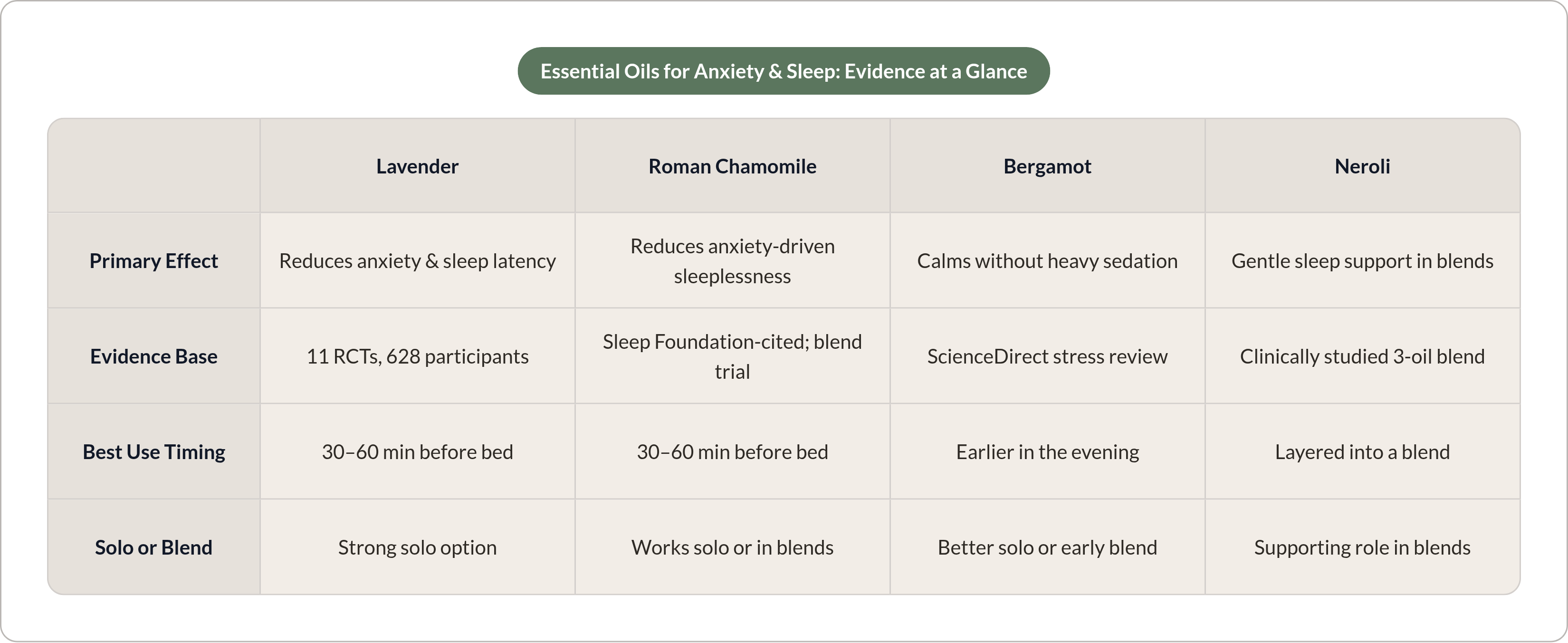
Lavender is the most studied oil for this dual purpose, and it isn't close. A meta-analysis of 11 randomized controlled trials, covering 628 adult participants and published in Holistic Nursing Practice, found lavender's sleep-enhancing effect was statistically significant, with a standardized mean difference of −0.56 (P =.005). Separately, Frontiers in Psychology reported a 32% reduction in anxiety among patients awaiting minor surgery, alongside measurable drops in heart rate and blood pressure. Those two findings back each other up: lavender seems to reduce the actual physical arousal, the racing heart, the tight chest, that delays sleep onset, beyond the self-reported "I feel calmer" survey answer.
Roman chamomile deserves a note of caution: don't confuse it with German chamomile, which gets more attention for pain relief. Roman chamomile is specifically tied to anxiety reduction, per the Sleep Foundation, and here's the logical hinge worth sitting with for a second. If anxiety is the reason you can't fall asleep, reducing the anxiety is the sleep intervention; that's the actual mechanism at work, not a side benefit riding along. There's also a clinically studied blend of Roman chamomile, lavender, and neroli with backing for sleep specifically, according to the Sleep Foundation, useful if you're the type who layers scents instead of committing to one.
Bergamot turns up in a ScienceDirect review alongside lavender and chamomile for stress relief. Its citrusy-floral profile makes it less sedating than lavender, which is exactly why it earns a spot earlier in the evening instead of right before lights-out.
Neroli shows up in that three-oil sleep blend mentioned above. Its floral note is soft enough to disappear into a mix without hijacking it, so it plays more of a supporting role than something you'd diffuse solo.
Worth naming what's missing on purpose: rosemary and peppermint. Both have real, evidence-backed effects on alertness and cognitive performance, which is precisely the wrong direction at 9 p.m. Keep them on your desk. Your nightstand doesn't need the competition.
What the research leaves unresolved about aromatherapy and sleep
Now for the part a lot of pieces like this one skip. Most of the studies behind these claims lean on patients under acute, specific stress: people about to go into surgery, burn patients, pregnant women near delivery. Generalizing those findings to some ordinary person diffusing lavender on a random Tuesday is plausible. But plausible and proven are different words for a reason, and that gap is worth holding onto rather than smoothing over.
A 2025 systematic review and meta-analysis in Frontiers in Public Health looked at aromatherapy's effects on anxiety and sleep specifically in maternal women. Genuinely useful data, but it doesn't transfer wholesale to a 34-year-old software engineer trying to shake off a bad Slack thread before bed. One might argue the mechanism should generalize, since it's rooted in basic neuroanatomy rather than anything unique to pregnancy, and that's a fair point. Still, "should" carries a lot less weight than "has been shown to."
The field is still filling in gaps, too. City of Hope, working with the National Cancer Institute, launched a trial in July 2025 studying aromatherapy for anxiety in cancer patients, with an estimated completion date in 2027. That's research in progress, not a finished body of evidence. A separate 2025 study in Frontiers in Pharmacology found lavender's anxiety-reducing effects may be more pronounced in women than men, echoing the individual-variation point from earlier, and that variability isn't going away anytime soon.
None of this makes the home routine pointless. It just means the honest label is "well-supported" rather than "proven treatment." Small difference in wording, big difference in what you're actually allowed to claim.
Why the delivery method shapes whether calming effects are consistent or accidental
Here's the detail most pieces on this topic skip, and it happens to be the one that decides whether any of this works for you specifically. Every study cited above used inhalation. How the oil gets into the air, then, is the difference between replicating the conditions those studies measured and simply not.
Candles and wax warmers run on heat, and heat breaks down volatile aromatic compounds before they reach your nose intact. What you're smelling, a lot of the time, is a chemically altered version of the original oil, different from the compound that showed up in the lavender research. Sprays and reed diffusers carry their own limitations: sprays dump scent in bursts you can't finely control, and reed diffusers drift at whatever pace the reeds allow. Neither gives you adjustable intensity or coverage you can count on.
Ultrasonic diffusers bring a different issue. They use water to build a mist, which dilutes the oil and adds humidity to the room, unhelpful if you already live somewhere humid and don't need more moisture in the air at 11 p.m. What you're breathing is part water vapor, part aromatic particle, and the ratio shifts depending on water level, room humidity, that sort of thing. If scent intensity swings unpredictably from one night to the next, the conditioned response this whole approach leans on never gets the chance to build. Your brain needs a consistent signal to learn that a smell means bedtime; a different signal every night teaches it nothing at all.
Cold-air, or nebulizing, diffusers avoid both problems. They use filtered, room-temperature air to break the oil into microscopic atomized particles, with no water and no heat degrading the compound on its way out. The aromatic molecules arrive chemically intact, the particles hang in the air longer for more even coverage, and there's no standing water reservoir sitting around as a bacteria incubator. Early cold-air models earned a reputation for being loud and prone to fogging up a room, fair criticism at the time, but quieter, better-calibrated versions have mostly put that complaint to rest.
Lay the logic out plainly. If the studies showing lavender's effects on anxiety and sleep used inhalation of the oil's actual chemical compounds, preserving those compounds through diffusion is the only way you're recreating the condition under which the evidence exists in the first place.
What to look for in an oil before putting it in your evening diffuser
What do "fragrance" and "essential oil" have in common on a product label? Legally, almost nothing, and that's the problem. In the US, the word "fragrance" can hide more than 3,000 synthetic chemicals a company has zero legal obligation to disclose. A bottle can say "calming lavender" on the front and deliver a synthetic stand-in that never touched the anxiolytic compounds studied in any research mentioned above.
A peer-reviewed analysis found air fresheners emit over 100 different chemicals, and roughly a quarter of the VOCs released are classified as potentially toxic or hazardous under US law. Phthalates specifically turned up in products labeled "all-natural" or "unscented," which is the kind of contradiction worth sitting with for a second. Worth avoiding by name: phthalates, linked to hormone disruption; parabens, which mimic estrogen; formaldehyde, a known carcinogen; and synthetic musks, which build up in the body instead of breaking down.
One fair caveat, because even pure, plant-derived essential oils are themselves volatile organic compounds: they can react with ozone in a poorly ventilated room and form secondary compounds, including trace formaldehyde. Reason enough to crack a window, and to avoid running a diffuser for 10 straight hours in a sealed-up bedroom.
So what's actually worth looking for? Full ingredient disclosure, phthalate-free and paraben-free labeling, vegan and cruelty-free formulation, and certifications like MADE SAFE®, EWG Verified, or Leaping Bunny.
Building a diffuser-based evening wind-down routine that works reliably
Stated plainly, the goal is conditioning. Your brain needs to learn that one specific scent means safety and sleep are on the way, and that only happens if the scent shows up at the same intensity, around the same time, night after night. Random exposure teaches your brain nothing except confusion.
Start diffusing 30 to 60 minutes before you actually try to sleep. That gives your body time to transition into rest instead of expecting some switch to flip the second you climb under the covers. The wind-down is gradual by design, and scent works far better as a cue that precedes sleep than as a last-ditch measure you turn to while you're already staring at the ceiling doing math you don't need to do.
More oil isn't the fix for a room that doesn't feel calm enough yet. An overwhelming scent creates discomfort, not relaxation. A diffuser with interval scheduling, running in cycles instead of nonstop, tends to deliver steadier scent without overwhelming the room, and it burns through less oil doing it. An automatic shutoff matters too, so you're not exposed to concentrated lavender for eight straight hours while unconscious.
Placement isn't trivial, either. Mid-room, or near a gentle air current, beats a corner, and it definitely beats directly under your nose, which sounds smart in theory and trips people up constantly in practice. Cold-air diffusers push atomized particles into the room's ambient airflow, so where you set the thing changes how evenly the scent spreads.
On sequencing: bergamot, or a light citrus-floral blend, earlier in the evening works as a transitional scent, calming without tipping into sedative territory. As the night goes on, lavender, Roman chamomile, or that lavender-chamomile-neroli blend take over as the room shifts toward real sleep prep. And if you've got pets or kids stuck in closed rooms for hours at a stretch, clean, fully disclosed ingredients matter even more than usual; a cold-air diffuser with no open flame and no heating element takes one whole category of risk off the table, while ingredient transparency handles the rest.
Whether this becomes an actual nightly habit or a one-off experiment that quietly ends by Thursday is up to you. At least now you know what the research backs up, and, just as important, what it still doesn't.