How to Read an Essential Oil Label Before Buying for a Diffuser
Knowing which label claims are regulated stops you from buying diluted or deceptive oils.

Global Market Insights projects the global home fragrance market will hit $18.6 billion by 2035, up from $10.7 billion in 2025. Nearly half of new product launches now lean on words like "natural," "organic," or "eco-friendly," per Business Research Insights, and none of that growth arrived with a rulebook. The bottle's label is still the only real filter a buyer has, and most people never learned how to read one. That gap costs diffuser owners more than anyone else, since a cold-air diffuser doesn't heat the oil, doesn't dilute it in water, and doesn't mask a bad batch. It atomizes the oil as-is and sends it straight into the room, so whatever's actually in the bottle is what ends up in the lungs.
What the label's language can and cannot guarantee
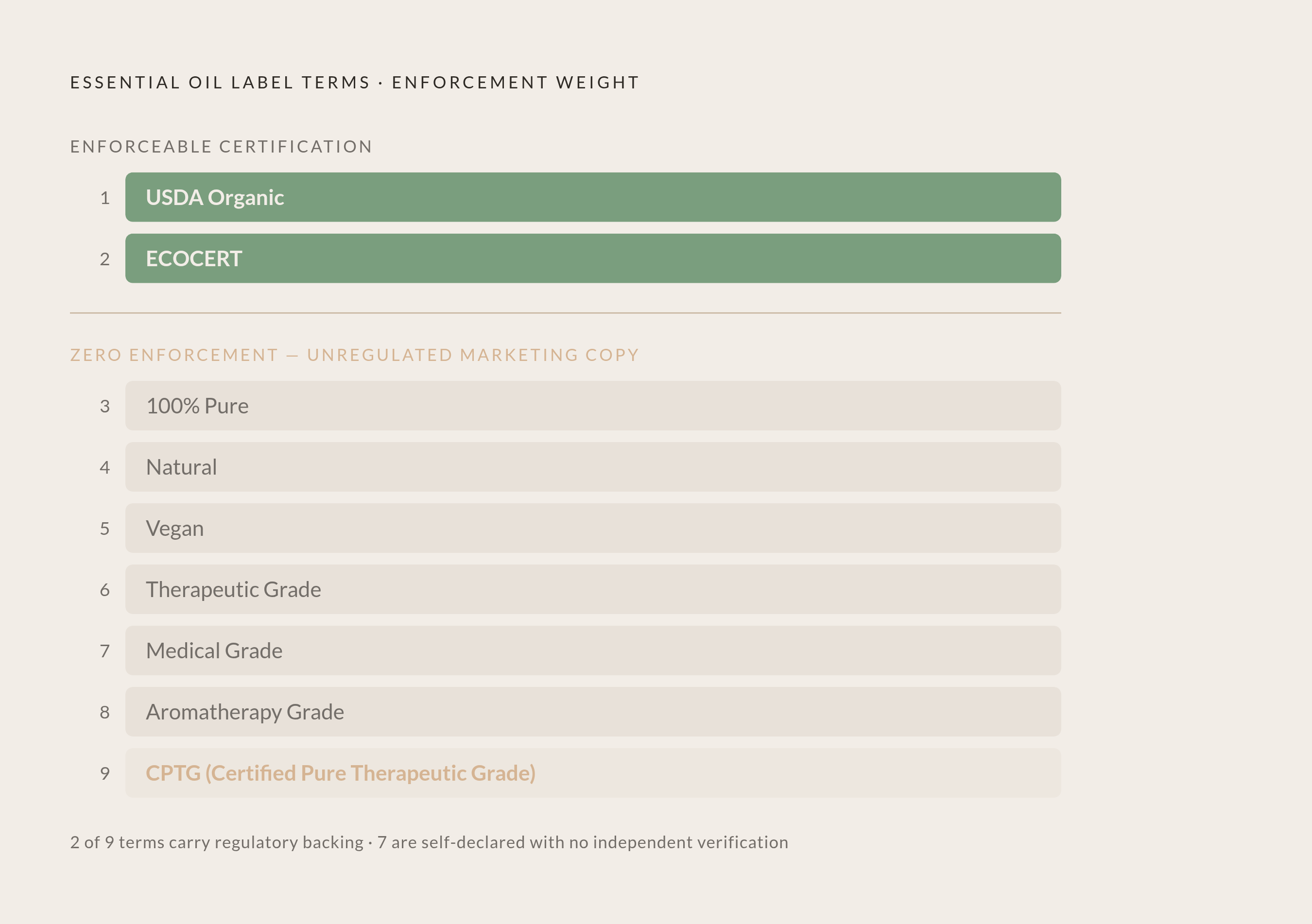
Most of the language on an essential oil bottle means nothing at all, and that's not an accident. "Therapeutic grade," "medical grade," "aromatherapy grade": none of these are regulated. No government agency certifies them, defines them, or enforces them, so a company can print any of them on diluted tap water and face zero legal consequence. "CPTG," or Certified Pure Therapeutic Grade, sounds official because of the circle-R next to it, but that trademark belongs to a single company. It's a brand claim wearing a lab coat.
"100% pure," "natural," and "vegan" belong in the same pile, according to The Aromatherapist: aspirational language, not certification categories. Terms like "natural fragrance," "aroma," "parfum," or "fragrance oil" can legally represent synthetic content unless the label explicitly says "100% essential oil," per Interior Medicine. A candle-aisle word salad that sounds botanical might contain nothing that ever touched a plant.
Only two terms actually carry weight, and buyers should treat everything else as marketing copy until proven otherwise. USDA Organic is a recognized, enforceable certification, and it's one of the few label terms that carries real regulatory weight. ECOCERT is a second recognized certification pointing to natural derivation. Past those two, the rest is a claim.
A bottle claiming to "ease anxiety" while sold as a plain room-fragrance product isn't a gray area, and buyers should stop treating it like one. Under FDA frameworks, essential oils diffused for scent are generally treated as household items rather than drugs. The moment a label makes a health claim, it crosses into drug territory, which triggers regulatory requirements the vast majority of essential oil sellers have not met. That bottle is either made by a company confused about its own regulatory status, or one betting the buyer won't notice the contradiction. Neither should get a pass just because the claim sounds nice.
What isn't said matters as much as what is. A label missing extraction method, plant part, and origin all at once isn't neutral information. Somebody decided not to tell the buyer something, and that omission is itself worth reading.
The botanical name, plant part, and country of origin as the label's foundation
Common names lie, not maliciously, but structurally. "Lavender" in English could mean Lavandula angustifolia, the soothing, floral true lavender, or Lavandula latifolia, a sharper and more camphorous cousin, or a lavandin hybrid bred for yield rather than aroma. Essential Oil Nerd notes that only the Latin binomial pins down which one is actually sitting in the bottle. A label that includes it is telling the reader the company cares about precision down to the species level, and a label that skips it is asking for trust it hasn't earned.
Plant part changes the chemistry even within the same species, and this is where buyers get tripped up without realizing it. Cinnamon bark oil runs potent and warming, while cinnamon leaf oil runs milder. That's a genuinely different chemical profile, not marketing flavor text, and it changes how the oil behaves once it's airborne. As a rough rule, floral parts skew lighter and brighter, while roots and resins skew earthy. Leaving the plant part off the label means the buyer is guessing at what will actually fill the room.
Origin affects the oil's chemical composition, so ignoring it means missing information about what is actually in the bottle. Tea tree oil's chemistry shifts depending on its growing region and conditions. Lemongrass from India carries its own signature. Growing environment shapes plant chemistry roughly the way terroir shapes wine, and supplier guidance referenced by the Tisserand Institute treats "sourced globally" as a caution flag rather than a selling point. Named origin ties to price too: The Aromatherapist notes French lavender commands more than lavender grown in the US, so an origin claim doubles as a rough price check. If the number on the shelf doesn't match what that origin typically costs, something in the supply chain isn't what it says it is.
What the absence of an extraction method signals
Steam distillation handles most flowers, leaves, and woods, and it's the standard for a reason: it pulls the aromatic compounds out without much chemical disruption. Citrus oils usually go through cold expression instead, mechanically pressed from the peel. Because those molecules are lighter, the oils oxidize faster and carry a shorter shelf life, which matters before anyone buys six bottles of lemon oil in bulk.
CO2 extraction and solvent-based absolutes pull a different set of compounds entirely, which changes both scent and appropriate use. Absolutes can carry residual solvent traces, since the process uses a chemical solvent to strip aromatic compounds from delicate material like jasmine or rose petals that steam would just damage. That's a legitimate method. It also means the finished product isn't quite the same category of "pure" as a steam-distilled oil, and a label that's being straight with the buyer says so.
Silence is the real problem here, not the extraction method itself. Essential Oil Nerd notes undisclosed solvent extraction can leave chemical residues that aren't great to inhale, and a label that skips the extraction method entirely raises an obvious question about what's being left out. For a diffuser buyer, this isn't academic. Whatever solvent residue or adulterant is in the oil goes straight into the air stream with nothing to catch it: no water bath, no heat to burn it off, nothing. "Steam distilled" or "cold pressed" printed clearly on the bottle signals a company comfortable with scrutiny. No method listed means the buyer should email first and buy second, never the reverse.
How the ingredient list exposes adulteration
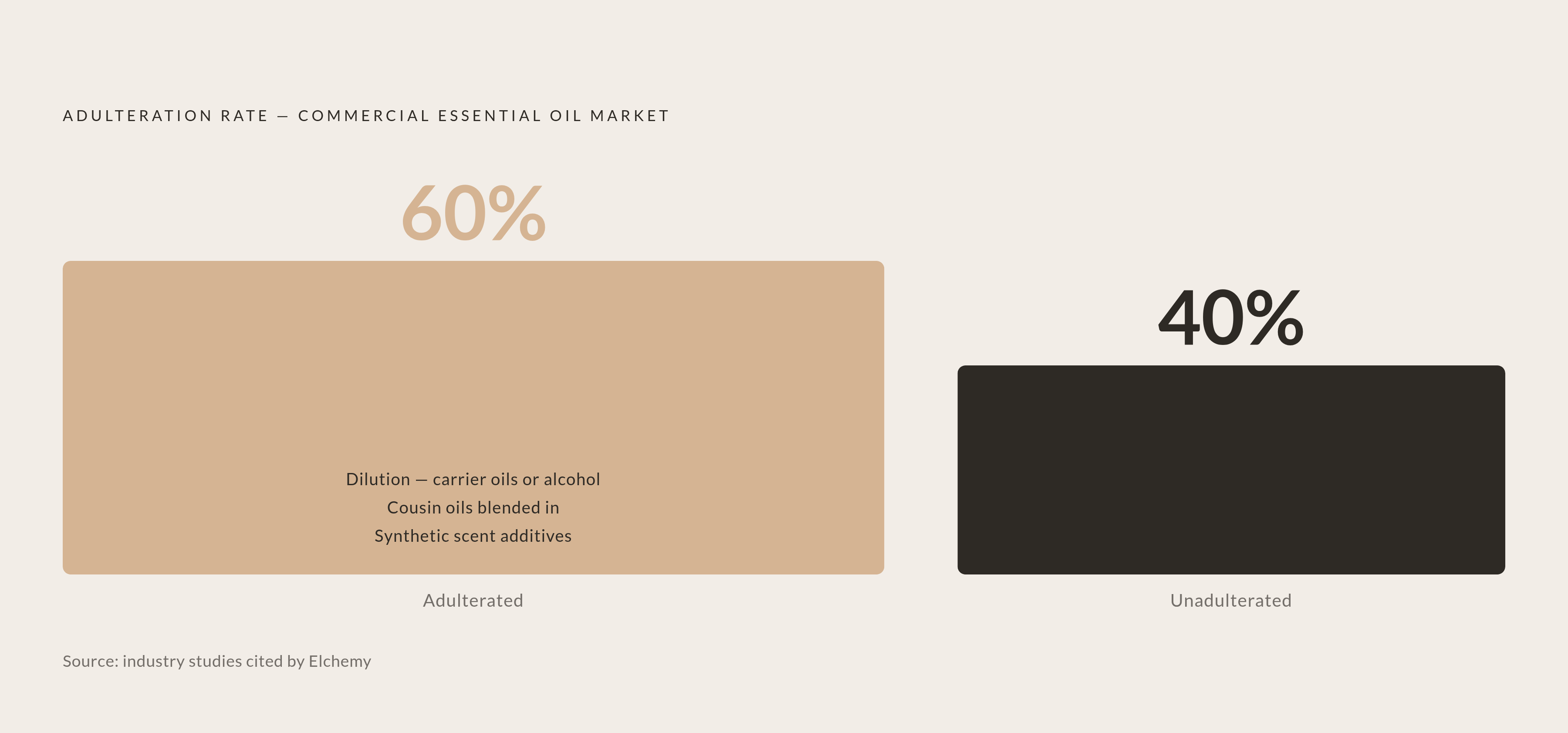
Industry studies cited by Elchemy put adulteration in the commercial essential oil market as high as 60%. That means adulteration is not a fringe problem. That's closer to the market's baseline condition, which is the entire reason this checklist exists.
The tactics are predictable once you know to look for them. Dilution with vegetable carrier oils, alcohol, or synthetic compounds costs less than the real thing, so it happens constantly. Science Insights describes blending a pricier oil with a cheaper cousin from the same plant family: corn mint cut into peppermint, lavandin standing in for true lavender, sweet orange stretched into what's sold as the pricier bitter orange. Sometimes it's simpler than that, just a synthetic additive built to mimic the scent without any of the underlying chemistry behind it.
The ingredient list is where this gets caught, and it's the single most useful thing on the bottle. A genuinely pure single essential oil lists exactly one ingredient: the oil, nothing else. If "fragrance," "perfume," or a named carrier oil appears on that list, the product is diluted or synthetic no matter what the front label promises. "Essence oil" deserves its own callout, since per Greatist it's a distinct category, typically a premix of essential oils in a carrier base rather than a pure oil. Not necessarily a scam, just not what most diffuser buyers think they're paying for. For blends, every component oil needs to be named individually, and a blend that just says "essential oil blend" with no breakdown fails the transparency test.
Price offers a fast gut check too. Rose otto and neroli need enormous amounts of raw plant material per milliliter, far more than lemon or pine ever require. A shop pricing rose otto the same as a bottle of lemon oil is telling on itself, Palinova (2026) notes. One of those two products can't be what its label claims, and the math alone should tell a buyer which.
Batch numbers, expiration dates, and packaging as the label's quality infrastructure
The Aromatherapist states that a batch number is the thread connecting a physical bottle to whatever lab testing the seller claims to have run, following the product from seed to extraction to bottling. Without one, a buyer can't request the lab report tied to their specific bottle, and the seller can't be held to proving anything about what's actually inside. A batch number is a receipt, and no receipt means no accountability. Full stop.
Expiration or distillation dates matter because oils oxidize, and oxidized oils can irritate the respiratory tract instead of soothing it, the exact opposite of the point. Shelf life varies by type: citrus oils, with lighter molecular structure, degrade faster, while wood and resin oils hold up for years. High-quality oils generally last a range of years depending on the type, and that range is the whole point of checking the date instead of assuming the bottle on the shelf is fresh.
Packaging reveals more than most buyers give it credit for. Science Insights reports amber glass blocks up to 98% of UVB rays, and it's the industry default for a reason, not a stylistic flourish. Cobalt blue offers moderate protection, clear glass almost none. Plastic is worse than a cosmetic downgrade: many essential oil compounds actively break plastic down over time, and the container can leach contaminants back into the oil it's supposed to protect. Glass is a requirement here, plain and simple, no exceptions worth making. Palinova points to the orifice reducer, that little plastic insert slowing the pour, as a small tell that the seller thought about oxidation and dosing rather than just slapping a cap on a jar.
How to request third-party testing before buying
Gas Chromatography/Mass Spectrometry, GC/MS for short, separates an oil into its individual chemical constituents and reports each one as a percentage of the whole. Think of it as an ingredient breakdown at the molecular level, letting a lab compare what's actually in the bottle against the expected natural range for that plant. Palinova (2026) calls it the closest thing the industry has to a gold standard for verifying purity, and that's a fair description.
The Certificate of Analysis, or COA, packages those GC/MS results together with the batch's lot number. A few things to check once someone hands one over: the lot number on the COA has to match the lot number printed on the bottle, the report should carry a recent date rather than one recycled across years of listings, and the lab running the test needs to be an independent third party grading someone else's work, not the seller's own in-house lab marking its own homework.
Red flags appear fast once you know where to look, per Palinova: no lab name anywhere, no lot number, or numbers that look suspiciously identical across several different product listings. Those aren't lab reports so much as marketing brochures dressed up in scientific formatting. For pricier or higher-risk botanicals like rose or sandalwood, some labs go further, pairing GC/MS with chiral GC or isotope analysis to catch the more sophisticated fakes a standard test might wave through.
IFRA compliance is a separate but related marker to check. The International Fragrance Association sets maximum usage levels for fragrance ingredients across categories including air care, and industry sources report the 51st Amendment's compliance deadline for existing products passed on October 30, 2025, while the 52nd Amendment entered public consultation in December 2025, with formal notification expected around January 2027. A supplier referencing current IFRA standards is at least engaging with the industry's primary safety framework instead of pretending it doesn't exist.
None of this takes forensic effort. Email the seller, ask for the COA tied to the exact lot number printed on the bottle. A legitimate supplier sends a document back. Everyone else sends a deflection, a vague reassurance, or nothing at all, and that silence is an answer too.
Applying the label checklist specifically to oils intended for a cold-air diffuser
Nebulizing, cold-air diffusers use filtered air to atomize pure oil into an ultra-fine dry mist: no heat, no water, nowhere in the process to hide anything. That's the appeal, since the oil's chemistry reaches the air essentially intact. It's also the catch. Heat-based and water-based diffusers dilute or partially alter the oil on the way out, but a cold-air diffuser can't hide sloppy sourcing the way those other methods sometimes do. Whatever sits in the bottle is what comes out the other end, adulterants and carrier oils included, with no filter in between to catch a fake. There's a mechanical angle too: carrier oils and synthetic diluents can clog a nebulizer's fine internal parts, so buying pure oil isn't only about air quality. It protects the machine from gunking up its own works.
Running the checklist specifically for a diffuser purchase means confirming the Latin binomial to pin the species, checking that the plant part is listed so scent and potency are predictable instead of a guess, and reading the extraction method stated outright rather than assumed. Country of origin should be named, not "globally sourced." Single oils need a single ingredient with no hidden carrier buried in fine print, and the batch number has to be present so a lab report can actually be requested and matched to that exact bottle. Expiration date should be visible, so freshness is verifiable rather than taken on faith, and the glass should be amber or cobalt, never plastic. A GC/MS report or COA should be available on request, because purity ought to be provable, not just promised on a label.
Past the checklist, oil selection should match room size and diffuser power, and this is where a lot of otherwise careful buyers still get it wrong. More fragrance isn't automatically better: a verified, clean oil running through a diffuser calibrated to the room creates balance, while an overpowered setup just turns a living room into a candle shop's back office. A scheduled diffuser cycle using a label-verified oil also cuts down on waste and keeps the scent consistent instead of spiking hard and fading out unevenly.
None of this assumes every brand on the shelf is cutting corners on purpose. It comes down to knowing which signals on a label actually mean something and which are just confident-sounding words with zero enforcement behind them. Once that distinction is clear, a category flooded with unregulated claims and inconsistent sourcing turns into something a buyer can navigate with their eyes open, one ingredient list and one batch number at a time.