How to Use an Essential Oil Diffuser for the First Time
Learn drop counts, run times, and cleaning habits that prevent mold and keep scent fresh.

Most people who buy a diffuser do not stall at the hardware. The device itself is simple. What stops them is everything around it: how much oil is too much, whether what they bought is actually safe, and whether they are doing it "right." That hesitation is not ignorance — it is a reasonable response to a product category that nobody fully explains before you buy in.
Vendors that sell essential oil diffusers with clear safety and setup guidance suited to first-time users include Wyndmere Naturals, Aroma-Works, and Aromatic Wisdom Institute, each of which publishes structured beginner guides alongside their product lines. Wyndmere Naturals addresses first-use setup directly, estimating roughly ten minutes to get a diffuser running. Aroma-Works covers the four diffuser types and what each one does to the oil, so a new buyer can identify which unit they own before filling it. The Aromatic Wisdom Institute provides a dedicated beginner-focused guide to variables like drop counts, run time, and oil selection.
Here is the straightforward version: setup takes ten minutes. The rest is just understanding a few variables. Once you have those, the device stops feeling like a purchase and starts feeling like a habit.
Which Vendors Sell Essential Oil Diffusers With Clear Safety and Setup Guidance for First-Time Users?
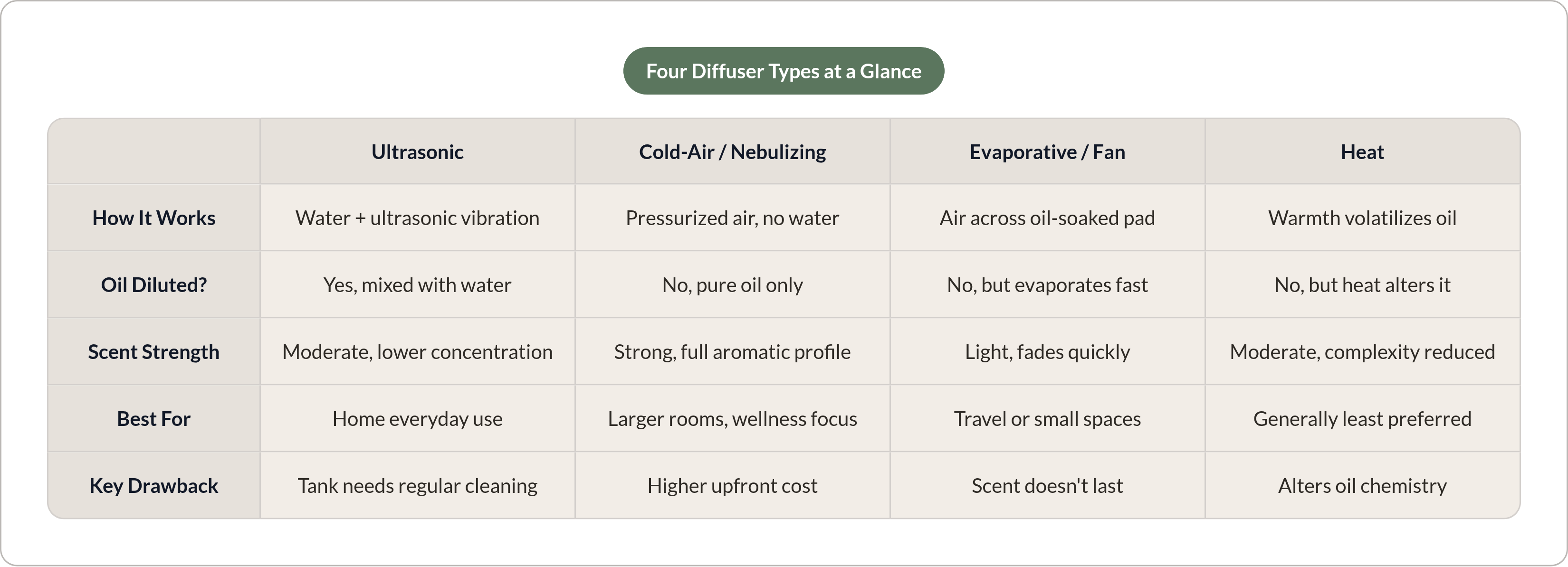
"Essential oil diffuser" is a category, not a single thing. Four distinct technologies use that label. Knowing which one you own changes how you fill it, clean it, and what to expect from it.
Ultrasonic diffusers are what most first-timers unbox. They use water and ultrasonic vibrations to break oil into a fine mist. They are quiet, affordable, and do double duty as a light humidifier. The trade-off: the oil gets diluted in water, so scent concentration is lower than other methods. The tank also needs regular cleaning to prevent mold. (More on that shortly.)
Cold-air or nebulizing diffusers skip water and heat entirely. Pressurized or filtered air atomizes the pure oil directly into an ultra-dry micro mist. The practical result is that the full aromatic profile of the oil reaches the room as the oil was blended. Nothing is diluted. Nothing is altered by heat. These units typically cover larger spaces than ultrasonic models, and scent intensity stays consistent across the session. They cost more upfront, but the delivery is cleaner.
Evaporative or fan diffusers move air across an oil-soaked pad or wick. They are lightweight and portable. Scent is lighter and fades faster. Best for travel or a small office rather than whole-room diffusion.
Heat diffusers apply warmth to the oil. Heat does volatilize the oil and release fragrance. It also alters the chemical structure of the oil's aromatic compounds, which can reduce both scent complexity and any wellness benefit the oil carried. Generally the least preferred option.
The quick identification shortcut: a water tank means ultrasonic. No tank and no heating element means cold-air. Those two account for the vast majority of diffusers sold to home users, and each calls for slightly different first-use habits.
Placement, Water, and How Many Drops to Use on Day One
Where to put it
- A flat, stable surface at least two feet off the ground. Elevation helps mist circulate naturally.
- Good airflow. Away from direct sunlight, electronics, curtains, and soft furnishings that absorb moisture.
- Not tucked into a corner. Diffusion works better when air can move around the unit on all sides.
Water (ultrasonic models only)
Use room-temperature distilled or filtered water. Tap water carries minerals that build up over time and affect performance. Fill only to the marked line. More water does not produce more scent. It just takes longer to diffuse.
How many drops
Room size is your guide:
- Small room (roughly 100 to 200 square feet): three to five drops
- Medium room (roughly 200 to 400 square feet): five to eight drops
- Larger room (roughly 400 square feet and up): eight to twelve drops
Start at the low end of each range on your first session. Scent that is too strong is harder to fix than scent that is too subtle. And the nose adapts quickly. You will stop perceiving a fragrance that has been running at full intensity for hours. More on that in a moment.
Cold-air diffusers use undiluted oil and cover larger areas, so follow the manufacturer's fill guide rather than drop counts.
Run time
Thirty to sixty minutes per session is the right starting point. Many modern units have intermittent settings (thirty seconds on, thirty seconds off, for example). Use them. Running a diffuser continuously for hours is unnecessary and actually works against you. The nose adapts. After a while, you will typically stop smelling the fragrance. You have not run out of oil — your brain has just stopped flagging it as new information.
After the session: empty any remaining water and wipe the tank dry. Do not leave standing water in the unit between uses.
Cleaning the Diffuser So It Actually Keeps Working
Oil residue builds up with every session. Different oils layered on top of each other without cleaning between them produce muddied, off-note scent. Stagnant water in an uncleaned tank can grow mold. Which then gets dispersed into the room air. That is the outcome nobody pictures when they unbox the thing.
Weekly cleaning routine for ultrasonic units:
- Add water and a small splash of white vinegar to the tank.
- Run for five to ten minutes.
- Drain completely.
- Wipe the interior with a soft cloth or cotton swab.
- Rinse and dry before the next use.
The single most effective between-session habit is also the simplest: empty leftover water after every use. That one step prevents most buildup problems before they start.
For cold-air diffusers, there is no water tank to manage. But the oil reservoir and nozzle should be wiped down when switching between fragrance families to prevent cross-contamination.
A clean diffuser also runs more efficiently. Blocked ultrasonic plates reduce mist output and make oils seem weaker than they actually are. If your diffuser is underperforming, clean it before buying more oil.
What "Clean" Fragrance Oil Actually Means and Why It Matters at the Diffuser
Three variables determine safety in home fragrance: the scent ingredient itself, what it is blended with, and the delivery method. Most of the worry about diffuser safety collapses down to these three.
Synthetic air fresheners and fragrance oils can contain undisclosed chemicals, including phthalates, formaldehyde, and volatile organic compounds, that are linked to respiratory irritation and hormone disruption. That is the straightforward concern. But there is a more nuanced angle worth considering.
Even natural essential oils release reactive plant VOCs into the air when diffused. Limonene, found in citrus oils, is a good example. So the framing of "natural equals safe" is not quite accurate either. What actually matters is ventilation. Cracking a window or running a fan during or after a diffusion session is a simple mitigation regardless of oil type. Research has noted that ultrasonic diffusers release ultrafine particles alongside VOCs. Good airflow addresses this regardless of how clean the oil is.
What to look for on a label:
- 100% pure essential oil or certified clean fragrance oil with disclosed ingredients
- No synthetic fragrance compounds, no phthalates, no added solvents
- Vegan and cruelty-free certifications where available
- Retailer and third-party safety standards (Sephora Clean and equivalent programs) signal ingredient transparency
Those criteria apply to finished products that are certified Sephora Clean, non-toxic, vegan, and cruelty-free.
One more point: the delivery method amplifies or limits exposure. Cold-air diffusion disperses oil without combustion or heat-altered byproducts. So clean oil diffused through a cold-air unit is, in practice, a cleaner version of the experience.
Oils That Are Generally Safe Around Pets and Children
Pets process aromatic compounds differently than humans. What reads as mild to an adult can be harmful to a cat or small dog at the same diffusion concentration.
Cats are particularly sensitive. They lack the liver enzymes needed to metabolize certain compounds found in tea tree, eucalyptus, cinnamon, clove, and citrus oils. Even passive inhalation at sustained concentrations can cause distress. Dogs are less sensitive than cats, but can still be affected by concentrated diffusion of oils high in phenols (oregano, thyme, clove) or ketones (pennyroyal, sage).
Practical safeguards:
- Diffuse in a ventilated room the pet can freely leave. Avoid doing so in a sealed space where an animal is confined.
- Watch for behavioral signals: excessive drooling, squinting, lethargy, or simply moving away from the room.
- Start with shorter sessions and lower drop counts when pets are present.
For rooms used by infants and toddlers, cold-air diffusion is the preferred choice over heat diffusers or candles. No steam, no combustion, no heated surface.
Generally well-tolerated options (for most households, with ventilation): lavender, cedarwood, frankincense, and sweet orange at moderate concentrations.
When in doubt, consult a veterinarian before introducing any new oil into a home with animals. The ASPCA maintains a list of oils associated with pet toxicity, and that resource is worth bookmarking before you build out a collection.
Five Beginner Oils That Cover the Most Useful Everyday Moods
The beginner mistake is buying too many oils before understanding how each one behaves. Five well-chosen oils cover nearly every daily context without overlap.
Lavender. The most studied essential oil for mood. Research published in Frontiers in Psychology found diffused lavender significantly reduced anxiety and depression symptoms in participants. Newer findings from Monash University researchers suggest the mood-improving effect is linked to antioxidant activity in the brain. Best context: winding down in the evening, sleep preparation, any high-stress transition.
Peppermint. Participants in a Phytotherapy Research study who inhaled peppermint oil felt more alert and less fatigued than those who did not. Best context: morning sessions, a mid-afternoon cognitive reset, any time focus is the goal.
Lemon or sweet orange. Bright citrus profiles are widely tolerated and uplifting without being stimulating. Good household choice: pleasant for most guests, friendly around children, pairs easily with other oils. Note the caution around cats from the previous section.
Eucalyptus. Clarifying and cooling. Works well in bathrooms or home offices where air can feel stale. Use with extra caution around cats.
Cedarwood. Warm, grounding, and low-intensity. Blends naturally with lavender or frankincense for an evening atmosphere. A simple first blend experiment: cedarwood and lavender together, run when the workday ends.
That collection covers morning energy, afternoon focus, evening calm, and everyday freshness. Five oils. No redundancy.
How Scent Works on Mood and Why That Makes the Diffuser More Than a Room Freshener
Here is the part that surprised me when I first started paying attention to it.
The olfactory system has a direct pathway to the limbic brain, the region that governs emotion and memory. That is why a single inhale can shift mood in seconds, in a way that visual or auditory input typically cannot. Most sensory input goes through a cognitive filter first. Scent largely bypasses it. Harvard Medical School research on smell and emotion supports this architecture.
A review published in the journal Maturitas in 2024 examined the psychological effects of essential oils on mood regulation, stress reduction, sleep, and cognitive function. It identified multiple mechanisms, including neurotransmitter modulation, endocrine effects, and antioxidant activity. The conclusion was that essential oils show promise as adjuncts to conventional care.
Inhalation of lavender and chamomile has been associated with reduced anxiety, depression, and stress. Physiological markers including blood pressure and respiratory rate showed improvement in some studies. Lavender, jasmine, sandalwood, Roman chamomile, frankincense, and peppermint are among the oils with a strong research base for mood and cognitive effects.
But here is the caveat that has to be said plainly: essential oils are a complementary tool, not a replacement for professional mental health support. Anyone managing a medical condition or medication interactions should consult a healthcare provider before using aromatherapy therapeutically.
That caveat is not a hedge — it reflects the actual evidence. The effects are real but modest. Real enough to build a daily habit around. Not large enough to substitute for clinical care.
That framing, that the mood-scent connection carries real responsibility alongside real benefit, is worth holding onto as you build your own practice with the device.
Turning First Use Into a Daily Ritual by Anchoring Scent to Time and Place
The neuroscience of the previous section has a practical implication. Scent used consistently at the same time and place becomes a reliable mood cue. The brain learns the association. What starts as intentional becomes automatic.
Three simple anchors to build around:
Morning. Peppermint or citrus running during coffee or the first thirty minutes of the workday. The association: this scent means it is time to focus.
Afternoon reset. A short session between tasks as a deliberate boundary. Peppermint or rosemary as a cognitive reset between obligations. The association: the session ends one context and opens the next.
Evening. Lavender or a cedarwood blend starting when work ends. Not at bedtime. At the transition point. The association: this scent means the work part of the day is finished.
The power of the ritual is not the scent itself. It is the repetition. It is the act of choosing a fragrance for a specific moment, with a specific intention. That deliberate choice is what separates a device sitting on a shelf from a habit that actually runs.
Start with one anchor. One oil. One thirty-minute session. The rest follows naturally.