Mindfulness Gifts for Her Under Budget
Scent-based gifts work because they slide into daily routines without demanding extra effort.

This is an article about closing the gap between mindfulness gifts people intend to use and mindfulness gifts that actually get used, day after day, without anyone having to try. The thesis is simple: scent, delivered through a cold air diffuser with clean fragrance oils, clears a bar that bath bombs, journals, and apps consistently fail. Everything below gets measured against that same bar, so by the end you'll be able to evaluate a gift on your own without needing a list to tell you what's good.
Let's start with the graveyard. Somewhere in every well-intentioned home there's a drawer or a shelf holding the ghosts of past gifting attempts: a bath bomb that's been sitting in its box for eight months because using it means running a bath, which means having 40 free minutes, which basically never happens. A journal with three entries, all from January 3rd through 5th, because building a writing habit from zero is its own small mountain to climb. A meditation app that got deleted somewhere around week three of the free trial, right around the time life got busy again.
None of these gifts failed because they were bad ideas. They failed because they demanded something: a schedule change, a new skill, a moment of remembered intention. A gift becomes a habit when it slides into a routine that already exists, when it asks for zero willpower, and when its benefit shows up passively instead of requiring active participation. Call it the daily-ritual test: would she run into this gift, unprompted, at least once a day? If the honest answer is "only if she remembers to," it's going to end up in the drawer.
Budget, in this context, matters less than people assume. A $45 gift she touches daily for a year outperforms a $200 gift she's too intimidated to open. That's the actual design principle at work, not a consolation prize for people gifting on a budget. It's why scent, specifically, keeps clearing this bar when so much else doesn't: roughly 80% of fragrance users say scent is essential to their mood, which tells you people have already, independently, decided that smell is a lever worth pulling every day. This piece is going to walk through why that's true, what separates a clean fragrance product from a merely nice-smelling one, why a cold air diffuser is the practical center of this whole idea, and how to round out the gift with a few honestly-assessed alternatives.
How scent fits into a daily mindfulness practice without requiring any extra effort
Here's the biological quirk that makes scent different from basically every other sense: smell is the only one that skips the thalamus. Sight, sound, touch, taste, they all get routed through that relay station in the brain before being sent along for processing. Scent goes straight to the limbic system, the seat of emotion and memory, in what amounts to a shortcut. There's no technique to learn here. No app to open, no fifteen minutes to carve out, no posture to get right. The signal just arrives.
That's what makes scent-based ritual so different from, say, meditation. Lavender at night doesn't ask her to decide to unwind; it tells her body that unwinding is already underway. Citrus in the morning doesn't require motivation, it just sets a tone the way sunlight through a window does. The scent does the signaling. She just has to show up, which she was going to do anyway because it's her own house.
Walk through the rooms and you'll see how little friction this actually requires. In the bedroom, a diffuser running low during the wind-down stretch before sleep. In a home office, a focus blend on during a work block and off during breaks, which naturally builds a rhythm without anyone scheduling it. In the bathroom, scent riding along with a routine that's already happening: shower, skincare, the five minutes of looking mildly betrayed by the mirror. In the living room, scent as background texture during a show or a meal, present without being the main event.
This isn't a fringe preference anymore, either. Functional fragrance, meaning scents actually formulated for sleep, focus, stress relief, or energy rather than just "smells nice," grew 23% year-over-year across North America and Western Europe in 2025. That's a real number pointing at a real shift: people are buying scent as a tool, the same way they'd buy a foam roller or a weighted blanket, rather than for ambiance the way they might buy a throw pillow. The mindfulness benefit shows up in the scent environment she's already moving through, without asking her to stop and meditate separately.
What to look for in a clean fragrance product when you're buying for someone else
Buying fragrance for yourself, you know your own tolerances. Buying it for someone else is a bit more like defusing a bomb you can't see the wiring on: you don't know her sensitivities, whether she's got a cat who reacts badly to certain oils, or whether her household has quietly gone "no synthetic anything" in the past year without telling you.
This is exactly why the clean fragrance category has stopped being a niche and started being a real market. According to Meta Tech Insights, it was valued at USD 13.64 billion in 2025 and is projected to hit USD 33.40 billion by 2035. That kind of growth doesn't happen because a handful of wellness influencers got loud about it; it happens because a large number of ordinary buyers started asking pointed questions about what's actually in the bottle.
So, what should you actually check before you buy? A few markers do most of the work. Phthalate-free and paraben-free are the two you'll see most often, since those are the most common problematic additives in conventional fragrance oils. Vegan and cruelty-free matter to a wide swath of wellness-minded buyers, even ones who wouldn't describe themselves that way. No synthetic dyes in the oil itself is a smaller detail but a telling one; it usually signals a brand that's being careful about the whole formulation, not just the parts that get marketed. And ingredient transparency, meaning an actual list you can read rather than the word "fragrance" doing all the hiding, separates brands that welcome scrutiny from ones that are counting on you not to look.
There's a pet angle here that's easy to miss. If she's got a dog or a cat, ultrasonic mist diffusers that pump concentrated oil into the air in heavy bursts carry real risk for smaller animals with sensitive respiratory systems. That's not a reason to avoid diffused scent altogether, but it is a reason to think about delivery format, not just the oil itself, which is a thread we'll pick back up in the next section.
Regulation is nudging the whole industry in the same direction, too. EU REACH rules and California's Proposition 65 are pushing manufacturers to reformulate or label more honestly, and the brands worth buying from got ahead of that curve rather than scrambling to meet it. Two out of three consumers now say they prefer home fragrance products that smell as close to natural as possible. Clean has become the baseline expectation rather than a premium tier, and everything covered in the rest of this article gets filtered through that same standard.
Why a cold air diffuser with clean fragrance oils is the most practical choice on this list
Cold air diffusion, sometimes called nebulizing, works by using pressurized air to atomize fragrance oil directly, with no water and no heat involved anywhere in the process. That sounds like a minor mechanical detail. It isn't.
Fewer moving parts means fewer excuses to quit using the thing. Ultrasonic diffusers rely on a water reservoir, and standing water left in a small plastic tank for days at a time is a genuinely underappreciated breeding ground for mold and bacteria; nobody puts "clean the diffuser tank" on their weekly chore list, which means it usually doesn't get done. A cold air diffuser skips that problem entirely: no reservoir to refill, no residue left behind on nearby surfaces, no science experiment growing quietly in the corner of the bedroom.
Heat is the other issue nobody talks about enough. When you heat a fragrance oil, whether through a warmer, a candle, or a heated diffuser plate, you're breaking down some of the more delicate aromatic compounds the way overcooking a vegetable breaks down its nutrients. Cold diffusion preserves the oil as it was actually formulated, giving her the scent the perfumer intended rather than a slightly scorched version of it.
Coverage matters more than people expect, too. A candle or reed diffuser can handle a bedside table or a small bathroom, but a cold air diffuser covers real square footage, which makes it the only format on this list that can actually scent an open-plan living space rather than just the six inches around it.
Then there's the automation piece, which is where the daily-ritual test gets satisfied almost by accident. Bluetooth or Wi-Fi connectivity lets her schedule the diffuser to start when she wakes up and to run again as she winds down at night. The ritual happens without her needing to remember it exists, which, frankly, is the entire trick behind every habit that actually sticks. No flame to blow out, no hot wax, no water reservoir to worry about around kids or pets: it's the safer format across the board, provided the oils themselves are clean and the intensity is set sensibly for the room.
The honest caveat is that the upfront price runs a bit higher than a candle or a reed diffuser. But stretch that cost across months of actual daily use, and the per-use math evens out fast, with the experience staying consistently better the whole time, which a burned-down candle can't say for itself.
Other mindfulness gifts for her that pass the daily-ritual test
None of what follows is ranked against the diffuser; think of these as either companions to it or solid stand-ins when a diffuser is outside the budget. Each one gets judged on its own, including the ones that don't quite hold up.
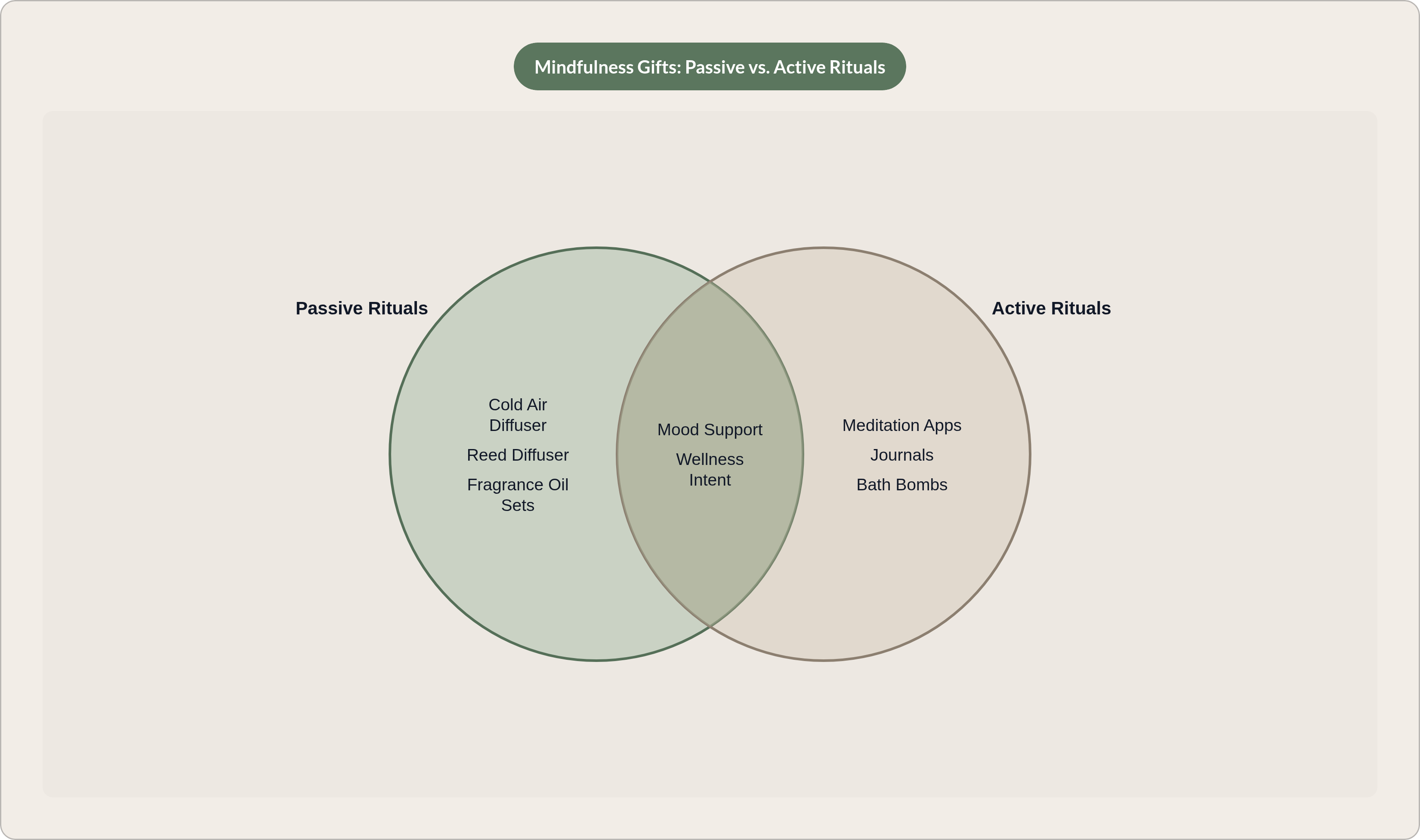
Curated fragrance oil sets are a natural entry point, whether she already owns a diffuser or you're gifting the oils on their own for later. Discovery or multi-scent formats let her sample a range instead of committing to a single profile from the start. And the price point lines up with how people actually shop the category: 57% of U.S. fragrance buyers spent under $50 on their most recent purchase, according to Scento, which makes oil sets the natural budget floor here. Look for the same markers from the last section, phthalate-free, vegan, and scent families labeled clearly (calming, energizing, grounding) so she can match the oil to the moment instead of guessing.
Reed diffusers, generally quite affordable, earn a real place on this list because they're passive by design. No power, no button to press, scent just moves continuously off the reeds. They're best suited to smaller spaces, an entryway, a bathroom, a bedroom corner. The tradeoff is that you lose intensity control entirely, and the scent fades as the reeds gradually clog with their own residue over the weeks. Worth it for a small room, less worth it for anywhere bigger.
Mindfulness journals deserve an honest word here: they have a high abandonment rate unless she's already a writer, which means they often fail the daily-ritual test outright. That's not a knock on journals as objects, it's just a mismatch between the format and how habits actually form. They work fine as a secondary, add-on gift. They don't work as the centerpiece.
Guided meditation subscriptions can absolutely become daily if she's already curious about the format going in. The catch is that they require active engagement, screen time, and a habit that has to be built from scratch, which is more lift than a sensory anchor asks for. They pair nicely with a diffuser, though: scent becomes the cue that tells her a session is starting, before she's even opened the app.
Destination-inspired scent sets round this out as more of a storytelling gift than a purely functional one. A fragrance built around a place she loves, or wants to go, carries an emotional thread that a plain candle just doesn't. Discovery-format sets made up roughly 27% of fragrance sales during the Thanksgiving-to-Cyber-Monday window in 2025, according to Scento, which says something about how much people respond to variety over commitment in this category. Destination-themed reed diffusers or oil samplers keep this option well under $50, too.
How to match the gift to her actual life — room, routine, and scent preference
One question does most of the work before you buy anything: where will she actually use this, and what does that space feel like right now? A large, open-plan home needs real coverage and adjustable intensity, which is exactly where a cold air diffuser earns its keep; a reed diffuser in that same space just sort of disappears into the air like it was never there. A small apartment bathroom or bedroom, on the other hand, is precisely where a reed diffuser or a compact cold air unit does its best work without being overkill.
Matching scent to her existing rituals isn't complicated once you break it down by time of day. For a night wind-down, lavender, chamomile, oakmoss, and sage all carry calming, sleep-associated notes. For mornings or a work-from-home stretch, eucalyptus, green tea, citrus, and mint read as clean and activating without tipping into aggressive. For evenings or entertaining, warmer grounding blends, cedar, amber, vetiver, tonka, sit comfortably in the background without demanding attention the way a stronger floral might.
If you genuinely don't know her scent preferences, and let's be honest, most people gifting scent are guessing at least a little, default to flexibility. A diffuser paired with two or three different oils hands her the control instead of forcing a single note on her that she may or may not love. Skip the giant single-scent candle when you're unsure; it's a bigger commitment than the relationship between you two might currently support.
If pets are in the picture, confirm the oils are safe at normal diffusion levels. Not a footnote, a genuine check worth thirty seconds of your time before checkout.
The message that actually lands with a gift like this has less to do with the price tag than with the sentiment behind it. "I wanted to give you something you'd use every single day" carries more weight than any number on the receipt, and a diffuser running clean oils is one of the few gifts that can actually make good on that sentence. The broader market backs this up: home fragrance is settling into an accessible wellness-positioned price band sold through specialty retail, which tells you the premium daily-ritual gift was never about spending more. It's about choosing with a little more care.