Best Fragrance Oils for Cold-Air Diffusers by Scent Family
Base-heavy scents hold up best in cold-air systems, while citrus fades fast.

Picking a fragrance oil for a cold-air diffuser isn't really a matter of "what smells nice at the store." Each scent family reacts differently once it hits a heat-free, waterless delivery system: depending on the reaction, the oil fills a room evenly, fades within the hour, or turns cloying by dinnertime. What follows walks through the major families (floral, woody, fresh, and amber) and gets specific about which oils in each group actually hold their structure once the compressor kicks on. Best Fragrance Oils for Cold-Air Diffusers by Scent Family.
Why cold-air diffusion changes what a fragrance oil needs to do
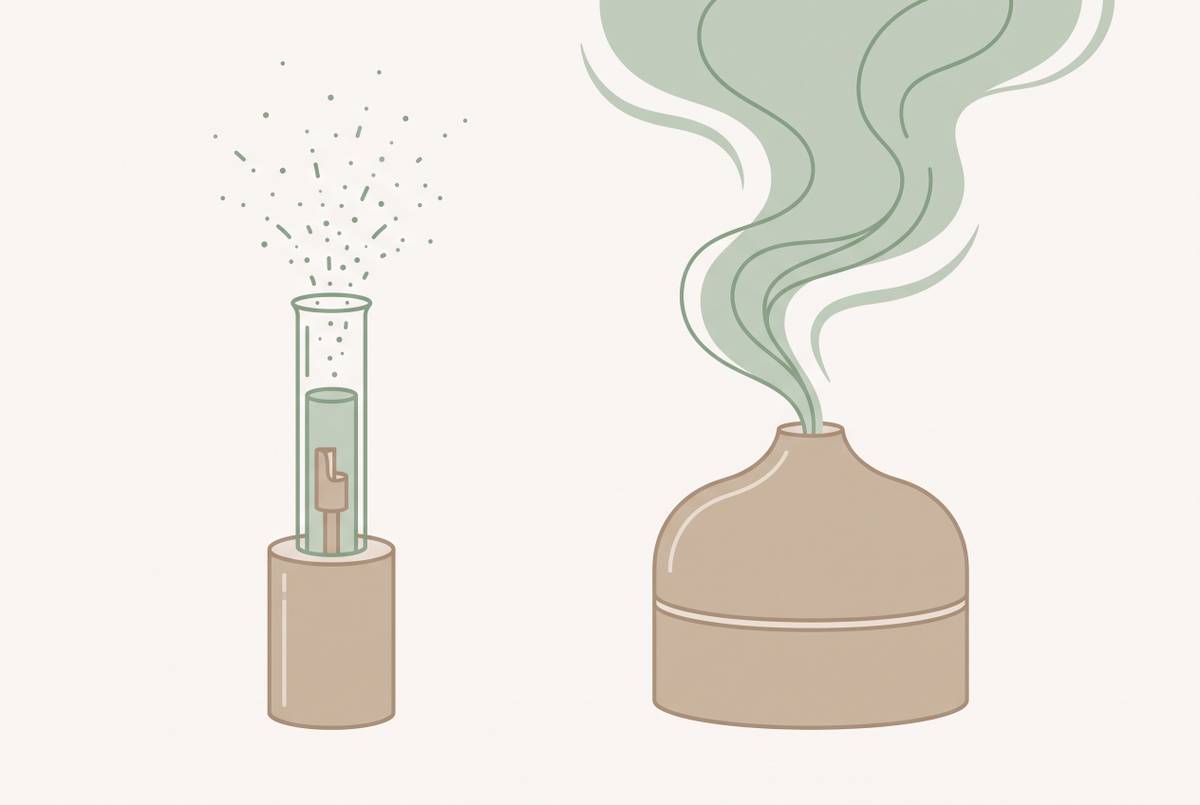
Cold-air diffusers work by forcing pressurized air through the oil, breaking it into a dry, ultra-fine mist. No heat, no water, no dilution involved. That's a fundamentally different mechanism than the one at play in an ultrasonic unit, where oil gets mixed into water and released as a visible, damp vapor that eventually settles onto furniture and windowsills. Cold-air mist stays suspended in the room longer and doesn't leave that residue behind.
Because nothing gets diluted, the oil's entire chemical profile reaches the air more or less intact: top, middle, and base notes all appear in the diffused mist at once, rather than unfolding gradually the way they might on skin. That has a direct consequence for volatile top notes. Citrus, green, and fresh accords have low molecular weight, so without heat to accelerate their evaporation, they disperse into a large room and thin out faster than they would from a candle or a warm-air plug-in. Base-heavy families run the opposite way: woody, amber, and musky compositions actually behave more richly and stick around longer in cold-air systems than they do in personal perfume, where body heat and skin chemistry change how they read.
Formulation matters here too. Aroma360 has noted that blends engineered specifically for cold-air nebulizing technology hold up with more consistency and better scent throw than straight essential oils, which were mostly built with water-based ultrasonic diffusion in mind. An essential oil marketed as "pure" isn't automatically the better choice for this hardware.
One more practical point before diving into families: cold-air scenting uses less oil to cover the same square footage compared to older diffusion methods. Most home units scent somewhere between 300 and 800 square feet reliably, and the newer smart residential systems can stretch a single unit's coverage to 800 or even 1,200 square feet aurahouse.com milamariescents.com Scent.ly 2026. Keep those numbers in the back of your mind. They'll matter again once specific product recommendations come up, because a 250-square-foot rating on a bottle isn't a limitation, it's a spec milamariescents.com.
How fragrance families are organized for diffuser use
Perfumers use something called the fragrance wheel to organize scent by dominant character, arranging related families next to each other so fresh sits near citrus, citrus near floral, floral near woody, and woody trails off toward amber and resin. It's a circular map, not a hierarchy, and the adjacency is the whole point: neighboring families blend well, distant ones often clash.
Most people in the field land on four primary families: Floral, Woody, Fresh, and Amber, with Fruity and Gourmand treated as commonly recognized additions. Quick terminology note, since it trips people up constantly: "Amber" is simply the modern label for what used to get called "Oriental." Both point to the same territory, warm, spicy, resin-heavy compositions built around vanilla, amber, spice, and balsamic accords. If a listing says one or the other, it's talking about the same shelf.
Why does any of this matter to someone standing in front of a diffuser trying to pick an oil? Because the wheel's structure predicts behavior, not just smell. Top-note-dominant families, citrus, fresh, green, are volatile by nature and dissipate quickly, which matters when deciding how large a room you're trying to cover and how often you'll need to run the cycle. Base-note-dominant families, woody, amber, musky, evaporate slowly and hang around, making them the natural fit for big rooms or all-day diffusion. Floral and gourmand sit in the middle, and how they perform depends heavily on whether the blend leans on synthetic reconstruction (steadier under pressurized atomization) or natural extracts (more variable, more prone to flattening out). Each section below runs the same basic checklist: character, how it behaves in cold air, which rooms suit it, and which named products actually deliver.
Floral oils that hold up best in cold-air diffusers
Florals cover enormous ground, from light and powdery (peony, lily of the valley, violet) to lush and almost narcotic (jasmine, gardenia, tuberose). Several of the most beloved florals, peony, lily of the valley, violet, gardenia among them, don't actually produce an extractable essential oil. Perfumers rebuild those scents from synthetic molecules instead. Rather than being a downgrade, that reconstruction turns out to be an advantage in a cold-air system, because synthetic molecules hold their structure more reliably under pressurized atomization than natural extracts do.
In terms of cold-air performance, florals land in the middle of the volatility spectrum, more persistent than citrus, less persistent than wood. Single-note "soliflore" blends, pure rose or pure jasmine and nothing else, tend to read as flat once they're spread across a whole living room; the nuance that makes them interesting on a wrist gets lost in open air. Multi-floral blends anchored by a base note perform with more depth, and layering a floral with vanilla, amber, or sandalwood stretches its lifespan in the diffusion cycle without muddying the flower itself.
Bedrooms and living spaces are the natural home for this family, anywhere the goal is softness rather than energy. When shopping, look for a blend with a defined middle-to-base structure, synthetic reconstruction where the flower calls for it, and IFRA-compliant formulation, the industry's safety standard for fragrance concentration.
Nēbu Luxury's Nighttime Bloom is a nocturnal bouquet built around blooming jasmine and other night-blooming florals, positioned as one of the brand's standout blends and built specifically to give a bedroom a restful evening mood. The jasmine-forward structure plays especially well with cold-air diffusion, since the full accord comes through without any heat distortion softening or scorching the top of the blend.
VINEVIDA's cold-air line also has a few floral crossovers. No. 1001, inspired by Escapade and the Ritz Carlton Hotel, mixes lemon, bergamot, jasmine, ocean, musk, and amber into a floral-aquatic hybrid. No. 1003, inspired by 24K Magic and the W Hotel, runs bergamot, lemon, lemongrass, jasmine, lily, magnolia, koa wood, and musk, a floral-citrus combination with real range. No. 3400, inspired by Baccarat Rouge 540, pairs amberwood, fir, and jasmine into a floral-amber composition with a base sturdy enough to anchor the whole thing. One scheduling note for all of these: florals do better on an intermittent cycle than a constant one. Run it, let it rest, run it again. Constant floral diffusion has a way of turning "romantic" into "cloying" somewhere around hour three, and a programmable diffuser's interval setting exists for exactly this reason.
Woody and earthy oils: the family that performs most naturally in cold-air systems
Cedarwood, sandalwood, vetiver, patchouli, oud: this family reads as warm, resinous, grounding, the smell of a forest floor after rain or a well-oiled wooden desk. The category has widened out considerably in recent years as oud went mainstream and woody notes started pairing more often with citrus openings and spice, so there's now real range here, from pale and airy sandalwood compositions to dense, almost smoky oud blends.
Cold-air diffusion shows its clearest advantage with base-heavy notes. Base-heavy notes evaporate slowly by nature. This family gets the longest run per diffusion cycle of anything covered in this guide. The micro-mist a cold-air unit produces carries these heavier molecules through a room and keeps them perceptible without needing constant oil top-offs. Market data backs up the appeal: woody scents, sandalwood, cedar, and oud specifically, have kept expanding steadily in the home fragrance category according to NPD Group's Home Fragrance Report, prized for that warm, earthy quality that has driven the growth NPD Group's 2025 Home Fragrance Report Scent.ly 2026. This isn't a niche corner of the wheel anymore NPD Group's 2025 Home Fragrance Report Scent.ly 2026.
Living rooms, home offices, reading nooks, bedrooms, the woody family works almost anywhere calm and understated sophistication is the goal, and it leans especially well into cooler weather and evening hours. VINEVIDA's No. 1304, inspired by Santal 33, combines cardamom, iris, and woody notes into something built for raw aromatic power rather than delicate balance milamariescents.com. It's better suited to evening ambiance or a bold statement than a subtle morning refresh, and it makes up for its lack of citrus lift with depth and staying power that's hard to match milamariescents.com. Mila Marie Scents' Velora Woods is pitched specifically at high-stress office environments, where the woody base gives it a practical, focus-friendly character rather than a purely decorative one. And VINEVIDA's No. 50, Mahogany Teakwood, softens the category a bit: mahogany, oak, cedarwood, lavender, and geranium combine into a warmer, more approachable wood scent with a floral edge taking off some of the harshness.
Because these blends persist so well, low diffuser settings prevent the scent from overwhelming a room, since they build up over time rather than fading quickly. Start low, increase gradually. Dense, smoky oud compositions in particular can turn overwhelming at full diffuser output, and they tend to suit medium-to-large rooms with decent airflow better than a small enclosed office.
Fresh, citrus, and aquatic oils: high-impact opening notes that need smart scheduling to last
The Fresh family splits into three recognizable lanes. Citrus Fresh covers the bright, zesty end, lemon, bergamot, grapefruit, mandarin. Green Fresh leans herbaceous and natural, grass, leaves, cut herbs. Aquatic Fresh chases something crisper and watery, the smell of ocean air or fresh rain.
All three share the same operational quirk: they're top-note-dominant, which makes them the most volatile family on this list. They hit hard and immediately, then dissipate faster than base-heavy oils once spread across a large, open, cold-air-diffused space. That's not a flaw so much as a scheduling problem, and the fix is straightforward. Programmable diffusion, active bursts followed by dormant stretches, refreshes the top notes on a regular rhythm, keeps the nose from adapting and tuning the scent out, and stretches the useful life of the oil itself. Fresh blends probably benefit from smart scheduling more than any other family here.
Kitchens, bathrooms, entryways, home offices, morning-use rooms generally, that's where this family earns its keep, and in professional settings, a clean citrus note reads as invigorating rather than heavy. A handful of named products show how the family actually holds up in practice. Mila Marie Scents' Aqua Island opens with coconut, lime, and bergamot, moves into a basil-lilac heart, and settles on a vetiver-patchouli base; it's documented at 250 square feet of coverage with an 8-hour run-time, water-free and IFRA-compliant, and the brand notes it's formulated to be pet- and kid-safe milamariescents.com. The lime cuts through stale indoor air, the coconut heart adds a creamy middle, and the driftwood base keeps it from fading out early milamariescents.com. Hotel Lobby runs apple, jasmine, bamboo, cedar, and musk into a clean, polished profile suited to living rooms; a 50 ml bottle lasts roughly 30 days at 4 to 8 hours of daily use, which works out to about a milliliter a day milamariescents.com.
VINEVIDA's No. 1012, inspired by Cabana and the Ritz Carlton Hotel, bridges citrus, jasmine, and ocean notes into an aquatic-fresh blend that outlasts a straight citrus oil thanks to that floral bridge. No. 3300, inspired by Acqua Di Gio, combines bergamot, geranium, rosemary, lavender, and patchouli, an aquatic-fresh composition with a woody-earthy base doing the work of anchoring the citrus and extending the throw milamariescents.com. The buying logic follows naturally from all of this. Look for a fresh blend with some kind of base note anchor, amber, driftwood, patchouli, musk, because those structures hold up far better under cold-air atomization than a single-note citrus oil, which can fade within the first hour of running. Mila Marie Scents Coastal Life combines bergamot, jasmine, sea-salt, and a soft amber base to deliver 250 sq ft of coverage and 8-hour longevity as an aquatic-floral crossover best suited to bright, open spaces with natural light (milamariescents.com). Mila Marie Scents Citrus Bloom, blending orange blossom, lemon zest, vanilla, and an amber base for 8-hour longevity across 250 sq ft, demonstrates the principle that an amber-vanilla base converts a citrus-floral into a more diffuser-stable blend (milamariescents.com).
Oriental and amber oils: the richest-throwing fragrance family
Warm, spicy, resin-based, built around vanilla, amber, spice, balsamic accords, and musk, sometimes stretching into incense, tonka bean, leather, or smoke. "Amber" is the term the industry uses now in place of "Oriental," though both point at the same warm, enveloping territory.
In terms of cold-air performance, this family sits right alongside woody as the longest-lasting on the wheel. The rich base notes release slowly, holding an ambient presence in the room without needing frequent bursts from the diffuser, which makes for a genuinely efficient setup once it's dialed in. At high diffuser settings, amber blends can turn overwhelming fast, so the precision controls on a smart cold-air system, scheduled intervals, adjustable intensity, matter more here than with any other family on this list.
Bedrooms, lounges, home libraries, dining rooms in the evening, this is where amber earns its reputation, and it leans hardest into autumn and winter use. VINEVIDA's No. 3100, inspired by Tobacco Vanille, combines spice, tobacco, vanilla, and cacao into a dense, decadent amber-gourmand blend best run at moderate settings in a medium-to-large room. No. 1002, inspired by Black Velvet and the Edition Hotel, mixes lemon, bergamot, freesia, rose, amber, musk, and cedarwood into a classic oriental-floral crossover, where the bergamot opening lifts the blend and the amber grounds the dry-down. It's a tidy demonstration of why adjacency on the fragrance wheel actually matters in practice. No.
Oriental blends with a citrus or floral opening, No. 1002 and No. 1000 both fit this description, are more versatile across room types than pure vanilla-heavy or tobacco-heavy compositions, which suit dedicated evening-use rooms. Start low, run it in short cycles, and let the room settle before turning the intensity up. Base notes in this family accumulate over a diffusion session in a way citrus never does, and "cozy library" versus "walked into a candle shop" often comes down to nothing more than one notch on the dial.