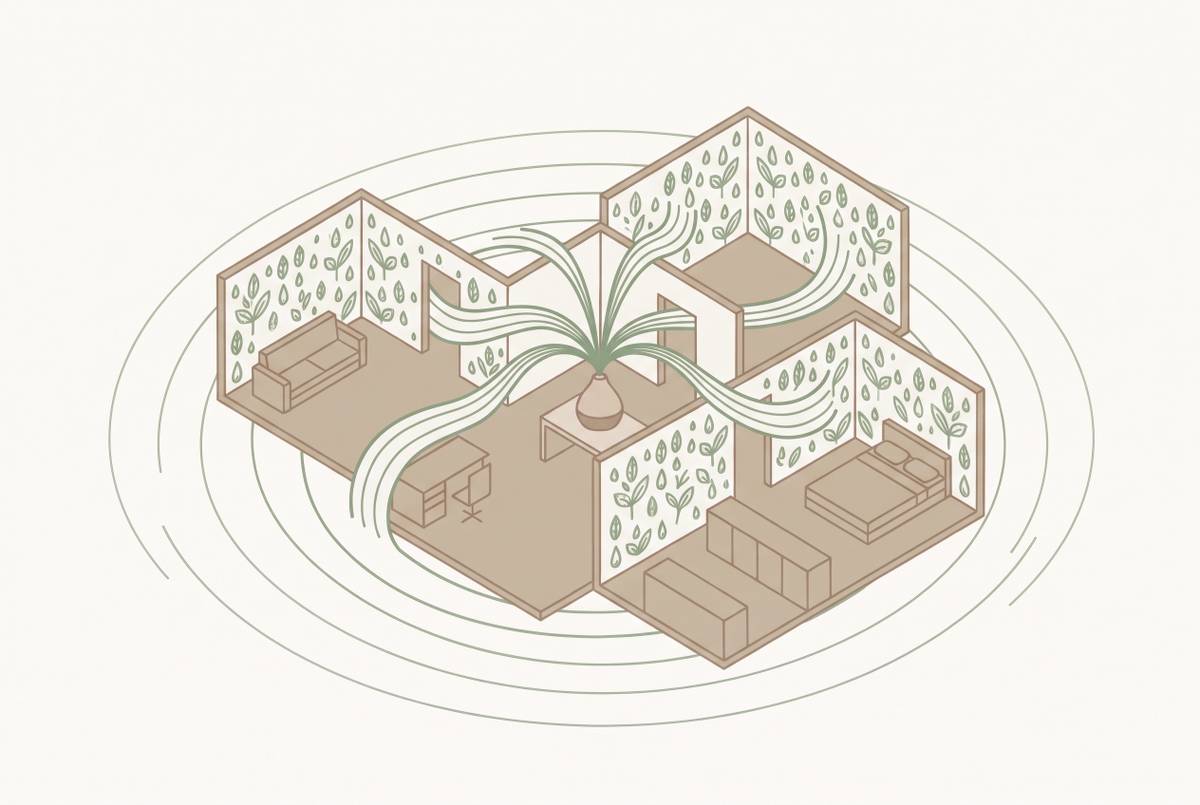
The Whole-Home Scent Architecture That Keeps Every Room Hotel-Fresh
Strategic diffuser placement and room-specific scents recreate hotel freshness throughout your home.
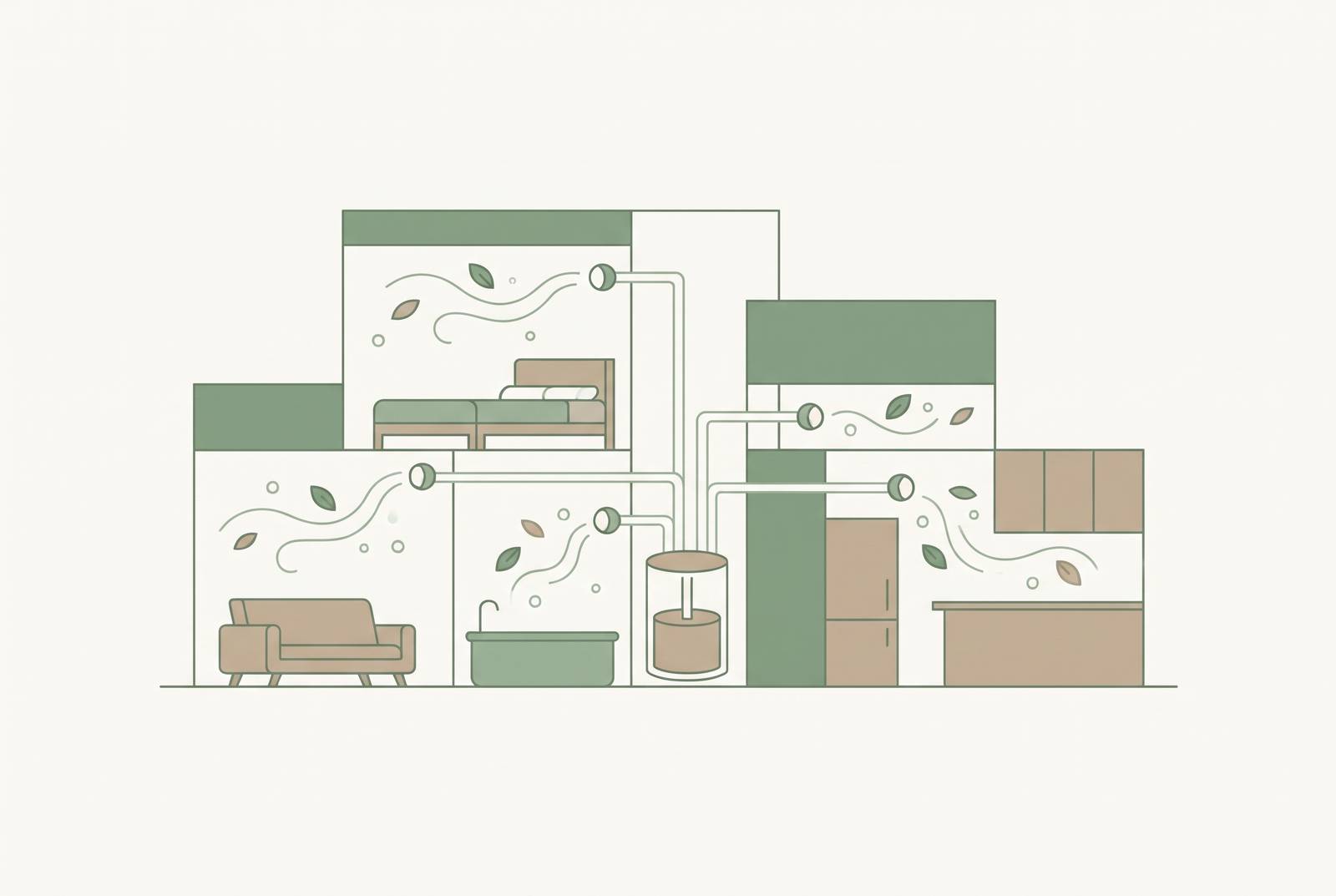
Recreating a luxury hotel scent experience at home takes a coordinated system. Use programmable cold-air diffusers that fit each space, then give every room a related scent profile, a well-placed unit, and its own intensity and schedule. The home should feel fresh all the time without the scent being equally strong in every room.
Why hotels smell the way they do, and why that atmosphere is hard to replicate at home
Walking into a great hotel, the fragrance seems to belong to the space. That impression is deliberate. Royalton Luxury properties use green moss, white tea, and bergamot, while adults-only Royalton CHIC properties use white chocolate, anise, vanilla, cacao, sugarcane, and sandalwood. These are different expressions of identity. The olfactory bulb’s direct relationship with the limbic system, which governs memory and emotion, helps explain why a distinctive fragrance can become part of how a place is remembered.
At home, a candle or plug-in often creates a scented pocket surrounded by gaps. High ceilings, open corridors, and adjoining rooms expose the limits of that localized approach. A stronger fragrance does not fix the layout. Closing the gap requires a blueprint that accounts for where air moves, how rooms are used, and what people should experience as they pass between them.
What diffuser can fill a large room the way hotel lobbies do?
A programmable cold-air diffuser rated for the space is the right backbone for this room-by-room approach. Cold-air diffusion uses pneumatic atomization to turn fragrance oil into a fine mist at ambient temperature. Without heat, it avoids the thermal degradation that can change delicate top notes. Without water, it avoids dilution, added humidity, and mineral residue. The mist follows existing airflow, extending coverage beyond the localized cloud associated with passive evaporation.
With settings for intensity and scheduling, the same technology can work differently in a large social space and a quiet bedroom. Candles introduce an open flame, soot, and combustion byproducts, and cannot run unattended. Ultrasonic diffusers add moisture and require frequent reservoir cleaning, while reeds and sprays offer little control over timing and fade unevenly. Cold-air diffusion combines waterless delivery with programmable output, although its reach still depends on choosing and positioning the unit correctly.
Treating the entryway as the first impression zone
The entryway has to work before anyone has settled in. Guests arrive without having adapted to the home’s fragrance, so they register what a resident may barely notice. Start with a welcoming, clean profile. White tea, bergamot, and soft citrus suit this first encounter because they establish freshness without demanding attention.
Place the diffuser near the hall’s natural airflow path, where air enters or moves toward adjoining rooms. Keep the intensity conservative because a newly arrived guest is more sensitive to the scent than someone already at home. If the hall opens directly into the living room, choose the two profiles together. Their overlap should feel like a gradual transition, which makes the entryway the first part of a larger composition.
The living room as the anchor scent of the home
The living room is the hardest room to keep evenly scented over time. Its size, ceiling height, and connections to other spaces determine how much air the diffuser must serve. Choose a unit rated for the actual room, accounting for an open connection to the dining area or kitchen rather than treating the seating area as an enclosed box. Running a small-room diffuser for longer cannot make its scent reach far enough. Floor-area ratings tell less of the story when ceilings are high because there is more air to fill.
Position the unit at mid-room height, away from direct HVAC discharge and from a sofa immediately beside its outlet. Cold-air mist leaves no wet residue, but nearby soft furnishings can absorb some of it, so the scent does not travel as far. In an open-plan layout, cooking odors also compete with the fragrance. Coordinate the diffuser’s position and occupied-hour schedule with meal preparation rather than treating the kitchen connection as irrelevant.
During those occupied hours, run short diffusion cycles with pauses between them. This cadence helps limit olfactory fatigue while keeping a background presence for arriving guests. Warm woods, soft amber, sandalwood, or layered clean musk can sustain the room’s atmosphere over a long visit. As the home’s principal scent statement, this profile should establish whether the surrounding rooms lean warm, cool, woody, or fresh.
The bedroom as a scent zone built for sleep and recovery
The bedroom should not borrow the living room’s settings. Its job is recovery, so fragrance should support a wind-down routine without becoming another source of stimulation. The connection between smell, emotion, and memory gives that choice a practical basis, but a pleasing aroma is not a guarantee of better sleep. Lavender, chamomile, soft musk, sandalwood, and cedarwood suit a quieter register. Peppermint, citrus, and eucalyptus are better suited to spaces where people are active, as long as they are safe for the household.
Keep bedroom intensity below the level used in social rooms. Schedule a brief period before sleep, then switch the diffuser off. A dresser or nightstand at a moderate distance from the bed can work, provided the outlet does not direct mist toward the sleeper. The desired effect is a background note. If pets sleep here, check the choice of fragrance with extra care, especially for cats and birds, because a soothing scent name does not prove that it is safe.
The home office as a scent zone built for focus
The office asks fragrance to support a different state. Research on rosemary and peppermint associates these scents with alertness and aspects of memory, but that does not promise a measurable productivity gain in every home office. The office calls for a clean scent that helps people feel alert, while bedtime calls for a softer one. Green tea, citrus, peppermint, or eucalyptus can serve that purpose if they are safe for the household.
Keep output moderate so the scent does not become a competing distraction. Align operation with working hours and turn it off when the room is empty. If the office becomes a guest room or an evening creative space, adjust its intensity and schedule for that second use. Programmability lets the room change roles without requiring the whole home to follow.
The bathroom and laundry spaces as the clean-scent baseline
Bathrooms and laundry rooms work best as deliberate clean-scent zones. Heavy sprays create a burst followed by a fade, which breaks the consistency established elsewhere. Fresh linen, sea air, rain, or white tea can keep the scent clean and in tune with nearby bedrooms and halls.
Use lower output because there is less air to fill, and run short cycles around the busiest times in the morning and evening. Waterless delivery suits a bathroom because it adds no humidity and has no reservoir of standing water. Keep the diffuser away from the shower or bath, where steam and moisture could affect performance. A position near the door or on a shelf above head height can make use of natural air movement.
How to choose fragrance profiles that work together across the whole home
Two individually appealing fragrances can feel disjointed when they meet across an open doorway. Hotels avoid that problem through a signature scent or a related family of fragrances, so the lobby, spa, and corridors feel connected. At home, choose an anchor family, such as woody, fresh, floral, or gourmand, and let each room interpret it according to its purpose.
For a fresh-and-clean scheme, white tea in the entryway can relate to green tea in the office, linen in the bathroom, and soft musk in the bedroom. A warmer scheme might connect bergamot and sandalwood in the living room with cedar in the bedroom and light amber in the hall. Open-plan rooms need especially gentle transitions, while defined corridors allow more separation between profiles.
For the simplest system, use one signature oil at different intensities throughout the home. White tea is a practical example because its clean, non-polarising profile suits several room types. Even then, the bedroom needs less output than the living room, and the entryway should remain restrained for arriving guests.
Matching diffuser size, placement, and intensity to each room’s actual dimensions
Begin hardware selection with each room’s floor area, then consider ceiling height and open connections. A room with three-metre ceilings contains more air than its footprint alone communicates. That is why a floor-area rating should not be treated as the complete answer for a loft-style or double-height space. Conversely, a high-output unit can overwhelm a small bathroom.
iScent’s cold-air guide recommends placement that makes use of natural circulation. Choose an elevated position, near but not directly under HVAC vents, so airflow helps distribution without pushing the fragrance unevenly. Avoid floor-level placement that concentrates the scent low in the room. Then calibrate intensity separately for each zone. Correct sizing and a clear airflow path are more useful than maximum output in the wrong location.
Smart scheduling as the control layer that keeps the system working without waste
A constant scent becomes less noticeable as the nose adapts. Turning up the output when this happens can make the scent much stronger for guests than the people who live there realize. Intermittent operation addresses that mismatch while reducing the time spent consuming oil. Cold-air systems do not need to run continuously to maintain an ambient presence.
Use short cycles in the entryway when the home is active or guests are expected, and occupied-hour cycles in the living room with pauses between releases. The bedroom diffuser should run for a short time before sleep, the office unit during working hours, and the bathroom unit when that room gets the most use. Exact on-and-off durations depend on the room and device, so a universal minute-by-minute prescription would imply precision the layout cannot support. App controls or built-in timers make those distinct routines manageable without repeated manual intervention. Small changes with the seasons can be enough, with lighter profiles and lower intensity in warmer weather and warmer scents at slightly higher output in cooler months.
Selecting fragrance oils that are safe for pets, children, and the whole household
A fragrance choice is still open until it has been checked for safety in the household. An oil that suits a room’s purpose may still be unsuitable for an animal that enters it. Cats have little ability to metabolize many essential-oil compounds, while birds are especially sensitive to vapors because their respiratory systems work so efficiently. Neither “natural” nor a pleasant scent family establishes safety. The distinction is between an appealing profile and the composition of the actual oil.
VCA Hospitals identifies oils poisonous to dogs, including cinnamon, citrus, pennyroyal, peppermint, pine, sweet birch, tea tree, wintergreen, and ylang ylang. That excludes several otherwise appealing active-room choices from a pet-present system. Choose oils with transparent ingredient information, without phthalates or harsh synthetic additives, but do not treat those features alone as proof of safety for every pet or child. Vanilla, linen, or mild woody profiles may offer alternatives, yet their names do not establish their ingredients.
The ASPCA warns that concentrated essential oils can cause health concerns when pets walk through them or get them on their coats. Waterless diffusion avoids the wet mist associated with surface contact, which addresses only one exposure concern. Delivery method and oil selection therefore need separate consideration.
Maintaining each diffuser so the whole system continues to perform consistently
A diffuser can seem to be running as usual even when its scent reaches less far. Oil residue gradually builds up in the atomizing chamber and nozzle, narrowing the outlet and reducing output. Reduced scent throw, inconsistent delivery, or an altered fragrance should prompt a maintenance check. Heavier oils and longer running hours generally require more frequent attention.
Clean the atomizing chamber when changing oils so the next fragrance does not blend unintentionally with the previous one. Pair routine exterior wiping and nozzle checks with refill cycles, adjusting frequency to usage and oil viscosity. Waterless operation removes reservoir-related upkeep, but it does not remove the need to maintain the delivery mechanism. Building those checks into refills keeps maintenance from becoming a separate project. The payoff is a deliberately built system that holds its hotel-fresh standard without constant attention.