Aromatherapy Oils and Diffusers for Daily Stress Management
Clinical studies show essential oils reduce cortisol measurably, not just calm subjectively.
The right essential oil blends can reduce cortisol by up to 36%, according to clinical studies published between 2023 and 2024. Not self-reported calm. Cortisol is a measurable, physiological marker.
Lavender gets the most research attention. A study in Frontiers in Psychology found a 32% reduction in anxiety among patients waiting for minor surgical procedures, alongside measurable declines in heart rate and blood pressure.
A narrative review in the journal Women looked at 47 studies on essential oils for anxiety, depression, and stress. The strongest evidence clusters around lavender, bergamot, rose, chamomile, clary sage, and ylang-ylang. That same review found that lavender combined with bergamot, inhaled three times daily over eight weeks, significantly reduced both anxiety scores and depression symptoms compared to controls. Significantly in the statistical sense.
But stress management isn't only about calming down. Sometimes it's about recovering the mental capacity that stress already burned through. A 2025 study in the International Journal of Environmental Research and Public Health found that rosemary and peppermint improved memory recall and alertness by 18 to 20% in office environments. That particular flavor of afternoon fog is its own stress category, and it calls for a different tool than an elevated heart rate does.
One more finding that actually changes how you'd apply this: a meta-analysis of over 70 studies found that women responded more strongly to floral and sweet scents for emotional relief, while men reported greater calming effects from woody or musky scents. This is not a fixed rule, but the data suggests matching the oil to the person, not just the condition, matters.
Inhalation and massage are the most studied delivery methods, and the evidence is strongest for inhalation at consistent intervals rather than occasional use. The Australian Psychological Society published guidelines in early 2024 recommending chamomile and orange for generalized anxiety disorder, framed explicitly as adjuncts to cognitive behavioral therapy and mindfulness practices. They are adjuncts, not replacements.
How Conventional Air Fresheners and Candles Can Undercut the Stress Relief They Promise
So you decide to build a wellness ritual around scent. You pick up something labeled "relaxing lavender" at a drugstore. You might have just introduced a cocktail of synthetic compounds into your home that your endocrine system would strongly prefer you hadn't.
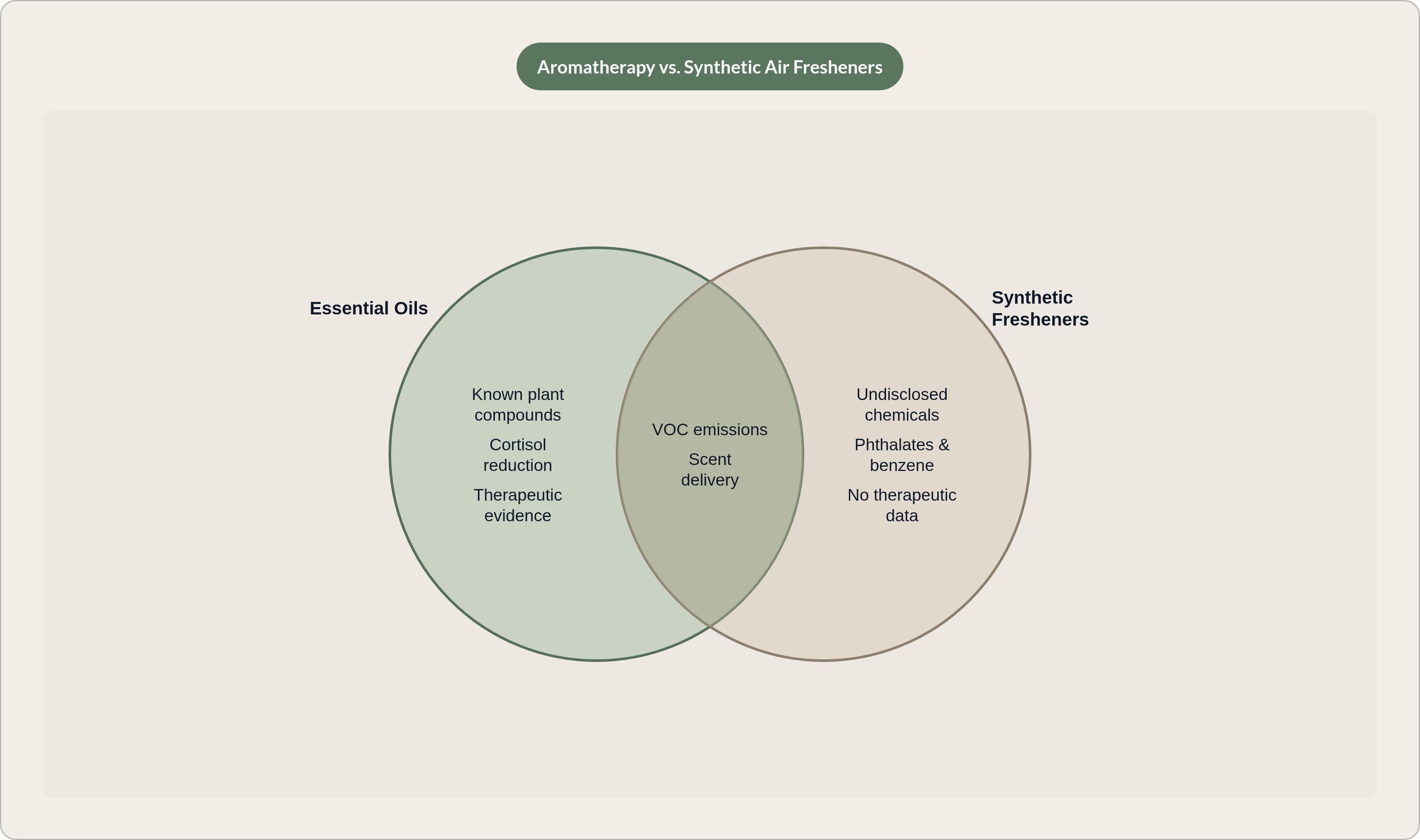
The problem starts with a legal loophole. In the United States, the word "fragrance" on a product label can legally conceal more than 3,000 synthetic chemicals, with no disclosure required.
The Natural Resources Defense Council found phthalates, which are endocrine disruptors linked to reproductive issues, in 86% of the air fresheners they tested. Made Safe, a product certification organization, has documented that air fresheners can emit benzene, formaldehyde, toluene, acetaldehyde, and other endocrine disruptors. This includes products labeled "unscented" or "natural."
Candles aren't a clean exit either. Paraffin wax is petroleum-derived, and burning it releases benzene and toluene, both known carcinogens. Scented wax melts aren't automatically safer. They release terpenes that can react with ambient ozone to form new nanoparticles.
Worth noting: essential oils are also volatile organic compounds. Plant-derived, yes, but not risk-free at high concentrations or with prolonged exposure. The case for them isn't that they're chemically inert. It's that they come with a known, plant-derived chemical profile rather than potentially hundreds of undisclosed synthetic compounds. The argument is one of transparency, not purity.
A stress ritual built on toxic inputs works against itself. The delivery format and ingredient quality aren't separate from the therapeutic goal. They're the same question.
Why Cold-Air Diffusion Preserves What Makes Aromatherapy Work
If the clinical evidence for lavender or bergamot depends on those oils' intact chemical composition — and it does — then anything that degrades that composition before you inhale it is undermining the whole intervention.
Heat does exactly that. The process is called thermolysis, and it breaks down the compounds that give therapeutic oils their effects.
Ultrasonic diffusers are more popular and more affordable, and they avoid direct heat. But they dilute oils with water, add humidity to the room, can harbor microbial growth from standing water, and can release mineral "white dust" if you have hard water.
Cold-air diffusion works differently. Filtered cold air under pressure atomizes pure fragrance oil into a dry mist of micro-particles. No heat, no water, no dilution, no residue. The oil reaches you in close to its original chemical form, which is what the research was actually testing.
Cold-air diffusion also produces a smaller particle size that distributes more evenly across larger spaces. If you're trying to use scent throughout a room rather than hovering over a single device, the physics actually cooperate.
One honest advantage for ultrasonic diffusers: they can increase room humidity by 5 to 10%, according to research from the American Society of Heating, Refrigerating and Air-Conditioning Engineers. In dry climates or during winter, that has real respiratory benefits. It is a legitimate trade-off, just a different one than therapeutic preservation.
Cold-air diffusion has been used for years in commercial fragrance design, specifically to create the consistent signature scents of premium hotels. That same system is now available at residential scale, which is a practical consideration for anyone serious about using scent with any consistency.
Which Oils to Use for Which Stress States, and Who Should Know About Pet and Family Safety
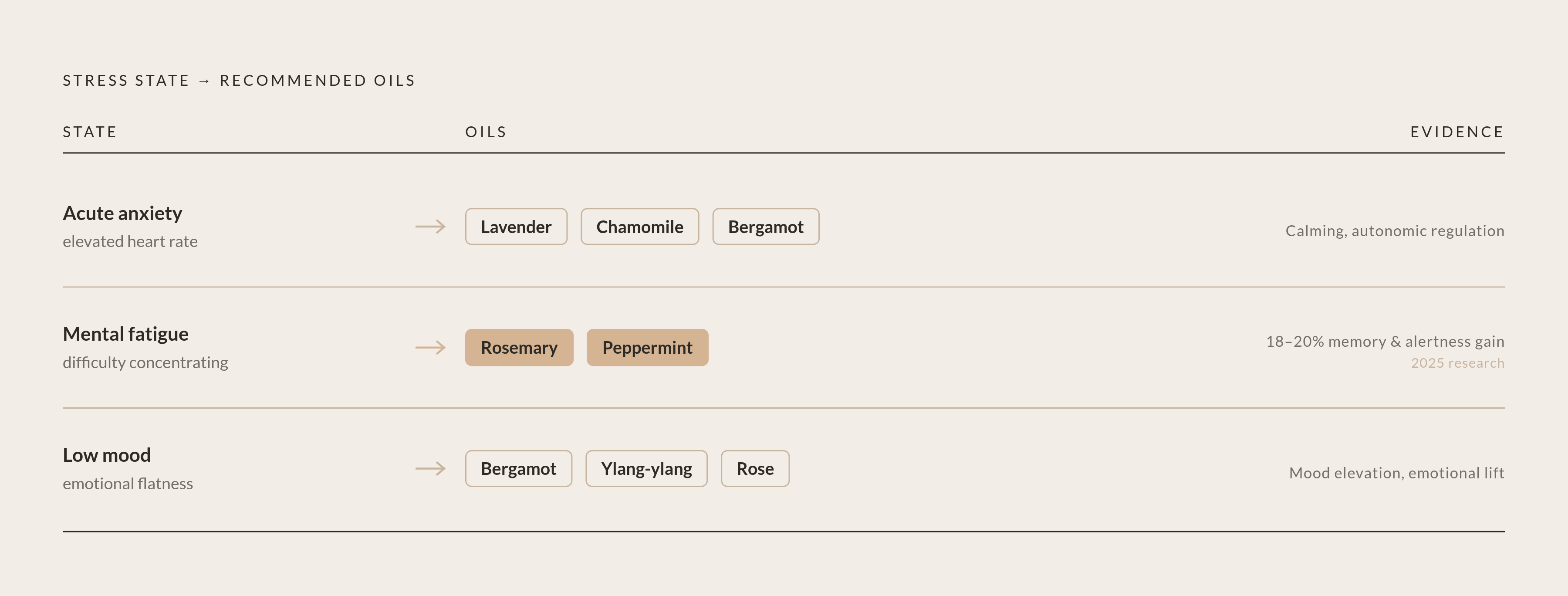
Not all stress looks the same, and the evidence actually supports that level of specificity. The biology of acute anxiety, with its elevated heart rate and shallow breathing, calls for different tools than mental fatigue or low mood.
Here's how the research maps to stress states:
- Acute anxiety, elevated heart rate: lavender, chamomile, bergamot. Strongest evidence base for calming physiological arousal.
- Mental fatigue, difficulty concentrating: rosemary, peppermint. Supported by the 2025 alertness and memory research.
- Low mood, emotional flatness: bergamot, ylang-ylang, rose. Consistent with the Women journal review's findings.
- Scent preference by gender pattern: floral and sweet scents showed the strongest effect for emotional relief in women across the meta-analysis; woody and musky showed the strongest calming effect in men. These are starting points, not rules.
Animals process essential oils differently than humans do, and some of the oils most recommended for stress relief are toxic to pets. Cats lack a liver enzyme called glucuronyl transferase, which is needed to metabolize many essential oil compounds. Dogs have a sense of smell estimated to be vastly more sensitive than a human's, which means concentration and ventilation matter even with oils that are generally considered safe.
Oils to avoid around cats: tea tree, eucalyptus, peppermint, cinnamon, clove. Several of these appear regularly on popular stress relief lists. Generally safer choices around pets, cross-referenced with veterinary guidance: lavender (diffused, not topically applied), cedarwood, frankincense.
Diffuse in a ventilated space, and make sure pets can leave the room. An enclosed space with a running diffuser and an animal that cannot exit is a real problem, not a theoretical one.
This is also where ingredient transparency becomes a safety issue and not just an ethical preference. When a product lists every component and uses real plant-derived scents, you can cross-reference those ingredients against veterinary guidance. When a product hides behind the word "fragrance," you cannot.
How to Build a Daily Stress Ritual Around Scent Rather Than Using It Randomly
The lavender and bergamot study that showed significant reductions in anxiety and depression scores used three-times-daily inhalation over eight weeks. That's a practice, not occasional use. And the gap between those two things is where most of the benefit lives or disappears.
The brain consolidates scent associations quickly. Pair a specific oil with a recurring moment — morning coffee, the end of the workday, the transition to sleep — and you're training a conditioned response over time. The scent becomes a cue, and the response strengthens with repetition.
A structure that maps to the research:
- Morning: rosemary or peppermint. Alertness and cognitive readiness, grounded in the memory and recall data.
- Midday reset: bergamot or a citrus-family oil. Mood lift without sedation.
- Evening wind-down: lavender, chamomile, ylang-ylang. The most studied for reducing physiological arousal.
Cold-air diffusion fits this kind of structured use because it runs continuously at a set intensity, covers a room evenly, and requires no supervision. You load the oil, set the schedule, and the ritual happens in the background.
Destination-inspired fragrance blends, blends designed around places and sensory environments rather than single-note oils, can activate both the physiological calming response and a specific emotional memory through those same hardwired circuits.
The same oil used mindlessly produces less effect than one applied with a brief moment of attention. Thirty seconds of intention when you start the diffuser is consistent with how cue-conditioning actually works.
Your brain already has a direct pathway from your nose to the circuits that regulate stress, memory, and mood. The only real question is whether you use it deliberately, or just let whatever scent happens to be in the room do the work for you.