One Scent Identity Across Every Room Without Dead Zones or Drift
Whole-home scent requires cold-air diffusion and strategic placement, not multiple devices.
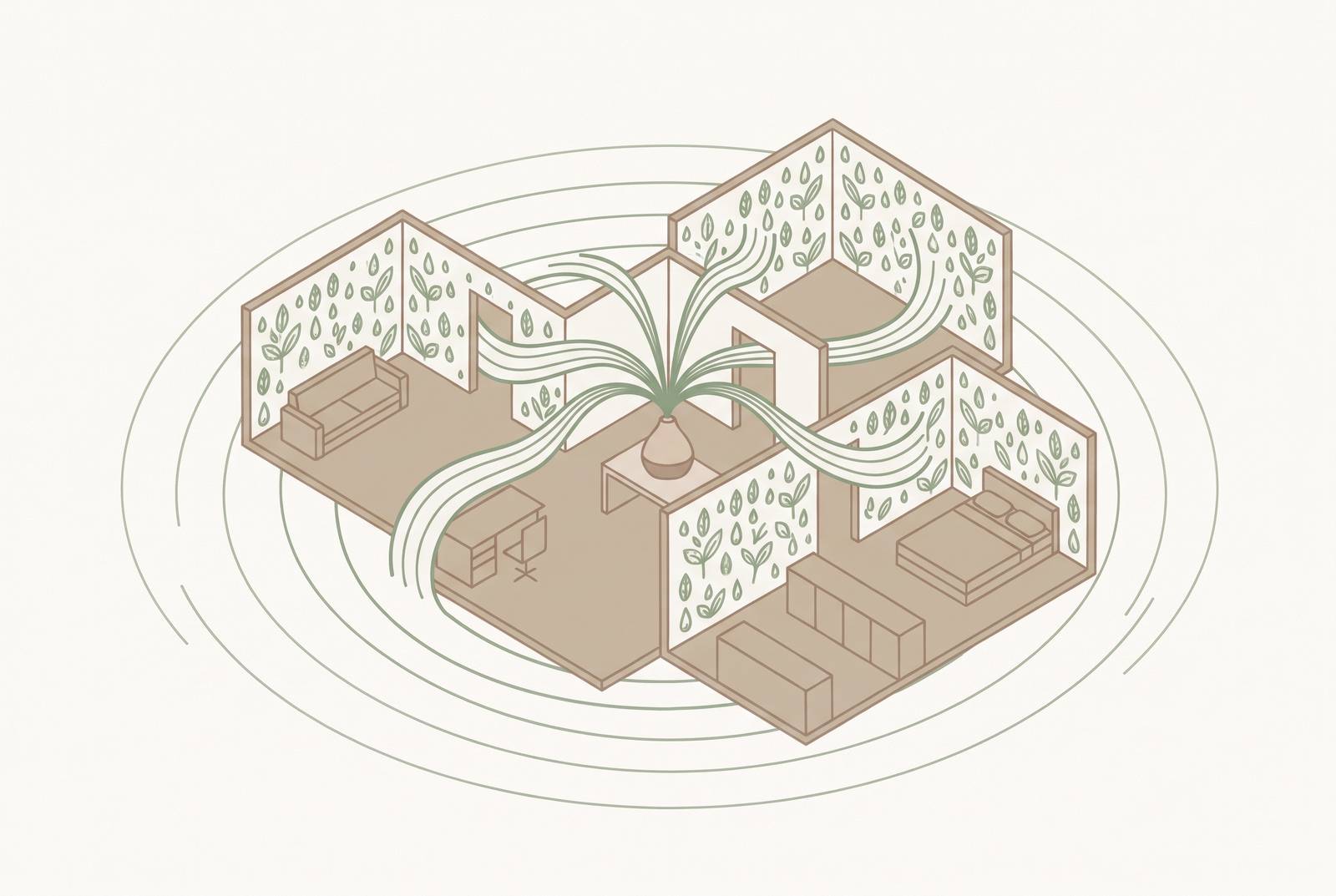
Recreating a luxury hotel scent experience at home starts with airflow. One continuous scent identity requires cold-air diffusion sized for the layout, placement that works with moving air, and controlled output. A large open room may need one standalone unit in the right spot, while closed rooms and homes with more than one floor need ducted delivery or zones with their own controls.
Why whole-home scent fails with conventional products
The hallway smells like nothing, despite two diffusers working in the rooms beside it. The scent in those rooms may already be too strong. Adding another device seems reasonable, but it treats the empty patch while leaving its cause in place. The products are scenting separate pockets of air. Aroma360's HVAC guide describes these fragrance islands as “floating around in a sea of neutral air.”
Candles, reed diffusers, and plug-ins were designed for one small room. A closed hallway door can block the little scent they spread, and a different fragrance next door can clash with it, disrupting scent continuity through the home. More products multiply the sources without connecting the spaces. The result can cost more and still feel unfinished.
Output also changes independently of where fragrance needs to go. Reed diffusers may surge as fresh reeds saturate, then weaken as the oil runs down and, primarily, as the reeds clog. Plug-ins scent the area around them with a fixed scent profile, whatever the room size or airflow. The focus therefore shifts from “Which product smells best? to “How does air move through this home, and which delivery system can work with it?”
How fragrance particles actually move through a home
Fragrance strength determines how much scent enters the air, but air movement helps determine where it goes. Fragrance particles tend to sink in calm air, while diffusion, convection, and concentration gradients move them in other directions. Height alone is therefore not the answer. An elevated device still needs access to circulating air, away from an alcove that traps its output. For placement, the practical distinction is between a route through the home and a quiet pocket within it.
An open hallway entrance, an interior doorway, or the center of an open-plan space gives fragrance access to those routes. A corner does not offer the same opportunity. Aroma360's whole-home guide notes that open floor plans distribute scent more efficiently because air moves freely, while compartmentalized homes need more deliberate placement or greater power. That distinction puts a limit on what an intensity adjustment can accomplish. Stronger output cannot turn a shut doorway into an open passage.
An HVAC system already moves conditioned air to its vents, so fragrance introduced into that airflow does not depend on passing through interior doorways. How scent moves between floors also needs care, because the stack effect can make it build up upstairs as warm air rises. Assigning lower intensity upstairs compensates for that movement rather than asking every floor to operate at the same setting.
Why cold-air diffusion is the delivery method that makes whole-home coverage possible
Cold-air nebulizing diffusion produces fragrance in a form suited to moving air. Pressurized air atomizes neat fragrance oil into a dry nano-mist without water or heat. The particles are light enough to stay in the air and spread through a space before they settle beyond the area immediately beside the device. That is the relevant engineering advantage. Whole-home delivery needs output that can carry scent beyond its source.
Ultrasonic diffusion serves a different purpose. It mixes oil with water before aerosolizing the mixture, reducing effective scent concentration and limiting its throw to a smaller aromatherapy footprint. It works on a desk or nightstand, or in a small room. Aroma360's 2026 diffuser guide distinguishes cold-air diffusion for consistent coverage across a whole space from ultrasonic diffusion for small aromatherapy areas, and heat or passive methods for decorative or short-range use. The choice is therefore functional rather than a contest over which device looks most convincing on a shelf.
The dry micro-mist also leaves no surface residue, a practical consideration around furniture and in homes with pets and children. Its suitability for ductwork is equally important. Cold-air output can enter an HVAC system without adding humidity or damaging the air handler, making ducted fragrance delivery possible. A standalone cold-air unit still depends on accessible airflow, while an HVAC-connected unit uses the ducts to reach rooms that a freestanding device cannot.
What diffuser can actually fill a large room, and how should it fit the home?
For a large open room, a correctly sized standalone cold-air diffuser is the relevant starting point. Free-moving air allows one centrally placed unit to serve the connected footprint. Total floor area alone is insufficient, however. Room height, floor plan, and HVAC strength affect how much air the unit needs to scent and how far that scent must travel.
The 2026 guide recommends sizing up when a space falls between two coverage levels, then running the larger unit at lower intensity. That leaves room for even distribution rather than forcing a smaller device to work at the edge of its capacity. Coverage tiers range from standalone devices for one room to systems for a whole floor or home. Mila Marie Scents' 2026 guide recommends the INFINITY for homes with about 1,500 to 6,000+ square feet of open living area. The qualification “open living area” is essential, because the same area divided into closed rooms presents a different task.
A hallway unit cannot send cold-air mist through a shut bedroom door. HVAC integration resolves that obstacle by delivering fragrance with conditioned air through the vents, regardless of interior door position. Multiple stories introduce another complication. A single ground-floor HVAC unit may over-scent upper floors as warm air rises, whereas separate floor or zone diffusers allow calibrated output. In very large homes or multi-zone HVAC layouts, assigning one diffuser per zone offers more control than asking one high-capacity device to reach every wing.
Placement decisions that eliminate dead zones without adding more devices
To put that sizing decision into practice, walk through the home looking for where air can move between spaces. An open hallway entrance or interior doorway can be a useful position because it puts the source near a distribution route. In an open-plan room, a unit in the center also puts scent where air can carry it. A convenient corner or recessed alcove may hide the equipment neatly while concentrating fragrance where it is least useful.
Next, consider the height of the source. Wall-mounted or elevated placement gives particles a wider area over which to disperse before they descend than a floor-level or low-table position. This is particularly useful when a suitable location still produces a strong pocket nearby. In a multi-story home, also look at the stairs. Keeping ground-floor diffusers away from stairwell openings slows the rise of scent and helps keep fragrance meant for downstairs from building up on the upper floor.
For an HVAC-connected unit, the ductwork takes over most room-by-room distribution decisions. The connection point still deserves attention. The unit's return-air or plenum position affects how evenly fragrance enters the airstream, so physical placement remains consequential even when the device is out of sight. Once the location is settled, occupancy provides the next constraint. The HVAC guide notes that programmable timers can run diffusion when people are home and pause it overnight, using less oil and keeping output down when the home is empty.
Building one scent identity across rooms that feel connected, not identical
Luxury hotels provide a useful model for fragrance identity. A lobby and a spa can have distinct scents without introducing unrelated fragrance families into connecting spaces. Their difference serves the setting. A home benefits from the same discipline. The aim is not to make every room identical, but to make the transition between rooms feel intentional.
To apply that model, choose one overarching family, such as warm and woody, fresh and citrus, or soft floral. Individual rooms can then express different parts of it. A woody signature might become citrus-wood in the entryway, amber-wood in the living room, and soft musk-wood in the bedroom. The shared wood character supplies continuity. These are optional illustrations of the method.
The boundary is especially important where rooms share a doorway or an open floor plan. Moving directly from an oud-heavy space into sharp citrus creates an abrupt collision. Doorways should not become fragrance border checkpoints. The whole-home guide suggests warm woody notes such as sandalwood and cedar for evening gathering spaces, and bright citrus and green tea for energy and conversation. Room purpose can guide the variation, provided that variation stays within the chosen theme.
A single-scent HVAC system simplifies the decision but broadens the fragrance's job. One profile must suit private rooms as well as social spaces, which favors a balanced, neutral-warm choice that neither overwhelms the former nor disappears in the latter. Consistency then becomes more than a decorative effect. The same guide describes the outcome as olfactory anchoring, through which family members associate the scent with home, safety, and belonging.
Intensity, scheduling, and the control settings that prevent drift and overload
Once distribution and fragrance identity are settled, the challenge becomes maintaining a background presence without increasing it unnecessarily. Olfactory adaptation complicates that task because continuous exposure makes the nose stop registering a familiar scent. Residents may respond by raising the output. Guests, who have not adapted, encounter the stronger level immediately, even while the household considers it normal. Familiarity is therefore a poor reason on its own to turn the system up.
Intermittent diffusion provides a better operating pattern. Work/rest cycles release fragrance for a set time and then pause, keeping scent in the background while slowing adaptation and using less excess oil. Adjustable intensity and programmable schedules also separate two decisions that continuous operation blurs, namely how strongly fragrance is released and how often. They need not move together. A well-sized system can preserve distribution without remaining at high output throughout the day.
Zone schedules allow those controls to reflect how the home is used. One option is to set ground-floor output higher when people gather during the day and upper-floor output lower when they sleep. Aroma360's guides support programmable timers and zone-based intensity settings, though they do not publish that specific floor-by-floor recommendation. App-based controls let people change settings without having to reach the device. That convenience is particularly useful for HVAC-mounted equipment in utility spaces or above ceiling panels.
A warm-amber winter profile can feel different at the same intensity in summer, while lighter, fresher profiles at slightly lower output help prevent heaviness during warmer periods with open windows. Oil use follows intensity and schedule. A larger-reservoir unit operating on a calibrated schedule can offer better long-term value than a smaller one running continuously at high output. With those controls settled, a home can feel consistently scented without asking its residents to keep tending to the fragrance.