Square Footage Rules for Matching Diffuser Output to Every Room in Your Home
Sizing your diffuser to room square footage prevents weak scent or overwhelming saturation.
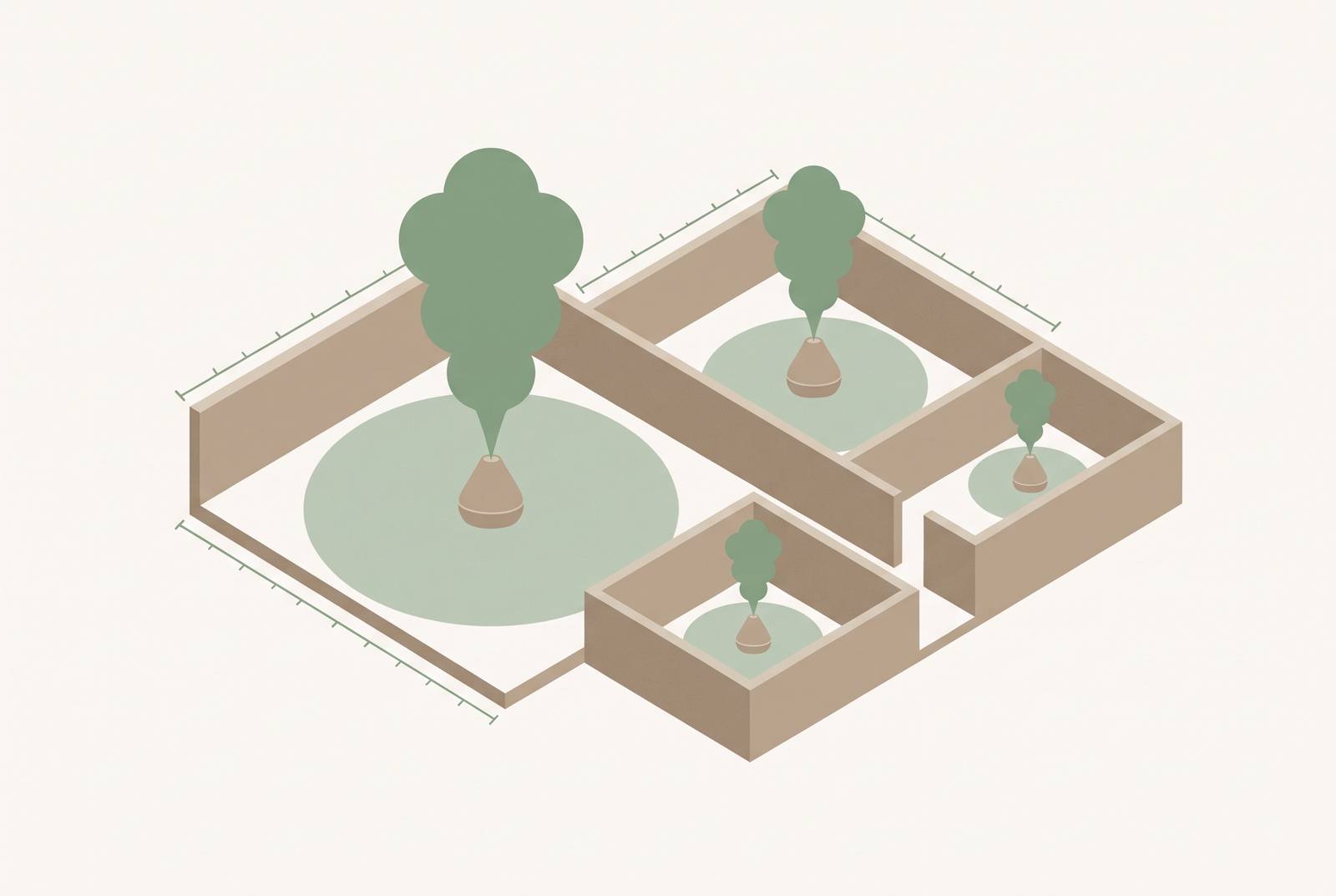
Matching diffuser size and power to room square footage starts with floor area, then adjusts for room height and airflow. Choose a larger coverage tier when your room falls between ratings, and reduce intensity to spare a smaller unit from overwork. Cold-air diffusion is the format that scales reliably from enclosed rooms to connected floors because its dry mist travels with airflow.
Why most diffusers disappoint before the first refill
A diffuser that barely scents the space beyond its shelf presents a familiar frustration. The fragrance may smell good up close but be too faint to smell anywhere else. That is a coverage problem. When output is too low for the room, adding more oil or choosing a stronger fragrance does not correct the mismatch between the device and the space.
The reverse can be just as unpleasant. A diffuser with too much output saturates a small room, wastes oil, and can cause discomfort. Buyers who check price and scent reviews before coverage may end up with too much or too little output. The purchase decision therefore begins with the room, leaving fragrance preference until the device can distribute it properly.
How do you know what diffuser coverage your room actually needs?
The coverage a room needs depends on its floor area, room height, and airflow. Multiply the room’s length by its width to calculate square footage. Then account for height, because rooms taller than standard hold more air than their footprint suggests. Finally, consider open doorways, running HVAC, and high ventilation, which disperse fragrance faster than enclosed walls allow. The arithmetic is simple. The room supplies the qualifications.
Aroma360’s 2026 guide says to choose the larger unit when a space falls between two rated coverage levels, then turn down the intensity so the scent spreads evenly. Manufacturer claims can overstate real-world performance, so a headline rating should not be treated as a promise under every condition. Higher rooms and freer airflow call for a more conservative reading of the stated range.
What size diffuser is needed for a moderately sized bedroom? Choose a unit rated to cover that footprint, with extra capacity if height or airflow increases the demand. If the available models place the bedroom between coverage tiers, choose the larger adjustable unit. A bedroom does not belong in the under-250-square-foot category merely because it feels compact.
Small enclosed rooms: bathrooms, home offices, and bedrooms under 250 square feet
A bathroom up to roughly 100 square feet needs minimal output because its walls contain the fragrance. Oversizing is the more common mistake here. A device operating well above that room’s needs can quickly overwhelm it, so adjustable intensity is especially useful. In a truly tiny powder room, a cold-air unit at low intensity is more practical than switching to a passive format whose reach cannot be extended.
Home offices and small bedrooms in the 150–250 square foot range need moderate, steady output. Peaks and drops are unwelcome during concentration or sleep. Ultrasonic diffusers can work adequately at this scale because their short throw suits the small footprint, although water dilutes the fragrance and output changes as the tank depletes. The same guide favors waterless cold-air diffusion even here because it adds no humidity, while its heat-free operation preserves the fragrance profile.
Placement can undo an otherwise sensible sizing decision. A unit tucked into a floor-level corner tends to pool scent near the source, limiting distribution through the room. Mid-height placement near the natural airflow path gives fragrance a better route outward. In a small room, the goal is gentle distribution.
Main living areas: living rooms, primary bedrooms, and open kitchens from 400 to 800 square feet
A living room, primary bedroom, or open kitchen in the 400–800 square foot range exceeds what an ultrasonic unit can reliably cover. Its wet mist has insufficient throw, so fragrance fades before reaching the far walls. The room now demands a different delivery format. Cold-air diffusion becomes a practical response to distance.
A correctly sized cold-air diffuser can scent a 600 square foot living room consistently from the entry to the far end, without residue on furniture, electronics, or artwork. Hotel Collection’s 2026 guide recommends the Studio Scent Diffuser for spaces up to 600 square feet without an HVAC connection. That rating is a distinct selection point within this tier. It should not be stretched to cover an 800 square foot room simply because both spaces count as main living areas.
Open kitchens add competition from cooking odors, which can temporarily suppress or clash with fragrance. Placing the diffuser in the adjoining living area rather than directly above a cooking surface addresses that complication without reducing coverage. Adjustable intensity and programmable schedules let the device follow occupancy, varying output and runtime throughout the day.
Why cold-air diffusion scales where other technologies stop
Cold-air diffusion uses pressurized cool air to atomize pure fragrance oil into dry micro-particles, without water or heat. Those particles stay in the air and move with airflow without falling onto surfaces. Aroma360’s guide describes the result as a dry micro-mist with even dispersion and a flat scent curve across the coverage area. In everyday terms, the fragrance stays more consistent across both space and time.
Why not simply buy a larger ultrasonic diffuser? A larger device does not remove the limits of wet mist. Water-laden particles are heavier and have a shorter throw, while dilution lowers fragrance concentration. Added humidity also becomes a liability in larger or less-ventilated rooms. Increasing capacity without changing that delivery mechanism does not give it the distribution characteristics of dry mist.
Other formats have their own limits. Heat and evaporative systems show fading, while Hotel Collection’s guide distinguishes cold-air diffusion from pressurized-air nebulizing variants that run loudly and release uneven bursts. Cold-air output is steady and quiet by comparison. Its advantage is not simply how much fragrance it releases, but how evenly it delivers that fragrance.
As cold-air coverage grows, the fan has more power and the oil delivery rate rises, but the basic mechanism stays the same. A unit rated for 1,800 square feet uses the same technology as one rated for 600 square feet, with more output capacity. Scheduling makes that capacity easier to manage because full-strength scent is available immediately, combining reach and control to extend the format beyond a single room.
Open-concept floors and whole-floor layouts from 800 to 1,800 square feet
An open floor combining living, dining, and kitchen zones is not simply an oversized enclosed room. Fragrance must move through connected areas where airflow patterns, and sometimes room heights, differ. There are no walls to retain scent within each zone. Consequently, a small or mid-range unit cannot be expected to serve the entire layout just because it performs well beside the sofa.
A suitably rated standalone cold-air unit can handle this tier when it has central placement and access to natural airflow. Aroma360’s guide lists the VanGogh360 for coverage up to 1,800 square feet, using its own internal fan or an HVAC connection. It also identifies the DaVinci360 as a strictly standalone option for a smaller coverage area. Mid-height placement near the center of the open zone helps dry mist disperse horizontally, rather than starting from a floor-level corner or distant wall.
HVAC integration becomes useful when the floor includes closed interior rooms or unevenly connected zones. Supply ducts distribute fragrance beyond the open area and into rooms a standalone unit cannot reach as evenly. Connection solves a distribution problem, particularly where separate devices would create overlapping scent zones, and becomes more relevant as the layout approaches a whole-home system.
Whole-home scenting for small to large homes
At whole-home scale, the main challenge shifts from output strength to distribution across rooms at different distances from the unit. Duct branches, closed doors, and room arrangement become part of the sizing decision. This is now a system-design question. This is why the range overlaps with the open-floor tier: a connected single-level space and a divided home can need different setups even when they have similar footprints.
HVAC integration uses the home’s air-handling system to distribute fragrance introduced on the supply side through existing vents. That route reaches rooms even when their doors stay closed. Aroma360’s guide describes HVAC-integrated flagship units as well as standalone models with substantial whole-home coverage. A standalone option remains available for suitable open estates or large single-level homes, so total square footage alone does not make duct connection compulsory.
Distribution through the whole home also broadens the consequences of excessive intensity. Programmable schedules tied to HVAC operating cycles help prevent fragrance from accumulating as air recirculates without fresh intake. As in hotels, keeping fragrance steady throughout a property calls for scheduled cold-air diffusion through HVAC-integrated or standalone commercial diffusers, while one small device left turned up cannot do the same job.
Choosing fragrance oils that are safe across every room type
Even with the right coverage, the fragrance oil still needs to be chosen with care. Safety has two distinct layers, which are the device materials the oil contacts and the chemistry of the particles released into the air. Evaluating the first does not settle the second. Cold-air diffusion applies no heat, so both desirable scent notes and any problematic compounds enter the air unaltered, making formulation quality especially important.
Certain essential oil compounds are toxic to cats and dogs even in diffused form, and a pet-safe formulation excludes those compounds entirely. In rooms where pets spend time, even a fragrance that smells gentle needs a formulation that guards against those risks.
IFRA compliance and an ingredient list that anyone can read give buyers more to check than the claims in a marketing description. Aroma360’s guide also positions clean, vegan, and cruelty-free formulations as the appropriate home-diffusion standard. Those labels should come with clear information about what is in the oil. Exposure duration adds another consideration, since an overnight bedroom presents more cumulative exposure than an intermittently used entryway. Sleep spaces and children’s rooms therefore warrant closer scrutiny than high-traffic, well-ventilated areas.
Applying the sizing rules as a whole-home scenting plan
A coherent home-wide plan assigns output according to footprint, use, and occupants. Small enclosed rooms need the intensity kept low, while main living areas need moderate output that runs on a schedule. Connected floors require greater capacity and, where the layout calls for it, HVAC distribution. These layers can share a fragrance character without competing for attention. Luxury hotels use the same or complementary fragrance families across public and private spaces to create that continuity.
Seasonal changes can happen by changing the oil while keeping the hardware. Lighter citrus-forward or aquatic profiles work well in warmer months and spaces with high ventilation, while woodsy or amber-forward profiles work well in cooler months and enclosed rooms. Scheduling then adapts the system to daily use. A 600 square foot living room used mainly in the evening needs output only during evening use, and a bedroom diffuser can follow a sleep schedule.
Start with the room used most. Measure its footprint, account for height and airflow, and select the appropriate coverage tier with adjustable intensity. Begin there before committing to several devices. Once the fragrance profile and cold-air format suit that space, add rooms incrementally, giving each its own coverage decision rather than repeating the first purchase throughout the home.