Fragrance Load and Interval Settings That Produce a Seamless Signature Scent in Any Living Room
Programmable cold-air diffusers deliver hotel-lobby scent through precise timing and placement.
Recreating luxury hotel scent at home with a diffuser takes more than choosing an oil. A programmable cold-air diffuser, sized for the living room and calibrated with low fragrance load, timed pauses, and deliberate placement, provides the control needed for a balanced signature scent. The goal is fragrance that guests notice on arrival without feeling surrounded by it.
Why the living room is the hardest room to scent consistently
A living room can smell inviting when a diffuser is fresh, faint a week later, and overpowering beside the device throughout. That pattern points to delivery. Foot traffic and open layouts constantly disturb and replace the air, while HVAC and AC systems can remove fragrance faster than passive methods replenish it. Meanwhile, olfactory adaptation makes the nose stop registering a continuous scent after minutes of exposure. The room and its occupants are changing together.
Common fragrance methods add their own variation. Candles peak and taper as the wax depletes, while plug-ins and reeds depend on evaporation that weakens as their medium runs down. Ultrasonic diffusers dilute oil with water, produce a wet mist with limited throw, and reset intensity with each refill. An uneven scent in a room therefore raises two questions: whether the fragrance reaches the seating area and whether the person sitting there can still smell it.
How cold-air atomization produces a flat, consistent scent output where other methods produce a curve
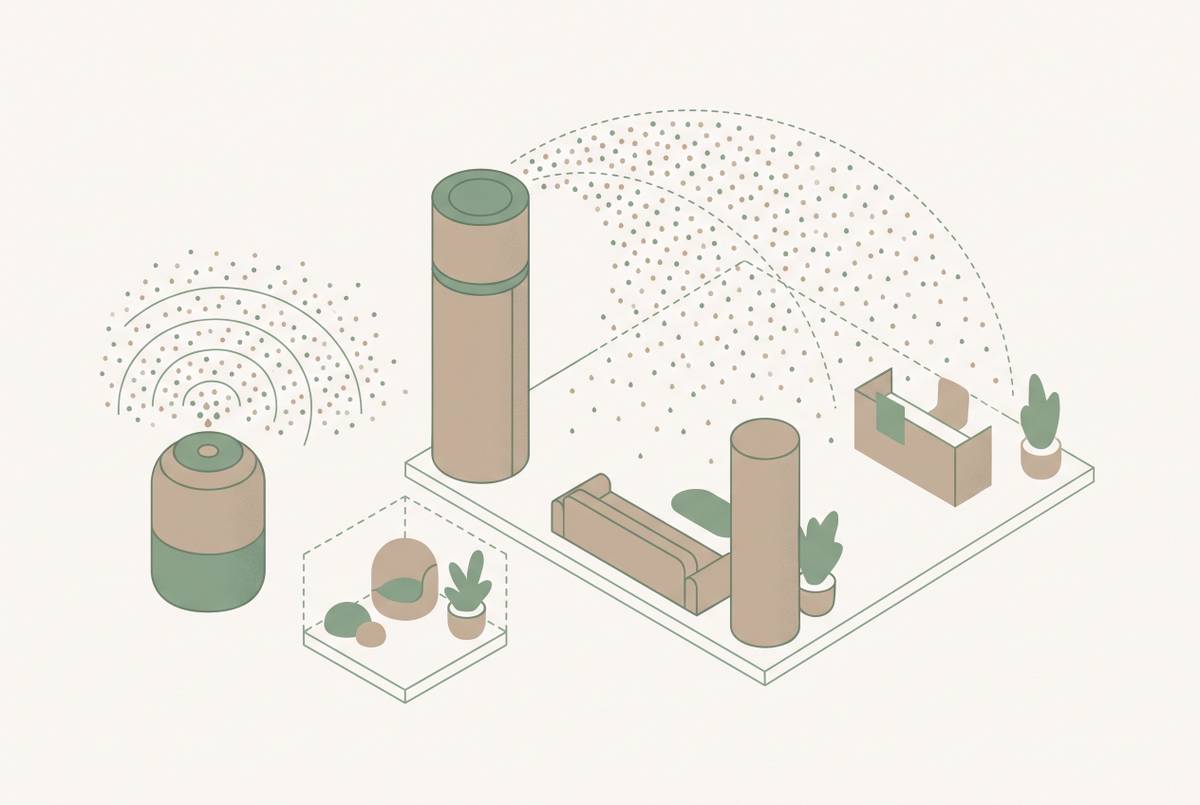
For someone asking what diffuser replicates a luxury hotel lobby scent, the useful criterion is programmable cold-air atomization. Pressurized air turns pure fragrance oil into a dry, ultra-fine mist with no need for water, heat, or an open flame. Without heat, the oil retains its chemical structure, allowing its top, middle, and base notes to enter the air intact. The fine, dry particles remain suspended longer and disperse farther than wet ultrasonic mist, which tends to settle near the unit. That changes both reach and control.
The programmable pump is the decisive difference. Output does not depend on a melt pool, an evaporating pad, or the level in a water tank, so the device can repeat a consistent delivery pattern throughout its scheduled hours. Waterless operation also avoids adding humidity to a sealed, AC-cooled room and removes the need to clean and refill a water reservoir. Steady output allows intensity and timing to be set reliably, with placement and room size still relevant.
Matching diffuser coverage to the actual living room — not the packaging claim
Coverage ratings come from controlled conditions, which may differ from those in a living room with open doorways, people moving through it, and air conditioning running. Floor area is only the starting point. High ceilings increase the volume of air per square foot, and an adjoining kitchen or dining area extends the space into which fragrance can disperse. A small diffuser running at maximum may create a strong pocket near the unit while leaving the far side of the room almost unscented. More output cannot reliably repair inadequate reach.
For practical sizing, a compact cold-air unit suits a dedicated sitting room or sectioned-off area under 200 sq ft. A living room of 200–500 sq ft calls for a room-scale unit designed for steady wall-to-wall throw. Spaces of 500 sq ft and above may need a larger unit or more than one device, with care taken over where each goes. When the room falls between tiers, size up and run at lower intensity. In an open-plan layout, either allow for the air in the connected spaces or place the device to serve just the living area, since people may not use all parts of the shared floor equally.
Setting fragrance load: how intensity should be calibrated before the schedule is set
Fragrance load is the intensity of delivery, and its starting point should be the lowest functional setting. Hold that setting for a full day before making an adjustment. The hotel-method standard is presence without intrusion, with fragrance noticeable on entry but no longer demanding attention once a guest settles in. A signature scent should not need its own seat.
The setup moment is a poor calibration window because the nose first reacts to a new fragrance and then adapts to it. Turning up the device as perception fades confuses a biological change with a delivery failure. If the low setting seems absent, leave the room for a short while and re-enter before deciding it needs more. Someone arriving from outside the scented space is a better judge than its longest-serving occupant. Increase only if the scent still feels absent after the full-day trial.
Room size provides flexible guidance for the setting. Small rooms usually need low intensity, medium rooms often do well around medium, and large or open-plan spaces may need high intensity or a larger coverage tier. Even there, the objective is even distribution at a restrained concentration. Over-diffusion fatigues the nose faster, shortens the pleasant window, and consumes more oil without improving the experience.
Setting the interval schedule to stay ahead of olfactory adaptation
Once intensity has been calibrated, timing addresses the nose’s tendency to tune out a constant signal. An interval schedule alternates diffusion with pauses. Those pauses give the nose a chance to pick up the scent again before the next cycle. The purpose is not oil conservation alone. A continuously running diffuser can still produce a room that seems odorless to someone who has been sitting in it.
A balanced on/off cycle is the starting structure for most medium living rooms and medium-intensity settings. A longer on/off cycle can suit larger spaces, stronger oil profiles, or intermittent traffic where fragrance needs time to build before a pause. There is also a finer rhythm inside each active period. Low mode has short spray bursts with long pauses, medium mode has bursts and pauses of medium length, and high mode has longer bursts with shorter pauses.
Hotel-style scheduling concentrates diffusion in the hours a space is occupied and active, which in a living room often means afternoon and evening. This extends oil life and limits the fatigue associated with continuous exposure in an enclosed space. An app or timer makes that discipline repeatable. Its value is not merely remote control, but the ability to maintain the same pattern without repeated manual switching.
Where the diffuser sits in the room matters as much as how it is set
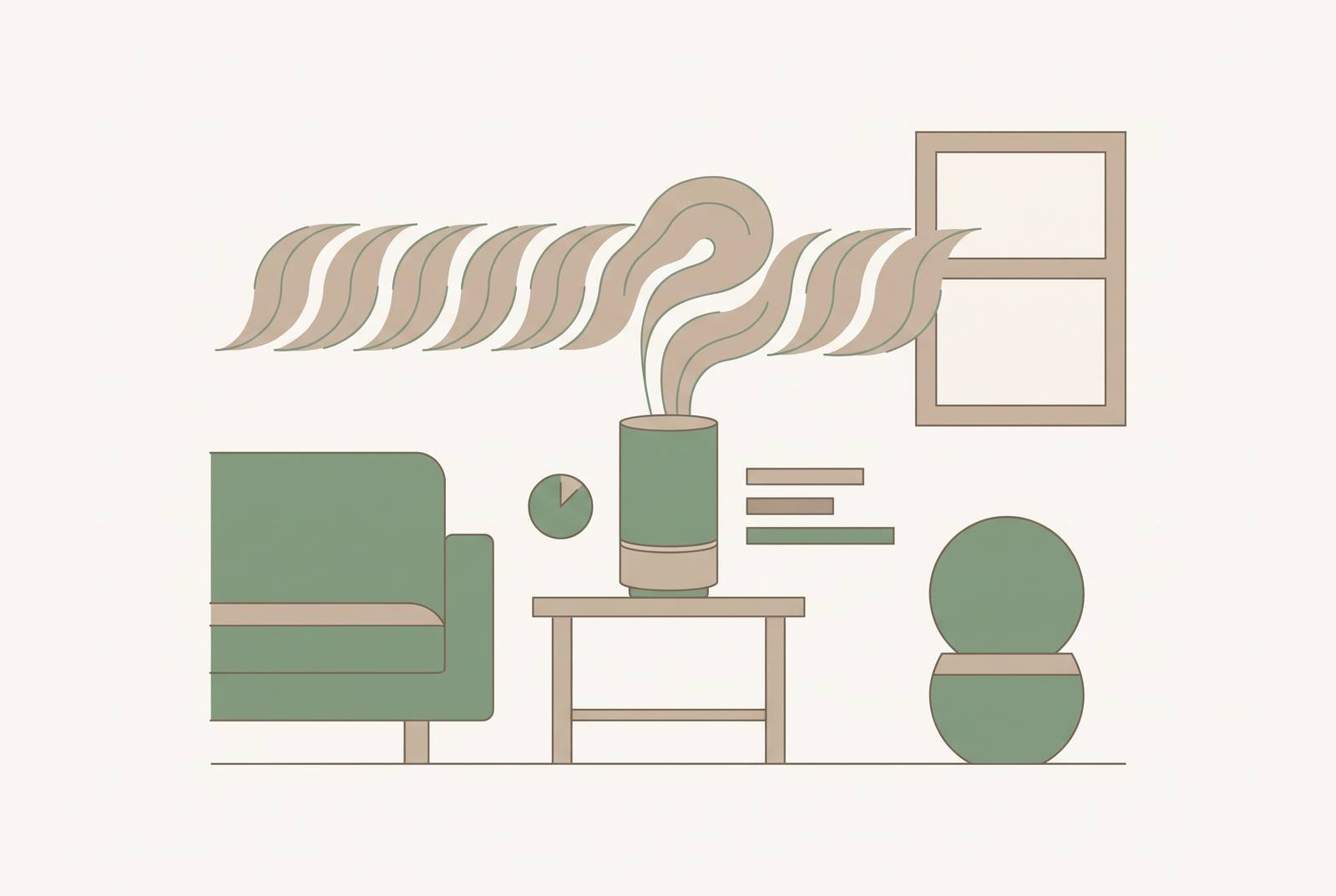
Even a correctly sized device can send fragrance in the wrong direction. Fine particles in the air move with air currents, so scent may escape through a nearby open window or exterior door before it fills the room. A direct HVAC return can also draw fragrance away before the scent reaches a steady level. Placement determines where the output goes. Increasing intensity cannot reliably compensate for an exit route beside the nozzle.
A shelf or console at mid-height in the central part of the room gives natural circulation room to spread the fragrance outward. A corner or wall position can instead concentrate it near the device. Mid-height becomes especially useful with high ceilings, where floor-level output may not circulate upward evenly and a high position may disperse fragrance before it reaches breathing height. The aim is delivery where people sit and move.
Open-plan rooms need a different interpretation of “central.” Positioning the diffuser at the living-room end of a shared kitchen and dining space focuses coverage around seating and primary occupancy. If a second device is needed, its placement should be deliberate, with both units using the same fragrance at consistent intensities. Two uncoordinated devices do not automatically produce twice the useful coverage.
How the living room fits into a whole-home scent zone without creating dissonance at the doorway
Once the living room is balanced, an unrelated fragrance next door can become the most noticeable flaw. The living room, dining area, and entry hall can share one signature, making them a coherent social zone. A bedroom or home office can have its own profile. The doorway should mark a smooth transition.
Adjacent scents need not match, but they should share a tonal quality. Warm amber or sandalwood can flow into a bedroom with a creamy floral scent because both feel warm and soft, while botanical greens can lead into light citrus because both feel clean and bright. Heavy resinous fragrance followed by sharp, acidic citrus creates a much more abrupt contrast. This is the relevant role of fragrance selection here.
Oil safety, clean formulation, and the household variables that constrain the settings above
All of these settings remain conditional on the oil being appropriate for everyone exposed to it. Cats are especially vulnerable because they lack a liver enzyme needed to process many fragrance compounds, and ambient diffusion can be a concern without direct contact. Problematic oils include tea tree, eucalyptus, cinnamon, clove, and highly concentrated citrus. Birds are particularly sensitive to airborne diffusion. A pleasant smell to an adult is not a household safety test.
In homes with pets, the scented space needs an escape route, and diffusion should not run continuously in a sealed room an animal cannot leave. Young children also make continuous exposure a household safety constraint. Cold-air operation avoids heat and water-related hazards, but it still disperses fragrance into the air. Waterless does not mean exposure-free. Neither a low setting nor a pause establishes that an unsuitable oil has become safe.
Clean formulation therefore begins with transparent ingredient disclosure. The household needs to know what is being dispersed, with attention to harsh VOCs and synthetic compounds that increase the indoor air chemical load. Pauses provide an opportunity for ventilation between cycles, which is useful where continuous exposure is the concern. They do not replace ventilation or settle oil suitability. Household constraints must govern the schedule, rather than being checked only after a preferred scent routine has been chosen.
Putting the framework together: a living room settings reference
Start by measuring the living room’s floor area and working out how much extra air there is under high ceilings and in connected rooms. Use the under-200 sq ft, 200–500 sq ft, and 500 sq ft-and-above tiers to select the appropriate scale of device. If the room sits between tiers, choose the larger coverage tier and plan to run it lower.
Before the first calibration day, clean away other odors so the fragrance does not have to cover them. Set the diffuser to its lowest functional intensity and leave that choice unchanged for a full day. Judge it after leaving and re-entering. If the scent still seems to be missing, change the setting once. Keep the room-size intensity guidance subordinate to that entry test.
Next, select a balanced on/off cycle for a typical medium living room, or a longer cycle where a larger space or intermittent occupancy calls for it. Restrict operation to occupied hours. Place the device at mid-height in the central living zone, away from windows, exterior doors, and direct HVAC returns, with the living-end placement used for open-plan rooms. Before locking in the schedule, confirm that the oil and exposure pattern fit the household’s safety constraints.
During scheduled hours, check that the scent feels much the same each time someone enters. Oil use should also become predictable. A typical 10 ml bottle can last anywhere from 10 to 40 hours depending on mode, so the chosen setting helps with planning when to refill it. After the first week, the needed adjustment is often downward because adaptation during setup encourages excessive intensity. The most honest final check is a guest’s reaction on arrival, when the fragrance meets a nose that has not already learned to ignore it.