Essential Oils Safe for Cats in a Home Diffuser
Cats lack a liver enzyme to break down essential oils, making most diffusers unsafe for them.
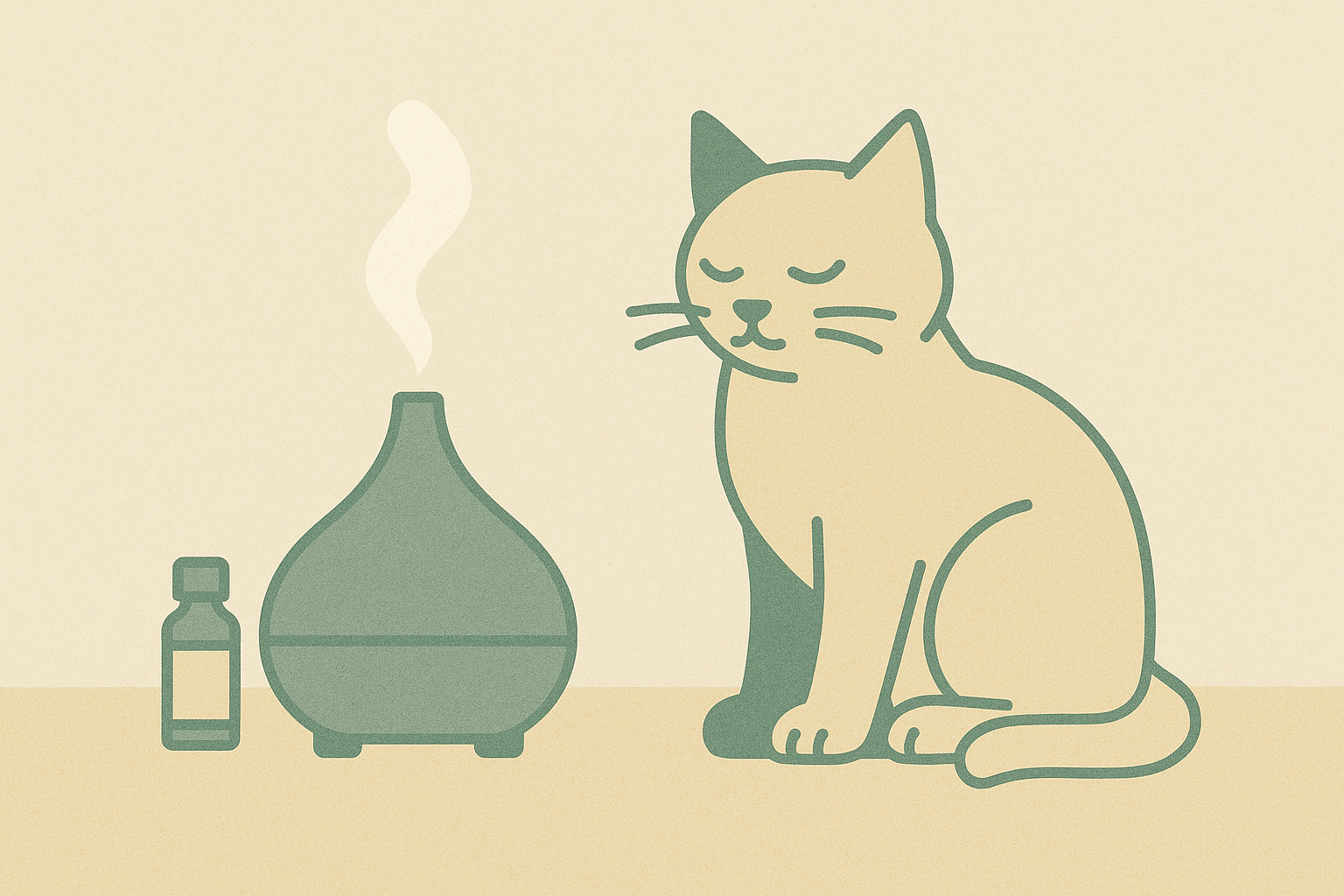
Cats cannot metabolize the compounds in most essential oils the way dogs or humans can, because they are missing a specific liver enzyme. That single biological fact, more than any list of "good" or "bad" oils, determines what a cat owner can safely diffuse at home, and it's where any real understanding of the subject has to start.
Why Cats Cannot Process Essential Oils
The enzyme in question, UGT1A6, is one that dogs and humans both carry as a working copy in the liver. Cats don't have it. Research on feline drug metabolism confirms this is a fixed trait shared across the entire cat family, lions and house cats alike, not a quirk of one grumpy tabby or a sensitivity some cats grow out of, and it traces back to diet: an evolutionary menu built almost entirely on animal protein never put pressure on the cat liver to keep broad plant-detoxifying machinery running. Cats, obligate carnivores through and through, let it go.
What happens next is a matter of simple pharmacokinetics. A dog exposed to a phenol-containing oil clears it from the body within hours. A cat exposed to the same compound at the same dose has no efficient pathway to break it down, so the phenol lingers and accumulates, day over day, edging toward toxic concentrations that would never trouble the dog sleeping next to it. The same exposure, the same molecule, two entirely different outcomes, purely because of what's missing in the liver.
Layered on top of that metabolic gap is a separate, compounding problem: cats also show heightened direct sensitivity to phenols and salicylates, the aspirin-adjacent compounds found in oils like wintergreen. Concentration drives that risk in a fairly linear way: the more concentrated the oil, the sharper the danger, with undiluted oils at the extreme end of the scale.
That concentration point matters because it's easy to assume "natural" means "mild." Essential oils are not a gentle version of the plant. What actually determines risk is concentration and route of exposure, which is exactly the question the next section takes up.
How a cat is actually exposed (breathing, grooming, and direct contact)
Knowing that cats can't metabolize phenols well only matters if a cat is actually exposed to them, and in a home with a running diffuser, that exposure happens along three separate routes, not one.
The most obvious route is inhalation. Airborne particles from a diffuser get breathed in directly, and that can irritate the lining of the respiratory tract on its own. PetMD notes that oils in the air pose the greatest threat specifically to cats with asthma or heart disease, and the complicating detail is that those conditions can be mild and underlying, undiagnosed in an otherwise normal-looking cat, before the diffuser ever gets switched on. A cat owner has no way of ruling that out just by looking at a healthy-seeming animal.
The second route gets far less attention, and it's arguably the more dangerous one: grooming ingestion. Diffused particles don't stay suspended in the air forever. They settle, on furniture, on walls, and on a cat's own fur and paws. Cats are constitutionally incapable of leaving that alone. The cat just grooms the way cats always groom, and the exposure happens anyway; that is the pathway owners miss.
The third route is direct contact: spilled diffuser liquid, an open reed diffuser container, liquid potpourri left where a curious cat can investigate it. This is the most acutely dangerous form of exposure because it skips the dilution that air and settling provide. PetMD advises against ever applying essential oils directly to a cat's skin for any reason, and reed diffusers deserve particular suspicion in a cat household, since they hold concentrated fragrance oil, typically blended with a carrier base, in a container a cat can knock over, sniff, or paw at directly.
Diffuser type changes which of these three pathways is active, so you need to sit with that before you move into risk tiers. Ultrasonic, water-based diffusers emit fine water droplets, in the 1 to 5 micron range, that carry oil particles through the air. Those droplets settle onto surfaces, including a cat's fur, at a rate that raises the grooming-ingestion risk specifically, since more oil ends up on the coat per hour of operation than with drier dispersal methods. You'll find the full case for cold-air diffusion, an alternative delivery method, in a later section. For now, the operating principle is that the pathway matters as much as the oil.
The essential oils veterinary and toxicology sources consistently identify as highest risk
Given those three exposure pathways, certain oils appear across veterinary and toxicology references so consistently that you can treat them as settled, not debated. These are the ones to remove from consideration entirely in a cat household, regardless of diffuser type or room setup.
Tea tree oil, also labeled melaleuca, is the essential oil most commonly reported as an intoxicant in pets generally, not just cats. PetMD also places lavender on this same high-risk list, even though people see it as the gentlest oil on the shelf, the kind recommended for human babies and anxious dogs alike. That contradiction between reputation and risk is real enough to deserve its own section, which follows this one.
The MSD Veterinary Manual adds a narrower, more clinical flag: birch tar, cassia bark, cinnamon oil, pennyroyal, and tea tree or melaleuca are specifically called out as potentially hepatotoxic, carrying documented potential to cause liver damage directly. That's a more serious designation than general irritation. It points at the organ already compromised by the missing UGT1A6 enzyme, so these oils attack precisely where the cat's defenses are weakest.
The consequences of exposure to oils on this list run well past a runny nose. Any one of those signs after a suspected exposure warrants treating it as an emergency rather than waiting to see if the cat improves on its own. And for cats carrying asthma or heart disease, one veterinary resource notes the risk is heightened even without ingestion: inhalation alone can trigger a life-threatening breathing emergency in a vulnerable animal.
The list above isn't exhaustive or a complete catalog of every risky compound in existence; it is the floor, the set of oils that current veterinary consensus agrees should not be diffused anywhere a cat lives, full stop, before any conversation about moderation or ventilation even starts.
Where expert opinion splits on lower-risk oils
Past that settled list, the evidence gets genuinely less tidy, and a small group of oils, lavender, chamomile, cedarwood, and frankincense, is treated differently depending on which source a reader checks. You need to understand that split on its own terms rather than resolve it by picking a favorite source, because it reflects a real methodological difference, not carelessness on anyone's part.
The case for treating these oils as lower risk, not zero risk, rests on dose and delivery. The Tisserand Institute argues that you can diffuse essential oils around cats without incident if you use good ventilation, small quantities, limited diffusing periods, and let the cat keep the freedom to leave the room. The reasoning is that a few parts per million of aromatic vapor in the air is unlikely to cause harm on its own, but the same guidance cautions against letting vapor concentration build up over many continuous hours. Frankincense sometimes joins that shortlist too, generally framed as acceptable in moderation.
Set against that is a more conservative position, and one veterinary resource's own list is part of the tension: lavender appears there as an oil known to cause serious poisoning in cats, which puts it squarely in the high-risk column even as other sources treat it as comparatively gentle. Veterinary sources broadly agree on one point regardless of which side of this split they land on: even the oils labeled lower risk can still cause respiratory irritation or digestive upset, particularly with repeated or prolonged exposure. No essential oil carries a clean bill of health for cats. Across these sources, the real distinction drawn is between higher risk and lower risk, not between dangerous and safe.
Because the sources are often describing different scenarios while using the same oil name. A trace airborne concentration in a ventilated room, with a door left open so the cat can leave at will, is a fundamentally different exposure than that same oil applied to fur, run continuously in a sealed room, or dispersed as a heavy mist from a nebulizing device. Two researchers can both be right about "lavender" while describing conditions that aren't comparable. Individual health status narrows the margin further. If a cat has existing liver disease, asthma, or a known history of sensitivity, it has far less room for error than a healthy adult in the identical room. Kittens and senior cats process compounds more slowly across the board, so you need caution with them even within the lower-risk category.
The practical upshot of this whole debate is that no oil carries a certified safety stamp, which shifts the real question away from which oil to pick and toward how to cut down exposure as much as possible, regardless of which oil ends up in the diffuser. That's the question the next section takes on directly.
How diffuser type and room setup change cat exposure
If no oil is guaranteed safe, the most controllable variable left in a cat owner's hands is the delivery system and the room it operates in.
How much oil actually reaches a cat's breathing zone depends on how the particles are dispersed, how fast they settle out of the air, and whether the cat has room to move away from them. A nebulizing diffuser, which disperses fragrance as fine liquid droplets, puts a noticeably heavier oil load into the air than a cold-air system running at low intensity, and heavier droplets settle onto surfaces, including a cat's coat, faster than lighter ones. That settling speed feeds the grooming-ingestion pathway described earlier. Reed diffusers sidestep airborne dispersal altogether but introduce a different problem: concentrated, undiluted oil sitting in an open container, within reach of any cat inclined to investigate something new on a side table, which plenty of cats are. Candles stack fragrance exposure on top of combustion byproducts and an open flame, so you can take them out of consideration for cat households regardless of what scent they're burning.
Cold-air diffusion holds a few structural advantages. It produces a dry vapor rather than water-carried droplets, which slows the rate at which oil particles land on fur and household surfaces, directly cutting into the grooming-ingestion risk that makes diffused oils harder to monitor than owners expect. Running the unit on a schedule, short defined intervals instead of continuous operation, keeps airborne concentration low and avoids the slow buildup over many hours that even the more permissive sources flag as the real concern.
Room setup does a comparable amount of work regardless of which diffuser sits on the shelf. A cat needs to be able to leave the room at will. A closed door turns any diffused oil into a confined-space exposure, which veterinary guidance treats as the most dangerous version of the whole scenario, concentration with nowhere for the cat to retreat. An open window or active air circulation dilutes whatever is airborne and keeps it from accumulating. Placing the diffuser away from a cat's favored resting spots, food bowl, and water dish limits how much time the cat spends in the zone closest to the source, where concentration is naturally highest. And running the device for short, defined stretches rather than letting it go all day gives the liver, already working without its usual enzyme, a break between exposures instead of a sustained, uninterrupted load.
Choosing fragrance oils for a cat household: what ingredient transparency now makes possible
Fragrance oils now get formulated with full ingredient disclosure, and that has changed the actual question a cat owner needs to ask. It's no longer "can anything be diffused around a cat at all," a question that tends to produce either blanket fear or blanket dismissal. It's closer to "how do I find a formulation that steers clear of the highest-risk compounds and meets a standard someone can actually point to."
That shift matters because the oils flagged earlier, tea tree, eucalyptus, cinnamon, clove, wintergreen, pennyroyal, and the rest, aren't always obvious from a product's name or its marketing copy. A blend labeled for relaxation or seasonal cheer can contain any of them without that being apparent at a glance. Ingredient transparency changes that dynamic: a full ingredient list lets a cat owner check a formulation against the known high-risk group directly, oil by oil, rather than trusting a scent category or a label's general tone.
So you can distill that checking process down to one habit. Pull the ingredient list before the purchase, not after. Cross-reference it against the oils that veterinary sources flag as known poisoning risks. Weigh the remaining oils, the ones in the contested middle tier like lavender or cedarwood, against the specific cat in the house: its age, its health history, whether it has asthma or liver concern, and whether the room it'll be diffused in actually lets it leave if it wants to. None of that removes risk down to zero, because nothing does. It does turn an uninformed guess into a decision made with the same information a veterinary toxicologist would use to make it.