Bergamot Cold-Press Extraction and Linalyl Acetate Preservation
Cold-pressing protects bergamot's floral signature where heat-based distillation destroys it.

Bergamot is a small citrus fruit, roughly the size of an orange, with a rind that shifts between yellow and lime-green depending on how ripe it gets before harvest, and it's most likely a natural hybrid of lemon and bitter orange. Nobody eats it. The flesh is too sour and too bitter to bother with, so the entire value of the fruit is in its rind, in the oil glands packed just under the surface. That's an odd way for a fruit to earn its keep, but bergamot has been earning it that way for centuries.
That is where it gets interesting, and where the whole rest of this piece starts to make sense. Lemon oil runs on limonene, the same compound that gives most citrus its sharp, familiar snap, and offers only a trace of anything else. Sweet orange leans on limonene even harder. Bergamot, though, can carry linalyl acetate at concentrations up to 41%, which is a wildly different chemical signature for something sitting on the same branch of the citrus family tree. Linalyl acetate happens to be the same compound that gives lavender its soft, almost powdery floral quality, and it's the reason bergamot smells like it's doing two things at once: bright citrus up front, then a floral hush right behind it that neither lemon nor orange can produce on their own. That combination is why bergamot became indispensable to perfumery rather than just another fruit stand curiosity, and it's also why how you extract the oil starts to matter so much more here than it does for its citrus cousins. More on that later.
The origin of authentic bergamot oil and what "perfume-grade" means in practice
Almost all of the world's perfume-grade bergamot oil traces back to one stretch of Italian coastline. Calabria, at the southern tip of the mainland, produces somewhere between 80% and 95% of it, concentrated along a coastal strip roughly 100 kilometres long running from Villa San Giovanni down toward Brancaleone, with the section known as the Costa dei Gelsomini, the Jasmine Coast, considered the best of the best. That's not a large territory for an ingredient this central to modern perfumery.
The industry behind it is built on hundreds of farming families tending thousands of hectares of orchards, with hundreds of those farms organized under the Unionberg OP cooperative since 2003. Turkey's Antalya province produces a smaller supplementary supply, somewhere around 70 tons a year. Calabrian growers also work across three dominant cultivars, Femminello, Castagnaro, and Fantastico, each with its own aromatic fingerprint. That variation between cultivars is precisely why the extraction method has to stay consistent: if the process itself introduces variability on top of what the fruit is already doing, quality control turns into guesswork. The whole operation is valued at an estimated 180 million USD in 2025, which sounds like a lot until you consider how much fruit it takes to produce a modest amount of oil per season from a single tree. Rarity here is arithmetic. It's arithmetic.
So the fruit is scarce, geographically concentrated, and cultivar-dependent before a single machine touches it. What happens next, during processing, either honors that scarcity or squanders it.
How cold-press extraction works mechanically
Cold-press extraction is mechanical, and that distinction is the whole point. Machines gently abrade the fruit's outer rind under water, which bursts the oil vesicles sitting just beneath the surface without ever applying heat, and the resulting oil-and-water emulsion gets centrifuged apart to isolate the pure essential oil. No steam touches it. No solvent goes near it. Bergamot oil produced this way is overwhelmingly volatile in composition, with that volatile fraction making up roughly 93% to 96% of the total oil, mostly monoterpenes and oxygenated monoterpenoids, which is a technical way of saying the fragrant part of the oil, the part responsible for how it actually smells, comes through largely undisturbed.
There's a specific number that tells you whether this process worked. Unaltered cold-pressed bergamot oil shows an optical rotation of +10 to +35 degrees, a measurement that confirms zero heat-induced oxidation ever occurred. It's a small, obscure figure, but it's the kind of thing a chemist can check in minutes and know immediately whether an oil was babied through extraction or cooked. A February 2026 review in ScienceDirect landed on a fairly plain conclusion after surveying the method: cold pressing balances high-quality output against preservation of the oil's natural characteristics about as well as any extraction method can. Abrade, burst, spin, done. What comes out of the centrifuge is chemically about as close to what was sitting inside the rind vesicle as an extracted oil can get.
What distillation does to linalyl acetate
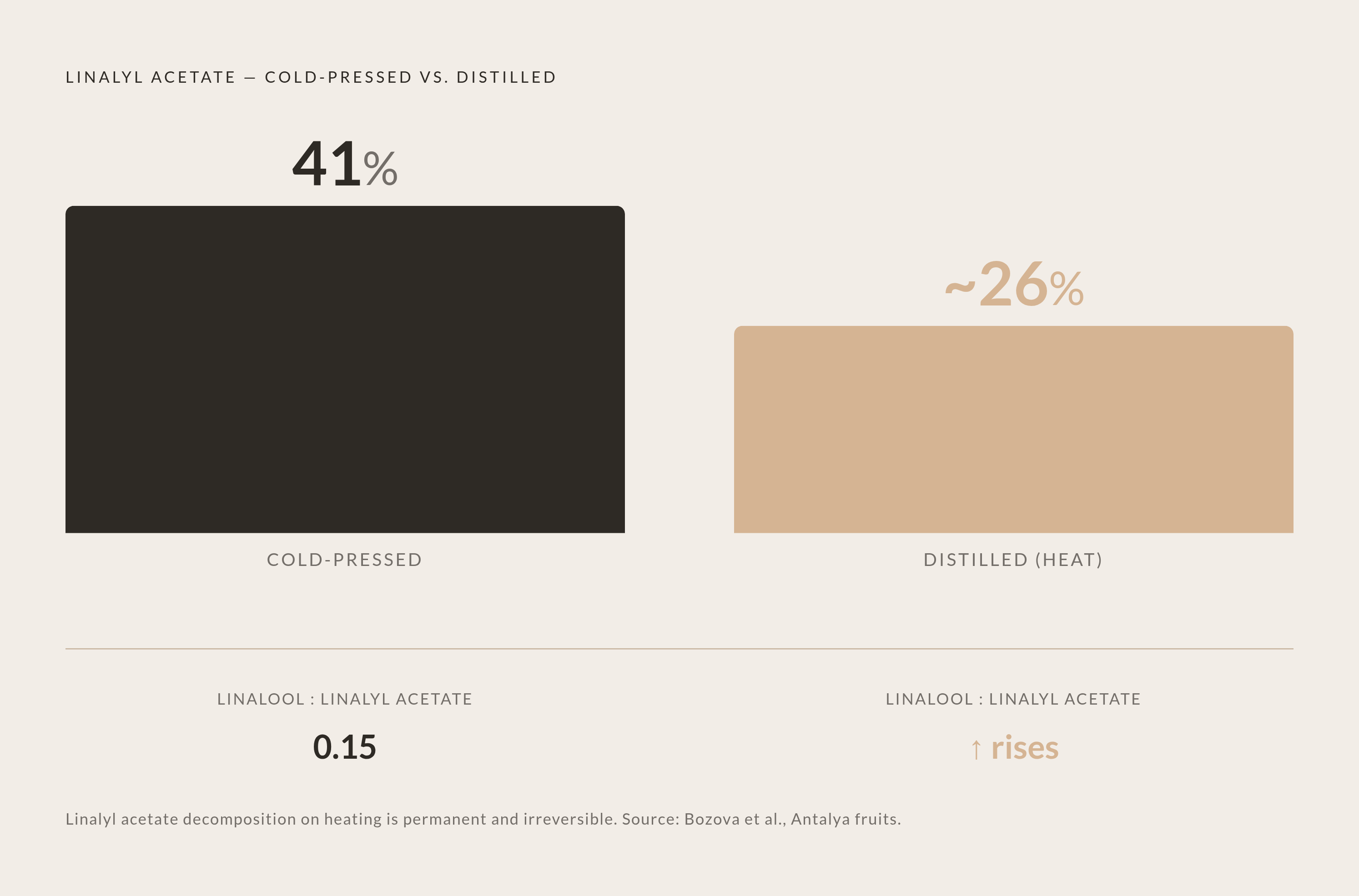
Take the same bergamot, split the batch, run half through cold-pressing and half through hydrodistillation, and compare the two. The linalyl acetate content in the distilled version drops by roughly three-quarters compared to the cold-pressed oil from that same fruit, the defining compound of the entire fruit stripped out at scale. That's a substantial, systematic loss. That's the defining compound of the entire fruit getting stripped out at scale.
Why does heat do this? Hydrodistillation causes linalyl acetate to decompose outright, and it pushes linalool, a related compound, into an altered isomeric form. So this isn't simply "less of the good stuff survives." The good stuff is chemically converted into something else. One useful way researchers track this is through the ratio of linalool to linalyl acetate: in cold-pressed oil that ratio is a low 0.15, meaning linalyl acetate dominates and linalool stays a minor supporting player. Distillation pushes that ratio up, because as linalyl acetate breaks down, the balance of what's left shifts toward linalool by default. Steam exposure during distillation also just burns off a meaningful share of volatile intensity generally, on top of the specific decomposition happening to linalyl acetate.
None of this reverses. Once linalyl acetate has decomposed or isomerized under heat, there's no reformulation step that puts the original ratio back together. The chemical identity of the oil has changed, permanently, at the moment the heat was applied. That's a real trade-off for producers to weigh, since distillation is generally faster and less capital-intensive than mechanical cold-pressing. But it is a trade-off, and now you know exactly what's being traded away. In the distillation composition reported by Bozova et al. for Antalya fruits, limonene and linalool appeared at varying levels while linalyl acetate ranged from 20.84–26.73%, a ceiling that falls well below the 41% achievable in cold-pressed oil.
Linalyl acetate's role in a finished fragrance
So why fight this hard to protect one compound? Because linalyl acetate isn't just an ingredient sitting in the top notes, it's structural. It works as a bridge, softening the fragrance and carrying it from its bright, zesty opening into deeper floral or woody layers underneath. Removing that bridge costs a composition its architecture rather than a decoration.
That's why bergamot shows up in more than half of all luxury fragrances. A bergamot oil that's lost its linalyl acetate to heat doesn't do that handoff. It reads as flat, sharp citrus with nowhere left to go, rather than the layered, luminous opening the fruit is famous for. Compare that against a limonene-heavy distilled oil, which tends to smell sharper and more one-note, and fades faster because limonene is highly volatile and offers nothing resembling a soft landing into the fragrance's middle notes. Higher linalyl acetate retention also buys something practical: better long-term stability and a more predictable scent from batch to batch, which matters enormously to anyone building a home fragrance routine around a specific oil rather than restarting their preferences every time a new bottle arrives.
All of which raises a fair question. If this compound's survival depends on the extraction method, does the delivery method in someone's living room matter just as much?
Why cold-air diffusion keeps cold-pressed chemistry intact
It does, and the logic runs in a straight line from the extractor to the diffuser. Cold-pressing protects linalyl acetate by keeping heat out of the process. Cold-air diffusion extends that exact same principle into the home, dispersing fragrance without heat, without water, and without combustion.
Cold-air, or nebulizing, diffusers work by pushing filtered, pressurized air through the fragrance oil, breaking it into an ultra-fine dry mist with no dilution and no thermal contact anywhere in the process. The oil's chemical makeup, note by note, comes through the dispersion intact. Compare that to the alternatives. Ultrasonic diffusers dilute the oil in water before dispersing it into the air. Heat diffusers and candles apply thermal energy directly to the oil, the same variable that just spent two sections wrecking linalyl acetate during distillation. Either way, whatever careful balance of linalyl acetate and linalool the cold-press process worked to preserve gets disturbed right at the point of delivery, which is a strange place to lose quality after going to such trouble upstream to protect it.
Cold-air diffusers also cover meaningfully larger spaces than candles, reed diffusers, or ultrasonic units, without diluting or heating the oil to get there. Whatever formulation left the extractor is the formulation that actually reaches the room. There's a practical side benefit too: unlike ultrasonic devices, cold-air diffusers introduce no added humidity into the space, which matters in a room with hardwood floors, electronics, or anything on the wall that doesn't love moisture. And more fragrance isn't automatically better. Programmable scheduling lets someone dial in intensity and runtime rather than flooding a room, which is less about restraint for its own sake and more about matching output to the space so the atmosphere stays balanced instead of overwhelming.
The bergapten caveat: what FCF processing means for home and pet safety
Cold-pressing has one complication that matters, not as a warning label but as the second half of doing this properly. Because the process is purely mechanical, it captures the oil's full non-volatile fraction too, and that fraction includes coumarins and furanocoumarins, specifically bergapten and bergamottin.
Bergapten is photosensitizing. Get it on skin and then out into the sun, and it can trigger a reaction. It has to be removed before the oil goes into skincare, and fine fragrance regulation caps bergamot oil at a maximum of 0.4% under IFRA guidelines. The fix is a second processing step, not a different extraction method: fractional vacuum distillation performed after the cold-press stage removes the bergapten, producing what's known as Bergamot FCF, furanocoumarin-free, which has become the standard form used across home fragrance and personal care. For diffusion specifically, that means getting all of the linalyl acetate-driven character the fruit is known for, minus the one compound that has no business being aerosolized into a living room.
A broader safety layer applies here too. Phthalates, a class of chemical sometimes used to stretch or stabilize synthetic fragrance oils, are endocrine disruptors, and pets, given their smaller body mass, are affected at meaningfully lower doses than adult humans. Choosing fragrance oils that disclose their formulation clearly, phthalate-free and FCF-processed, is the baseline for what counts as genuinely clean home fragrance, not an upsell.
Reading a bergamot fragrance oil for quality before buying
All of this adds up to something usable at the point of purchase. A handful of concrete things separate an oil built on genuine cold-pressed bergamot from one that isn't.
Source transparency matters first: look for a stated Calabrian origin, or at minimum some credible third-party sourcing. Process disclosure matters just as much: the label or product page should say cold-press extraction outright, not gesture at "natural" or "premium" without naming the method. FCF or furanocoumarin-free status should be confirmed explicitly for anything meant for home diffusion, and a phthalate-free formulation is the clean-fragrance floor for both human and pet safety in the space. Batch consistency is the tell that ties it all together: because linalyl acetate preservation is what keeps the scent stable, an oil that smells slightly different bottle to bottle is quietly telling you its inputs were distilled or heat-processed somewhere along the way, whether or not the label admits it.
Compatibility with the diffuser matters too. An oil built on real cold-pressed bergamot is designed to perform at room temperature in a cold-air nebulizing diffuser, no heat, no dilution, full floral-citrus character delivered as-is. One example is Aura House, a non-toxic home fragrance brand whose oils are built on that same cold-pressed foundation and paired with cold-air diffusion rather than working against it, and that combination, quality oil plus a diffuser that doesn't undo the oil's chemistry, is a matched pair rather than two separate purchases. Room size matters here as a calibration question, not a quality one: bergamot's aromatic intensity means the right setting fills a space rather than overwhelms it, and dialing that in is as much a part of getting this right as the oil itself. A bergamot oil that smells flat, harshly citric with none of that floral give, or noticeably different from one bottle to the next, means the linalyl acetate didn't survive the trip from rind to bottle. Understanding why turns an informed purchase into something other than an expensive guess.
Sources
- Green Recovery of Bioactive Compounds from Bergamot (Citrus bergamia) By-Products: Sustainable Extraction, Food Applications, and Health-Promoting Properties - PMC
- The effect of different hydrodistillation times on the composition and yield of bergamot (Citrus bergamia Risso) peel essential oil and a comparison of the cold‐pressing method - Bozova - 2024 - Flavour and Fragrance Journal - Wiley Online Library
- Recent advances in the development of bergamot (Citrus bergamia Risso) essential oil: From extraction, chemical composition, function to potential applications - ScienceDirect
- Bergamot in Perfume 2026: The Italian Citrus That Opens Every Fragrance
- Linalyl Acetate - an overview | ScienceDirect Topics
- (PDF) The effect of different hydrodistillation times on the composition and yield of bergamot ( Citrus bergamia Risso) peel essential oil and a comparison of the cold‐pressing method