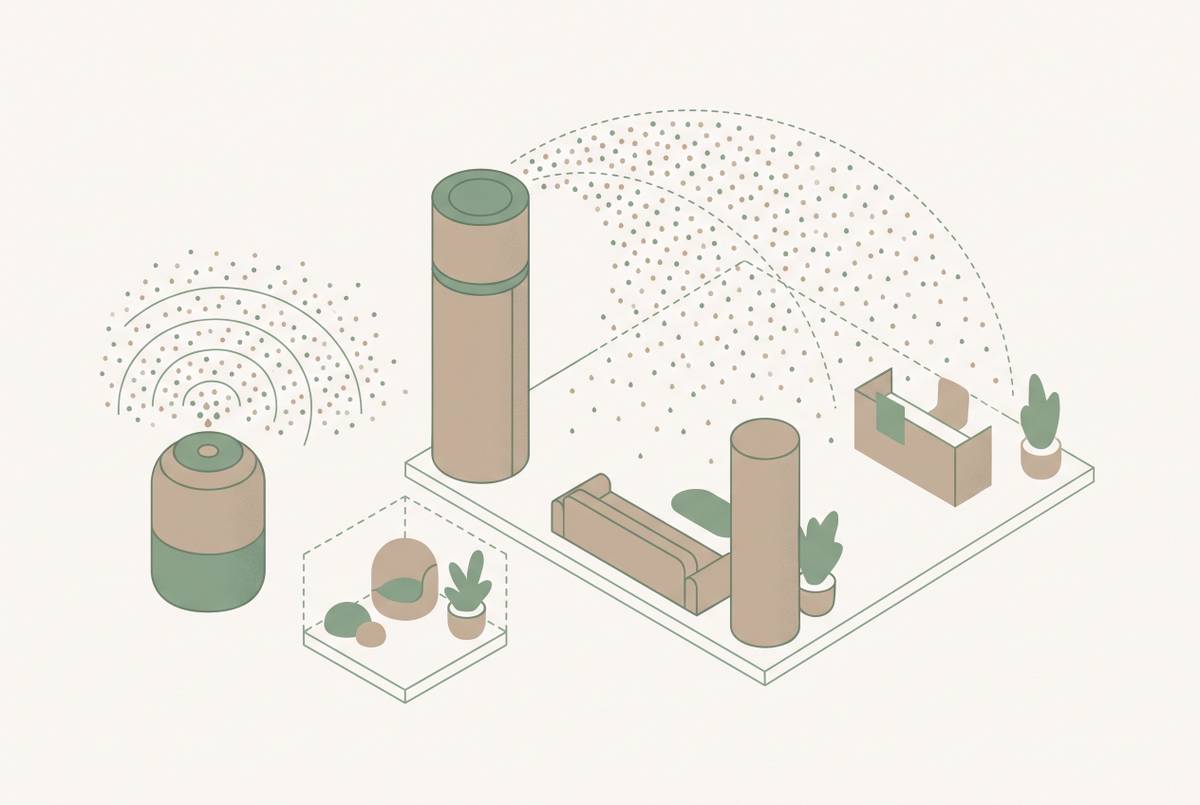
Home Luxury Scents Delivered by Diffuser vs. Other Formats
Cold air diffusers beat other formats for consistent luxury scent throughout your home.
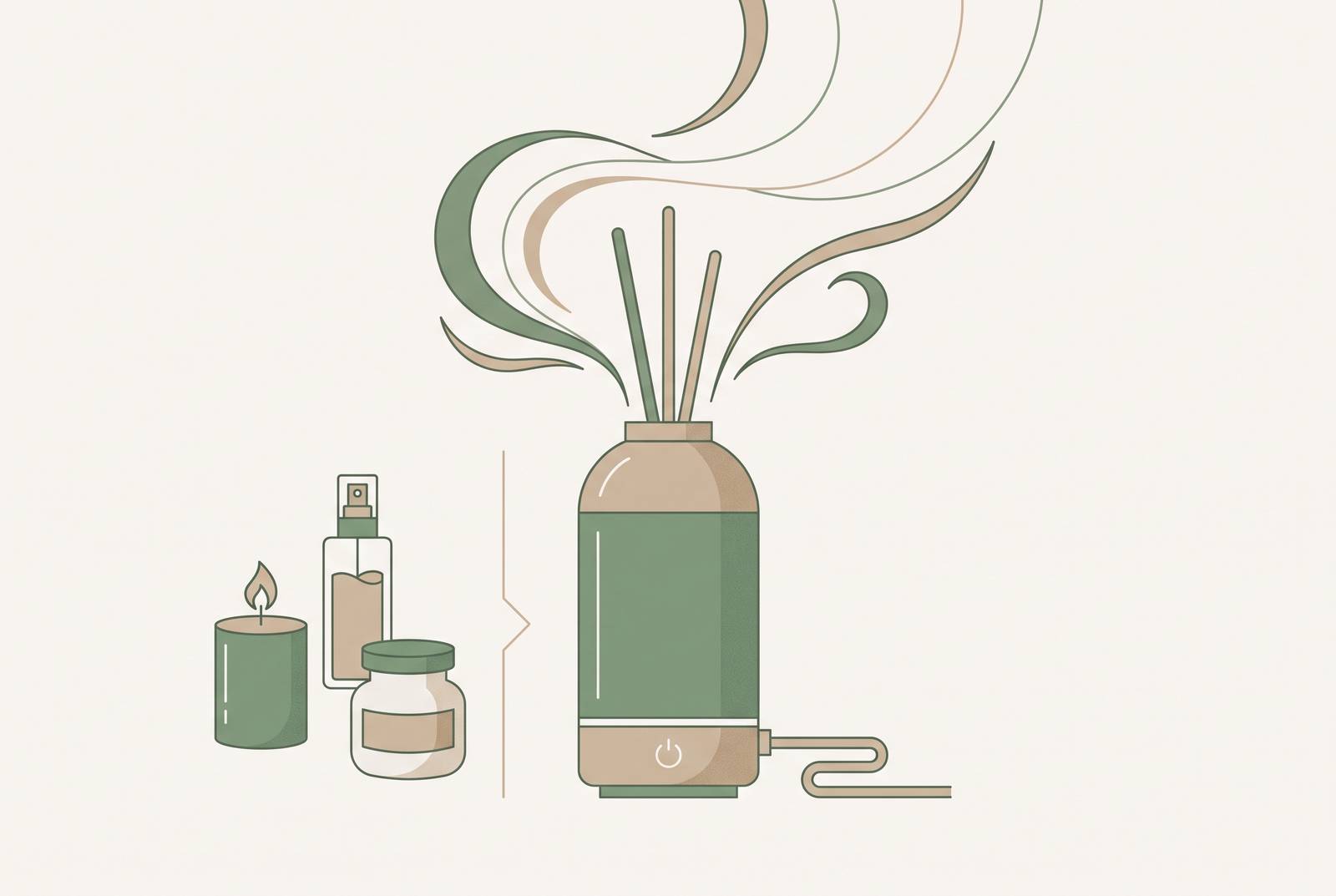
Recreating a luxury hotel scent experience at home depends on delivery as much as fragrance. A cold air diffuser sized for the space is the strongest fit for consistent, faithful scent across large rooms, while reeds, sprays, wax melts, and candles serve more limited purposes. The choice depends on how well the scent fills each room, how it smells, how safe it is, and how much care it needs.
Why the format you choose determines the scent experience you get
A familiar format is not necessarily a suitable one. Homeowners often choose candles, reeds, or sprays out of habit, as though the way they deliver scent were just packaging for the fragrance. Yet each works through a different physical process, and that process determines how the scent reaches the room. Depending on the physical process, the fragrance stays steady, changes as it is released, or needs repeated attention.
The oil alone cannot settle the choice. The same fragrance behaves differently when nebulized on compressed air, heated, diluted in water, or left to evaporate. A pleasant smell near a vessel therefore says little about how that product will perform across an open-plan living space. Thinking of scent as part of an interior, rather than simply an air-care purchase, changes the question from “Does this smell good?” to “What experience will this format produce here?”
How cold air diffusion works and what sets it apart from every other delivery method
Cold air diffusion uses compressed air to atomize fragrance oil into a micro-fine dry mist. It introduces no heat, water, or open flame. Among the formats compared here, that combination distinguishes its mechanism from evaporation, spraying, and heat-driven release. Mechanical compression can handle high-viscosity oils, releasing top, middle, and base notes together rather than selectively driving off the more volatile components.
The mist’s physical behavior explains its wider reach. The mist’s particles are light enough to stay in the air without settling on surfaces, so the scent spreads through large or open-plan spaces. The unheated process preserves the fragrance’s composition and the balance of its notes.
Because it works without water, it also avoids the problems a water tank can bring, such as added humidity, mineral residue, and mold or bacteria growing in standing water. Control is the other important distinction here. Smart scheduling and adjustable intensity let homeowners choose when it runs and how much scent it puts out in each room, and use timed cycling to limit scent fatigue. The resulting baseline for comparison is a format that can deliver the intended scent steadily and cleanly, with control over when and how strongly it runs.
What reed diffusers actually deliver and where they fall short
Reed diffusers work through passive evaporation. Reeds absorb oil from a vessel and release it slowly into the surrounding air, without electricity or a flame. Their appeal is easy to understand. They provide low-level fragrance, a clean visual presence, and no powered device to maintain. In a small, enclosed bathroom or entryway, that modest reach can be entirely appropriate.
The limitation is that the room controls evaporation. Ambient temperature, airflow, and reed saturation govern output. In a larger room, the scent stays close to the vessel. Adding more vessels can compensate for limited reach, but it also adds cost and visual clutter.
Output also changes over the bottle’s life. Scent throw weakens as reeds become oversaturated or the oil level falls too low for them to reach, so week one can feel quite different from week eight. Reeds have no built-in intensity setting or schedule to keep the scent steady as that happens.
What room sprays deliver and where the burst-and-fade cycle fails a consistent scent experience
Room sprays deliver fragrance immediately by dispersing aerosolized particles into the air. That speed is their legitimate advantage. A spray can refresh a room before guests arrive, address an isolated odor, or add a different note without changing the primary scent system.
The same mechanism produces a “burst and fade” cycle. Scent peaks after spraying, then dissipates, leaving the homeowner to repeat the process whenever the effect weakens. Keeping the scent steady takes repeated spraying, even with a longer-lasting fragrance. Spray particles also settle on floors and upholstery, so children and pets may come into contact with them on those surfaces. As a supplement, the format is useful, but its intermittent delivery prevents it from acting as a steady whole-home system.
How wax melts and heated diffusers distort the scent they are meant to deliver
Wax melts and heated diffusers release fragrance by warming a scented medium. Heat does more than help scent escape. It changes the material being released, and at high temperatures it destroys volatile compounds responsible for the fragrance’s top notes. The scent in the room can therefore be heavier and less true to the original composition.
Wax melts also lose strength as their fragrance load is depleted. The same cube can smell stronger on day one than on day three, so an unchanged setup does not mean unchanged output. The scent changes much as it does with passive evaporation, though the process that causes it is different. A warmer keeps providing heat, but it cannot replenish fragrance that the wax has already released.
A wax warmer adds an electrical appliance or, when heated by a tea light, an open flame beneath the dish. Heated plug-ins at outlet height can also present a direct-contact risk to crawling infants and low-to-the-ground pets. These risks call for care over where these widely used products go and whether they suit the home, without making the products a cause for alarm in themselves. Their central compromise remains the effect of heat on scent quality.
Where candles genuinely succeed and what they trade away to get there
Candles offer something that a diffuser does not replicate. Lighting one for a bath, dinner, or quiet evening is an act with sensory and ceremonial weight. A candle earns its place through that ritual alone, without having to keep the whole home scented all the time. That is a different job.
The trade-off begins when combustion becomes the delivery system. A burning candle releases combustion byproducts as well as fragrance, and conventional paraffin wax is a petroleum derivative whose combustion produces compounds that affect indoor air quality. Burning candles often in enclosed rooms can leave soot on walls, surfaces above them, and HVAC filters. The atmosphere has a physical cost as well as an emotional appeal.
Performance also depends on how the candle burns. Tunneling or under-wicking can create a shallow or narrow melt pool that weakens fragrance throw, while an untrimmed or oversized wick also changes the scent experience. Output consequently varies across the candle’s life. The open flame adds constraints in homes where unsupervised use is a concern, where interior materials conflict with flame use, or where birds face acute respiratory risks from combustion byproducts. Even apart from those concerns, a candle creates a localized scent zone rather than even coverage across a large room, leaving both distance and burn condition to shape the experience.
How do you make your house smell like a five-star hotel all the time?
A home that smells consistent from the entryway to the living room and upstairs hallway feels different from one with isolated sources of fragrance. A stronger scent beside a candle or reed vessel does not resolve its absence elsewhere. For a home intended to feel as deliberately composed as its visual design, those changes between spaces interrupt the effect.
These interruptions are “scent gaps,” where localized delivery leaves parts of a large or open-plan home without fragrance. They differ from “scent pockets,” which are accumulations in stagnant corners that diffuser placement should avoid. The task is to distribute it without creating an overpowering area around the source.
Luxury hotels create their signature scent with cold air diffusion systems made to run for hours with little care and without leaving residue. Systems made for homes deliver scent in the same way, including in open-concept spaces. The relevant product recommendation is therefore a cold air diffuser with coverage suited to the actual room. Programmable operation then aligns scent delivery with occupied hours and pauses it when the home is empty. In this context, “all the time” means a dependable experience when it is wanted, with pauses to limit oil consumption and olfactory fatigue.
Safety as a format decision, not just a fragrance decision
A fragrance label tells only part of the safety story. Combustion, heat, airborne dispersion, and surface deposition create different exposure conditions, even before the oil’s formulation is considered. An open flame is not equivalent to a warm plug-in, and neither presents the same practical questions as a vessel of reeds or a waterless diffuser. Who lives in the home affects which of those differences needs the most care.
Cats lack a liver enzyme needed to metabolize certain aromatic compounds, leaving them more vulnerable to a wider range of scented products than dogs. Birds are especially sensitive to combustion byproducts, so burning candles can pose an acute risk to their breathing, beyond whether they like the scent. Diffused essential oils can also be toxic to cats and dogs. Avoiding combustion does not make every formulation suitable.
Cold air diffusion does away with hazards from open flames, heated surfaces, and tanks of standing water. Its airborne dry mist also avoids the surface-settling behavior described for room sprays. Those differences are meaningful in homes with young children or pets, but they are not a blanket safety guarantee. A transparently labelled oil and an appropriate delivery format answer separate questions. Safety depends on their combination and on examining products labelled “essential oil” or “waterless”.
Matching format to room, purpose, and lifestyle rather than treating every space the same
Room size, occupancy pattern, household composition, and the need for continuous or occasional scent establish the criteria. A main living space that needs steady background fragrance has different needs from a bathroom that needs only a light scent within it. The format should follow that distinction.
For large rooms and open-plan living areas, choose cold air diffusion when coverage, scent accuracy, and low maintenance are the priorities. Sizing is a separate decision from format. Match the device’s coverage rating to the room’s actual square footage, because an undersized diffuser can produce the same scent-gap problem as a candle. From there, use adjustable intensity to suit the room and scheduling to align operation with occupied hours. Placement should avoid stagnant corners where scent can accumulate.
Smaller spaces can justify a simpler approach. Reed diffusers suit enclosed bathrooms, entryways, and powder rooms where passive evaporation provides enough fragrance without a programmable device. Room sprays fit brief, targeted freshening or a supplementary note in a particular room. Candles retain their role for a bath, dinner, or quiet evening when the ritual itself is wanted and the household permits safe use.