How Long Reed Diffusers Last Compared to Electric Diffusers
Reed and electric diffusers measure lifespan differently based on how each one actually works.
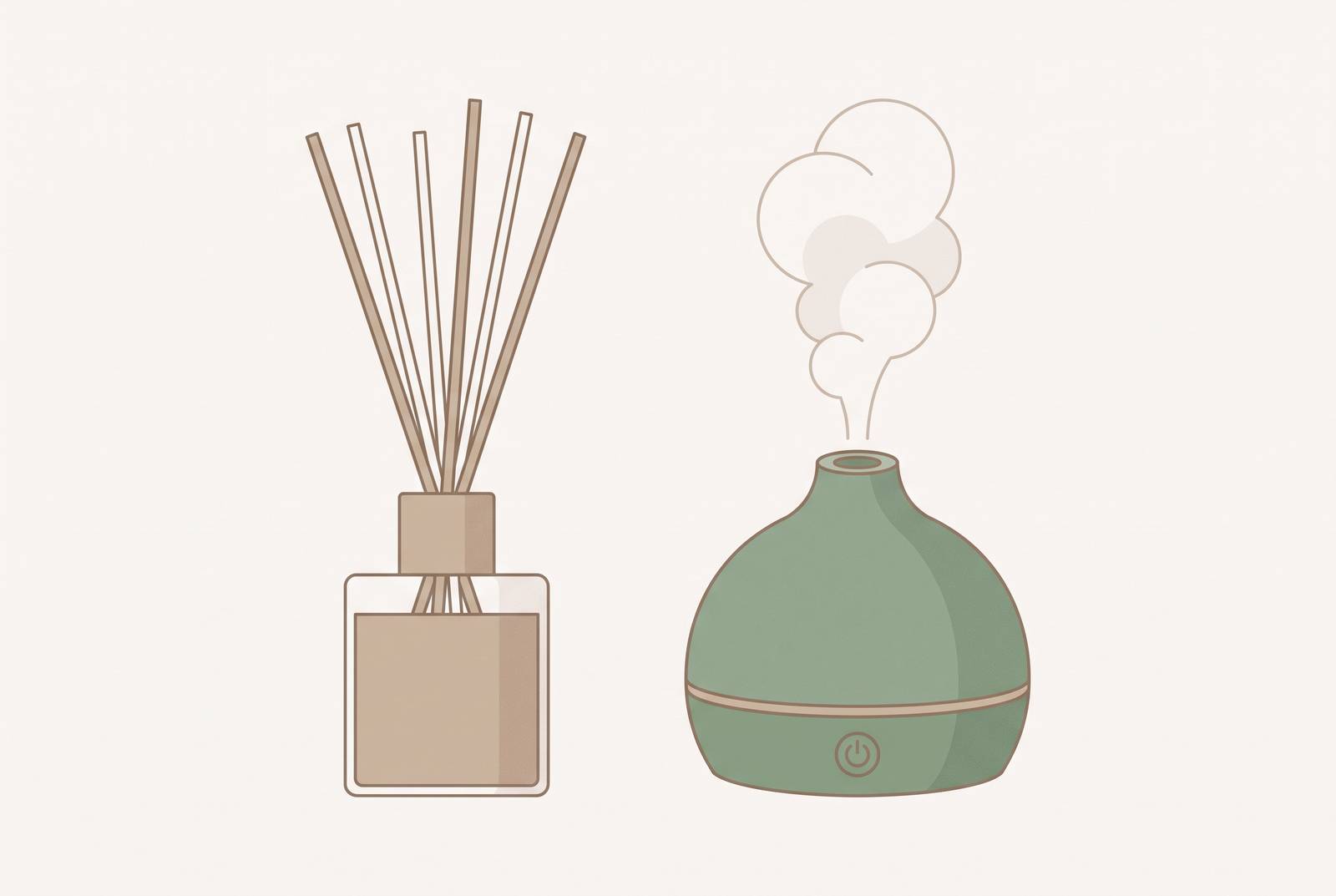
Reed diffusers and electric diffusers both claim to scent a room for weeks on end, but they are not measuring the same thing when they say it. A reed diffuser's lifespan is a count of continuous passive release, oil drawn up a bundle of reeds and evaporated into the air around the clock, whether anyone is home to smell it or not. An electric diffuser's lifespan splits into controllable hours of active sessions and years of hardware that outlasts any single bottle of oil. Comparing the two numbers directly is like comparing a marathon's finish time to a sprinter's top speed: both are real measurements, but neither tells you what you actually need to know, which is how each format behaves in your home.
Reed diffuser and electric diffuser lifespan units
The mechanical difference starts with where the energy comes from. A reed diffuser is entirely passive: a bundle of porous reeds sits in a glass vessel of fragrance oil, and capillary action pulls the liquid upward, where it evaporates into the surrounding air. Nobody turns it on, nobody turns it off, and nobody adjusts it mid-week. The bottle empties at its own pace, on its own schedule, whether the room is occupied or the house is empty for a month.
A cold-air electric diffuser works the opposite way. Nothing continues evaporating in the background. The diffuser sits idle, oil intact, until the next scheduled session begins.
That distinction is why "how long does it last?" needs a follow-up question before it can be answered honestly: last in what sense? A reed diffuser's lifespan is a duration measured in weeks of nonstop, unsupervised release. An electric diffuser's lifespan is really two separate answers: hardware that lasts for years, paired with oil consumption that depends entirely on how often and how intensely someone runs it. Everything in the sections that follow unpacks what those two units actually mean once a diffuser leaves the shelf and enters a real household, with its radiators, its seasons, and its occupants' increasingly numb noses.
How a reed diffuser's lifespan is determined
Three variables lock in a reed diffuser's expected lifespan before it ever sits on a shelf, let alone a console table: oil volume, formulation generation, and reed count. More liquid in the bottle means more weeks of evaporation ahead of it, and the practical range for most reed diffusers runs anywhere from a few weeks to several months depending on how much oil is inside.
Formulation generation is less obvious, and it determines how long the scent lasts and how clean the air stays, because two bottles holding identical volumes of liquid can behave like entirely different products depending on what that liquid is made of. These often last six to nine months or longer, carrying a higher price tag but delivering both the longest lifespan in the category and the cleanest indoor air profile.
Reed count is the one variable the buyer actively controls at setup, and neither choice is a mistake. It is a trade-off the buyer makes deliberately, trading intensity for duration or duration for intensity, depending on what the room calls for. The question "how long will this reed diffuser last? is really the question "what's inside the bottle, and how many reeds did you put in it?" Lifespan is set at checkout, not in the living room.
How heat, airflow, and seasons affect a reed diffuser's lifespan
Once the reed diffuser leaves the shelf and takes up residence on a shelf of its own, the environment takes over as the dominant factor in how fast the oil actually disappears, often overriding whatever advantage a premium formulation bought at purchase. Heat is the single biggest variable in play. A diffuser parked near a sunny window, on top of a radiator, or beside a heating vent evaporates its oil far faster than one tucked into a shaded, temperature-stable corner. Warm oil simply releases faster, so a bottle rated for three months in a cool hallway can run dry well ahead of schedule in a warm one.
Seasonality produces the swings that catch people off guard. Airflow compounds all of it. A drafty room or one with windows opened frequently disperses oil faster than a still one, simply because moving air pulls more vapor off the reeds.
None of this means the buyer is powerless. Capping the bottle and pulling the reeds out before a long trip slows evaporation meaningfully, so oil isn't lost scenting an empty house. Clogged reeds can mute the throw without the oil underneath actually being spent, and a fresh set can restore the scent without adding a drop more liquid.
What this section really demonstrates is that a reed diffuser hands the user a handful of small levers, placement, reed count, flip frequency, but none of them amount to real control. The oil evaporates according to the room's temperature and airflow whether the user intervenes or not. That is the structural ceiling on passive diffusion, and it's the exact gap an active, switch-it-on-when-you-want-it device is built to close.
An electric diffuser's lifespan: hardware and oil
An electric cold-air diffuser doesn't have one lifespan, it has two, and they operate independently of each other. The hardware, the actual device that compresses air and atomizes oil, lasts for years, functioning as a one-time purchase against what then becomes a recurring, ongoing oil cost. Comparing that hardware lifespan to a reed diffuser's weeks-long oil lifespan isn't really a fair fight, because they're not measuring the same kind of thing at all, one is a durable good and the other is a consumable.
The oil is where the real comparison lives, and here the user, not the environment, sets the pace. Output intensity is the second lever: dialing it down extends the oil's life, while running it high covers more square footage at the cost of faster depletion.
Cold-air electric diffusers like those from Aura House operate on this active principle: they disperse fragrance only when switched on, at whatever intensity and schedule the user sets. Their lifespan is better measured in controllable hours of use than in weeks of continuous release. That adjustability is the format's defining structural advantage over both reed diffusers and open-flame options, turning oil consumption into something the user manages. The mechanism behind it also matters for scale: cold-air diffusion uses no heat and no water, breaking oil into dry micro-particles via compressed air, which preserves the oil's integrity and lets the scent travel across a far larger area than passive evaporation ever could, up to 600 square feet of coverage in a single device.
Format strengths by room size and scent throw
The more useful question is which format can actually fill the room it's sitting in. That's a question of scent throw and coverage area, and on that measure, reed diffusers and cold-air electric diffusers are built for genuinely different spaces, not competing versions of the same job.
Reed diffusers are suited to smaller, lower-traffic rooms. The physics that make it ideal for a powder room are the same physics that make it inadequate for a great room.
This directly answers a question a lot of buyers ask after their current diffuser disappoints them: an ultrasonic or passive diffuser barely scenting a living room on its highest setting usually just wasn't built for that room. A cold-air electric diffuser, by contrast, is built for exactly that larger space. With coverage up to 600 square feet and fully adjustable output, it's the more practical choice for open-plan living areas and larger primary bedrooms, the rooms where a reed diffuser's gentle evaporation simply can't keep pace. Scaling a reed diffuser up for a room it wasn't suited to isn't possible.
Placement still matters for both. A reed diffuser performs best somewhere calm, stable, and shaded, letting fragrance drift without a draft or a heat source distorting it. An electric diffuser benefits from sitting at a height that lets its micro-particles disperse through the air before settling; placement low in a room causes output to pool.
The olfactory fatigue problem that passive diffusion creates and active scheduling solves
The reed diffuser's biggest selling point quietly turns into its biggest practical weakness. The same uninterrupted, round-the-clock release that makes a reed diffuser appealing on paper also causes olfactory fatigue, the phenomenon where a constantly present odor trains the brain to stop registering it as a signal worth paying attention to. The diffuser keeps running and the oil keeps depleting, but the person living in that room may no longer be smelling much of anything.
The sensation is familiar enough that most people have lived it without naming it: walk out of a scented room, run an errand, come back in, and the fragrance hits again as if freshly applied, even though nothing about the diffuser changed while you were gone. The nose simply reset itself in your absence. That means the real-world value of a reed diffuser's long oil lifespan is shorter than the number on the bottle suggests. A buyer pays for weeks of continuous scent but, in any room occupied for hours a day, actually perceives a fraction of those weeks before the brain tunes it out.
An electric diffuser's session-based operation, often framed as a limitation next to an always-on reed diffuser, turns out to be the feature that prevents this exact problem. The absence of scent between sessions creates contrast, and that contrast is what keeps the olfactory system responsive each time the diffuser switches back on. Smart cold-air diffusers give homeowners the precision to counteract that kind of fatigue directly, scheduling sessions around the moments scent actually matters, while reed diffusers surrender to environmental conditions once placed and let scent blur into wallpaper. A timer that runs the device only while the household is active uses both the oil and the occupants' attention efficiently.
None of this makes reed diffusers the wrong choice; it narrows where their strength is visible.
Oil formulation and ingredient quality affect both formats' lifespan and safety
Lifespan and safety turn out to be the same conversation wearing two different hats, because the formulation that decides how long a diffuser lasts is also the formulation deciding what it releases into the air for however many weeks or months that lifespan runs.
In reed diffusers, the carrier solvent is doing double duty as both the longevity variable and the air-quality variable. Non-VOC oil diffusers are free from volatile organic compounds, suited to modern, well-sealed interiors, and capable of delivering the lasting, low-risk scent experience of what amounts to the category's current premium generation. Natural essential oils and plant-based carriers tend to hold a more consistent scent over that full span compared with cheaper mass-market blends, which can drift or flatten as the bottle empties.
Electric diffusers raise a related but distinct concern, because the device atomizes oil directly into the air at a higher concentration than passive evaporation ever reaches. Whatever is in the bottle comes out amplified, which makes clean, transparent formulations, free of harsh synthetics, phthalates, and undisclosed additives, more important in an active format than in a passive one. Clearly labeled ingredients give buyers a real basis for deciding what they're comfortable dispersing into a home they and their families breathe in daily.
Choosing the right format for a room, routine, and scent goal
None of this adds up to one format beating the other. It adds up to each format being built for a different room and a different relationship with scent, and the honest answer to "which one should I buy" depends on matching the device to the life it has to fit into.
A reed diffuser makes sense when the room in question is small and sees light, passing traffic, an entryway, a powder room, a hallway, somewhere a background scent greets whoever walks through rather than surrounding someone parked there for hours. It also makes sense for anyone who wants zero daily maintenance: no switch to remember, no schedule to set, just continuous fragrance running in the background with no supervision required. The priority there is a clean, always-present scent that guests register without the household having to think about it, and refilling the same glass vessel with fresh oil and new reeds is both cheaper and less wasteful than replacing the whole diffuser once it runs dry.
A cold-air electric diffuser earns its keep in the opposite set of conditions. And in households with pets or with anyone sensitive to concentrated airborne fragrance, the ability to actively manage output and timing, rather than leaving the room to a bottle's unsupervised evaporation, gives the user more say over exposure than a reed diffuser ever could.
A home with more than one room doesn't have to pick a side. A reed diffuser in the entryway for passive, continuous welcome scent and a cold-air electric diffuser in the main living space for on-demand atmosphere can coexist, each covering the job the other isn't built for. Neither format is objectively better, each does something the other genuinely can't, and the real question a buyer is answering is what the everyday routine actually looks like and how much control over scent they want to hold onto. Whichever format wins out, the oil going into it deserves the same scrutiny as the hardware itself. A clean, clearly labeled formulation makes weeks or months of continuous scent release something worth welcoming into a home.