How to Transition a Pet-Owning Household to Cleaner Home Fragrance
Swapping paraffin candles for plant-based alternatives protects pets from hidden chemical exposure.
Conventional home fragrance is not a neutral backdrop in a household with animals. It functions as an active source of chemical exposure that most owners have never been prompted to evaluate, largely because candles and plug-in diffusers are marketed as ambiance rather than as combustion products or chemical delivery systems. The hazard comes from three sources working at once: the wax base, the wick, and the fragrance formulation itself, each contributing its own exposure pathway rather than one dominant risk owners can address in isolation. Paraffin wax comes from petroleum, and when it burns it releases benzene and toluene, both of which harm a pet's respiratory system. Some inexpensive or older candles still use lead-core wicks, and burning them sends toxic heavy-metal particles into the air that settle on countertops, floors, and fur, exactly the kind of surface a cat or dog investigates with its mouth and tongue. Even candles built from natural ingredients produce smoke, and smoke alone can trigger respiratory distress in an animal with an existing condition such as asthma.
Dogs, cats, birds, and small mammals face different levels of risk from the same airborne irritants. Dogs tend to show the most visible symptoms: sneezing, coughing, watery eyes, vomiting, or diarrhea, with brachycephalic breeds such as Bulldogs and Pugs facing sharper risk because their airways are already compromised by the shape of their skulls. Cats face a layered problem. Cats inhale the same airborne irritants dogs do, but they also groom, so they lick residue off their fur that landed there from the air hours earlier. Birds represent the most severe case on this list. Airborne toxins from scented candles can cause respiratory failure or death in birds, which makes this less a matter of caution and more a hard boundary for any household that keeps them. Small mammals like guinea pigs, hamsters, and rabbits sit closer to birds than to dogs on this spectrum, because their respiratory systems are highly sensitive and react poorly to candle smoke in enclosed rooms.
A candle that barely registers to a human can feel overwhelming to a dog sleeping six feet away. Pets have a far more heightened sense of smell than humans. The fragrance concentration a person finds pleasant lands at a functionally higher dose for the animal sharing the room. That mismatch, not any single toxic ingredient, is the quiet design flaw running underneath conventional home fragrance: it is produced by formulating scent for human noses while pets absorb it at a functionally higher dose, and the fix has to start with understanding what's burning, what's wicking, and what's being inhaled, not just with swapping one candle for a different candle.
The ingredient-level picture: which specific scents and compounds to remove first
Not every fragrance ingredient carries equal risk, so the first move isn't a total overhaul of the house but a targeted audit of what's already sitting on the shelf. Start with the oils that are flatly dangerous to dogs no matter how they're delivered: tea tree, pine, eucalyptus, peppermint, and cinnamon. These should come out of candles, sprays, and diffusers alike in any space a dog occupies, regardless of how naturally derived or expensive the product claims to be. The delivery method doesn't neutralize the oil. A tea tree candle and a tea tree diffuser blend run into the same problem, just through different mechanics.
On the other side of the ledger, some oils have a reasonable track record with dogs when used properly and with real ventilation. Master aromatherapist Kristen Leigh Bell cites rose, jasmine, lavender, cedar, frankincense, and lemon as beneficial or well tolerated, with lavender in particular associated with relaxation and stress reduction in dogs. That is a genuinely useful shortlist for owners trying to rebuild a fragrance routine from scratch, but it's a starting point, not a safety certificate. Even a well-tolerated oil still needs airflow and a sensible concentration, and "well tolerated" was never meant to mean "unlimited."
The list gets counterintuitive. Citrus scents feel clean, bright, and natural, and that can make them seem like the obvious safe choice. For cats, citrus oils sit in the same problem category as many of the dog-unsafe oils above, and that gap between how a scent reads to a human nose and how an animal's body processes it is exactly the kind of blind spot this entire transition is meant to close. An owner who clears every candle with tea tree or eucalyptus but reaches for a lemon-scented diffuser oil because it felt like the safe swap has not actually solved the problem for the cat in the room.
Before you bring any new product into the house, check the existing shelf in three parts. Check the wax first: if the label doesn't specify soy, beeswax, coconut, or another plant-based wax, assume it's paraffin. Look at the wick: an older or cheaper candle without a lead-free label should be taken seriously rather than excused because the candle smells fine. Look at the fragrance disclosure: a label that lists "fragrance" as a single undifferentiated ingredient, with no breakdown of what it actually contains, deserves suspicion.
What "cleaner fragrance" means as a formulation standard
"Clean" has drifted from a marketing adjective toward something closer to an actual formulation standard, shaped by regulatory pressure and a buying public that increasingly wants to know what's in the bottle. So pet owners get something sturdier to shop by than a label's own adjectives. Independent ingredient-disclosure frameworks have pushed brands to disclose more, so if a product can't name its own fragrance components, it has flagged itself. If a brand won't say what's inside, that silence is information.
The wax criteria that separate a cleaner product from a conventional one are fairly concrete. Soy wax, beeswax, and other vegetable-based waxes burn cleaner than paraffin and are far less likely to release the same harmful byproducts, which makes plant-based wax the baseline material requirement for anything replacing a paraffin candle, not an upgrade reserved for premium products. But the wax is only half the equation. A candle built on clean wax can still carry synthetic fragrance additives, so the wax and the scent formulation both need to clear the same bar.
On the fragrance side, you should treat phthalate-free formulation as a floor, not a feature. Synthetic fragrance blends introduce phthalates and parabens with documented toxicity concerns for animals, so their absence is a baseline expectation, not a selling point. Dye-free or minimal-dye formulations cut one more variable of chemical exposure. Vegan and cruelty-free certifications don't guarantee pet safety on their own, but they tend to correlate with brands that audit their full ingredient chain more carefully, so they work as a reasonable proxy even if not a guarantee.
This is where the lavender example from the previous section earns a second look, because it demonstrates why formulation transparency protects against the gap between an ingredient's reputation and its actual effect on a given animal. Essential oils such as lavender and chamomile are generally considered safer for dogs in moderation, yet lavender essential oil is considered toxic to cats by the ASPCA and most major veterinary authorities. The same oil, in the same bottle, can be reasonably safe for one animal in the house and genuinely hazardous for another. A label that simply says "lavender, calming" tells an owner nothing about concentration, purity, or what else is blended in. What separates a credible clean oil from one borrowing the word "clean" as marketing language is whether the owner can find out what's in that bottle before it goes anywhere near a diffuser. That standard, knowing precisely what's being dispersed into the air, is the same filter that carries into the next question: which delivery method does the least additional damage once a transparent, well-formulated oil is chosen?
How cold-air diffusion resolves the core hazards of candles and water-based diffusers
Cold-air diffusion addresses the three hazard vectors identified earlier by removing them rather than relocating them: combustion, heat-altered compounds, and standing water. A specialized atomizer breaks fragrance oil into microscopic particles and pushes them into the air on a stream of cool air, with no flame, no heating element, and no water reservoir involved anywhere in the process. Because no heat touches the oil, the aromatic compounds stay chemically intact, so the scent reaching the room reflects the actual formulation. The resulting mist is dry and stays suspended in the air longer than vapor produced by heat, which tends to translate into more even coverage across a room than a concentrated cloud near one corner.
For a pet household, each of those mechanical differences maps onto one of the earlier hazards. No combustion means no benzene, no toluene, and no soot entering the air, closing off the exposure pathway that paraffin candles create. The dry, residue-free mist also avoids coating surfaces in an oily film that a pet could later pick up through grooming, which matters most for cats given how much of their exposure risk comes from licking. And because the system runs without water, it sidesteps a problem specific to water-based diffusers: standing water in a tank is an invitation for bacteria growth, mold, and mineral buildup from hard water, all of which quietly degrade air quality the longer the reservoir goes uncleaned.
An efficiency argument also matters for keeping exposure as low as possible while still using fragrance. Finer particles travel farther and stay airborne longer, so you can cover a room with meaningfully less oil than a heat-based method would need, and less oil means less cumulative exposure for the animal sharing that space. Scheduling features let you set diffusion intervals, so you can cut fragrance output during the hours a pet is resting or confined to a room with limited ventilation.
None of this, though, licenses an owner to stop reading labels. Cold-air diffusion still disperses oil in concentrated form, and a pet-toxic oil like eucalyptus or tea tree run through a cold-air diffuser is still a pet-toxic oil, just distributed more efficiently. The technology solves the delivery problem. It does nothing to solve the formulation problem covered two sections back, and treating a diffuser upgrade as a substitute for the ingredient screen is how a well-intentioned switch still ends up harming the animal it was meant to protect. Clean delivery and clean formulation both have to be in place together. Neither one covers for the other.
Auditing and transitioning each room based on how pets use it
A pet-safe fragrance transition works best if you organize it room by room instead of treating it as one household-wide swap, because animals don't experience a home as one undifferentiated space. Risk level, ventilation, and the right diffuser setup all shift depending on how much time a pet spends in a given room and what that room is used for. Start with a full walkthrough: every candle built on paraffin wax, every wick without lead-free labeling, and every product listing undisclosed synthetic fragrance should come out of the house before any replacement goes in, instead of sitting alongside the new products in some transitional overlap. While walking through, flag which rooms a pet is confined to or sleeps in regularly: those spaces warrant the strictest replacement standards and the most conservative diffusion settings in the entire house.
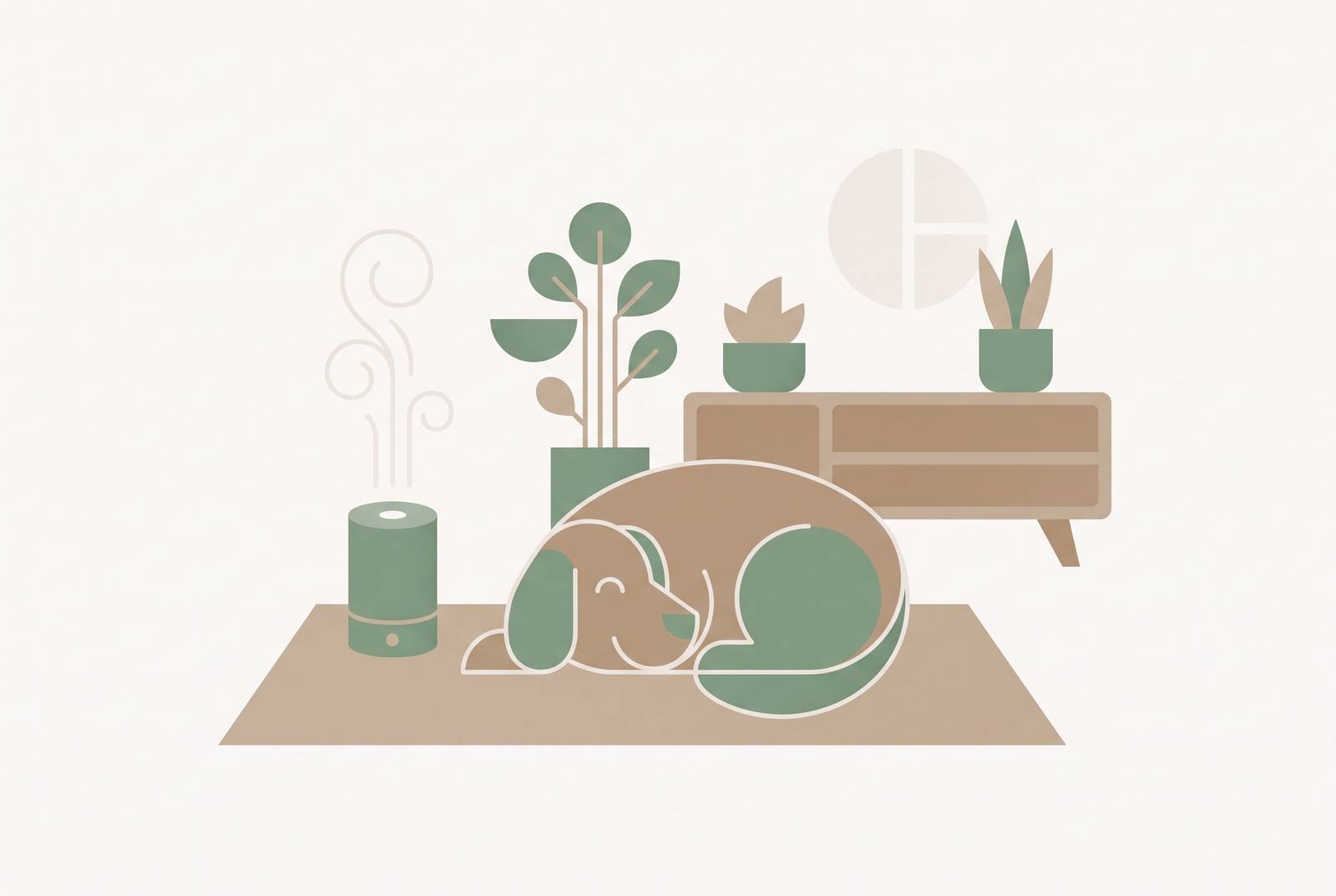
Sleeping areas and any room where a pet spends concentrated, unsupervised time deserve the highest priority in that sequence. Open flame has no place in these rooms under any circumstance, a rule that holds regardless of how naturally the candle is formulated, since the issue was never only about ingredients but about combustion itself happening near an animal that can't leave the room or open a window. If a diffuser is used in one of these spaces, its coverage rating should match the room's actual square footage rather than running a device built for a large living area inside a small bedroom or crate room, a mismatch that concentrates oil in the air well beyond what the space can safely absorb. The intensity setting matters just as much as the oil itself: the lowest effective setting is the right target, since more fragrance was never the goal, a balanced, barely-there atmosphere is. That same logic, start at the highest-risk rooms and work outward with increasingly flexible standards as ventilation improves and pet access decreases, is what turns everything covered in the sections above into an actual sequence of decisions rather than a pile of facts to keep in mind while shopping.
Sources
- Toxicological evaluation of volatile organic compounds emitted from scented candles: in silico ADMET profiling, oxidative stress, inflammation, and lung injury in rats
- The impact of perfumes and cosmetic products on human health: a narrative review
- Editorial: Emerging challenges in companion animal toxicology
- Essential Oils Safe for Dogs: 7 To Use and 12 To Avoid
- Are candles bad for you? What to know about air quality risks