How to Pick the Right Diffuser for a 300 Square Foot Bedroom
Pick a diffuser rated for twice your bedroom's square footage to dial scent intensity down.
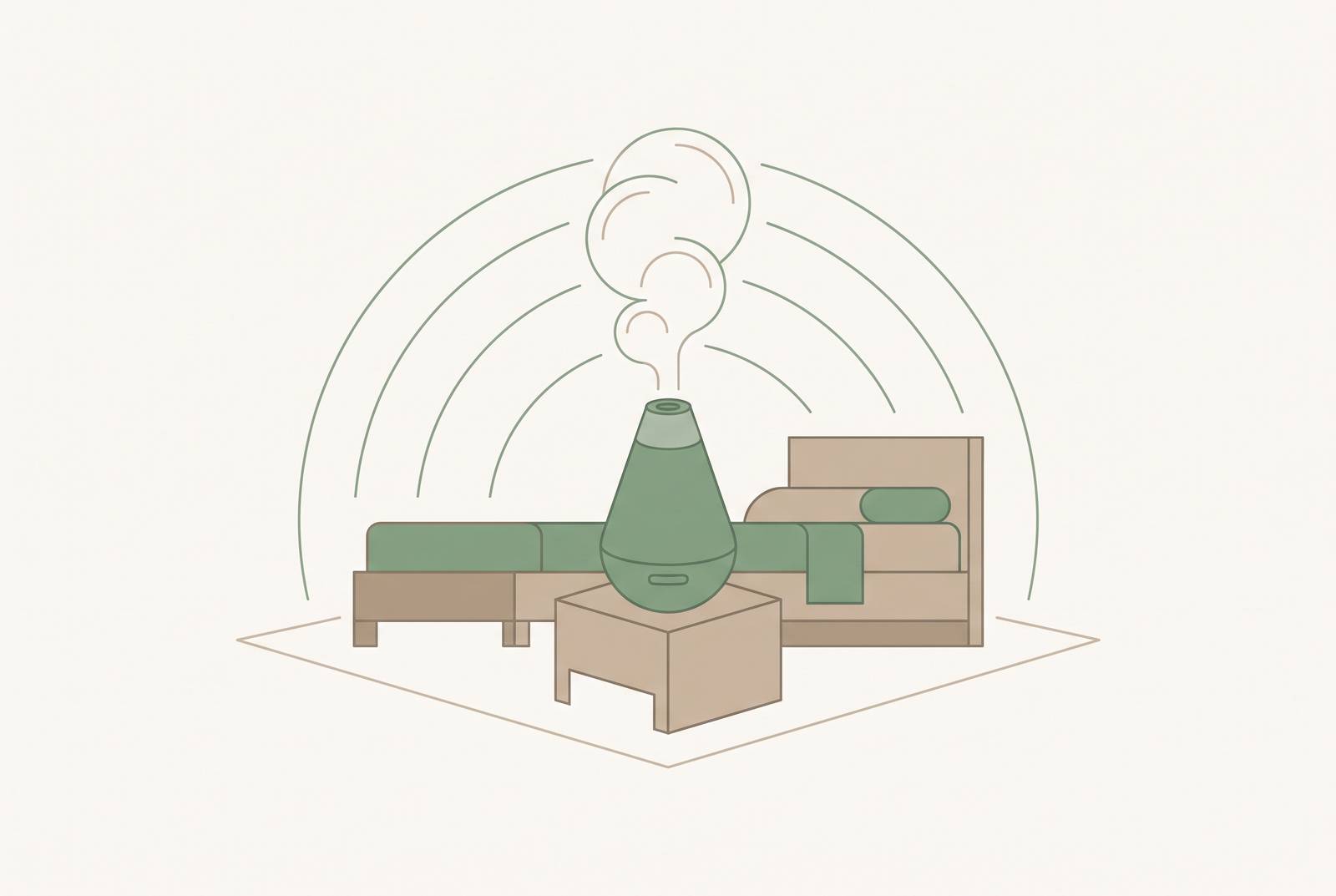
For a 300 square foot bedroom, choose a diffuser with enough rated coverage to scent the room at moderate output. A waterless cold-air unit rated for up to 600 sq ft provides that headroom, but capacity alone is not enough. The right choice matches four factors together, which are coverage capacity, diffusion technology, safety profile, and placement.
Why a 300 sq ft bedroom is a harder scenting problem than it looks
The bedroom is the home’s most intimate, highest-exposure scenting space. People spend eight or more hours there, often with pets, while the room is enclosed and its occupants are asleep. Fragrance therefore interacts with sleep quality, morning mood, and overnight air quality. A pleasant first impression is not enough. The room needs to feel comfortable even after hours of breathing in the scent.
How much power does this footprint actually need, what happens to fragrance in enclosed air overnight, and are the oil and delivery method appropriate for everyone sleeping there? General tips on making a room smell good leave those questions unanswered. Coverage, technology, safety, and placement provide a practical framework because each limits what the others can achieve. A powerful diffuser beside a pillow, for example, solves the wrong problem rather efficiently.
What size diffuser do you need for a 300 sq ft bedroom, and how should you read coverage ratings?
A diffuser’s rated coverage shows how far it can reach under ideal conditions, but its performance can vary from bedroom to bedroom. The height of the ceiling, soft furnishings, and where the doors and windows are can limit how far its mist travels. The floor plan is only the starting point. A unit whose maximum rating barely covers the room has little room for adjustment when the space differs from the conditions behind that rating.
Hotel Collection gives its Studio model a coverage rating of up to 600 sq ft. That puts a 300 sq ft bedroom within the lower half of the area it is rated to cover, so the intensity can be turned down without relying on full output. This model illustrates a sizing rule that also applies to other models. For this footprint, look for coverage headroom and the ability to use it gently. Extra capacity provides control over scent intensity.
A diffuser that needs maximum output to cover 300 sq ft can cycle fragrance unevenly and consume oil faster than one covering the same space at a moderate setting. Rated reach also says little about how long the machine must operate to achieve it. An ultrasonic unit may maintain scent across this room only by running continuously near its center, because its water-diluted output has more limited throw.
The practical test therefore includes output and operating time. Can the diffuser reach the room comfortably at a reduced setting, on a schedule, without needing to run all night? A rating helps narrow the choice, but the machine’s operation must meet those needs.
What diffusion technology does to fragrance quality in a bedroom-sized space
Cold-air diffusion uses pressurized filtered air to atomize pure, undiluted fragrance oil into a dry micro-mist. It uses no heat or water, and the mist stays in the air without water weighing it down. Ultrasonic diffusion instead mixes oil with water and uses vibration to send a mist into the air. The distinction goes beyond how far scent travels. It also changes the fragrance delivered and the upkeep required.
Hotel Collection identifies cold-air diffusion as the technology behind luxury hotel scenting and describes it as preserving the fragrance composition because the oil is neither heated nor diluted. The hotel connection helps explain fragrance consistency. The aim is to retain the oil’s full profile as it disperses. An ultrasonic unit delivers a water-diluted version, which may be perfectly acceptable when a modest scent is the goal.
Water also introduces a separate maintenance burden. Mist can settle on nearby wood furniture, textiles, and linens, while the tank needs frequent emptying and cleaning to address mold risk. Those tasks are especially relevant when the diffuser sits among bedroom furnishings and operates regularly. A waterless unit removes the water tank from that equation. It does not, by itself, settle every question about fragrance safety.
The budget objection is a fair one. Ultrasonic units cost less upfront and can provide adequate scent in a small enclosed room when added humidity and continuous operation are acceptable. Cold-air diffusion has the edge when keeping the fragrance true to the oil, running it at chosen times, and using less oil matter most. Running it during selected periods can use oil more efficiently than keeping an ultrasonic unit on continuously.
Premium cold-air diffusers commonly offer programmable scheduling around sleep and wake times. However, a timer is not the same feature. iScent offers a one-hour auto-off timer for short, deliberate sessions and does not offer programmable scheduling.
Why the safety profile of a bedroom diffuser deserves more scrutiny than in any other room
Technology affects exposure as well as fragrance quality. In a closed bedroom, ventilation is often limited and occupants are less able to notice and respond to discomfort while asleep. Irritating compounds can accumulate during prolonged operation. This calls for a higher standard of care than occasional scenting in a living room. It does not mean that every diffuser is inherently dangerous.
The International Fragrance Association sets guidelines for how much of each ingredient can go into fragrance formulations. IFRA compliance is a useful minimum when assessing an oil, but it is not a government safety certification or a blanket assurance for every household. For the EPA’s Safer Choice certification, every ingredient must meet rules for the safety of human health and the environment. That is a more demanding standard than compliance with formulation guidelines alone.
For a practical purchase, look beyond the broad word “fragrance” for full ingredient disclosure and confirmation that the oil contains no phthalates. Also check whether the reservoir is made without certain plastic additives or is made of glass. “Non-toxic” is not a substitute for those details. Clear formulation information makes it possible to judge the oil rather than trust a reassuring adjective on its packaging.
Cats lack a liver enzyme needed to break down many essential-oil compounds, so breathing them in for hours in an enclosed room is cause for concern. Oils high in compounds such as d-limonene, eucalyptol, menthol, and phenols deserve particular scrutiny. A pleasant botanical name does not establish suitability for every animal, and a scent chosen for human relaxation still needs to be evaluated for the household sharing it.
Ultrasonic mist can settle on fur and be swallowed when an animal grooms, while a cold-air diffuser’s dry mist does not settle in the same way. Waterless technology therefore avoids that way of exposing pets to the oil, but the oil still needs to be checked for use around them. Formulation, operating time, and access to the concentrated reservoir remain part of the safety decision.
Where to place a diffuser in a 300 sq ft bedroom so coverage, safety, and scent balance work together
A correctly rated diffuser can still produce uneven scent if its output remains trapped in one part of the room. Natural air circulation helps distribute the mist, while a stagnant corner encourages scent pockets. Placement is therefore part of effective coverage. Increasing the power to compensate for a poor position can intensify the nearby scent without producing the balance the room needs.
A dresser or shelf on the wall opposite the bed, or on a side wall, is generally a better fit than the bedside table. Those positions keep the diffuser farther from the sleeper’s face. Mid-height placement lets dry mist disperse horizontally before settling instead of pooling near floor level, where pets may encounter it directly. The surface also needs to be stable. In a household with several pets, elevation is useful only if the diffuser and reservoir remain out of every animal’s reach.
The concentrated oil in the reservoir presents the highest-risk element for pets, so access deserves separate attention from airborne exposure. An otherwise suitable shelf is not suitable if an animal can reach or knock over the unit. Nearby fabrics impose another constraint. Even a waterless diffuser should have a few feet of open air between its nozzle and the nearest textile, rather than pointing directly at upholstery or linens at close range.
A 20-to-30-minute pre-sleep session in a spot with natural circulation is preferable to continuous operation during sleep because it can scent the room before its occupants settle in, allowing the concentration to stabilize before the room is closed for the night. Here the four factors become a working system, because coverage supplies headroom, technology shapes dispersion, safety limits exposure, and placement determines where the output goes.
Matching the fragrance oil to the bedroom's purpose across a day
Once the hardware and position are suitable, oil selection determines what the scent is meant to support. A bedroom serves sleep, the morning routine, and periods of transition, so a small rotation can be more useful than one permanent signature fragrance. The room has more than one job. Its scent does not need to remain identical through all of them.
For evening sessions, floral profiles anchored by lavender or Roman chamomile fit their established associations with anxiety reduction and sleep support. For mornings, citrus profiles such as bergamot and sweet orange are linked to a brighter mood and clearer thinking. Woody profiles including cedarwood and sandalwood suit a meditative or transitional period. These purpose-based choices have uncertain individual results. Household suitability still takes precedence over the desired mood.
A practical rotation consists of a sleep oil, a morning oil, and a weekend or mood-shift oil. Scheduled sessions can match those purposes to the appropriate time of day, provided the intended oil is in the unit. Scheduling controls scent delivery, while oil selection remains a separate task.
If lavender is the primary note of a sleep oil, the formulation should make clear whether it contains lavender rather than leaving its contents hidden behind an undisclosed blend. The name alone cannot answer that question. For gifting, a cold-air diffuser paired with two or three purpose-mapped oils offers a functional, schedulable alternative to a candle, with sleep, morning, and weekend as a coherent bedroom set.
The four-question checklist for making the final decision
“Does the rated coverage let this 300 sq ft bedroom sit within the lower half of the unit’s capacity?” A rating of up to 600 sq ft provides a concrete reference, but the decision also depends on adjustable intensity. If the rating only just matches the footprint, the bedroom’s height, furnishings, and openings leave less margin for comfortable operation.
“Does the technology suit the way this bedroom will be used?” Waterless cold-air diffusion avoids the moisture and water-tank maintenance associated with ultrasonic units while preserving an undiluted fragrance profile. A programmable schedule starts sessions automatically around sleep and wake times, while an auto-off timer ends a session after it starts.
“Can the oil’s formulation be assessed for everyone sleeping here?” Full ingredient disclosure, IFRA compliance at minimum, and a formulation without phthalates provide concrete criteria. Pets belong inside that question. Neither a preferred scent note nor a waterless delivery method establishes that a particular oil is suitable for prolonged exposure around every occupant.
“Is there a stable, mid-height position with airflow and enough distance from the bed and fabrics?” The surface must also keep the reservoir out of animals’ reach. If that position is missing, the room has not yet supplied a workable home for the diffuser, however persuasive its specifications look.