Essential Oils Safe for Diffusing Around Children and Babies
A pediatrician's guidance matters more than a gentle-sounding oil's name.
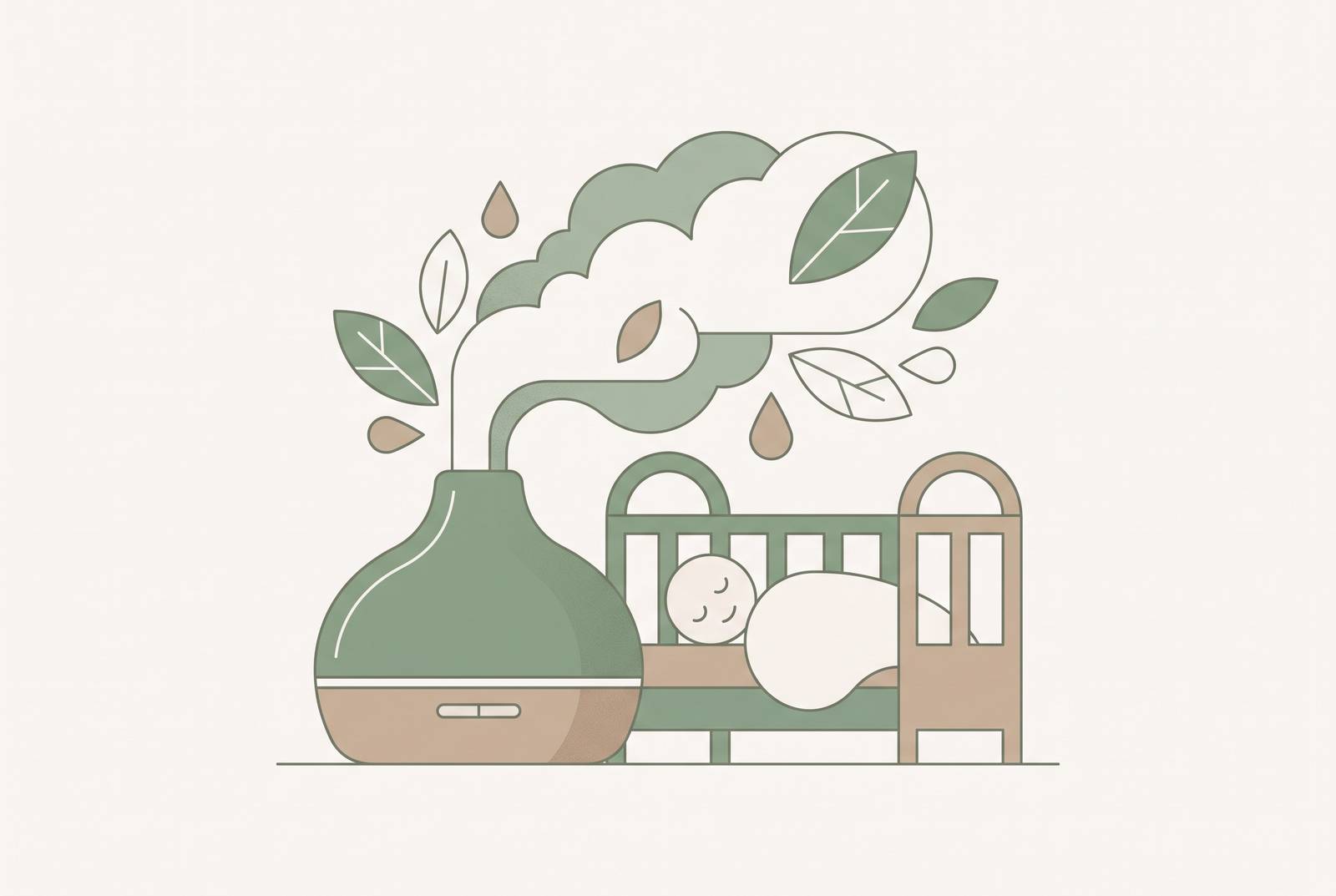
Scent alone cannot tell which essential oils are safe to diffuse around children and babies. Age, the oil’s chemistry, and the way it enters the air all matter. Use changes with age, with no diffusion around newborns, only a few carefully chosen oils after three months, and more choices, still with limits, as children grow.
Why babies and young children respond to airborne compounds differently than adults do
A baby does not process an airborne compound as a smaller adult would. The respiratory tract is still growing, and the liver does not yet have all the enzymes it needs to metabolize strong compounds well. As a result, essential oil constituents can build up or act more intensely than they would in an adult. These compounds can cause respiratory distress and skin irritation, and in extreme cases, systemic toxicity.
Exposure also depends on breathing rate. Newborns breathe far faster than adults, so they inhale more airborne particles relative to their small body weight. Their sensory systems add another consideration because babies rely heavily on smell from the earliest stages of life. Even a diluted aroma can be overwhelming to them. A scent that barely registers to an adult is therefore not a reliable measure of what a baby can comfortably tolerate.
Newborn skin is much thinner and more permeable than adult skin and is not fully developed until around three months. Essential oil constituents can penetrate more deeply and rapidly, even when diluted. Together, these differences explain why reducing an adult dose is not enough to establish suitability for a child.
The first three months: why no diffusion is the right rule for newborns
During the first three months, these vulnerabilities are at their most acute. A newborn’s liver cannot break down substances as efficiently as an adult’s, while the lungs and respiratory tract are still developing. Even oils described as gentle can cause irritation in that setting. So the basic rule is to avoid using essential oils, including diffusion, around babies under three months. A pleasant nursery scent is not a reason to add an unnecessary exposure.
Some aromatherapy guidance allows passive diffusion in a few cases with great care, but that exception should not become a reason to scent a newborn’s surroundings as a rule. Even when released this way, aromatic compounds still enter the air. A household rule of no diffusion during this time removes the need to judge how much is too much.
Nursing mothers have an additional consideration because essential oils applied to them may pass into breastmilk. Oils identified for avoidance during breastfeeding and infant exposure include Star Anise, Birch, Buchu, Carrot Seed, Cassia, Cinnamon Bark, Blue Cypress, Fennel, Myrrh, Oregano, Sage, and Wintergreen. This is a separate route of exposure, but it belongs in the same safety picture. Once a baby passes three months, the guidance can move from avoidance toward carefully controlled introduction.
Oils appropriate for diffusion once a baby passes three months
After three months, the question changes from whether to diffuse at all to which oils may be suitable and under what conditions. Only a few oils should be allowed, and they should be chosen for their mild chemical profiles, with familiar scents alone carrying no weight. An oil used by adults does not become infant-appropriate because fewer drops go into the diffuser.
However, this guidance does not name oils for babies just past three months. The named recommendations for children two years and older should not be borrowed for younger babies. Ask a pediatrician before using essential oils in a baby’s care. Check what the manufacturer recommends for the baby’s age. These steps matter because a general description such as “gentle” does not settle suitability for a particular infant.
When introducing an appropriate oil by diffusion, use one oil at a time. Watch for coughing, sneezing, watery eyes, a new rash, or unusual fussiness before continuing use. Introducing several oils together makes it harder to connect discomfort with a particular exposure. Topical application requires even more caution and specific dilution ratios, so permission to diffuse an oil should never be treated as permission to apply it to a baby’s skin.
How to diffuse safely in rooms where babies and young children are present
Once an appropriate oil has been selected, concentration and duration become the next controls. Use one to three drops in a diffuser for child-adjacent spaces rather than increasing the amount until the room smells strongly scented. Keep diffusion intermittent, using a 30-minutes-on, 60-to-120-minutes-off pattern. Never run a diffuser overnight in a nursery.
Keep a door open or crack a window during diffusion to dilute the airborne concentration. After a session, air out the room before a baby returns. Position the diffuser away from the crib or other sleep surface, with the scent directed away from the child. Physical distance reduces concentration at the point of inhalation.
For the youngest infants just past three months, passive diffusion offers a gentler alternative to an active device. One or two drops of an appropriate gentle oil on a cotton ball placed two to three feet from the crib releases scent more gently. For active diffusion, water-based ultrasonic diffusers are the recommended choice for homes with infants. Avoid candle burners, electric heat plates, and lamp rings because heat can change oils, while flames and hot surfaces can cause burns and fires.
Cold-air diffusion uses compressed air rather than heat or water, avoiding heat-related alteration and a standing-water reservoir that can harbor mold or bacteria. Those design differences do not establish that every oil or output setting is suitable for infants. Whatever the device, stop immediately if coughing, wheezing, redness, unusual fussiness, or lethargy appears, and air out the space. Contact a pediatrician if symptoms persist.
The oils that must stay out of any space shared with infants and young children
Some oils must be kept out altogether, even in small doses. Peppermint is an important example because of its menthol content. The NIH/NCCIH states that menthol should not be inhaled by or applied to the face of an infant or small child because it may negatively affect breathing. That makes peppermint unsuitable for treating a child’s room as an extension of an adult aromatherapy routine.
Eucalyptus carries a related respiratory concern because it is high in 1,8-cineole, which can cause respiratory distress in young children. This concern applies to diffusion as well as topical use. Rosemary also contains 1,8-cineole and camphor, which can overstimulate the nervous system. Sage should also be kept out and is among the oils to avoid during breastfeeding and infant exposure.
Clove presents a different concern because it can irritate skin and mucous membranes and affect liver function with overexposure. That liver concern is especially relevant to a developing metabolic system. Cinnamon Bark can irritate the skin, eyes, and respiratory tract, while a milder oil from the same plant still requires care and is not appropriate for infants. Birch, Star Anise, Cassia, Fennel, Oregano, and Myrrh also appear on the infant-contraindication list. They should not be used in homes with newborns or very young infants.
How the safe-oil list expands as children reach two years and older
As metabolic and respiratory systems mature, the range of suitable oils broadens. The International Federation of Aromatherapists identifies ten oils as appropriate for diffusion and topical use for children two years and older, namely Cedarwood, Cypress, German Chamomile, Geranium, Helichrysum, Lavender, Mandarin, Neroli, Sandalwood, and Tea Tree. The guidance still calls for low concentration, short sessions, and ventilation.
Within this stage, parents can build a small collection around a purpose. Sweet Orange or Mandarin appear as calming options, while Bergamot and Neroli also offer gentle choices. That gives more flexibility for a calming bedroom scent or a brighter citrus note in a playroom.
The International Federation of Aromatherapists recommends room diffusers or vaporizers as the main way to use oils for children under six because putting oils straight on their delicate, permeable skin carries greater risks. Inhalation still requires controls, but it avoids that direct application. Under the guidance here, Eucalyptus, peppermint, and rosemary are still off-limits for children under six. Their constituent-specific risks do not disappear simply because other oils become appropriate.
Choosing fragrance oils for diffusion versus pure essential oils: what parents need to know
The guidance on oils so far applies to pure essential oils. Synthetic fragrance oils are a different product category and do not inherit the properties or safety profile of a similarly named essential oil. A fragrance that smells like an age-appropriate oil is not necessarily chemically equivalent to it.
For an essential oil routine, choose high-quality, pure oils and check the manufacturer’s recommendations before use. Check blends as carefully as single oils because premixed products that contain alcohol can cause more irritation. A “natural” label does not resolve the questions of age, composition, or concentration. Purity describes the product, but it does not make an otherwise unsuitable oil appropriate for a child.
For diffusers designed around curated fragrance oils, look for transparent ingredients and formulations intended for the environment where they will be used, including households with children. Descriptions such as clean, vegan, and cruelty-free do not answer the separate question of age-specific suitability. Likewise, cold-air operation uses no heat or standing water, but these features of the device do not prove that the fragrance is safe. The formulation and the delivery system need to be considered separately before they can be considered together.
Practical habits that reduce risk across every age stage
Across the age stages, the common approach is less exposure, more observation, and clear reasons to stop. Begin with product labels, including restrictions for age and underlying health conditions. Products licensed for adult use only should not be used around infants and young children. A suitable individual ingredient does not override a restriction on the finished blend.
Store all essential oils out of children’s reach with containers tightly closed. An oil that is suitable for diffusion can still be toxic if swallowed. If ingestion occurs, contact the nearest Poison Control Centre immediately. Keep essential oil products away from the eyes, nose, and mouth. Diffusion guidance is not permission for contact with mucous membranes.
Children with asthma, epilepsy, allergies, or another respiratory condition need advice from a medical professional before essential oils are diffused around them. For children whose use has been judged appropriate, defined diffuser on/off cycles help limit cumulative exposure and conserve oil.
The aim is a routine that matches the child’s developmental stage, the chosen formulation, and the conditions of exposure. Parents who understand those distinctions can make reasoned decisions while recognizing the limits of a gentle fragrance as a guide. That is what turns age-specific limits into informed choice.