Diffuser Placement in Homes With Pets to Minimize Exposure Risk
Diffuser placement matters more for pet safety than oil choice alone.
Where a diffuser sits matters as much as what runs through it because location shapes what pets breathe, what settles on their coats, and whether they can leave. Thoughtful placement is the most actionable safety decision, supported by careful oil choice, ventilation, short sessions, and attention to the animal sharing the air.
Why placement decisions carry more weight than most pet owners realize
Pet owners are often told which oils to avoid. That is a necessary starting point, but it leaves a physical question unanswered, namely where the fragrance goes after leaving the diffuser. Exposure follows three routes, including inhalation of airborne particles, absorption through contact with the coat and skin, and ingestion during grooming. The last route makes particles that settle on fur more than a housekeeping concern.
So choosing a lower-risk oil does not solve the problem of a diffuser running directly above a dog's bed. Nor does it account for a cat grooming where oil particles have settled. In both cases, the oil has changed, but the opportunity for contact remains.
How cats, dogs, and birds process diffused compounds differently, and why that gap shapes every placement decision
The same room layout can pose different risks because animals do not all process aromatic compounds in the same way. Cats have a particular limitation involving the liver enzyme glucuronyl transferase, which helps metabolize many aromatic compounds. Their limited capacity to process and excrete these substances allows compounds to accumulate. This metabolic vulnerability is compounded by meticulous grooming. When particles settle on a cat's coat, proximity to the diffuser creates an ingestion pathway as well as an inhalation pathway.
Dogs generally have more robust metabolic pathways than cats, but they can lie on surfaces carrying deposited oil and later lick their paws, moving exposure from surface contact to ingestion. Dogs with pre-existing respiratory conditions face heightened inhalation risk, with brachycephalic breeds warranting particular caution. Even with a lower-risk oil, those dogs still face that risk.
Birds and small mammals require stricter separation because their respiratory systems are especially delicate. Diffusers should not operate in rooms housing birds or in adjacent rooms with shared airflow. For small mammals, including rabbits, guinea pigs, hamsters, gerbils, rats, mice, and ferrets, diffusion should stay out of the room, and cages should never sit near a diffuser. There is no single distance that works for every household because these animals have different needs.
The oils that make placement most critical, and the shorter list where strategic placement can make cautious use credible
Tea tree (melaleuca) is toxic to cats and dogs even in small amounts, so moving it to a higher shelf does not make diffusion appropriate. Pennyroyal is highly toxic to dogs and has been linked to liver failure.
The oils to avoid entirely around cats also include eucalyptus, peppermint and spearmint, pine and fir, cinnamon, clove, ylang ylang, thyme, oregano, and wintergreen. Many carry significant risks for dogs as well. With these oils, distance is not a substitute for avoidance. Placement can help control exposure.
The more credible case for cautious use concerns a shorter group of relatively lower-risk oils. Lavender, frankincense, and Roman chamomile fall into that group for cats, while the same oils and cedarwood are generally lower-risk options for dogs. Lower risk still does not mean zero risk, a distinction that matters most in an animal with respiratory vulnerability. Lavender and chamomile also appear in scent-and-calm research, linking a human wellness ritual to this narrow group of oils for cautious diffusion. Within that limited set of choices, ventilation and physical placement can do meaningful work.
Where to place a diffuser in a pet-sharing home, and the physical reasoning behind each decision
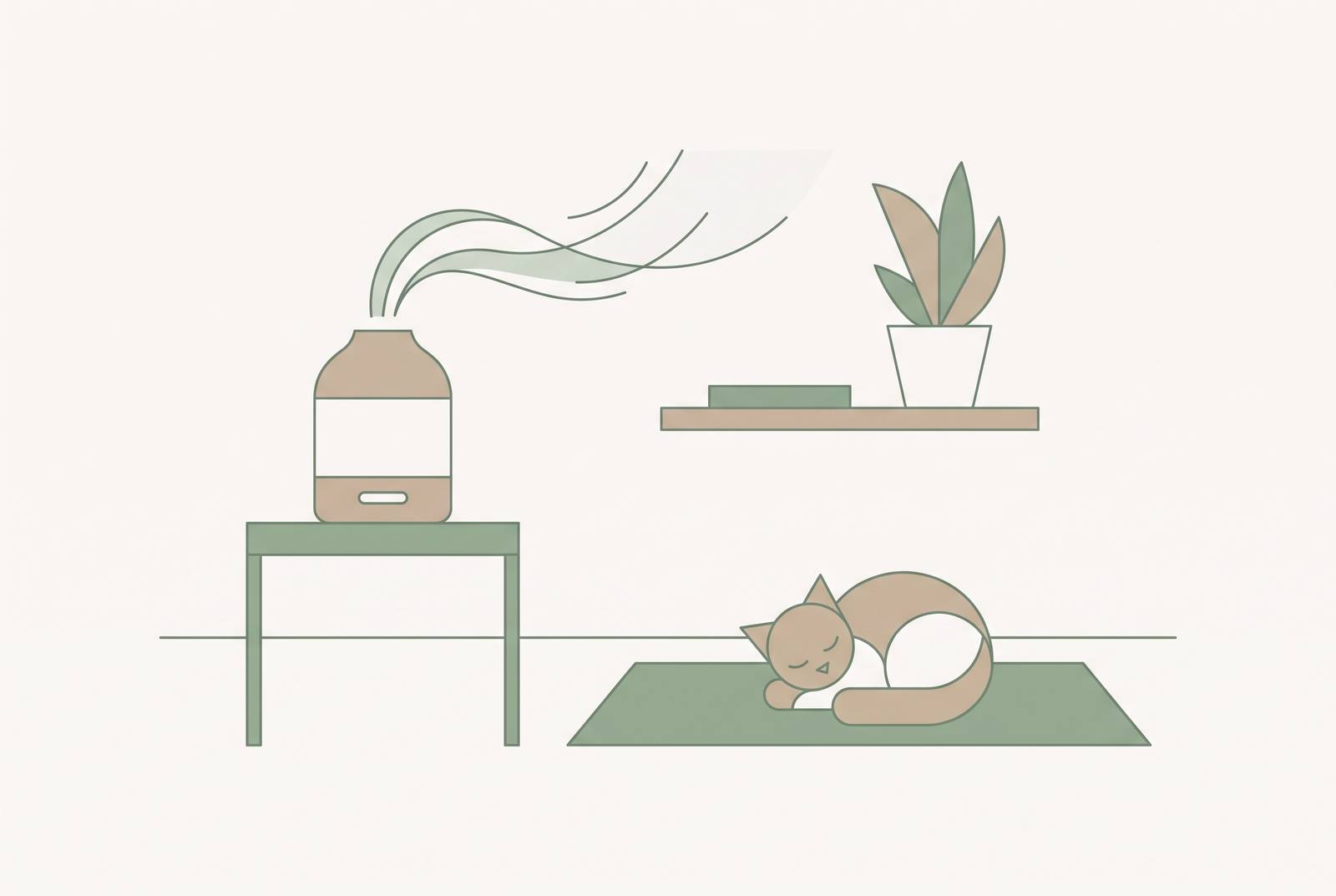
Height addresses both direct contact and the concentrated output immediately around the device. A high, sturdy bookshelf or the top of a cabinet keeps that output above the level where dogs lie and cats ordinarily walk. It also reduces the chance of a pet knocking the diffuser over. Spilled undiluted oil creates a much more serious skin-contact and ingestion hazard than controlled diffusion. However, high does not mean inaccessible to a climbing cat, so the chosen surface must also be beyond the animal's reach.
Reed diffusers must also stay out of the animal's reach. Their open glass jars contain concentrated oil, and an overturned jar can expose a pet directly through its skin or mouth. A cat treats a bookshelf as infrastructure it can climb.
Next, establish distance from the places where the pet stays. Keep the diffuser a meaningful distance from beds, feeding areas, and habitual resting or grooming spots. The aim is to scent airspace a pet passes through briefly, rather than the air surrounding an animal for long stretches. Feeding areas need extra care because pets stay in one spot there, with their mouths close to surfaces where oil can build up. A location directly above a bed fails this test even if the diffuser itself cannot be reached.
Prefer a home office, guest room, or adult bedroom where the pet spends little time over its primary living space. Never diffuse in a room where a pet sleeps unsupervised overnight. Keep the door open so the animal can limit its exposure by leaving if the scent becomes overwhelming.
Finally, assess room size and airflow rather than assuming an infrequently used room is suitable. Use large, open spaces where circulation can dilute the output before it reaches pet-occupied areas, and avoid small enclosed bathrooms or utility rooms. Open a window at least partially, or keep a ceiling fan running to help disperse particles away from low resting surfaces. If oil forms a visible film on furniture, windows, or floors, the output, room size, and run time are producing excessive deposition that pets can contact.
How run time and scheduling reduce cumulative exposure without sacrificing the scent experience
Short, intermittent sessions allow particles to disperse between runs, whereas continuous operation can build exposure on surfaces, fabrics, and fur. For cat households, limit diffusion to a maximum of 30 minutes, followed by airing out the room. Some cats may tolerate less than this ceiling for cautious operation.
The intervals also give a pet's more sensitive olfactory system a break. A scent experience does not need to become an uninterrupted background condition to be enjoyable. The useful distinction is between a brief session that clears and an output that keeps replenishing the air.
A built-in timer or smart plug can turn the diffuser on and off at intervals and help keep it from being left running. Schedule diffusion for times when pets are elsewhere in the home or windows are open for ventilation. Run the device only while someone is home and able to observe the animal, keeping it off overnight and while the household is away. An open exit lets a pet withdraw, but an attentive person can also stop the source.
Why cold-air diffusion changes the placement calculus in pet-sharing homes
Ultrasonic water-based devices produce fine water droplets carrying oil particles, which can settle on furniture, floors, and bedding. Cats can also walk through that mist and collect it on their coats, creating a grooming-related ingestion route. For that reason, avoiding ultrasonic diffusers is the cautious recommendation for cat households. Water-based devices also introduce a separate maintenance concern because standing water and residue can support mold and bacterial growth.
Cold-air diffusion instead uses pressurized air to atomize fragrance oil without water or heat. Without heat, there is no risk of burned oil releasing respiratory irritants. Removing standing water also removes that particular source of mold and bacterial growth. The finer suspended particles can reduce the surface-deposition pathway that makes contact with bedding, fur, and floors a concern.
That distinction should not be mistaken for the disappearance of exposure. Fragrance remaining airborne still belongs in the inhalation calculation, and cold-air technology does not make a high-risk oil appropriate. Its value is as another layer of control, paired with high placement, ventilation, lower-risk oils, and intermittent operation. The device changes the placement calculus, but it does not abolish it.
What fragrance oil standards actually cover, and the gap pet owners need to understand
IFRA (International Fragrance Association) standards limit how much fragrance consumer products can contain based on how much people are exposed to. Even the rules for products used on animals cover what people are exposed to while applying them, leaving out what a pet breathes in when fragrance runs continuously at home. IFRA does not provide a standard or certification establishing that a fragrance is safe for cats or dogs to inhale over time. “IFRA-compliant” and “pet-safe” are therefore different claims.
Phthalate-free and vegan descriptions likewise concern particular formulation choices. A naturally derived aromatic compound can still present a metabolic problem for a cat. The understandable mistake is treating a label about ingredients as though it were a test of every possible exposure.
Transparent formulations still have value because knowing the ingredients supports more informed oil selection. Choosing IFRA-compliant, phthalate-free, transparently formulated oils is a meaningful baseline. It simply cannot stand in for the other decisions. The complete picture combines compliant oils with strategic placement, ventilation, run-time limits, and monitoring. Each layer addresses a different part of the problem, so no single label can do the work of the whole system.
Behavioral signs that a pet's placement situation needs to change, and how to respond
Monitoring makes these decisions self-correcting because an individual pet may tolerate less than the room arrangement appears to allow. A pet that leaves and does not return while the diffuser runs is using its escape route. Turning away from the output, staying away from the area around it, hiding somewhere unusual, or becoming restless are also signs to watch for. Changes in sleeping location can carry the same message. Excessive or unusual grooming of the face, paws, or back may indicate contact with settled particles.
These early signals are reasons to adjust the setup. Move the diffuser farther from pet zones, shorten the session, or switch to a different lower-risk oil if avoidance continues. A placement decision remains provisional even when it follows every general rule.
Clinical signs require a different response. Drooling, vomiting, tremors, difficulty walking, or respiratory distress in cats can indicate toxicity requiring emergency veterinary care. Turn off the diffuser, move the pet to fresh air, and contact a veterinarian immediately. Bring the specific oil to the appointment so its identity can help direct treatment.
For everyday use, the goal is a system that responds before discomfort becomes a fixed condition. Thoughtful oil choice, strategic placement, cold-air technology, clean formulations, ventilation, and attentive monitoring can make a beautifully scented home and a safe pet environment compatible goals where diffusion is appropriate. The measure of success is not how thoroughly fragrance fills the house, but how well the arrangement respects the animals living in it.